October 31, 2026
B2B Lead Generation Strategy for Predictable Calls
The most popular advice is also the most expensive. Get more leads. Everyone says it, usually while selling you a bigger list, a new tool, or another channel to manage badly. A better B2B lead generation strategy starts with the opposite question. How many qualified, multi-stakeholder conversations can you turn into opportunities, and what stage math gets you there without lying to yourself?
Table of Contents
- The Pipeline Scorecard Before You Scale
- How to Lock the ICP Offer and List
- How to Send Outreach That Reaches Inboxes
- How to Turn Replies Into Qualified Meetings
- How to Test When Attribution Is Messy
- Pick In-House Build or Pay-Per-Close Help
The Pipeline Scorecard Before You Scale
A B2B lead generation strategy is a scorecard, not a bigger list. Ten thousand scraped inboxes isn't pipeline. It's a hobby with bounce rates. Build the scorecard first, then work backward to the number of contacts you need.
| Stage | What you count | Directional benchmark | If it slips |
|---|---|---|---|
| Valid contacts | Verified decision makers with a current buying trigger | No universal rate, hard bounces and complaints are the gate | Pause sending and clean the list |
| Lead to MQL | Contacts matching ICP plus a defined trigger | About 31% | Narrow the ICP instead of adding names |
| MQL to SQL | MQLs with problem, urgency, authority, fit, and next step | About 13% | Rewrite qualification fields, do not buy more volume |
| SQL to opportunity | SQLs that become a real sales opportunity | About 47% | Fix the meeting handoff and the offer |
| Speed to human follow-up | Minutes from positive reply to a person | Inside 5 minutes, about 21x vs a 30-minute wait | Staff a live reply window |
| Complaint control | Spam complaints on outbound | Stay under 0.3% | Stop the mailbox or domain pool |
Read the rows like an operator
A valid contact isn't a name with a plausible email. It's a verified decision maker at an account that matches your ICP and shows a live trigger, like a new sales leader, a funding event, or a vendor contract approaching renewal. If you can't name the trigger, you're not targeting. You're mailing strangers and calling it volume.
The benchmark guide places lead-to-MQL conversion near 31% and MQL-to-SQL conversion near 13%, while SQL-to-opportunity can be approximately 47%. Those three numbers show where pipelines get inflated. Lead to MQL at 31% means the list was aimed. MQL to SQL at 13% is where fuzzy definitions hide, because problem, urgency, authority, fit, and an agreed next step have to be explicit or that stage is fiction. SQL to opportunity at 47% separates a real deal from a polite calendar hold.
Run the worked example before anyone buys data. Start with 1,000 verified contacts. At 31% lead to MQL, you get about 310 MQLs. At 13%, that's about 40 SQLs. At 47%, you're looking at roughly 19 opportunities. List size follows from the opportunity count you need, not from someone's excitement in a planning meeting. If you need more opportunities, improve a stage or accept the larger, cleaner list required. Don't just add lookalike junk and pray.
The two rows teams dodge
Speed is the row everyone skips because it requires staffing, not software. The same benchmark summary reports that responding within five minutes can make qualification roughly 21 times more likely than waiting 30 minutes. A positive reply answered after lunch, two meetings, and a Slack thread isn't follow-up. It's archaeology.
Complaint control is also essential. Keep spam complaints under 0.3%, and treat rising hard bounces as a pause signal even when replies look healthy. A campaign can produce a few nice conversations while burning the domains you'll need next month.
If a stage slips, fix that stage. Adding volume to a broken stage just makes the failure more expensive and harder to read.
Timing makes discipline matter more, not less. According to dentsu's Superpowers Index research, in 2024 the average B2B decision-making timeline had increased by 54 days compared with 2021. Weekly stage review beats a monthly victory lap because a slow leak has more time to drain the quarter.
For a useful outside view on tightening each stage instead of inflating the top, Data Hunters Agency's lead generation guide is worth comparing against your own definitions. Then sanity-check what a booked conversation should cost you with a meeting cost calculator before you scale anything.
Stop here and circle one Friday metric you won't negotiate. Pick the stage that, if it breaks, invalidates everything downstream. In many cases that's either complaint control or speed to human follow-up. Guard it weekly, in writing, with a named owner.
How to Lock the ICP Offer and List
Say a cybersecurity MSP blasts every company that employs someone with IT in their title. The IT manager gets the pitch. Finance never hears why it matters. Security never sees the risk detail. Then the MSP concludes outbound doesn't work. The list wasn't too small. It was aimed at a job title instead of a buying group with a reason to act now.
Build this in order. Don't start with data tools.
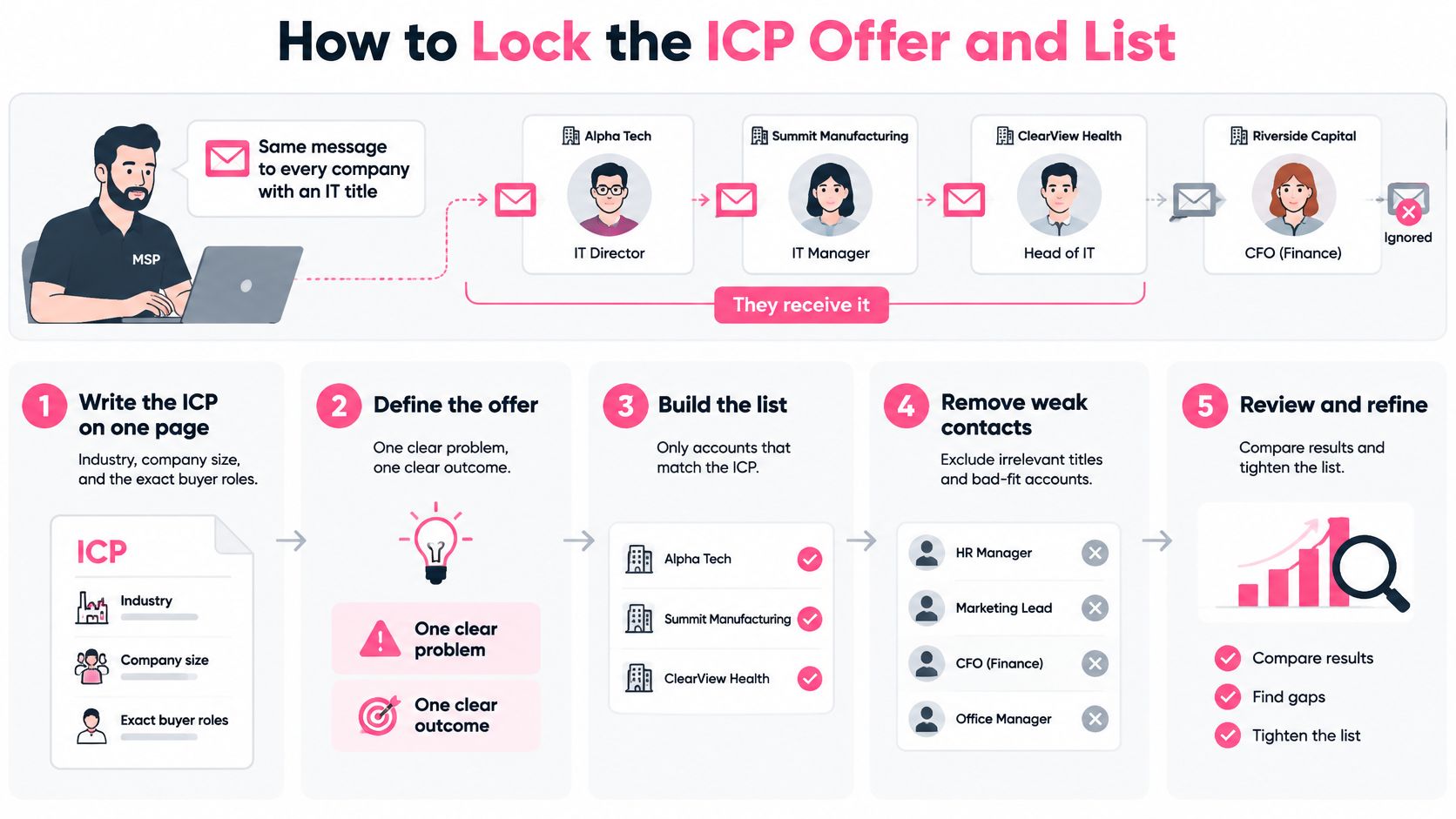
The five-step build
Write the ICP on one page. Name the industry, company size, geography, the economic buyer, two influencers who can block the deal, and one clear disqualifier. A good disqualifier is specific, like no budget owner or a competitor contract locked for the next eighteen months. For agencies, SaaS, consulting, recruiting, MSPs, and coaching firms, write down both the champion who feels the pain and the person who signs. If they aren't the same person, your list needs both.
Attach a buying trigger you can see. Not a vibe. Not “companies that value innovation.” Look for a new executive, a hiring spike in the team you'd serve, a funding event, a vendor review, or expansion into a new region. A trigger answers why now. Without it, your email is asking a busy person to invent urgency for you.
Create a cold offer a stranger can forward. Lead with one painful problem, a result for a similar buyer, and a short call. Not a product tour. Not a platform walkthrough with twelve features. The test is simple. Could your champion forward the offer internally with one sentence that makes sense to finance? If not, rewrite it until the promise fits in a forwarded email.
Build the list by account first, then people. Confirm the account fits, then map the economic buyer plus at least one influencer per account. A champion should never be your only path in, because champions go on leave, change jobs, and lose internal arguments. Verify each person before marking them sendable. If you're deciding where automation helps and where it creates garbage, a practical breakdown of how to automate lead data collection can help you separate research speed from verification discipline. Run the resulting file through a lead list cleaner before anyone touches a sending tool.
Cap the first test cohort at a slice you can learn from. Take one segment, for example a few hundred verified contacts who share the same trigger and buyer role, and park everyone else. You're testing whether the segment, trigger, and offer produce qualified conversations. A giant mixed list only tells you that something somewhere didn't work, which you already suspected.
What good looks like in practice
- Agency example: Target ecommerce brands that just hired a head of growth. Champion is that new hire. Signer is the founder or VP marketing. Disqualifier is an in-house team already covering your exact service.
- SaaS example: Target operations leaders at firms opening a second location. Influencer is IT, because rollout pain lands on them. Offer centers on migration risk, not features.
- Consulting example: Target CFOs after a funding announcement. Trigger is visible, timing is defensible, and the offer speaks to reporting pressure that follows new capital.
Notice what's missing. No persona poetry. No forty-field spreadsheet nobody opens again. Each field changes who you contact, what you say, or who else you map inside the account.
Pass test: Hand the page to a colleague. If they can't tell you who this is for and why now in two sentences, the offer isn't ready and the list shouldn't ship.
Tighten until it passes. A narrow ICP feels scary because the list gets smaller. That's the point. Small and defensible beats large and apologetic every time you measure opportunities instead of sends.
How to Send Outreach That Reaches Inboxes
A clever sequence in spam is a diary. Nobody reads it, nobody replies, and the writer still feels productive. Deliverability isn't a technical garnish you add after copy. It's the gate that decides whether your B2B lead generation strategy exists in the world.
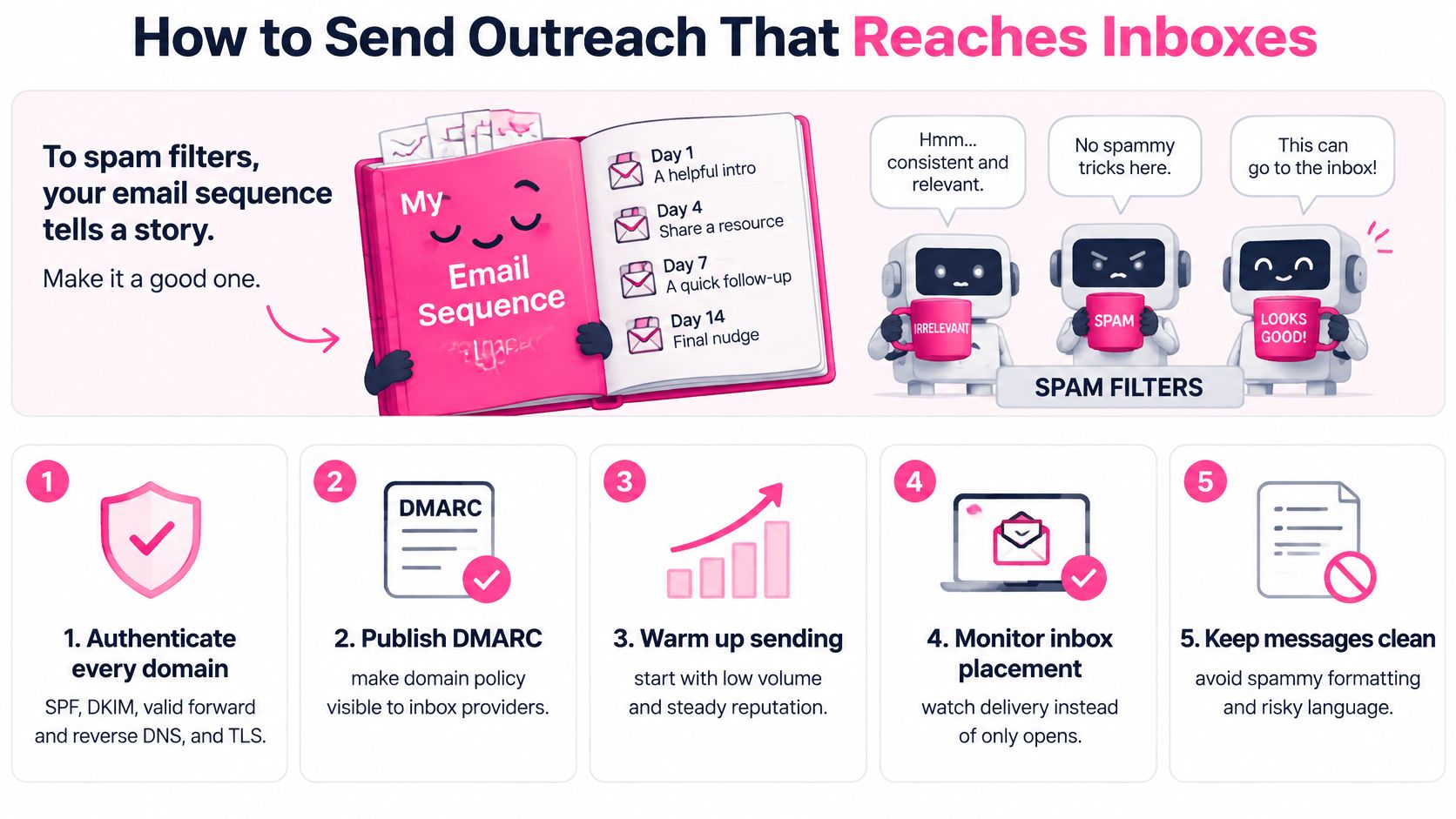
The send procedure
Authenticate before you scale. According to Google's Gmail sender guidelines, beginning February 1, 2024 all senders emailing Gmail accounts must authenticate sending domains with SPF or DKIM, maintain valid forward and reverse DNS records, use TLS, and keep the spam rate below 0.30% in Google Postmaster Tools. Senders reaching approximately 5,000 messages in a 24-hour period to personal Gmail accounts are classified as bulk senders and must implement SPF, DKIM, and DMARC, align the visible From domain, and provide one-click unsubscribe for marketing or subscribed messages. Check your setup with an email deliverability checker and fix gaps before the first cohort sends.
Warm mailboxes and raise volume slowly. Start low, monitor bounces, complaints, replies, and inbox placement, then increase in controlled steps. Splitting volume across domains only helps after targeting is clean. Extra domains don't forgive bad lists. They just let you damage more infrastructure in parallel, which is efficient in the worst way.
Write a short sequence with one idea per email. Use three to five touches over about two weeks. Open with the problem. Follow with proof for a similar company. Ask one specific question. Close with a clean breakup that gives the reader an easy no. Short copy forces clarity about the trigger and the offer, and it respects the reader enough to get read.
Use LinkedIn as a second door, not a second pitch. A profile view or a brief note should match the claim in your email. The website, the email, and the seller should never tell three different stories, because the prospect will check and the mismatch becomes the story.
Apply CAN-SPAM to B2B mail too. The FTC CAN-SPAM compliance guide states that the CAN-SPAM Act applies to every commercial message, including messages promoting products or services to businesses, that opt-out requests must be honored within 10 business days, and that each violating email can incur a civil penalty of up to $53,088. Use accurate From, To, Reply-To, and routing information, avoid deceptive subject lines, identify the message as an advertisement where required, and include a valid physical postal address.
Stop on evidence, not impatience. Pause a mailbox or domain pool when complaints or bounces deteriorate. Don't wait for reply rate to collapse and then act surprised. By then inbox providers have already made their judgment.
| Requirement | Threshold |
|---|---|
| Gmail spam rate | Below 0.30% in Google Postmaster Tools |
| Bulk sender trigger | About 5,000 messages in 24 hours to personal Gmail accounts |
| Sending authentication | SPF or DKIM for all senders, SPF, DKIM and DMARC for bulk senders |
| Opt-out processing | Honored within 10 business days |
| Civil penalty per violating email | Up to $53,088 |
Relevance is a deliverability setting.
That line should sit above every campaign dashboard. Authentication proves who you are. Targeting proves you should be in the inbox at all. You need both, every send, no exceptions for a hot list someone bought at midnight.
How to Turn Replies Into Qualified Meetings
A positive reply lands in a shared inbox at 12:04. Everyone sees it. Nobody owns it. By 16:30 the prospect has booked with a competitor who answered like a human with a calendar. Classification comes before celebration, and ownership comes before both.
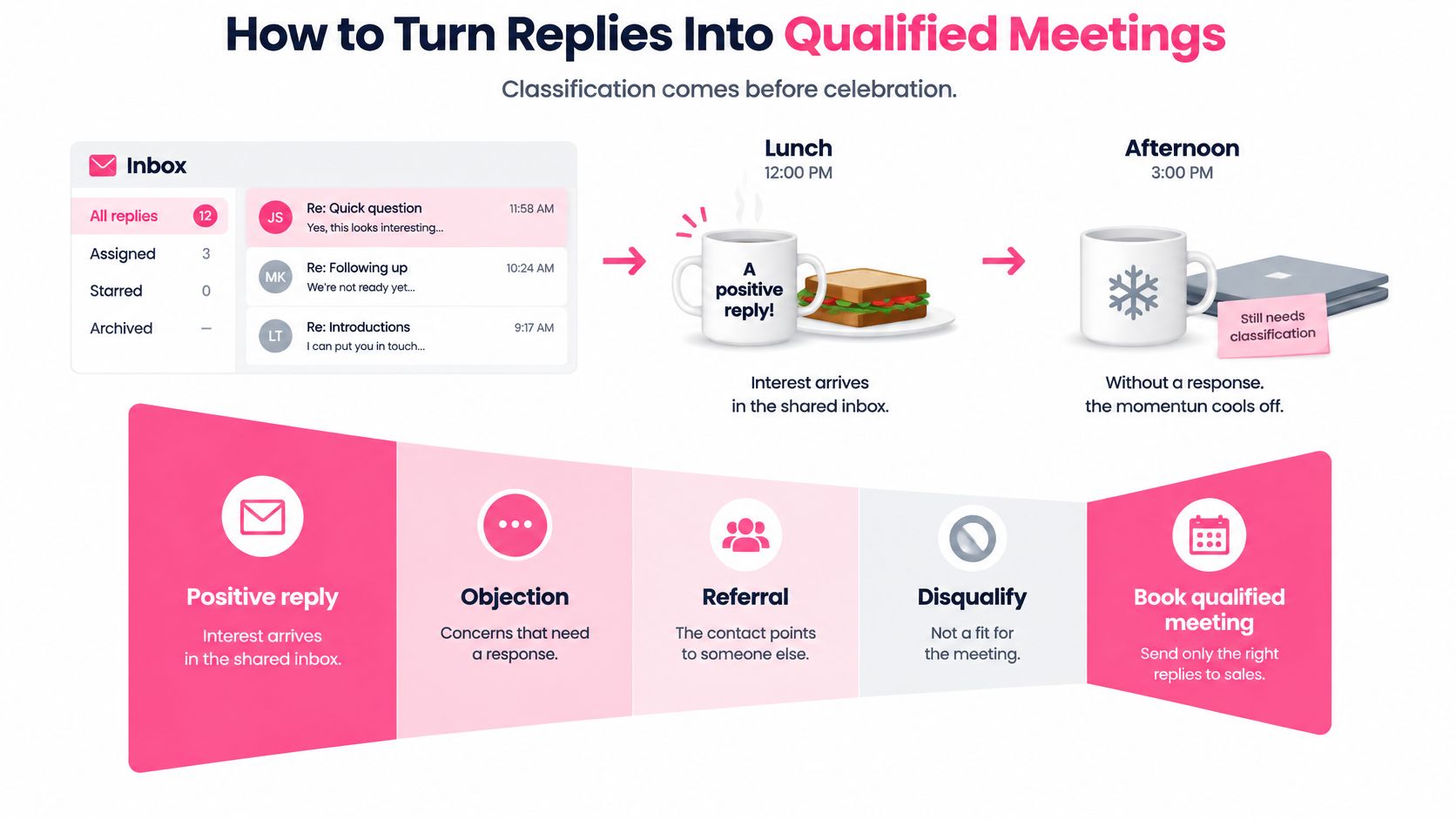
The reply procedure
Sort every response into five buckets. Positive, objection, referral, unsubscribe, or disqualified. Route only positives to a named person with authority to book. Objections get a real answer, referrals get a fresh, polite introduction to the right contact, and unsubscribes get suppressed immediately across every sequence.
Answer positives inside the coverage window and log the time. Staff a live reply window during your buyers' working hours. Record minutes from reply to human response on every thread. A speed target nobody logs is a poster, not an operating rule. If website visitors ask questions while your team is offline, options like AI live chat for service businesses show how instant first response can hold the conversation until a person takes over. The handoff to a person still matters.
Capture five qualification fields before you call it qualified. Problem, urgency, authority, fit, and the agreed next step. Get them on the booking thread or the first call. A meeting missing any field stays unqualified in the CRM. That sounds harsh. It's cheaper than discovering in week six that your champion can't spend money.
Arm the champion for the internal conversation you're not invited to. Send a one-page summary they can forward, one proof point from a similar company, and a plain answer for finance, security, or operations. Your champion will sell internally with whatever you give them, or with whatever they half-remember. Choose which.
Map the rest of the buying group. Identify at least the economic buyer and one likely blocker per account. Ask directly who else weighs in on budget, risk, and implementation. Then use a simple qualification checklist to confirm the meeting still counts as qualified once those names surface.
Why this design matches how buyers behave
Gartner's survey of 632 B2B buyers conducted in August and September 2024 found that 61% preferred an overall rep-free buying experience, yet buyers still preferred seller input for tasks requiring contextual judgment, such as determining whether an offering fits their organization's needs. The same survey found that 73% of B2B buyers actively avoid suppliers that send irrelevant outreach, and 69% reported inconsistencies between information on a sales organization's website and information provided by sellers. Buyers also completed an average of 3.0 activities both online and with supplier representatives, 2.3 activities with supplier representatives, and 1.8 activities through digital self-service tools.
Read that correctly. Buyers don't want no humans. They want no irrelevant humans saying things the website contradicts. Self-service assets carry the research load. Your rep earns their place on fit, risk, and judgment calls. That's why the forwardable summary and the consistent claim across email, site, and call aren't nice extras. They're the mechanism.
Close with this rule and enforce it in pipeline review. If you can't name who else must say yes, the meeting isn't qualified yet. It's a promising conversation. Label it clearly and go get the other names.
How to Test When Attribution Is Messy
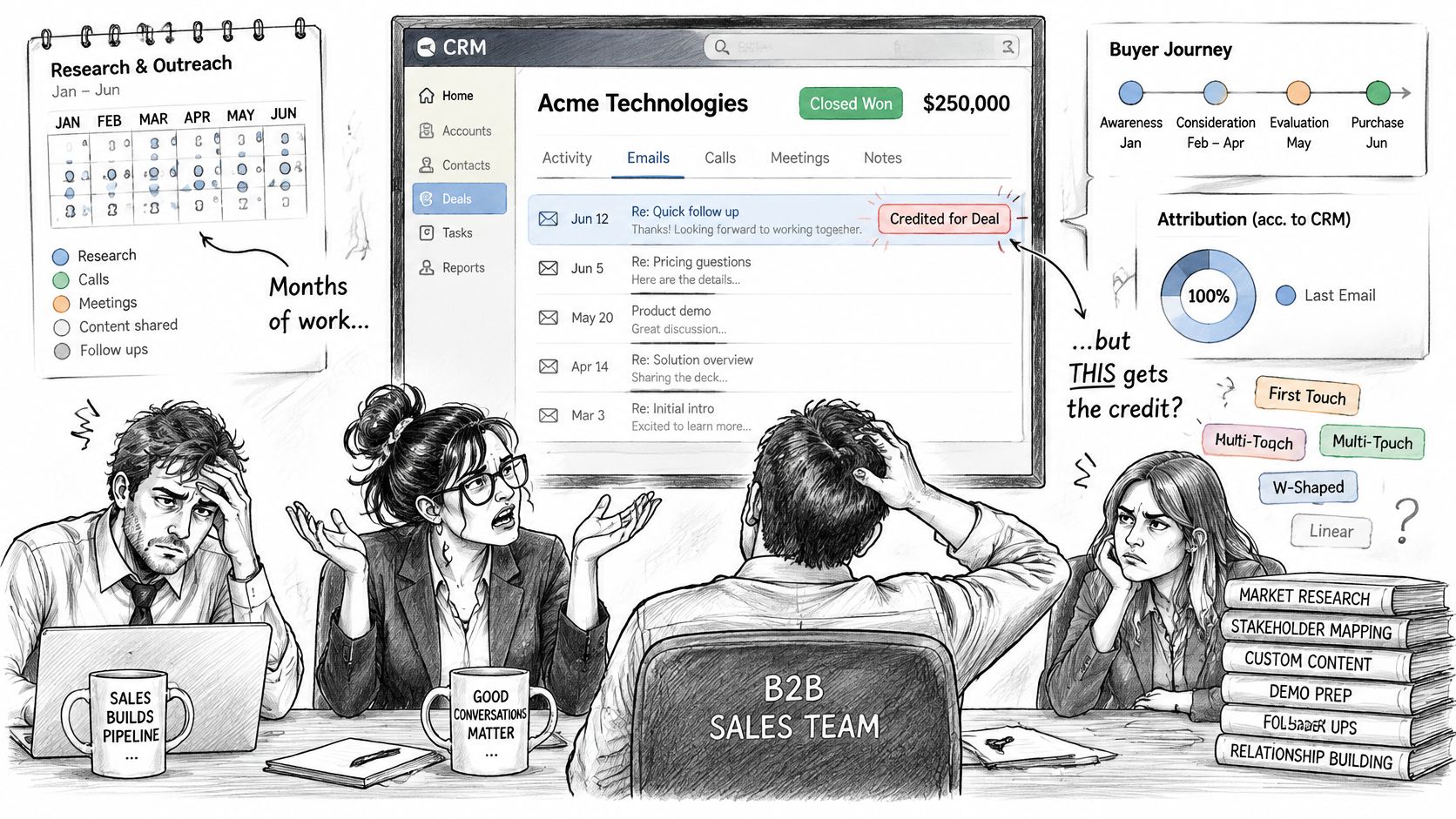
Your CRM will happily credit the last email for a deal the buyer researched alone for months. It's not lying on purpose. It only sees what it can track, and most B2B research happens where your tracking can't follow.
The frustration in this image is what happens when a team treats that partial trail as the whole truth.
Separate the two layers
The 2025 State of Marketing Attribution Report found that only 6 in 10 B2B marketers track pipeline generated, only half can measure opportunities created, and just 1 in 3 report new ARR. Meanwhile, according to Ray Rike's 2025 B2B SaaS Marketing Benchmarks, in 2025 62% of B2B SaaS companies ranked pipeline dollars generated among their top three marketing performance measurements. Pipeline dollars are the right family of number. They're a terrible basis for judging week two of a test.
So split the dashboard. Leading indicators for a two-week test include inbox placement, positive-reply rate, qualified-meeting rate, and show rate. Lagging evidence across the full cycle includes sales-accepted opportunities, pipeline dollars, win rate, cycle time, and closed revenue. Report operational metrics separately from financial outcomes, use account-level reporting, and stop claiming precise multi-touch credit you can't defend.
The one-variable test
- Change one variable per cohort. Offer, segment, or list source. Never all three, or you'll learn nothing except that Tuesdays feel confusing.
- Set the cohort window to your sales cycle length. Judging a long-cycle segment on a short window manufactures false losers.
- Write the source rule before launch. Decide in advance how a late inbound reply from a contacted account gets credited and who owns it. Documented rules beat whoever claims it loudest.
- Log every non-response and lost deal in four buckets only. Wrong target, weak offer, slow follow-up, or bad fit after the call. Four buckets force a decision. Twenty custom reasons produce a museum of excuses.
- Decide to keep, rewrite, or retire the cohort. Name the decision and the date. A test with no retirement date is just a campaign you're afraid to grade.
This short walkthrough shows how messy attribution looks when a buyer touches several channels before the first tracked reply.
Small samples lie with confidence. Don't kill a segment on a handful of sends, and don't scale one lucky week into a quarterly forecast. When the first measurable touch isn't the true cause of the deal, report what you operated, report what closed, and connect them at the account level with stated rules. If you can't say which bucket failed, you have a mood, not a learning.
Pick In-House Build or Pay-Per-Close Help
Stay in house when someone already owns deliverability, a verified-list habit, live reply coverage inside five minutes, and a CRM that records problem, urgency, authority, fit, and next step. If one of those owners is missing, hire or reassign before you buy another tool. Tools don't cover inboxes during lunch.
Hand it off when the bottleneck is execution, not strategy. No one to research decision makers. No one to write short copy, warm domains, or chase replies into the calendar. That's the job Ever Outbound runs, and we're pay-per-close. The service is for B2B companies that sell to other businesses.
Our working sequence has four moves. We build a list of verified decision makers, write and send short copy on warmed domains, book interested prospects onto your calendar, and you show up to close. You pay a 5% commission only when you close a deal from that work, the first two closes are commission-free, and plans start at $97 a month plus that commission. Details are on our pay-per-close page. The retainer isn't where the money is. Your closes are.
Named results keep this concrete. The Tax Engineers closed 2 deals in 2 weeks. highMpact landed 5 dream clients in month one. BoostUrBusiness closed 6 deals in 4 weeks. Bridget Poston at Beeline Copy reported 2 closed deals and 20 monthly calls. Peter Van Schaack at Brandocious said he was promised about 10 qualified leads in a month and saw over 50.
If your offer and ICP are still mushy, fix those before any vendor call. If they're sharp and the calendar's empty, book a conversation. We'll tell you if we can't serve your industry.
If your ICP and offer are sharp but nobody owns the list, the domains, and the five-minute reply window, Ever Outbound Inc. can run that execution for you on a pay-per-close basis, building verified lists, sending on warmed domains, and booking qualified prospects onto your calendar. Visit Ever Outbound Inc. to book a conversation and find out whether we can serve your B2B market.