October 14, 2026
B2B Marketing Emails: Step-by-Step Playbook for 2026
You know the drill. The list looked clean in the CRM this morning, the domain was warmed, the copy finally sounded human, and then the first replies started landing in spam folders, old contacts bounced, and the one prospect you wanted most had already changed jobs. That's the world of b2b marketing emails, where the prize isn't attention for its own sake, it's getting the right message into the right inbox without torching the sender reputation you'll need next week.
The upside is that email still gives B2B teams something most channels don't, a direct line to named professionals across markets. But the channel now rewards discipline more than volume. If you treat it like an attention game, you'll chase opens and subject lines forever. If you treat it like a system built on segmentation, deliverability, and attribution, you can scale without guessing.
Table of Contents
- Planning and Segmentation Before Writing
- Offer-Led Copy and Subject Lines That Earn Replies
- Deliverability as Engineering, Not Afterthought
- Multi-Step Cadences, Follow-Ups, and Calendar Routing
- Testing Framework and Commercial KPIs
- Playbook Templates and Ready Patterns
Planning and Segmentation Before Writing
The worst time to write a cold email is right after someone says, “Let's just get something out today.” That sentence usually means the target is fuzzy, the offer is vague, and the sending setup hasn't been thought through. Strong b2b marketing emails start before the draft, with one clear slice of the market and one problem worth solving.
Start with one slice, not the whole universe
Pick a single ICP slice and a single business problem. For example, if you sell to agencies, don't start with “agencies” in general, start with one type of agency, one role, and one pain point that role can feel this week. If you need a practical reference point for defining your ideal customer profile, use that as the foundation, then narrow from there.
Document the evidence that justifies the segment. Hiring signals, technology changes, funding events, and service-page gaps are useful because they connect the message to observable business context instead of guesswork. That's also where list hygiene matters, because outdated roles and stale addresses punish sender reputation. The lead list cleaner is the kind of internal tool that helps teams remove obvious risk before they ever press send.
Practical rule: if you can't explain why this exact contact should care today, the list isn't ready yet.
The planning step should also lock in send infrastructure. Google recommends SPF, DKIM, and DMARC for bulk senders, and even smaller B2B programs benefit from the same discipline because inbox placement is domain- and recipient-dependent. The point is simple, bad targeting plus weak list hygiene creates bounces, and bounces don't stay politely in the background.
Align the offer with the segment before any subject line
A subject line can't rescue a mismatched offer. If the problem and the audience don't fit, the best copy in the world will still feel generic. That's why the message, send domain, and follow-up logic should be decided together instead of in separate meetings that never speak to each other.
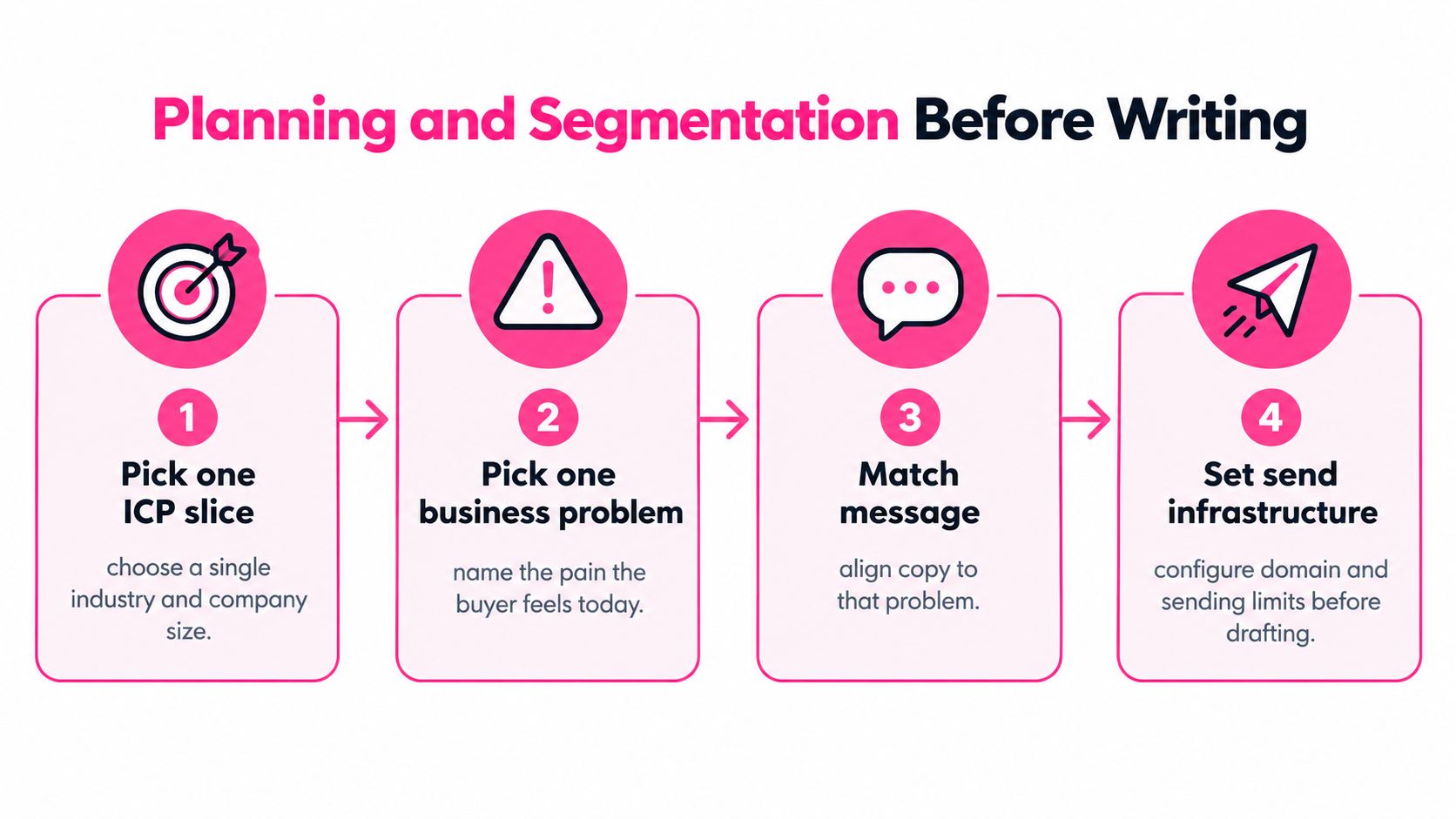
A good planning checklist is short. Choose one audience slice, name one live problem, gather one piece of evidence that proves relevance, and confirm the sending setup can support the campaign. Once those four things are true, the copy becomes easier because the boundaries are already in place.
Offer-Led Copy and Subject Lines That Earn Replies
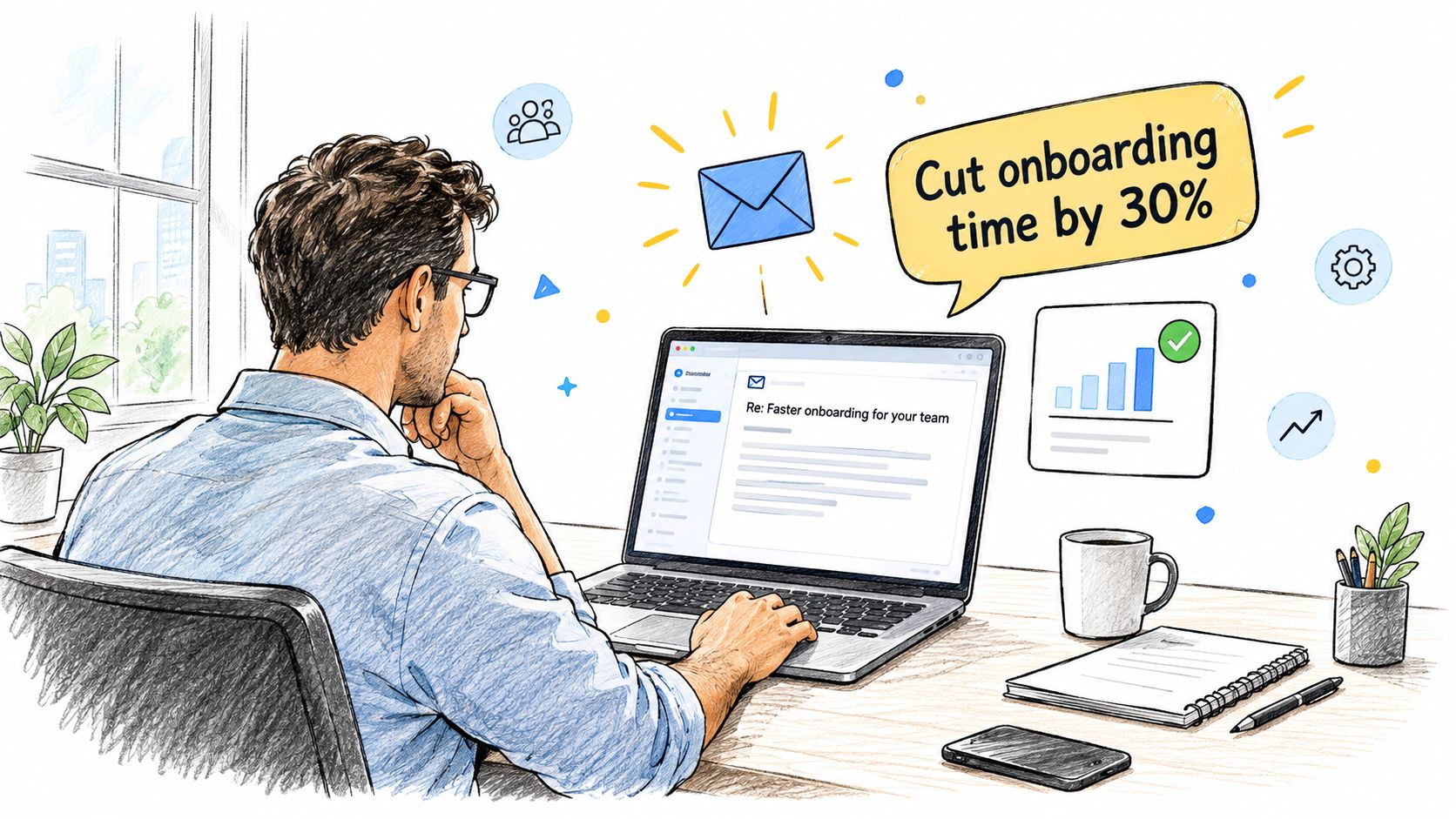
The strongest subject lines do one job well. They give a buyer a real reason to open. In b2b marketing emails, that usually means naming a business problem clearly, then promising a relevant next step instead of chasing attention with clever wording.
Write from the problem, then attach proof
Start with the pain the buyer already understands, then connect it to something concrete you have observed. If an agency is hiring for SDR support, a SaaS team has just changed systems, or a consultancy has a service gap, use that context. Personalization works when it reflects role, industry, and current buying situation. It breaks down when it is only a first-name token dropped into a template.
For a tactical library of high-converting cold email templates, look for patterns that front-load the problem and keep the ask small. Run drafts through the cold email grader before they go live. The strongest versions sound like one professional speaking to another, not like a funnel built in layers that never had to answer for itself.
Useful test: read the email out loud and ask whether it would still feel relevant if the recipient ignored the salutation entirely.
Keep the call to action in proportion to the offer. For agency and SaaS outreach, a useful CTA is often a reply that confirms the issue, a short resource, or a low-friction conversation. In consulting, cybersecurity, MSP, and staffing, that usually works better than asking for a hard booking on the first touch.
Don't confuse personalization with surveillance
More detail is not always better. A 2025 summary of Gartner research involving more than 1,400 B2B buyers reported that personalized experiences can backfire more than half the time, especially during transitions between research and vendor selection, and that passive personalization was associated with lower future purchase likelihood by as much as 44% in that summary. Over-inferred details can make a buyer feel watched instead of understood.
Use observable business context, not hidden certainty. If you know the role, the industry, or the initiative, say so plainly. If you do not know the timing, keep the message broader and let the prospect choose the next step. Hyper-specificity sounds sharp until it reads like you have been following the prospect around the internet.
Clean subject lines are specific, calm, and relevant. They do not need hype words, urgency tricks, or manufactured curiosity. They need enough clarity that the buyer can tell, before opening, whether the message is worth the few seconds it will take.
Deliverability as Engineering, Not Afterthought
A campaign can be well written and still fail before it reaches a buyer. Deliverability sets the conditions for inbox placement, and if the sending setup is weak, the message never gets a fair read.
Authenticate first, then watch the complaint signal
Google explicitly lists SPF, DKIM, and DMARC for bulk senders, and it also recommends a visible unsubscribe mechanism with one-click unsubscribe for marketing messages. Those controls are basic, but mailbox providers use them as proof that the sender is operating with discipline.
Complaint monitoring deserves even more attention. Google recommends keeping the user-reported spam rate below 0.1% and avoiding 0.3% or higher, and the metric is calculated daily, so a short spike can hurt you even if the campaign average looks fine. Run your setup through the email deliverability checker before ramping so authentication and placement issues show up early.
For cleaner list hygiene, SkipForge's email finder tool can help teams work from verified contact data tools that are less likely to create bounce problems before a send ever goes out. Clean data does not guarantee replies, but poor data almost always creates avoidable friction.
Ramp like you care about the mailbox
Increase volume gradually across authenticated mailboxes. Suppress prior unsubscribes and complaints globally, not just inside one campaign, and validate addresses before upload so a stale list does not drag down placement.
| Safer habit | Risky habit |
|---|---|
| Validate addresses before upload | Upload stale lists and hope for the best |
| Suppress prior unsubscribes globally | Treat opt-outs as sequence-specific |
| Ramp volume gradually | Blast full volume on a fresh domain |
| Monitor complaints by segment | Rely on campaign averages only |
A domain can pass every authentication check and still land in spam if the outreach is irrelevant.
That is the trap. Teams set up SPF, DKIM, and DMARC correctly, then send messages people did not want and wonder why inbox placement weakens. Relevance, complaint control, and list hygiene have to hold together, because sender reputation turns into an engineering constraint the moment volume starts climbing.
Multi-Step Cadences, Follow-Ups, and Calendar Routing
A single email rarely does the whole job. Good outreach behaves more like a guided sequence, where each touch has a different purpose and the next step depends on what the buyer did, not on what the sender hoped would happen. That's where cadence design matters more than one perfect message.
Build the sequence around response states
Start by separating responses into practical buckets. There's interest, objection, delay, and opt-out. Those are not the same thing, and treating them as if they are is how teams either annoy good prospects or waste time on dead ones.
The email sequence generator is useful as a structural aid, but the main work is the routing logic after the reply lands. A buyer who asks for a case study should not be handled the same way as someone who says, “Not now,” and neither should be pushed into a generic calendar link without context.
Use automation to route, not to impersonate
AI-assisted appointment setting works best when a human still owns tone, timing, and judgment. That matters in agency, consulting, and cybersecurity outreach, where robotic follow-up can make a decent offer sound cheap. Automation should remove the lag, not the nuance.
A practical cadence often looks like this:
- Initial outreach that names the problem and gives the buyer a reason to keep reading.
- Problem-led follow-up that adds one more piece of evidence without repeating the same pitch.
- Reply routing that sends warm interest to booking and softer interest to a useful asset.
- Calendar coordination that respects context instead of forcing a hard sell.
- Quiet suppression for explicit opt-outs, so the sequence stops cleanly.
That last point matters more than most organizations admit. A slow reply is still a live reply, but it needs a thoughtful handoff. The best systems keep the conversation moving without making the recipient feel like they're being chased by software.
Testing Framework and Commercial KPIs
The easiest metric to optimize is usually the wrong one. Open rates are tempting because they're visible and tidy, but they don't pay the bills. A better testing system ties every experiment to commercial movement, not just inbox behavior.
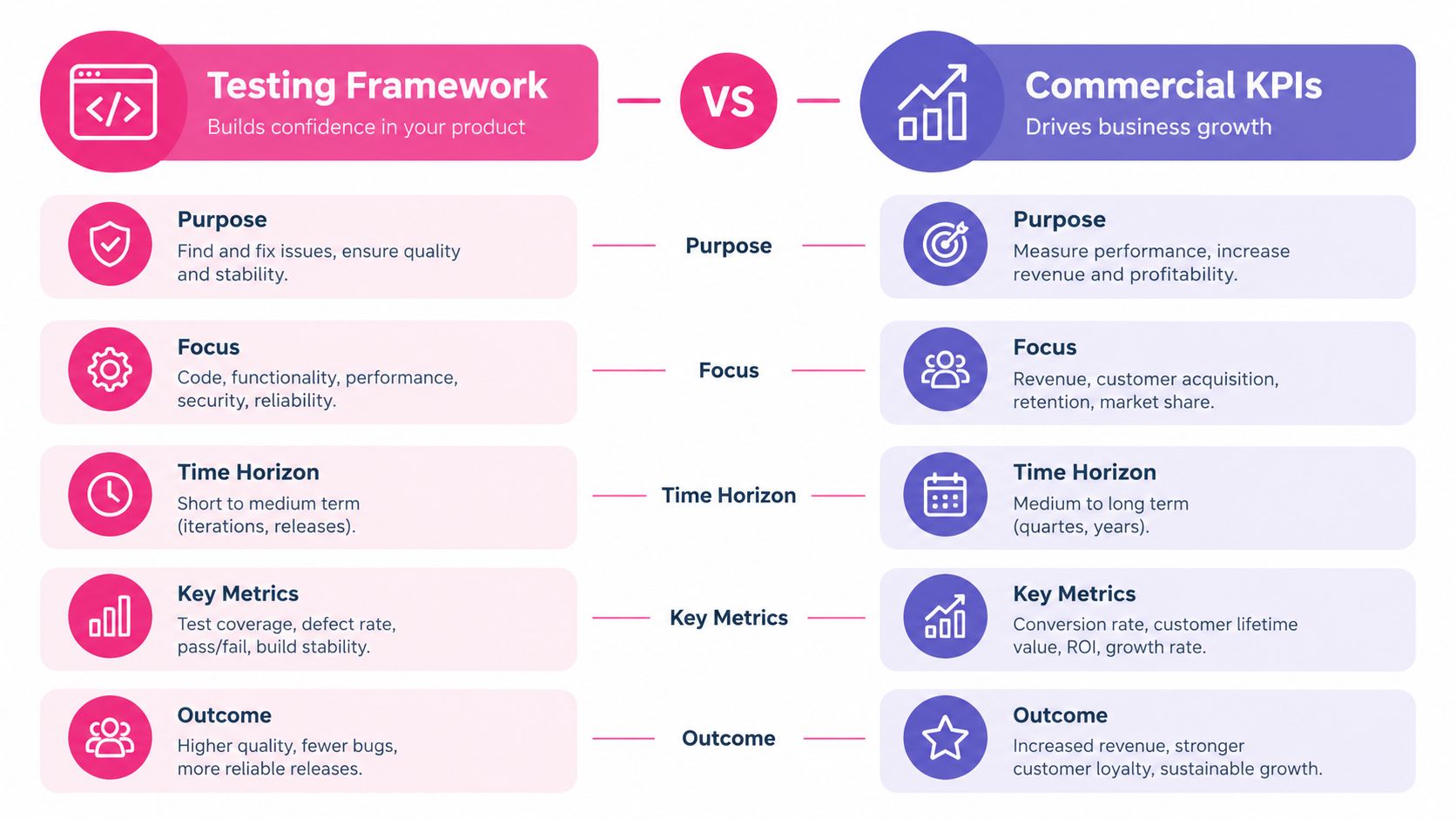
Test one variable, not the whole stack
Run one hypothesis at a time. If you change the subject line, the offer, and the audience together, you won't know what worked. The cleanest tests usually compare problem framing, proof, call to action, or follow-up timing across similar segments.
The cold email ROI calculator is useful when stakeholders want a business discussion instead of a vanity-metric debate. Use it to keep the conversation tied to outcomes, not dashboard theater.
Measurement rule: if the test improved replies but increased complaints or unsubscribes, it did not win.
Track the funnel, not the headline number
HubSpot's broad 2025 benchmark reported a 42.35% average email open rate across industries, but that's not a reliable target for cold B2B outreach because consent level, mailbox mix, tracking, and campaign type all differ. For outbound, the more useful chain is delivered messages, positive reply rate, meeting acceptance, show rate, pipeline created, and closed revenue.
| Stronger signals | Weaker signals |
|---|---|
| Positive reply rate | Open rate targets |
| Meeting acceptance | Subject line curiosity |
| Show rate | Clicks without context |
| Pipeline created | “Any reply” counted as success |
| Closed revenue | Inbox activity without sales impact |
The point isn't to ignore engagement. It's to rank it properly. A campaign can open well and produce nothing, or open modestly and create serious pipeline. The second one pays for lunch.
Once you've found a segment-message combination that improves qualified replies without increasing complaints, document it and scale carefully. That's how testing compounds instead of turning into a never-ending rewrite cycle.
Playbook Templates and Ready Patterns
Teams rarely need more theory. They need a working pattern they can reuse without turning every send into a fresh invention. The best b2b marketing emails are usually simple enough to repeat and specific enough to feel like they were written for the recipient sitting in front of them.
Cold outreach template pattern
A clean opener works across agencies, SaaS, consulting, staffing, MSP, coaching, and cybersecurity when it follows the same logic. Name the situation, tie it to the buyer's world, and make the next step small.
A practical structure looks like this:
- Opening line: state the observed business context without overexplaining.
- Problem line: name the likely friction in plain language.
- Proof line: give one reason the outreach is relevant now.
- CTA: ask for a simple reply, not a commitment ceremony.
That pattern works because it respects attention. It also leaves room for the buyer to say no without drama, which is often what keeps a message from feeling invasive.
Follow-up and referral-style nudge
Follow-ups should add, not repeat. If the first email raised a problem, the next one can offer a resource, a different angle, or a shorter route to a conversation. Referral-style nudges work best when they sound like a useful prompt rather than a demand.
A soft referral note might say that you noticed a similar team facing the same issue and wanted to share a relevant approach. Keep it brief. If the buyer is ready, they'll take the next step. If they aren't, a respectful note keeps the door open.
Ever Outbound is one option in this space, and we're pay-per-close. Ever Outbound provides done-for-you B2B client acquisition with human research, copywriting, appointment setting, AI-assisted workflows, and managed sending infrastructure, and the model charges only a 5% commission when you close a deal from their efforts, with your first 2 closes commission-free. That matters for teams that want the outbound function handled without building the whole machine in-house.
The operating rhythm that holds it together
Planning decides who gets the email. Copy decides whether it feels relevant. Deliverability decides whether it reaches the inbox. Measurement decides whether it deserved the send in the first place.
Keep those four pieces together and the channel stops behaving like a lottery. It starts behaving like a system.
If you want this kind of outbound without bolting together research, writing, send infrastructure, and follow-up on your own, visit Ever Outbound Inc.. We're pay-per-close, so the model is built around booked, qualified deals, not retainer theater. If you want a team to run the outreach while you stay focused on closing, that's the conversation to have.