November 21, 2026
8 B2B Sales Email Templates That Book More Calls
The most popular advice about B2B sales email templates is to personalize the opener, keep it short, and ask for a call. Sensible enough. It's also how you end up with a beautifully personalized email asking the wrong person for a meeting about a problem they don't have.
Most sellers collect templates without defining the job each email must do. They've got a case-study email, a breakup email, and something involving a raccoon GIF. What they haven't got is a reason to send any particular message to this particular buyer.
A template is a strategic play, not a spell. It needs a trigger, credible evidence, an offer that fits, and a next move that makes sense after the reply. Otherwise, you're just standardizing your interruptions.
Don't ask which template gets replies. Ask what the recipient needs to believe before replying.
These eight plays give you usable copy, the signal each needs, where it backfires, and what to test next. Adapt the bracketed details using facts you can verify, not optimistic guesses wearing a first-name variable.
The objective isn't to produce an impressive swipe file. It's to build a sequence in which every message earns its place, and interested buyers can move forward without deciphering your sales process.
Table of Contents
- 1. The Direct Problem-Solving Cold Email
- 2. The Insight-Led Personalized Email
- 3. The Short Demo-Request Email
- 4. The Case-Study or Customer-Result Email
- 5. The Trigger-Event Outreach Email
- 6. The Partnership or Referral Email
- 7. The Re-engagement or Win-Back Email
- 8. The Multi-Step Value Nurture Sequence
- How the 8 templates compare by use case, trigger, CTA, and failure risk
- Steal the Template, Keep the Strategy
1. The Direct Problem-Solving Cold Email
A prospect doesn't need your company biography. They need to recognize the problem you're describing and understand how you'd address it.
Use this play when you have a visible business signal and a plausible operational consequence. For a SaaS founder targeting growing sales teams, that might mean advertised SDR vacancies and a relevant offer to review lead routing.

The Template
Subject: [Company]’s SDR handoffs
Hi [Name],
Your careers page lists openings across the SDR team. As that team grows, keeping lead ownership clear may become more complicated.
We help SaaS revenue teams review routing rules and follow-up ownership before changing their outbound tools.
Is lead handoff something you're reviewing, or is another part of the funnel taking priority?
[Sender]
Proof requirement: Confirm the hiring signal and make sure you can explain your review process. Don't turn a vacancy into a confident diagnosis of revenue leakage.
- Where it backfires: You describe a generic pain, then offer a generic solution. Every company wants efficiency. That isn't targeting.
- Testable variant: Keep the audience and offer fixed, but compare a handoff question with a routing-review offer.
- Exact next move: If they confirm the issue, ask which handoff causes trouble before proposing a meeting.
Check whether the message communicates its value without an attachment using the cold email copy grader. For tone, writing with authority in English emails is a useful companion, but authority comes from precise language, not sounding like procurement drafted your greeting.
2. The Insight-Led Personalized Email
Say a marketing agency notices that a prospect has launched regional landing pages, but the customer examples remain entirely domestic. That's a useful observation. Announcing that the company's international conversion rate must be terrible is not.
The insight must connect to a commercial implication without pretending you can see private performance.
A Stripo analysis of 5.5 million B2B emails found reply rates of 7% with personalization versus 3% without. That's directional evidence for relevance, not permission to treat every inserted company name as meaningful research.
The Template
Subject: Local proof on [Company]’s regional pages
Hi [Name],
Your [region] pages describe a local offer, while the customer examples I found focus on [existing market].
That may leave buyers wondering whether the same approach fits their market.
We help agencies adapt positioning and customer proof for regional launches without rebuilding the entire site.
Would a short comparison of the messaging be useful?
[Sender]
The trigger is an observable mismatch between the prospect's initiative and its supporting material. Your proof requirement is the actual page comparison, reviewed by a human before sending.

This backfires when the observation becomes an unsolicited teardown. Public pages rarely reveal the whole strategy, so leave room for information you don't have.
Test the implication, not just the compliment: compare local credibility with message consistency while keeping the underlying observation unchanged. If the prospect responds, send the promised comparison and ask whether the difference is intentional before pitching corrective work.
3. The Short Demo-Request Email
A demo invitation should describe a useful working session, not announce that your salesperson has discovered screen sharing.
Use it when the buyer's workflow is identifiable and your product can demonstrate a relevant change. A recruiting platform, for example, can show how a hiring manager moves from an approved role to a reviewed shortlist.
The Template
Subject: Reviewing shortlists in [Company]’s workflow
Hi [Name],
If hiring managers at [Company] are reviewing candidates across separate threads and spreadsheets, our platform may be relevant.
I can walk through creating a role, reviewing a shortlist, and assigning the next action using a sample hiring workflow.
Would that be worth seeing, or is shortlist review already handled in your current system?
[Sender]
Before sending, replace the conditional workflow with a verified detail where you have one. Don't claim the prospect uses spreadsheets because your demo happens to contain a spreadsheet villain.
- Proof requirement: A working demonstration of the workflow you name, including relevant integration limits.
- Failure mode: You promise a personalized session, then deliver the standard product tour with the prospect's logo pasted onto a slide.
- Testable variant: Compare a live workflow review with an offer to send an annotated recording.
- Exact next move: Confirm the current system, decision-maker involvement, and evaluation objective, then offer scheduling.
Once there's interest, specify the actual duration you can honor and use a meeting title that names the outcome. Send relevant product context beforehand so the buyer doesn't spend the opening explaining their business.
When evaluating appointment acquisition, distinguish meeting volume from commercial fit. A pay-per-meeting comparison can help frame that decision, but your qualification criteria still need to exist before the calendar fills.
4. The Case-Study or Customer-Result Email
Relevant proof beats impressive but unrelated proof. An MSP considering incident-response support needs operational context, not a triumphant chart from an ecommerce advertising campaign.
A Soteria Media B2B ecommerce case study reports 146 total replies and 43 positive replies from 4,346 emails. The useful distinction is between any response and commercial interest, not a promise that another campaign will produce the same result.

The Template
Subject: [Relevant outcome] in a comparable environment
Hi [Name],
[Approved customer] was dealing with [specific operating problem] across [relevant scope].
We changed [specific process], which produced [documented outcome] during [verified period].
Your [verified business detail] suggests the approach may be relevant, although the operating conditions could differ.
Would you like the case summary showing what changed?
[Sender]
Only send that version when every bracketed claim has evidence. If the timeframe isn't documented, omit it rather than inventing a neat reporting window.
Proof discipline: Explain the starting condition and intervention. A result without either is a victory lap the buyer can't evaluate.
Use a results library or resources such as Purple WiFi case studies to examine how customer context is presented. Borrow the structure, never someone else's customer outcome.
Trigger: The prospect resembles the case in operating model or problem. Failure mode: You confuse a famous logo with relevant evidence.
Test operational similarity against industry similarity. If the buyer requests the case, send it with a question about which condition matches their situation, then decide whether a call is warranted.
5. The Trigger-Event Outreach Email
A funding announcement is not a purchase order. Neither is a leadership hire, acquisition, or expansion announcement, despite what the average congratulatory email seems to believe.
An event gives you a reason to investigate, not permission to invent urgency. Verify it through the company announcement, then connect it to a need your offer can plausibly address.
The Template
Subject: Hiring support for [Company]’s [region] expansion
Hi [Name],
Your announcement says [Company] is expanding into [region].
If that includes building a local sales team, identifying candidates with relevant buyer relationships may be an early priority.
We map talent markets for recruiting teams entering unfamiliar regions.
Would a sample market map help, or is local hiring outside the current plan?
[Sender]
For a recruiting firm, the proof requirement is an actual market-mapping method and relevant candidate-market knowledge. The announcement proves expansion, not an approved hiring budget.
SyncGTM's state-of-cold-email reporting distinguishes simple variable-based personalization from human-researched and human-edited messaging. The practical lesson is to verify both the event and its connection to the offer before approving the copy.
Keep the Timing Honest
This play backfires when you keep referencing an announcement after the initiative has moved on. Give event-based campaigns an expiration rule and stop treating old news as a fresh opening.
Test the proposed consequence: A regional expansion could justify talent mapping or onboarding support, but those are different hypotheses. Don't cram both into the same message.
If the recipient confirms hiring plans, ask which roles come first and who owns the search. If they reject the inference, record that answer and stop the event-based follow-up.
6. The Partnership or Referral Email
Partnership outreach has a special talent for sounding important while proposing absolutely nothing. “Explore synergies” usually means someone wants access to someone else's customers.
Start with a specific shared buyer and a bounded collaboration. A cybersecurity consultancy and an MSP might jointly produce an incident-readiness worksheet for operations leaders, with clearly separated responsibilities.
The Template
Subject: Incident-readiness resource for [Partner]’s clients
Hi [Name],
Your managed IT service supports [verified customer segment]. Our incident-readiness work addresses a complementary problem for that same buyer.
Would you be interested in testing a co-branded readiness worksheet? We'd draft the security content, and your team could review the operational guidance.
If the resource fits your audience, we could agree on distribution and referral handling before publishing.
Worth discussing the outline?
[Sender]
The trigger is genuine audience overlap without an obvious service conflict. The proof requirement is evidence of that overlap plus a draft contribution you can deliver.
- Define the work: Name the content owner, reviewer, distribution responsibilities, and approval process.
- Define the commercial model: Agree on referral attribution, compensation where applicable, customer ownership, and conflicts.
- Define the next move: Send an outline and responsibility split before negotiating a grand alliance.
For agency fulfillment arrangements, examine white-label delivery considerations before promising work under your brand. Client communication and responsibility for delivery matter more than the logo on the proposal.
Where it backfires: You ask for introductions before demonstrating reciprocal value. Testable variant: Compare a jointly produced resource with a narrowly scoped referral pilot, using separate partner segments.
Don't call the arrangement a partnership until someone has agreed to do something.
7. The Re-engagement or Win-Back Email
The strongest re-engagement opener is something real that changed. An integration shipped, a stalled project restarted, or a previously unsuitable service now fits.
A former trial user who needed an unavailable CRM integration has a reason to hear about its release. They don't need a theatrical farewell because they ignored your last email.
The Template
Subject: The [integration] you evaluated
Hi [Name],
When you evaluated [product], connecting [workflow] with [system] was a blocker.
That integration is now available, including [verified capability relevant to the earlier discussion].
If this workflow is still a priority, would you like the setup notes? If your plans have changed, I'll leave it there.
[Sender]
Proof requirement: Accurate CRM history and a verified change. Confirm what the new capability does before suggesting it resolves the entire earlier objection.
A previous conversation gives you context. It doesn't give you permanent permission to keep marketing.
The FTC's CAN-SPAM compliance guide requires accurate sender information, truthful subject lines, advertisement identification, and an accessible opt-out mechanism for commercial email. Previous engagement doesn't remove those responsibilities.
Audience classification matters too: the ICO's PECR email-marketing guidance distinguishes corporate subscribers from individuals, sole traders, and some partnerships, with different consent requirements.
Reopen the Right Conversation
Failure mode: You restart a closed opportunity without addressing why it stopped. Segment inactivity by lost fit, timing, missing capability, and explicit rejection.
Testable variant: Offer setup notes versus a configuration review. If they respond, reconfirm the blocker and current priority; if they decline or opt out, suppress further outreach rather than moving them into another campaign.
8. The Multi-Step Value Nurture Sequence
The best B2B sales email templates work together. They don't repeat the same meeting request with progressively more wounded punctuation.
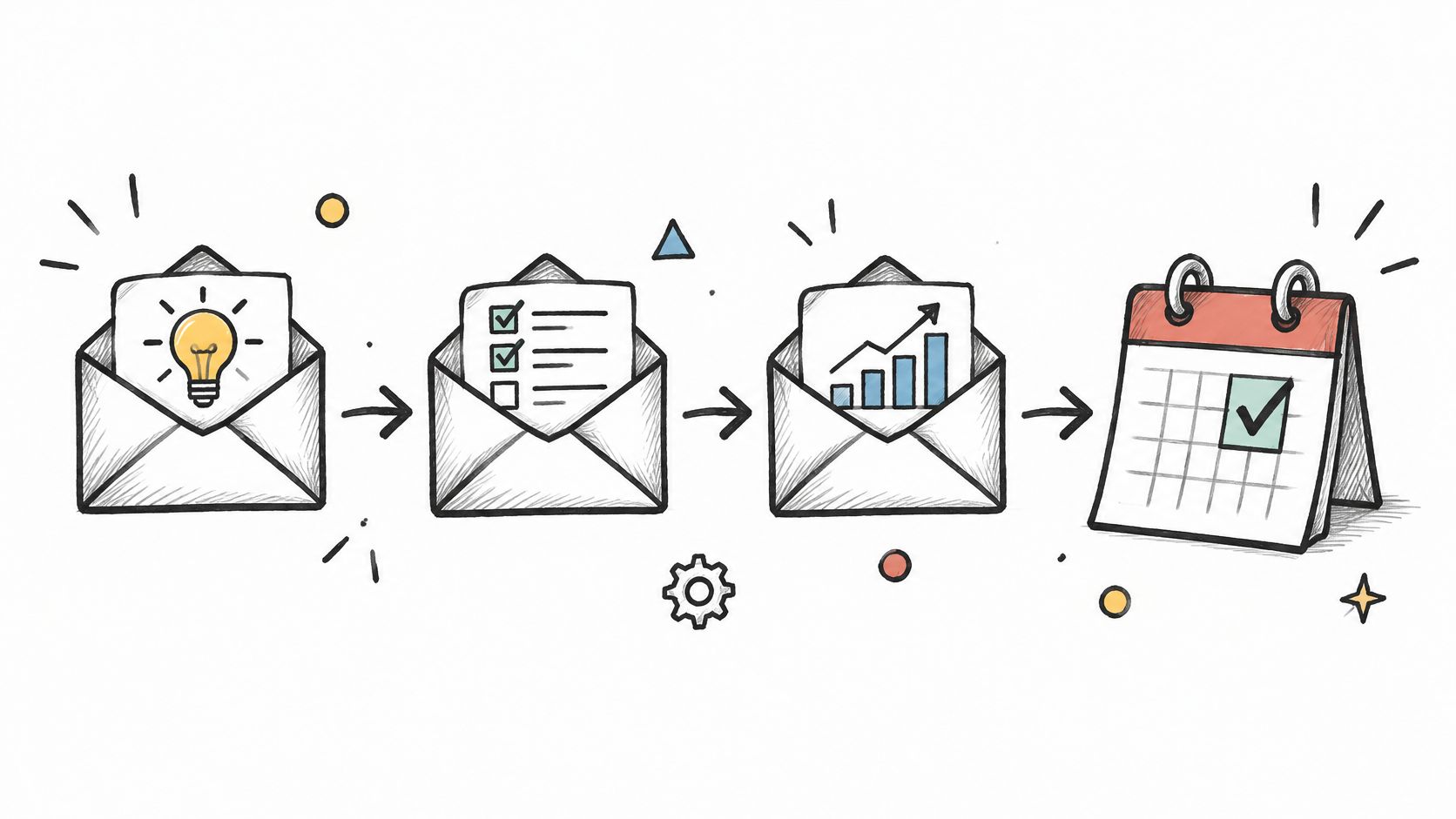
For an MSP selling readiness reviews, build a sequence around a consistent operational question: can the prospect identify and route an incident without confusion?
A Sequence With Distinct Jobs
- Establish relevance: “Your [verified operational change] may affect incident ownership. Is escalation routing part of that review?”
- Provide a diagnostic: “Our readiness worksheet covers ownership, severity, and handoffs. Would it help with that review?”
- Supply credible proof: “[Approved customer] addressed [comparable problem] by [documented intervention]. Would the case summary be useful?”
- Offer a decision: “If escalation ownership is still unresolved, would a readiness review help identify the next action?”
The trigger is a segment with a coherent problem hypothesis. Your proof requirement includes the promised worksheet and approved case, not merely enough copy to populate the sending software.
Use an email sequence generator to draft the outline, then check that every message contributes something different. Test one offer or message angle at a time, keeping audience selection consistent.
Delivery needs the same discipline. Google's sender guidelines require domain authentication and impose additional requirements on bulk senders; configure SPF, DKIM, and DMARC, verify addresses, and monitor complaints.
Google's bulk-sender FAQ explains that volume is assessed at the primary-domain level, so adding mailboxes isn't a loophole.
Failure mode: You keep automating after the prospect answers. Exact next move: Pause the sequence on a meaningful reply, classify intent, and let the buyer's answer determine the next message.
How the 8 templates compare by use case, trigger, CTA, and failure risk
| Template | Best For | Primary Trigger | CTA Style | Main Risk |
|---|---|---|---|---|
| The Direct Problem-Solving Cold Email | Targeted B2B outreach with a clear use case | Specific business problem or researched signal | One low-friction question or booking request | Generic problem framing weakens differentiation |
| The Insight-Led Personalized Email | Agencies, consultants, and advisory firms | Relevant market or company insight | Single next step tied to the insight | Insight may feel stale or disconnected from the offer |
| The Short Demo-Request Email | Visual or easily demonstrated products | Prospect intent or a narrow product use case | Brief, specific demo invitation | Unqualified bookings or premature demo requests |
| The Case-Study or Customer-Result Email | B2B offers supported by relevant customer proof | Comparable customer outcome | Permission-based question about the prospect's challenge | Irrelevant or unverifiable proof damages credibility |
| The Trigger-Event Outreach Email | Timely outreach to businesses undergoing change | Verified event such as funding, hiring, or expansion | Low-risk question about urgency or fit | Outdated event details or incorrectly inferred needs |
| The Partnership or Referral Email | Complementary businesses and shared audiences | Audience overlap or mutual business opportunity | Collaborative conversation about a defined initiative | Vague proposals consume time without producing results |
| The Re-engagement or Win-Back Email | Former leads, inactive customers, and stalled deals | Prior interaction plus a relevant new reason to reconnect | Low-pressure invitation to resume the conversation | Inaccurate history or excessive follow-up harms trust |
| The Multi-Step Value Nurture Sequence | B2B teams with longer sales cycles | Prospect segment, buyer need, or engagement signal | Progressive value followed by a direct meeting request | Sequence fatigue, weak personalization, or deliverability issues |
Steal the Template, Keep the Strategy
Choose the template that matches the signal you have. A verified expansion announcement supports trigger outreach; a documented customer result supports proof-led outreach; a previous conversation supports re-engagement. A company name and an email address support further research, not an elaborate theory about the buyer's problems.
The template is the repeatable part. The reasoning isn't. Before approving a message, the sender should be able to explain why this recipient, why this offer, and why now without mentioning the size of the available lead list.
Test the Commercial Hypothesis
Keep a campaign record containing the target segment, source signal, offer, proof asset, and reply classifications. That makes it possible to diagnose weak results without reflexively blaming the subject line.
- If buyers reject the premise: Revisit the targeting or business inference.
- If buyers recognize the problem but decline: Examine the offer, timing, and perceived effort.
- If meetings don't qualify: Tighten the fit question before scheduling.
- If delivery deteriorates: Pause sending and investigate infrastructure, address quality, and complaints before rewriting everything.
Measure positive replies, qualified meetings, and closed revenue, with delivered volume and negative signals alongside them. Opens can be distorted by privacy features and mail-client tracking, so they're a poor foundation for deciding whether buyers want your offer.
Test one variable at a time and preserve the rest of the campaign conditions where practical. Changing the audience, offer, subject, and call to action together may produce a different result, but it won't tell you which decision helped.
Make the Asset Fit the Promise
A useful follow-up asset should help the buyer complete a real task. For cybersecurity firms, customizable pentest reporting templates are an example of a concrete resource category; a generic company brochure isn't an equivalent substitute for the assessment aid you promised.
Be equally specific about the next move. Send the requested material, ask the relevant qualification question, and offer a meeting only when there's something worth discussing. Don't punish a positive reply by immediately assigning the buyer homework.
If you want the sequence run for you, Ever Outbound runs these sequences as a managed service, and we're pay-per-close: a 5% commission only when you close, and your first 2 closes are commission-free. Our human research, copywriting, and appointment-setting team uses AI and managed sending infrastructure to handle execution.
Keep the strategy even when you delegate the work. Know which buyers you want, what evidence supports the offer, and what makes a booked conversation worth attending.
At Ever Outbound Inc., we're pay-per-close, and we handle prospect research, personalized email sequences, sending infrastructure, and appointment setting so you can focus on qualified sales conversations. Visit Ever Outbound Inc., where we're pay-per-close, to discuss a managed outbound campaign built around your market and offer.