November 25, 2026
B2B Sales Strategy: How to Build One That Closes Deals
Most advice on building a B2B sales strategy boils down to a single loud slogan: buy a bigger list, fire off more cold emails, and celebrate every meeting that lands on the calendar. That playbook works great if your goal is keeping sales reps busy while burning through your addressable market. It fails miserably when your real job is closing profitable deals.
Spray-and-pray outreach collapses because buyers don't wait around for a cold email to start shopping, and one friendly contact rarely signs the contract alone. Personalization by itself won't bail you out either. McKinsey's B2B growth research found that more than 90% of organizations already personalize content across email, websites, social media, and other touchpoints, while 60% of market leaders (companies growing market share by more than 10% year over year) reported double-digit revenue growth compared with 21% of laggards whose share fell by more than 5%. Swapping in a prospect's first name isn't a strategy anymore; it's table stakes.
A working B2B sales strategy solves two much harder problems before anyone picks up the phone: earning credibility before direct contact, and building consensus across a skeptical buying group. You judge that system by qualified pipeline and closed revenue, never by how many polite 15-minute chats fill a rep's Tuesday.
Table of Contents
- The Six Decisions Behind Every B2B Sales Strategy
- Targeting Accounts Worth Chasing
- Positioning for Buyers Who Shortlist with AI
- Mapping the Buying Group Behind Every Deal
- Pipeline Stages and Channel Coordination
- Outreach Sequences That Protect Your Domain
- Matching Deal Motion and Metrics, Then Running a 30-Day Test
The Six Decisions Behind Every B2B Sales Strategy
Running a sales organization feels far more like managing a busy restaurant kitchen than reading a recipe card. The menu, the suppliers, the prep line, and the ticket times all have to agree before a single plate hits the pass. If your chef designs a tasting menu while your buyer orders drive-through ingredients, the dinner service falls apart fast.
Every solid B2B sales strategy comes down to six interlocking decisions: targeting, positioning, pipeline, outreach, channel coordination, and measurement. Skipping even one forces your sales reps to improvise on live calls, and buyers notice that chaos right away. You don't have much face time to recover from a messy pitch, either. According to Gartner's buyer enablement research, B2B buyers spend only 17% of their total purchasing time meeting with potential suppliers, and any single rep may get just 5% to 6% of that window when buyers compare several vendors. That same report notes that 77% of B2B buyers describe purchasing as complex or difficult, and 90% loop back to revisit at least one buying task. Your strategy has to carry the argument when nobody from your team is in the room.
| Decision | Question It Answers | Artifact It Produces | Common Failure |
|---|---|---|---|
| Targeting | Which accounts are worth chasing? | Ideal client profile and scoring rules | Chasing every company with a pulse |
| Positioning | Why should they care right now? | One-line value proposition and proof set | Generic claims that sound like every competitor |
| Pipeline | How does a deal move from interest to signed? | Stage definitions and exit criteria | Opportunities that never leave the first stage |
| Outreach | How do we reach the right people? | Multi-step sequence and mailbox plan | Volume without relevance and burned domains |
| Channel coordination | How do touchpoints connect? | Channel calendar and shared account notes | Email promises one thing, the call delivers another |
| Measurement | Is the strategy working? | Scorecard by pathway and stage | Counting meetings booked instead of deals won |
Turning Decisions Into Working Files
Every artifact in the third column is a real document your team can open on a Monday morning, not an inspiring sentence taped to a conference room wall. If a new account executive asks who counts as a good prospect, you hand them the scoring sheet instead of waving vaguely at "mid-market tech." Teams still mapping out how commercial choices connect to broader market positioning can use the Otter A/B strategy development guide to align offer structure before locking in sales workflows.
Each row also protects the row beneath it. Tight targeting keeps your outreach list clean, sharp positioning gives your pipeline stages real momentum, and shared channel notes prevent embarrassing handoffs between marketing and sales. You can see how those pieces lock together in how our outbound acquisition workflow operates from initial account selection all the way to the sales call.
Grab a pen and mark each of the six rows above as either done or missing for your business right now. The missing rows tell you exactly where revenue is leaking and which fix deserves your attention first.
Targeting Accounts Worth Chasing
Say an independent consultant sits down with a CSV holding 2,000 company names and exactly three hours a week to prospect. Writing a clever email opener is the wrong first move. The first job is ruthless subtraction, because targeting is the discipline of deciding which accounts enter your pipeline and which ones never get a second look.
Without clear selection rules, sales teams default to whoever answers the phone, which usually means small budgets, endless revisions, and high churn. I would always rather see a team work 80 sharp-fit accounts properly than blast 2,000 strangers and pray for replies. Give every prospective account a quick score out of 15 using five criteria, each worth zero to three points:
- Fit: Industry, business model, and company headcount match the clients you already deliver strong results for, so delivery doesn't turn into a custom science project.
- Pain: Public proof shows the problem exists today. Think open job postings for a role your agency replaces, messy checkout flows, or an outdated site leaking leads.
- Reachability: You have a verified work email or direct profile for an actual decision-maker, not a generic info inbox that nobody reads.
- Timing: Something changed in the last 90 days, such as a funding round, a new VP of Marketing, a product launch, or an office expansion, creating a real reason to act now.
- Deal value: The likely contract size covers your acquisition effort and leaves healthy margin.
Set a firm cutoff at 10 out of 15 before an account qualifies for outreach. Anything below that threshold stays out of your sending tool, no matter how tempting the logo looks.
Two Accounts Scored Side by Side
Run two hypothetical prospects through that rubric to see how fast the fog clears. First, consider a 40-person marketing agency that just hired a new head of growth, posted three client-delivery roles, has a reachable founder, and buys retainers that easily clear your minimum deal size. It scores 3 on fit, 3 on pain, 3 on reachability, 2 on timing, and 2 on deal value for a 13 out of 15, sending it straight into active outreach.
Now look at a 6-person IT shop with no recent hiring, no visible trigger, an unverified owner email, and a tiny annual budget. It scrapes together 2 on fit, 1 on pain, 1 on reachability, 1 on timing, and 2 on deal value for a 7 out of 15. You park it without spending a single minute writing custom copy.
Selection rule: Every bad-fit account you cut before launching a sequence buys back research time for an account that can actually sign.
Close the loop with a 30-minute monthly list-cleaning routine. Export your active prospect sheet, strip out any account whose score dipped below 10 or went dark after a full sequence, and refill those empty slots exclusively from your highest-converting segment. If you want a structured filter before outreach begins, pre-qualifying accounts ahead of campaign launch keeps reps focused on conversations that match your margin profile.
Positioning for Buyers Who Shortlist with AI
Sending four extra "just bumping this to the top of your inbox" emails won't save a vendor that never made the buyer's shortlist. Buyers increasingly build that list on their own before a sales rep knows they're shopping. According to Elite Content Marketer's B2B buyer statistics, 94% of surveyed buyers used large-language-model tools during purchasing, and buyers didn't contact sellers until roughly 61% of the way through their journey. Meanwhile, Salesforce's research covering sales professionals across 22 countries, reported by Statistics Global, shows 87% of sales organizations used some form of artificial intelligence in 2025. Both sides of the table run on AI now, which makes thin, generic outreach vanish on arrival.

Treat positioning like the label on a jar at the grocery store. Shoppers don't unscrew ten lids to taste what's inside; they scan the label for two seconds to see what the product does, who it's built for, and why it beats the jar next to it. If your website and public profiles read like vague corporate poetry, both human buyers and language models will leave your jar sitting on the shelf.
If the shortlist is set before your first email, your email is a reminder, not a pitch.
Five Pre-Contact Credibility Moves
Strong outbound works when your public footprint confirms every claim your email makes. Put these five assets in place before scaling any sequence:
- Write a blunt one-sentence value statement: Combine the exact problem you fix, the measurable outcome you deliver, and one piece of proof. Put it at the top of your homepage and LinkedIn profile so nobody has to decode what you sell.
- Publish honest comparison pages: Name real alternatives in your category, including agencies, in-house hires, or rival software, and state plainly when each option fits best. Buyers and AI engines trust concrete trade-offs far more than hype.
- Anchor proof in before-and-after numbers: Replace vague praise like "great communication" with specific client outcomes showing where the customer started and where they landed.
- Build a forwardable one-page brief: Give your internal advocate a clean PDF or webpage summarizing scope, timeline, pricing logic, and expected return so they can drop it straight into Slack.
- Audit three AI engines quarterly: Open ChatGPT, Claude, and Perplexity, ask each to recommend vendors for your exact niche and problem, and record which competitors appear.
When your team pairs pre-contact positioning with signal-based prospecting, reviewing practical lead generation ideas for SDR teams helps align outreach triggers with what buyers are already researching. If your company doesn't show up in those AI answers, stop tweaking cold email subject lines for a week. Tighten your category language on your homepage, publish structured comparison and case-study pages with clear headings, and make sure third-party directories describe your niche in the exact same plain words buyers type into prompts.
Mapping the Buying Group Behind Every Deal
Winning over one enthusiastic VP feels fantastic right up until your proposal vanishes into a six-week black hole. A single-contact campaign fails all the time because the person who loves your demo rarely holds unilateral approval power. Gartner's B2B Buying Report states that the average enterprise buying group contains five to 11 stakeholders spanning an average of five distinct business functions, while a separate Gartner version describes the median buying group as six to 10 decision makers, with each person independently gathering four or five pieces of information.
Those committees don't even sit still while you're selling to them. A Business Wire report published through the Financial Times noted that six in ten B2B technology buying groups changed composition over the prior two years, and 27% of buyers named missing business-decision-maker buy-in as a leading cause of purchase delays. If your whole deal rests on one friendly director, a single reorg or skeptical CFO kills your quarter.
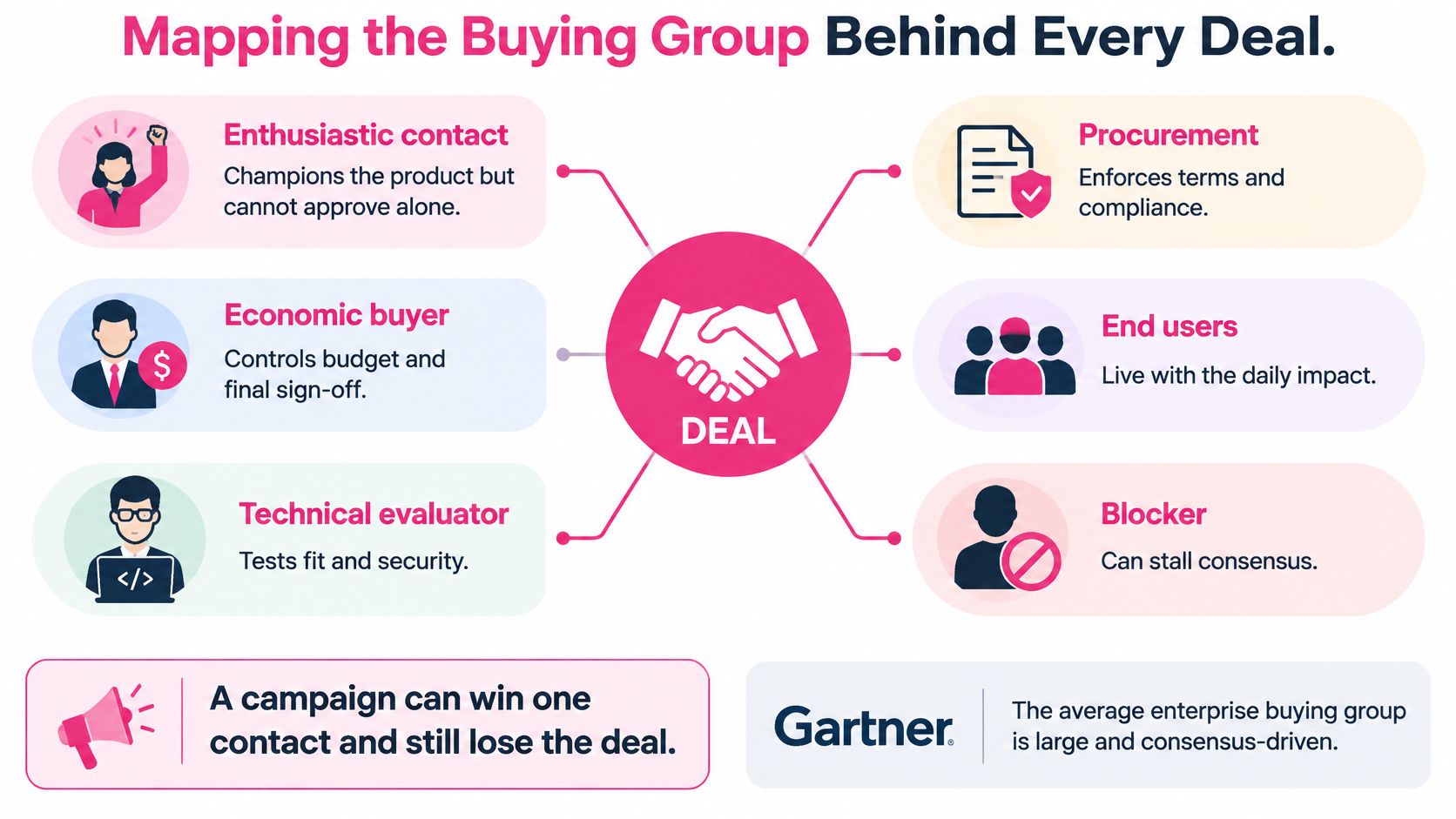
Map the account in a fixed order before writing your second follow-up. Start with the economic buyer who controls budget, then identify the end user who lives with the daily workflow, the technical evaluator checking fit, finance demanding payback, security or legal hunting for risk, and the potential blocker who could torpedo the deal if surprised late.
| Role | Main Worry | Proof That Moves Them | Outreach Angle |
|---|---|---|---|
| Economic buyer | Return and risk on the budget | Payback example with clear numbers | The cost of waiting another quarter |
| End user | Daily workflow friction | Before-and-after workflow walkthrough | Hours saved each week |
| Technical evaluator | Integration and fit | Integration notes and setup timeline | Effort required from their team |
| Finance | Payback and budget clarity | ROI model with stated assumptions | Payback period in months |
| Security or legal | Data and compliance risk | Security and compliance documentation | Early review to avoid late delays |
| Potential blocker | Being overridden or blamed | Risk-reduction plan with a pilot option | A small, reversible first step |
Running the Champion and Coverage Check
Your initial contact isn't the entire deal; they're your internal champion. Their real job is selling your offer inside meetings you'll never be invited to attend. Give them role-specific ammo for the people around their table, like an assumption-backed ROI sheet for finance and a brief compliance overview for legal, instead of forcing them to paraphrase your slide deck from memory.
Run a simple coverage check right after the second meeting: count how many of those six mapped roles have engaged via call, email reply, or document review. If only one person has spoken to you by week two, you don't have a late-stage opportunity. A booked call only graduates to a qualified opportunity when the person on the line can either bring the wider buying group into the room or actively move the case across those functions.
Pipeline Stages and Channel Coordination
Every CRM has a graveyard of "promising" deals sitting in Stage 1 for four months. They linger there because nobody wrote down the exact buyer action required to move a deal forward, so reps leave hopeful guesses on the board to keep forecast meetings pleasant.
Replace vague stage labels with five concrete stages governed by verifiable exit criteria:
- Interest: A prospect replies with a buying question or books an introductory call on your calendar.
- Qualified: Your booked contact confirms a real business problem and proves they can reach or influence the broader buying group.
- Evaluating: The buyer has received your proposal alongside the specific proof assets their stakeholders need.
- Committed: Both the economic buyer and your internal champion have agreed in writing on a dated next step toward signature.
- Signed: The final agreement is countersigned and kickoff is scheduled.
Move a deal forward only on buyer evidence, never on how warm the conversation felt. If a prospect says "this looks awesome, send me a deck" and disappears for two weeks, the deal stays in Interest instead of polluting your forecast.
Keeping Ten Channels on One Story
Clean pipeline stages still break down if your outreach channels contradict each other. McKinsey's Global B2B Pulse research found that B2B buyers now use ten or more interaction channels during a purchasing journey, up from five in 2016, while 94% of respondents rated today's mix of in-person, remote, and digital engagement at least as effective as pre-pandemic selling. Consistency across those touchpoints pays off directly: McKinsey's 2023 global B2B Pulse survey of more than 3,800 decision makers across 13 countries linked superior omnichannel experiences with annual market-share improvement of at least 10%.
Keep every touchpoint anchored to one shared account note inside your CRM, whether you run HubSpot, Pipedrive, or Salesforce. Track three mandatory fields on every active account: last touch across any channel, open buyer questions, and the exact promised next step. That way an email sequence never advertises a free audit that the account executive forgets to deliver on the Zoom call, and coordinating LinkedIn outreach with cold email feels like one coherent conversation rather than two strangers pinging the same executive.
Outreach Sequences That Protect Your Domain
A healthy sending domain beats a bigger prospect list every single week. You can write the sharpest copy in your industry, and it won't book a dime if mailbox providers dump your messages into spam.
Before writing your next sequence, walk through this eight-step domain-protection workflow shown below.
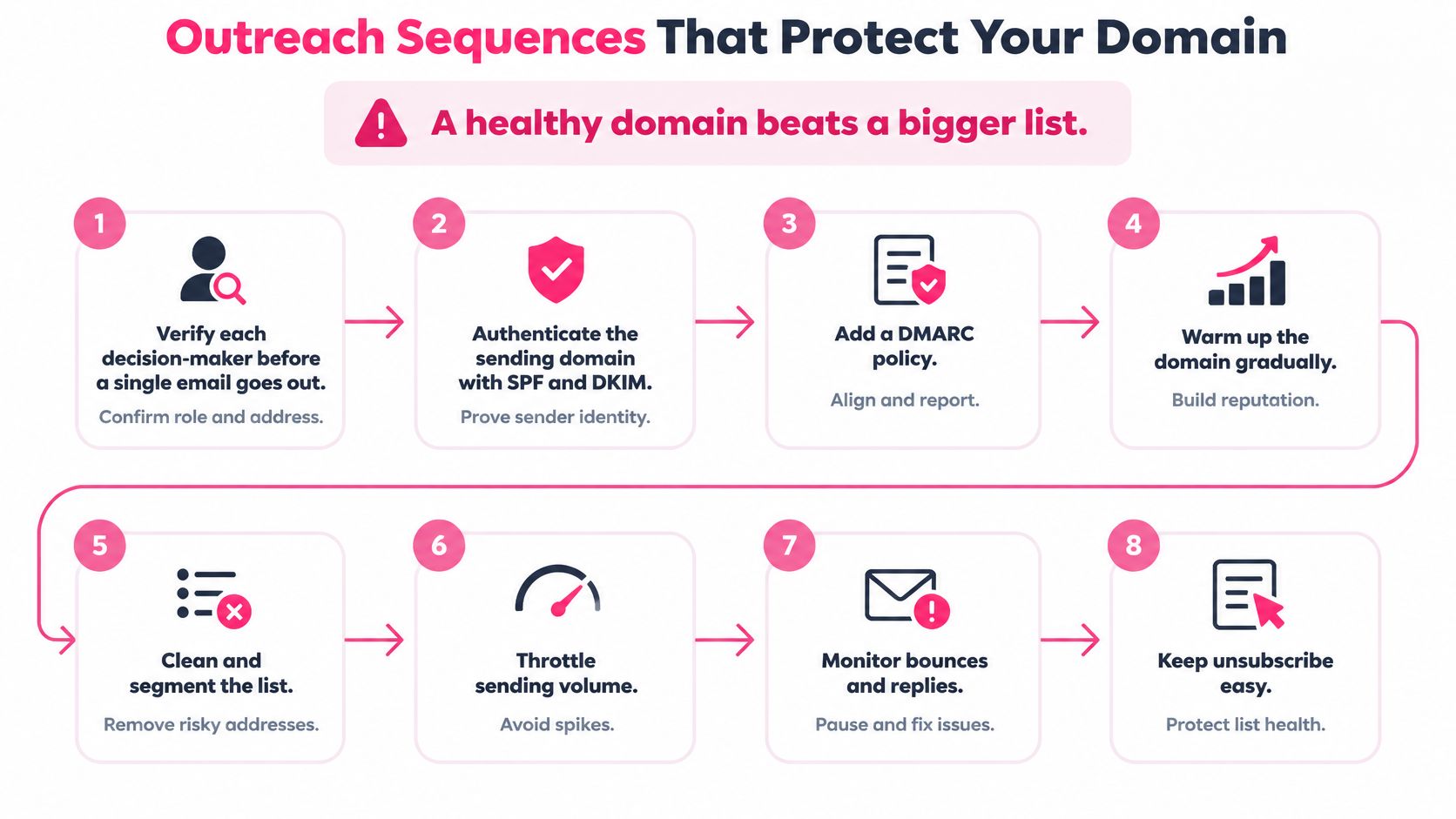
- Verify every decision-maker before launch: Run your list through email verification and confirm each contact still holds the right job title so hard bounces never spike.
- Authenticate your sending domain: Configure SPF and DKIM from day one, and layer in DMARC as sending volume increases.
- Warm mailboxes and enforce daily caps: Ramp new inboxes slowly over several weeks and cap daily sends per mailbox so volume never triggers automated filters.
- Keep sequences short and trigger-led: Send three to five concise touches tied to the specific company trigger you uncovered during scoring, rather than dragging prospects through 14 nagging follow-ups.
- Include one-click unsubscribe on marketing mail: Make opting out effortless so uninterested readers click unsubscribe instead of hitting the spam button.
- Monitor Google Postmaster Tools weekly: Track your user-reported spam rate closely, keeping it below 0.10% and pausing campaigns immediately if it climbs anywhere near 0.30%.
- Route replies to a human fast: Set a clear internal response window so curious buyers get a thoughtful human reply while your message is still fresh.
- Send interested contacts straight to a calendar link: Remove scheduling ping-pong once a prospect raises their hand.
Before sending a new batch, testing your setup with an email deliverability checker catches authentication gaps before they wreck sender reputation.
The Gmail Rules Behind Deliverability
Steps two, five, and six aren't optional hygiene tips; they mirror hard technical gates enforced by major inbox providers. According to Google's email sender guidelines, starting February 1, 2024, all senders emailing personal Gmail accounts must authenticate sending domains with at least SPF or DKIM and maintain valid forward and reverse DNS records, including PTR records. Senders pushing more than 5,000 messages per day to Gmail accounts face stricter rules: they must deploy SPF, DKIM, and DMARC together, align the sending domain with SPF or DKIM, and include a one-click unsubscribe mechanism for marketing messages.
Google also warns that unauthenticated mail can suffer temporary or permanent failures or land in spam, while senders with high spam rates risk losing delivery support or mitigation altogether. Deliverability is an engineering and reputation discipline, not a copywriting trick. Watch this short breakdown on protecting inbox placement as you build outbound sequences.
For teams that don't want to manage mailbox warmup and technical monitoring in-house, we're pay-per-close at Ever Outbound: we build your list of verified decision makers, write and send short copy on warmed domains, book interested prospects straight onto your calendar, and you show up to close the deals. Either way you run outreach, apply one blunt test every Friday: if positive replies rise while your spam rate stays flat, the sequence is working.
Matching Deal Motion and Metrics, Then Running a 30-Day Test
Too many B2B teams force every deal into the same heavy field-sales routine, burning senior reps on modest contracts while starving enterprise accounts of technical depth. McKinsey's omnichannel B2B sales report found that 20% of B2B buyers were willing to spend more than $500,000 through a fully remote or digital sales model, and 11% were willing to spend more than $1 million that way. Buyers don't need a steak dinner to sign a six-figure agreement; they need trust, clear proof, and zero friction.
Route every new opportunity using four signals: deal value, implementation risk, stakeholder count, and required proof. Lower-friction offers move cleanly from personalized outbound to a video meeting, a focused diagnostic, a written proposal, and e-signature via DocuSign or PandaDoc. Complex accounts trigger multi-threaded stakeholder outreach, technical validation, security paperwork, and structured executive follow-up.
Add four custom fields to your CRM right away: deal complexity, buying-committee roles, next-step owner, and time to follow-up. Measure each pathway separately instead of hiding behind one blended close rate. A blended average looks fine right up until you realize your small remote deals are carrying the team while every complex enterprise deal stalls out after discovery.
| Deal Profile | Sales Motion | Metric to Track | Time Signal |
|---|---|---|---|
| Small, low-risk, one decision-maker | Remote-first: outbound to video meeting to digital contract | Booked-to-qualified meeting rate | Days from booking to proposal |
| Mid-size, two to four stakeholders | Remote with a diagnostic and written proposal | Qualified-to-close rate by source | Days from first call to signed proposal |
| Large, many stakeholders, high risk | Field-assisted with multi-threaded coverage | Stakeholder coverage and champion activation | Days to consensus across the buying group |
| Very large, over $500,000 | Remote or hybrid with executive sponsors | Closed-won revenue per target account | Stage-to-stage conversion by pathway |
Running Your 30-Day Controlled Test
Don't overhaul your entire revenue engine in one chaotic quarter. Run a 30-day controlled test on one target segment and one buying group. Before Day 1, lock in four working pieces: your scored target list, your AI shortlist audit and forwardable brief, your six-role stakeholder map, and your authenticated outreach sequence. Use an outbound volume planner to size your 30-day test so your daily sending cap matches your mailbox capacity without risking domain health.
On Day 30, open the scorecard by sales pathway and ignore raw meeting count. A healthy test shows a rising share of qualified opportunities, more distinct stakeholder roles engaged per target account, and a flat, clean spam rate across every sending inbox.
Every 30-day test ends with one clear call: scale the winning segment, fix the single stage where deals stall, or drop the offer and reallocate your reps.
That exact closed-revenue discipline shapes how we work. Because we're pay-per-close at Ever Outbound, we judge campaigns on closed-won economics instead of calendar bloat: the first two closed deals generated through our services are commission-free, and for each closed deal after the first two, we receive five percent of net revenue collected for that specific deal. Whether you build this operating system internally or partner with a specialist team, the principle stays identical. Stop rewarding activity that fills calendars with uncloseable calls, and build a B2B sales strategy designed around how modern buying groups say yes.
If you'd rather focus on closing deals than managing domain warmup, list verification, and daily outbound sequences, we're pay-per-close at Ever Outbound Inc., meaning you only pay when new clients sign. Our human research, copywriting, and appointment-setting team builds verified decision-maker lists, runs domain-safe outreach, and books qualified sales conversations straight onto your calendar. Visit Ever Outbound Inc. to see how we turn a sharp B2B sales strategy into predictable closed revenue without retainer risk.