November 3, 2026
Book a Demo: 7 Proven CTA, Booking, and Follow-Up Tactics
You ship a strong product page. The copy lands, the screenshots make sense, and a prospect scrolls like they care. Then they hit a lonely button that says Book a Demo and bail.
That's rarely a product problem. You've given them no outcome to picture, a form that feels like a mortgage application, and follow-up that arrives after their attention has moved on. A demo request isn't one button. It's a journey from page CTA to booking form, outbound sequence, live chat, and what happens right after someone raises a hand.
Get one link in that chain right and you'll feel it. Get three right and your calendar stops looking sad on Mondays. The seven tactics below fix the gaps in order. Each one has a trade-off, so pick the leak that's costing you most and start there.
Table of Contents
- 1. Lead with a Clear, Outcome-Focused Demo CTA
- 2. Reduce Booking Friction with Short Forms and Embedded Calendars
- 3. Use Multi-Step Outbound Sequences That Ask for the Demo Early and Clearly
- 4. Add Social Proof Next to the Demo CTA
- 5. Offer a Self-Guided Product Tour or Interactive Preview Before the Demo
- 6. Use Conversational Chat to Book Demos in Real Time
- 7. Follow Up Quickly and Consistently on Demo Interest Signals
- Where Each Demo Booking Tactic Works Best
- Turn Demo Interest Into Calls Your Team Actually Takes
1. Lead with a Clear, Outcome-Focused Demo CTA
Generic buttons make prospects do the mental work. "See your reporting setup in 20 minutes" tells a SaaS buyer exactly what they'll leave with. "Get a free pipeline audit call" does the same on a consulting services page. Change the promise, not just the color.
Place that CTA above the fold, repeat it after the strongest proof section, and close key pages with it. Don't bury your best next step in the footer next to the privacy policy. In Scribewise's survey of 204 B2B buyers and budget owners, 64% of surveyed B2B buyers said content had led them to request a demo in 2024, so the moment after useful content is prime CTA real estate.
Match the Wording to Page Intent
A pricing page visitor wants cost and fit clarity. A case study reader wants the same result for their team. Use different CTA copy for each, then test one variable at a time and measure completed bookings, not clicks. Clicks are cheap applause.
Say the length up front and name the deliverable. Twenty minutes, a walkthrough of your pipeline gaps, no slide marathon. That framing helps meeting-ready leads self-select, which protects seller time. The trade-off is honesty. A specific promise will deter curious clickers, and that's fine. You want qualified calls, not calendar clutter. If your broader funnel feels fragmented, unified sales and marketing for SMBs is the same principle applied across teams. One clear promise beats five vague ones.
2. Reduce Booking Friction with Short Forms and Embedded Calendars
Say a B2B company cuts its demo form from eight fields to three. Completions rise because fewer people quit halfway. That's not magic. Every extra field asks a busy buyer to trust you a little more before you've earned it.
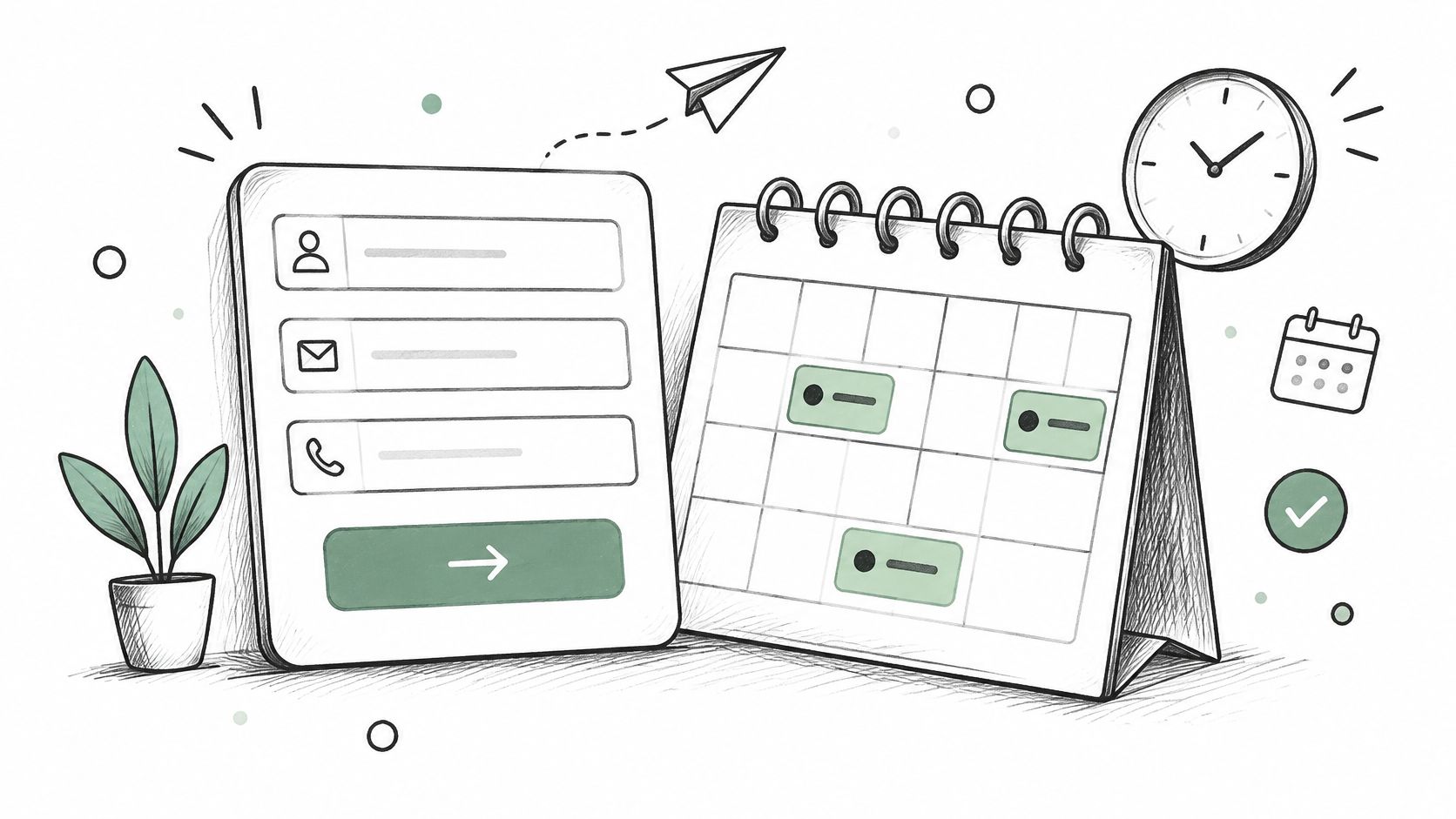
Ask for name, work email, company, and one qualifying question. You can learn the rest on the call or enrich it later. Embed the calendar on the page so booking finishes where intent started. A recruiting firm that embeds a scheduler on its contact page lets clients book intro calls without the email tennis that kills momentum.
Adoption is still patchy. A 2025 analysis in Chili Piper's buyer-first report found only 9% of websites offered calendar schedulers. Meanwhile, Navattic's 2024 buyer-first report found 61% of the 100 largest B2B SaaS companies made it easy to connect with sales through a website calendar or an email response within 24 business hours.
Make the Next Slot Feel Close
- Show near-term times: Offer two or three slots within 48 hours so the meeting feels real, not theoretical.
- Confirm instantly: Send a calendar invite with a short agenda, host name, and a reschedule link.
- Book on the spot: Use a direct booking page flow instead of a thank you page that promises someone will be in touch.
Practical rule: If a field won't change who takes the call or what you prepare, cut it.
The trade-off is thinner qualification data up front. Accept it. You'll get more conversations where you can qualify properly.
3. Use Multi-Step Outbound Sequences That Ask for the Demo Early and Clearly
Cold email that hides the ask until email four wastes everyone's time. Open with a relevant observation, follow with a short proof point, then ask clearly for a brief demo. Say a consultancy emails operations directors, references a recent hiring announcement, and offers a 15-minute look at one workflow problem. That's specific enough to reply to.
Personalization isn't decoration. McKinsey's personalization research reports personalization most often produces a 10% to 15% revenue lift. You don't need a novel about their company. You need one true detail tied to one painful problem.
Protect Deliverability While You Send
- Keep it short: One problem, one meeting ask, reply-friendly subject lines.
- Go light on links: Heavy links in the first email hurt trust and inbox placement.
- Authenticate everything: Google's Gmail sender requirements require bulk senders sending at least 5,000 messages per day to use SPF, DKIM, and DMARC, and keep user-reported spam rates below 0.30%.
Warm up domains and cap daily volume before you scale. Blasting a cold domain is how good copy lands in spam.
Omnichannel follow-up helps too. McKinsey's global B2B Pulse survey covered more than 3,800 decision-makers across 13 countries and found B2B companies delivering the strongest omnichannel experiences were increasing market share by at least 10% annually.
Ever Outbound runs human-written, multi-step sequences that book qualified sales calls, and we're pay-per-close, so results are tied to deals you close. Trade-off time. Human personalization costs more per send than spray and pray. It also protects your domain and your reputation.
4. Add Social Proof Next to the Demo CTA
Nobody books a meeting to be your experiment. Put proof where the decision happens, right beside the button. A marketing agency can place a client quote about pipeline growth directly above its demo CTA. A cybersecurity provider can add a short case summary with a measurable result on its booking page. Vague praise like "great team" does nothing.
Buyers already move across many touchpoints before that click. McKinsey's Global B2B Pulse research found buyers used an average of 10 interaction channels during the purchasing journey in 2021, up from five in 2016. Your proof has to reassure them at the exact moment they switch from researching to meeting a human.
Make Proof Specific and Current
Use named testimonials with role and company whenever you can. Pair each result with the problem it solved, so a prospect can map it to their own situation. Refresh case studies every quarter. Old logos and stale numbers raise doubt.
Place proof on dedicated social proof pages and borrow the strongest lines for booking pages. For deeper tactics, Bragly's guide to social proof conversion covers placement in detail.
If your best testimonial could describe any vendor in your category, it's wallpaper, not proof.
The trade-off is effort. Real proof requires client permission and upkeep. Skip it and you're asking strangers to trust a button.
5. Offer a Self-Guided Product Tour or Interactive Preview Before the Demo
Some prospects won't book a live call first, and forcing them won't change that. Gartner's survey of 632 B2B buyers found 61% preferred a rep-free buying experience for at least part of the journey. Give researchers a two-minute tour or recorded walkthrough, then let the live demo handle fit, risks, and their specific setup.
Say a SaaS company embeds a short product tour that ends with "Book a walkthrough." An MSP offers a recorded dashboard tour before discovery. Both turn a cold first call into a second conversation. Demand is real. TrustRadius's survey of technology buyers found 54% of technology buyers used at least one type of product demo in 2024.
This short walkthrough shows the format in practice, tight, visual, and focused on one workflow.
Keep tours under three minutes and track which steps correlate with bookings. A clear explainer of how the process works can do the same pre-selling job for a service offer.
The contrarian point matters. MeetRep's analysis of generic demos notes only 25% find online demos useful. So don't dump a 40-minute feature tour and call it self-service. The trade-off is production time now for better qualified, better prepared calls later.
6. Use Conversational Chat to Book Demos in Real Time
A visitor on your pricing page at 9 p.m. won't wait until morning. Chat can qualify them while intent is hot, ask about goals and team size, then offer a time slot or hand off to a human. A B2B software company can run this on pricing pages for enterprise prospects. A coaching business can use it to send qualified visitors straight to a calendar.
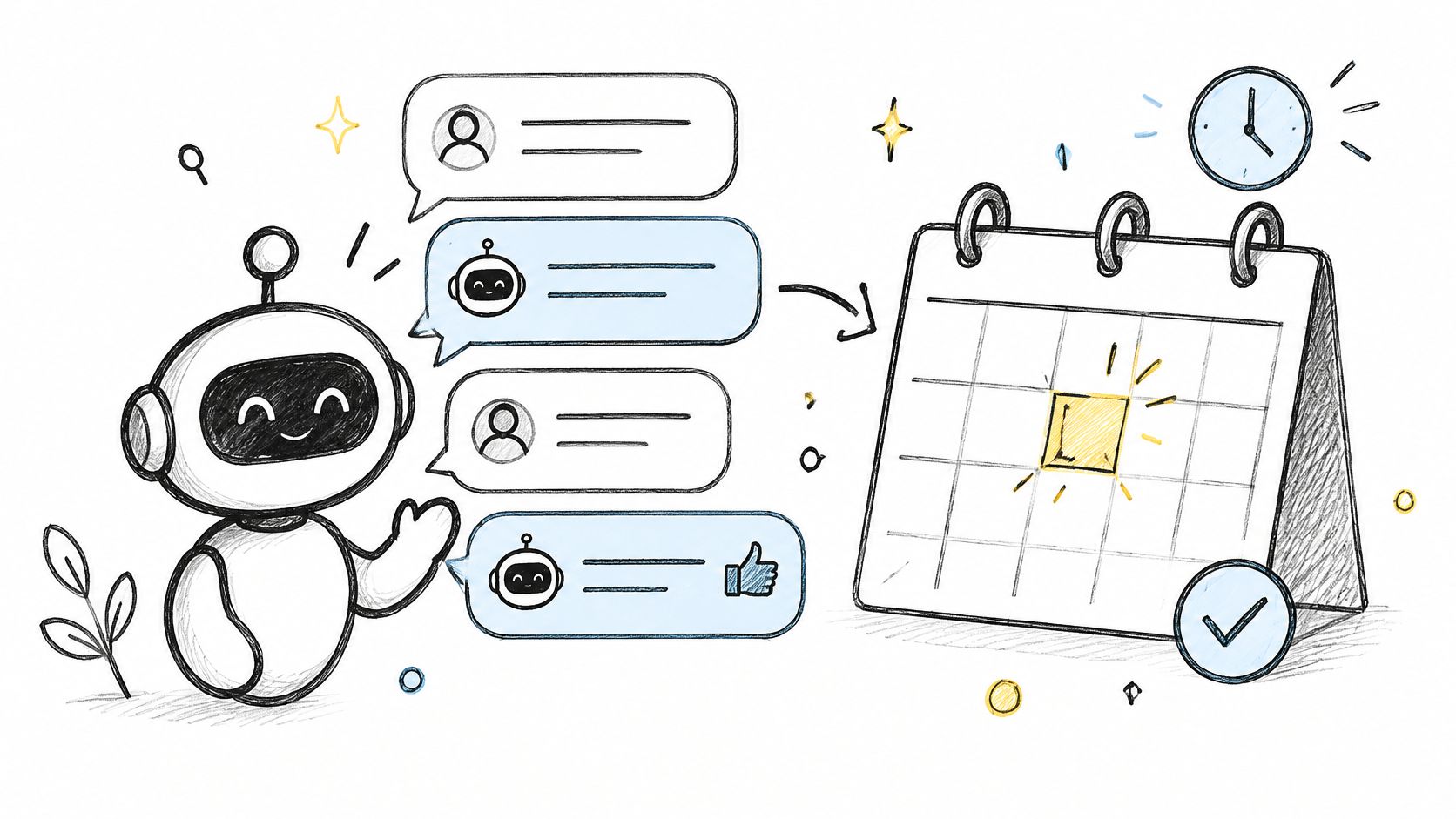
The upside is speed. G2's 2024 year in review reported prospects who chatted with its Monty chatbot were 30 times more likely to book a demo. That won't be your exact number, but it shows what happens when you answer questions at the moment they block a booking.
Keep the Bot on a Short Leash
- Limit the flow: Three to five questions, then book or hand off.
- Script by page: Pricing, blog, and product visitors need different openers.
- Review transcripts weekly: Fix dead ends where people drop off.
An AI setter handles the repetitive qualification while humans step in for nuance. The trade-off is tone. A clunky bot that traps people in loops will cost you demos you'd have won with a simple form. Test the exit paths like you test the happy path.
7. Follow Up Quickly and Consistently on Demo Interest Signals
Interest decays fast. InsideSales' 2021 lead-response study analyzed more than 55 million sales activities involving 5.7 million inbound leads and found conversion rates were more than eight times higher when the first response was attempted within five minutes than when it was delayed beyond five minutes. It also found 57.1% of first call attempts occurred more than one week after the lead entered the system. That's not follow-up. That's archaeology.
Timing also affects whether people show up. Same-day demos had a 6.9% no-show rate versus 23% when meetings were booked eight or more days ahead, according to reporting cited in the Chili Piper buyer-first analysis discussed earlier in this list. Wait, that source is already used, so treat the principle plainly. Near-term meetings hold attention better.
Build a Response Habit, Not a Hero Culture
Aim to respond within minutes, or the same business day at the latest. Reference the exact action they took, pricing visit, download, or reply, in your first line. Generic "just checking in" messages tell prospects you weren't paying attention.
Say a sales team contacts demo requesters within minutes and books same-day calls. A staffing firm follows up with service page visitors using a short, relevant invitation. Both win on speed plus context.
Stop sequences after a set number of attempts and log outcomes properly. If your process lives in inboxes and memory, build a better CRM follow-up process before you buy more traffic.
The trade-off is staffing. Fast response needs coverage and clear ownership. Slow response needs a bigger top of funnel to hit the same number of meetings. Pick your cost.
Where Each Demo Booking Tactic Works Best
| Item | Where It Works Best | Effort to Launch | Main Trade-off |
|---|---|---|---|
| Lead with a Clear, Outcome-Focused Demo CTA | High-intent website pages | Low; update and test CTA copy | Clearer value, but promises need careful targeting |
| Reduce Booking Friction with Short Forms and Embedded Calendars | Demo and contact pages | Moderate; configure forms and scheduling | Easier booking, but fewer fields may reduce lead qualification |
| Use Multi-Step Outbound Sequences That Ask for the Demo Early and Clearly | Targeted cold outreach | Moderate; build sequences and personalize prospect lists | More chances to engage, but poor targeting can hurt deliverability |
| Add Social Proof Next to the Demo CTA | Booking pages and other conversion points | Moderate; gather and maintain proof | Builds trust, but claims need permission and regular updates |
| Offer a Self-Guided Product Tour or Interactive Preview Before the Demo | Product-led websites and evaluation journeys | High; create and maintain previews | Better-prepared prospects, but some may not book a live demo |
| Use Conversational Chat to Book Demos in Real Time | High-intent pages and after-hours visits | Moderate; design flows and set up routing | Captures interest quickly, but poor bots can frustrate visitors |
| Follow Up Quickly and Consistently on Demo Interest Signals | Inbound leads and high-intent website activity | Moderate; configure CRM alerts and follow-up | Recovers interest, but overly aggressive outreach can feel intrusive |
Turn Demo Interest Into Calls Your Team Actually Takes
Start small this week. Audit one high-traffic page, rewrite its CTA around a specific outcome, shorten the booking form, and add one named proof point beside the button. Then check what happens after someone clicks. If follow-up still takes a day, fix that before you redesign anything else.
Measure the whole system, not just bookings. McKinsey's research on how business customers buy across more than 100 B2B sales organizations found redesigning sales around better customer-buying journeys can increase customer leads by up to 20% and reduce time from lead qualification to closed deal by as much as 20%. Track qualified-demo rate, show rate, opportunity-creation rate, and days from demo to close. A packed calendar of low-fit calls is expensive theater.
Structured management matters behind the scenes too. McKinsey's B2B digital leaders research reports B2B digital leaders generate a revenue compound annual growth rate five times greater than their peers. Dashboards, reply data, and booking outcomes let you manage outbound like a revenue process, not a volume contest.
If you'd rather have outbound booked for you, Ever Outbound offers a free discovery call, is honest about whether it can serve your industry, and is pay-per-close, so we only earn when deals you close come from our efforts. Interested prospects are booked straight onto your calendar, and you're notified the moment someone books.
Pick one tactic. Ship it. Watch completed, qualified bookings for two weeks. Then fix the next leak.
If your demo page gets traffic but your calendar stays thin, Ever Outbound Inc. can build and run the outbound behind it, from verified lists and human-written sequences to booking qualified calls straight onto your calendar. We're pay-per-close, so you show up, close the deals, and only pay when our efforts turn into revenue.