October 17, 2026
Cold Call Leads That Actually Convert: A Practical Guide
You can burn through a thousand numbers in a week and still have nothing to show for it except a louder dialer, a fuller calendar, and a sales manager asking why the pipeline looks busy but the revenue doesn't. That's the trap with cold call leads when they're treated like volume instead of fit. The game is narrower, sharper, and a lot less glamorous, because the leads that matter are the ones that can become money.

Table of Contents
- The 1,000-Dial Trap and What Replaces It
- What Counts as a Cold Call Lead in 2026
- The Cold Call Funnel from Dial to Closed Revenue
- Building and Verifying Lead Lists That Actually Convert
- Qualifying and Prioritizing Cold Call Leads
- Multichannel Outreach Sequences Around the Call
- Email Deliverability That Protects the Whole Funnel
- How Pay-Per-Close Outbound Fixes the Cold Call Lead Pipeline
The 1,000-Dial Trap and What Replaces It
A rep dials all day, gets a few live answers, books a handful of meetings, then watches the forecast collapse anyway. That's not a story about hustle, it's a story about bad economics. If a campaign produces activity without revenue, the list wasn't good enough, the offer wasn't relevant enough, or the follow-up didn't deserve the calendar slot.
The FTC's registry tells the same story from a different angle. In fiscal year 2024, it held more than 253 million active registrations, with more than 4.2 million additions that year, and the FTC received over 2 million Do Not Call complaints. The complaint data don't measure business-to-business success, but they do show the environment: indiscriminate calling gets harder to scale, while compliance, list hygiene, caller identity, and targeting become the key levers. FTC consumer complaint baseline
Practical rule: a lead isn't a dialed number. It's a person you can actually reach, who fits the offer, and who can move a deal forward.
A smaller list often wins because it gives you a chance to work the right accounts with actual intent. A 200-lead campaign built around clean data, verified roles, and a believable offer can outperform a 1,000-number blast that wastes connects on the wrong people. For a practical planning lens, I like to sanity-check volume against downstream capacity with this outbound volume planner.
If you want a feel for how other operators think about conversion, the cold calling conversion benchmarks for home services are a useful contrast point, even though the economics differ from B2B. The point isn't to copy a benchmark. It's to stop calling activity a win before the deal is real.
What Counts as a Cold Call Lead in 2026
A dialed number is not a lead. It's only the starting point.
The four checks that matter
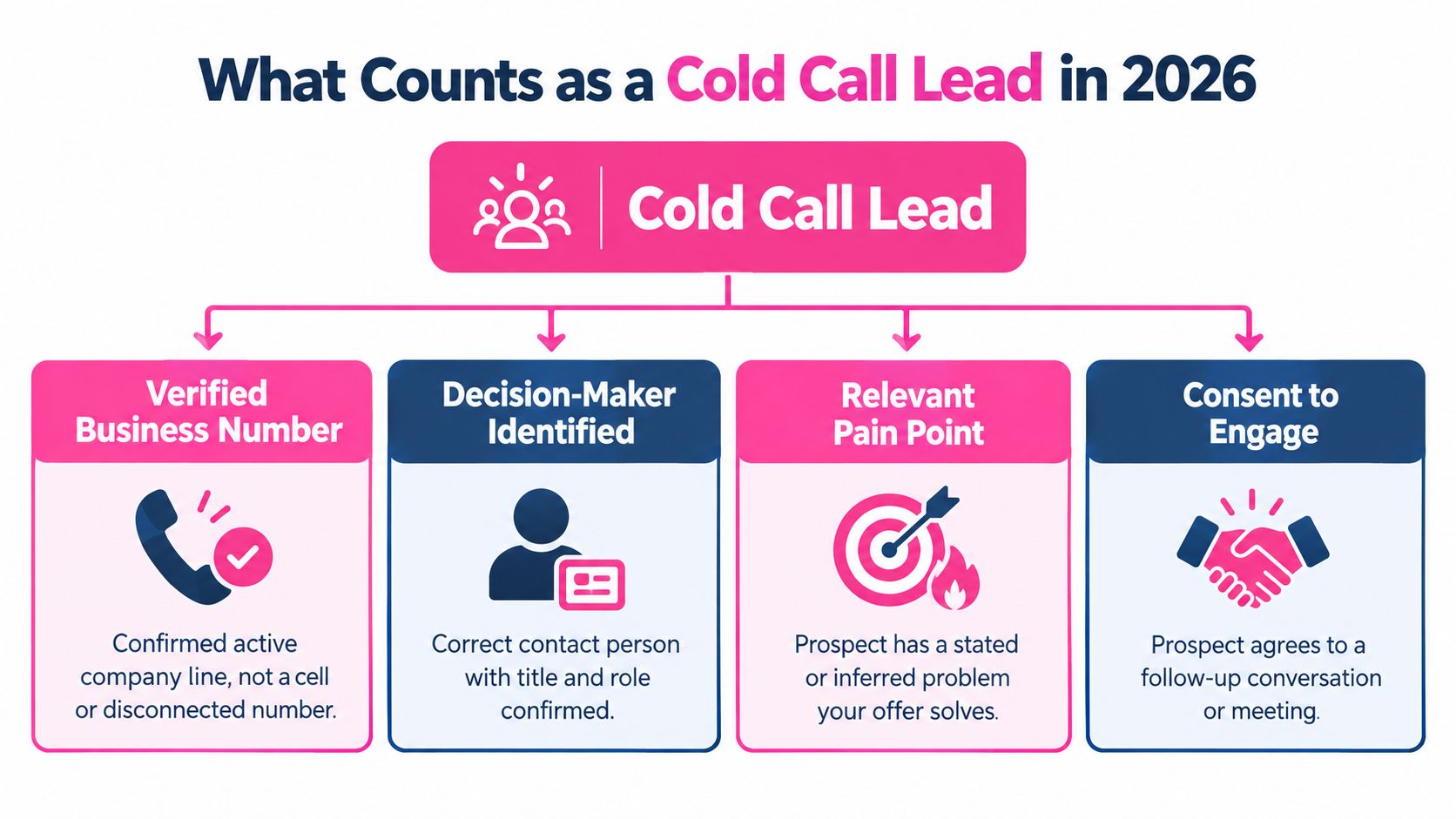
First, the number has to be verified and reachable. A recycled mobile line, a disconnected desk phone, or a catch-all line with no path to the right person turns your list into noise.
Second, the contact needs to be a decision-maker or a meaningful influencer. If the person no longer owns the buying category, the call can still connect, but it won't convert into an opportunity unless you've got a route to the stakeholder.
Third, the business context has to match the offer. A prospect can be reachable and senior, but if the pain point isn't there, the conversation stalls fast.
Fourth, there has to be no opt-out signal. A technically accurate record that ignores suppression is still a bad lead, because the campaign can't lawfully or practically use it.
The cleanest internal definition is simple: a cold call lead is a reachable, relevant decision-maker whose business context matches the offer and who hasn't opted out. That definition is more demanding than a raw contact field, and that's the point.
When one of those checks is missing, the lead stops being a commercial asset. A call to the wrong role can still create a conversation, but it's usually a dead end. A list full of technically deliverable contacts can still underperform if the buying context is stale.
The Cold Call Funnel from Dial to Closed Revenue
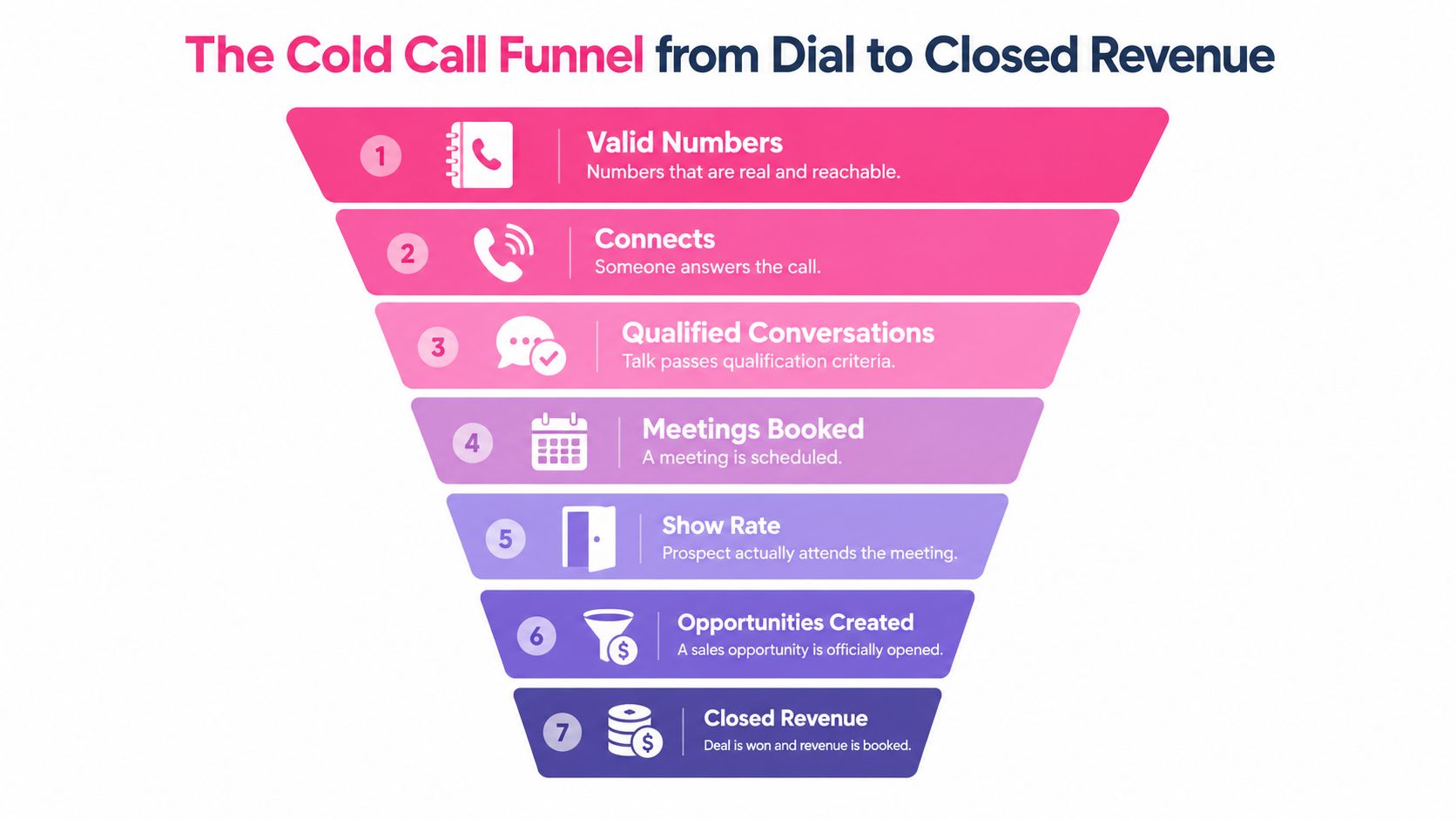
The funnel matters because each stage fails for a different reason, and the fix changes with the failure point.
Where campaigns usually break
Valid numbers fail when the list is stale. Verification and hygiene before the first dial solve that problem.
Connects fail when call windows, caller identity, and targeting are sloppy. Gong's benchmark shows an average connect rate of 5.4% and a top-quartile rate of 13.3% across more than 300 million calls. Gong connect-rate benchmark For a sense of how those rates behave in high-volume phone work, this placing international calls guide is a useful side reference.
Qualified conversations fail when the opener is generic. A person may answer, but that does not mean the call reached the right problem.
Meetings booked fail when the ask is too eager or too vague. A meeting without a clear reason to exist just creates work later.
Show rate fails when the prospect was never convinced the meeting mattered. That is usually a relevance problem, not a scheduling problem.
Opportunities created fail when sales follows up slowly or the offer does not map to the pain. A booked call is not pipeline until the buying side accepts it internally.
Closed revenue fails when earlier stages were treated as if they were the finish line. That is the cost of vanity metrics.
The practical rule is blunt: if a metric does not connect to revenue, it is support data, not a success measure. One rep can post a solid connect rate and still lose money if the conversations stall, meetings no-show, or follow-up drifts. That gap is operational, not mystical, and the teams that close it track the full sequence from dial to accepted opportunity, then measure what turns into cash.
Building and Verifying Lead Lists That Actually Convert
A cold call campaign usually wins or loses before the first ring. By the time the rep is reading a script, the list has already decided half the outcome.
How to build a list worth calling
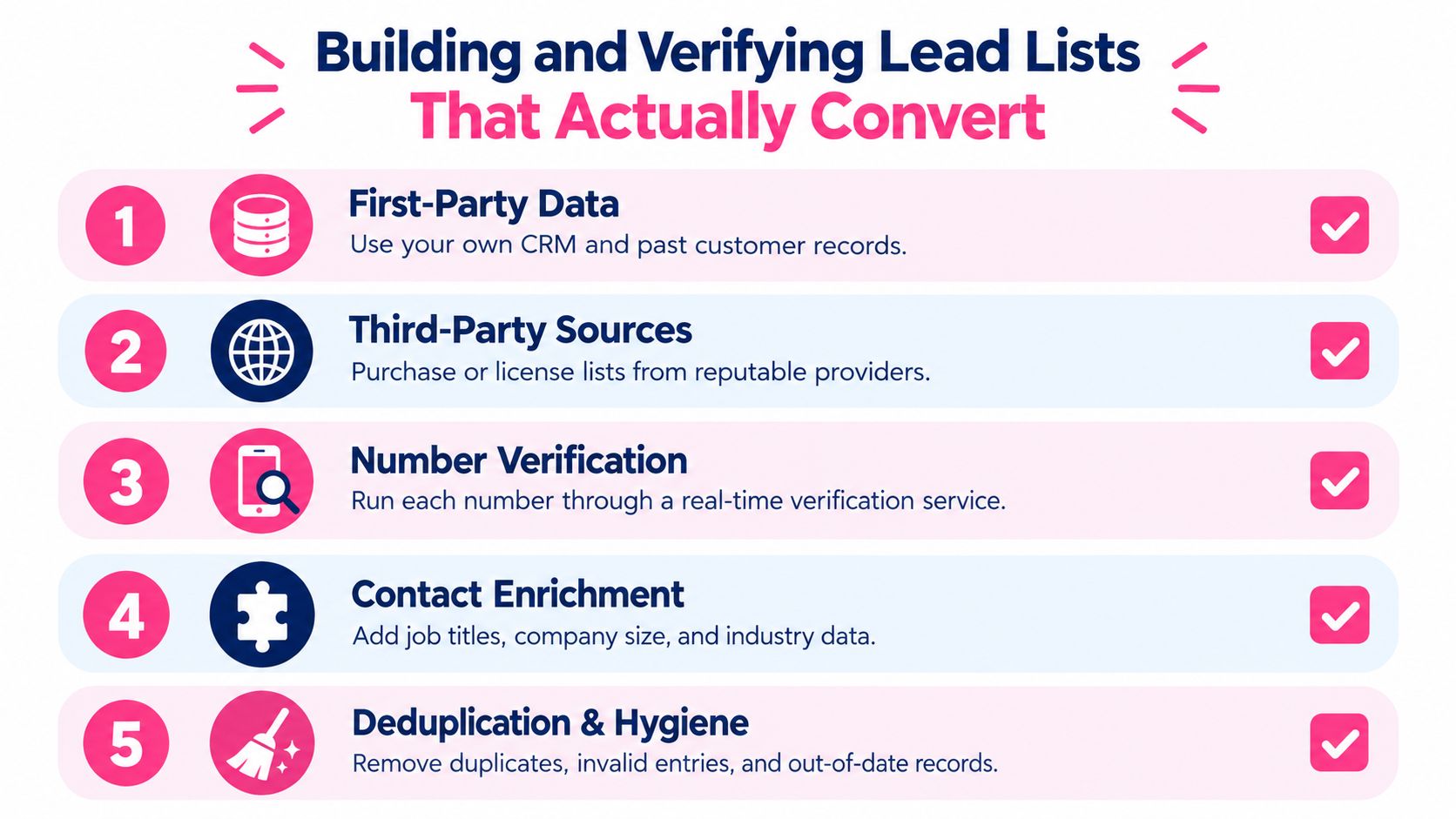
Start with first-party data if you have it. Your own CRM, past customers, lost deals, and churned accounts reveal who answered before and who never should've been on the list.
Layer in third-party sources next, but don't confuse a sourced contact with a qualified one. Public filings, intent-signal vendors, and hand-researched account lists are useful because they point you toward relevant business context, not just contact fields.
Then verify the number itself. Deliverable isn't the same as relevant. A number can ring and still belong to the wrong person, the wrong department, or a contact who's no longer part of the buying committee.
After that, enrich what matters. Job title, company size, industry, and recent trigger events are the fields that improve judgment downstream. Everything else is decoration unless it helps you decide whether to call, when to call, and what to say.
Field note: human verification still beats pure automation when the target is a B2B decision-maker. A machine can clean the record, but it can't always judge whether the lead still belongs in the campaign.
A practical launch checklist is boring for a reason. Confirm role fit, local time zone, recent trigger events, and suppression against opt-outs before a rep sees the list. That's the kind of hygiene that protects both connect rates and future contactability.
If you want a tool reference point while you sort your stack, the best sales prospecting tools for 2026 roundup is a useful way to compare the categories that sit between research and dialing. For cleanup work, this lead list cleaner is the sort of utility that helps teams strip out duplicates and obvious junk before they waste calls.
Qualifying and Prioritizing Cold Call Leads
Qualification gets easier when you stop asking, “Can we book them?” and start asking, “Will this account turn into revenue?”
| Qualification Frameworks Compared | BANT Focus | Fit-and-Trigger Focus |
|---|---|---|
| Criterion | Budget, authority, need, timing | Verified fit, buying trigger, decision-maker status, problem severity, expected deal value, next step |
| What it catches | Traditional sales readiness | Revenue likelihood and urgency |
| What it misses | Context, timing shifts, source quality, close probability | Less useful for casual or low-intent conversations |
| Best use | Basic discovery | Pay-per-close outbound and strict pipeline control |
BANT still has value, but it's too loose when every booked call has a cost. A contact can have budget and authority and still be a poor lead if the business problem isn't urgent, the trigger event is stale, or the buying path is too crowded.
A fit-and-trigger model is stricter. It asks whether the account matches the offer, whether something just changed, whether the person can move the deal, and whether the expected value justifies the effort. That's the standard that matters when the business model only pays on closed work.
Revenue test: if the meeting wouldn't survive a hard forecast conversation, it probably shouldn't be prioritized as a cold call lead.
That's why pay-per-close pricing changes behavior. It forces the standard upward. Instead of rewarding calendar fill, it rewards qualified progression, and it naturally weeds out leads that are reachable but weak.
If you're using a scoring sheet, keep it simple enough that reps apply it. Score for fit, trigger, authority, pain, and deal potential, then disqualify quickly when the account can't support a real opportunity. A loose “maybe” is expensive in a model where time has to cash out.
For a working filter, the internal cold qualify tool can sit alongside your spreadsheet or CRM logic. The useful part isn't the software name, it's the discipline of rejecting weak accounts early enough to protect the pipeline.
Multichannel Outreach Sequences Around the Call
A cold call works better when it's the first move in a sequence, not the only move in the sequence. The phone creates recognition, and the next touch uses that recognition instead of starting from zero.
A practical sequence that doesn't feel random
Call first when the account is tightly targeted and the timing makes sense. If the person doesn't pick up, leave a short voicemail only when it adds value. Then send a personalized email that references the business problem, not a fake conversation. Follow with another call scheduled around the prospect's time zone.
That sequencing matters because Gong's Engage benchmark says beginning a prospecting flow with a cold call can double the subsequent email reply rate. It also separates baseline from top performance, with flow connect rates of 1.9% versus 4.8% and non-flow rates of 2.9% versus 8.9%. Gong Engage benchmark
The right voicemail is short and useful. No rambling, no fake familiarity, no generic “just checking in” language. The point is to create context for the next touch, not to dump a monologue into the inbox.
A good sequence gets tested with holdout groups. Compare prospects who get an initial call with otherwise similar prospects who only get email, then watch reply rate, positive reply rate, booked meetings, attendance, and opportunity creation. That tells you whether the call is creating actual lift or just making activity look busier.
For teams that need a way to assemble that sequence faster, the email sequence generator can help structure the touch pattern without turning it into a generic blast. The sequence should still sound human. The tool should just keep the timing and order sane.
Email Deliverability That Protects the Whole Funnel
A cold call sequence can look fine on paper and still leak revenue if the follow-up email never reaches the inbox. The call did its job, then deliverability broke the handoff.
The infrastructure that has to be in place
Google's sender guidance requires all senders to use at least SPF or DKIM, and bulk senders must use SPF, DKIM, and DMARC. DMARC also needs alignment between the visible From domain and the authenticated sending domain. Google sender requirements
That technical baseline matters, but the operational side decides whether the system holds up. Keep complaint rates visible, sync suppression lists across tools, and stop sending from any mailbox pool that starts to attract noise.
Do not treat deliverability as copywriting. Once complaints rise, better subject lines will not fix a broken sending setup.
The complaint threshold that matters here is Google's guidance to keep the spam rate reported in Postmaster Tools below 0.3%, which gives operators a concrete line to protect against inbox damage.
Before you add more volume, check domain authentication, mailbox alignment, complaint monitoring, and opt-out handling. If those pieces are loose, the issue is infrastructure, not messaging.
A dedicated email deliverability checker helps you inspect the health of the sending layer without guessing. The goal is not perfect scores. It is keeping the call-to-email handoff intact so the lead still has a chance to turn into revenue.
How Pay-Per-Close Outbound Fixes the Cold Call Lead Pipeline
Cold call lead generation breaks when the team carrying the work has to do prospecting, research, copy, sending, routing, and follow-up all at once. Agencies and SaaS founders usually don't fail because the phone doesn't work. They fail because the pipeline needs more moving parts than their in-house system can hold consistently.
The pain points are predictable. Pipeline gets lumpy. Prospecting quality drifts. Follow-up slows down. Email infrastructure gets fragile. New segments take too long to test. Every one of those failures makes a lead look worse than it was, or worse, makes a good lead go cold before anyone can capitalize on it.
That's where a pay-per-close model changes the math. Ever Outbound Inc. is pay-per-close, which means you only pay a 5% commission when you close a deal, and your first 2 closes are commission-free. The service combines human research, hand-built lead lists, personalized copy, managed sending infrastructure, and AI-assisted appointment setting with human oversight so the work stays tied to booked, qualified meetings instead of raw activity.
Alignment matters more than volume. When the provider only wins when you close, there's a natural incentive to reject weak leads, protect deliverability, and keep the calendar full of conversations that can become revenue.
That's the true reframing. A good cold call lead isn't the one that gets dialed the fastest. It's the one that survives qualification, matches the offer, shows up, and has a believable path to closed revenue. Measure the campaign by qualified meetings booked, show rate, and closed revenue per campaign, and the noise starts to disappear.
If you want the outbound side handled without turning your team into a prospecting shop, visit Ever Outbound Inc.. They run done-for-you B2B client acquisition with the pipeline mechanics built around revenue, not vanity metrics, so your team can focus on closing the deals that matter.