November 24, 2026
Cold Email Template for Meeting: 7 Scripts for 2026
A founder opens her inbox on a Monday to forty sales emails, and thirty-eight of them start with "Hope you're well." She deletes the lot in under two seconds, which is roughly the attention budget you get. The fix usually isn't a cleverer first line. It's picking the template that matches what you know about this prospect and what you're asking them to do.
A cold email template for meeting booking works when the ask fits the moment. A senior buyer with zero context needs a permission ask, not a calendar link. A company that raised a round last Tuesday needs a trigger email while the news is still warm. A thread that's been silent for three weeks needs a graceful exit, not touch number nine. Send the wrong shape and you burn the contact, the domain reputation, and your own afternoon. If you're still weighing channels, comparing cold DMs and cold email is a useful sanity check before you commit volume to either.
Below are seven scripts, each tied to a specific situation, with the trade-offs I'd flag before you paste anything. Some ask for interest. Some ask for time. Knowing which one to send is the whole skill.
Table of Contents
- 1. Permission-Based Opener
- 2. Quick Question Template
- 3. Problem-Agitate-Solve (PAS) Meeting Request
- 4. Trigger-Event Meeting Request
- 5. Social Proof and Case Study Meeting Request
- 6. Referral or Mutual Connection Request
- 7. Breakup Email (Final Follow-Up)
- How the seven cold email templates compare
- Pick the Template, Then Let the Calendar Do the Work
1. Permission-Based Opener
Senior buyers guard their calendars like production servers. Ask a VP for twenty minutes in email one and you've requested a commitment before you've earned curiosity. The permission opener asks for something cheaper: a yes to receiving an idea.
Subject: Quick question on [Company]'s outbound
Hi [Name], would it be okay if I sent a short overview of how [similar company] booked 12 qualified calls last quarter? If it's not relevant, just let me know.
That's the entire email. One question, one escape hatch, no pitch deck attached.
Why the Small Ask Beats the Big One
A summary of Gong's analysis of 304,000 prospecting emails, published in Copycrest's state of cold email research, found interest-based CTAs produced 68% positive replies versus 41% for direct meeting requests, and roughly 82 positive conversations per 1,000 emails versus 29. Treat those as directional rather than gospel, since they come from a secondary summary, but the direction is hard to ignore.
The mechanics are simple. "Can I send you something?" costs the reader two seconds. "Are you free Tuesday?" costs them a calendar audit and a mental commitment to being sold to.
Here's how the two approaches diverge in practice:
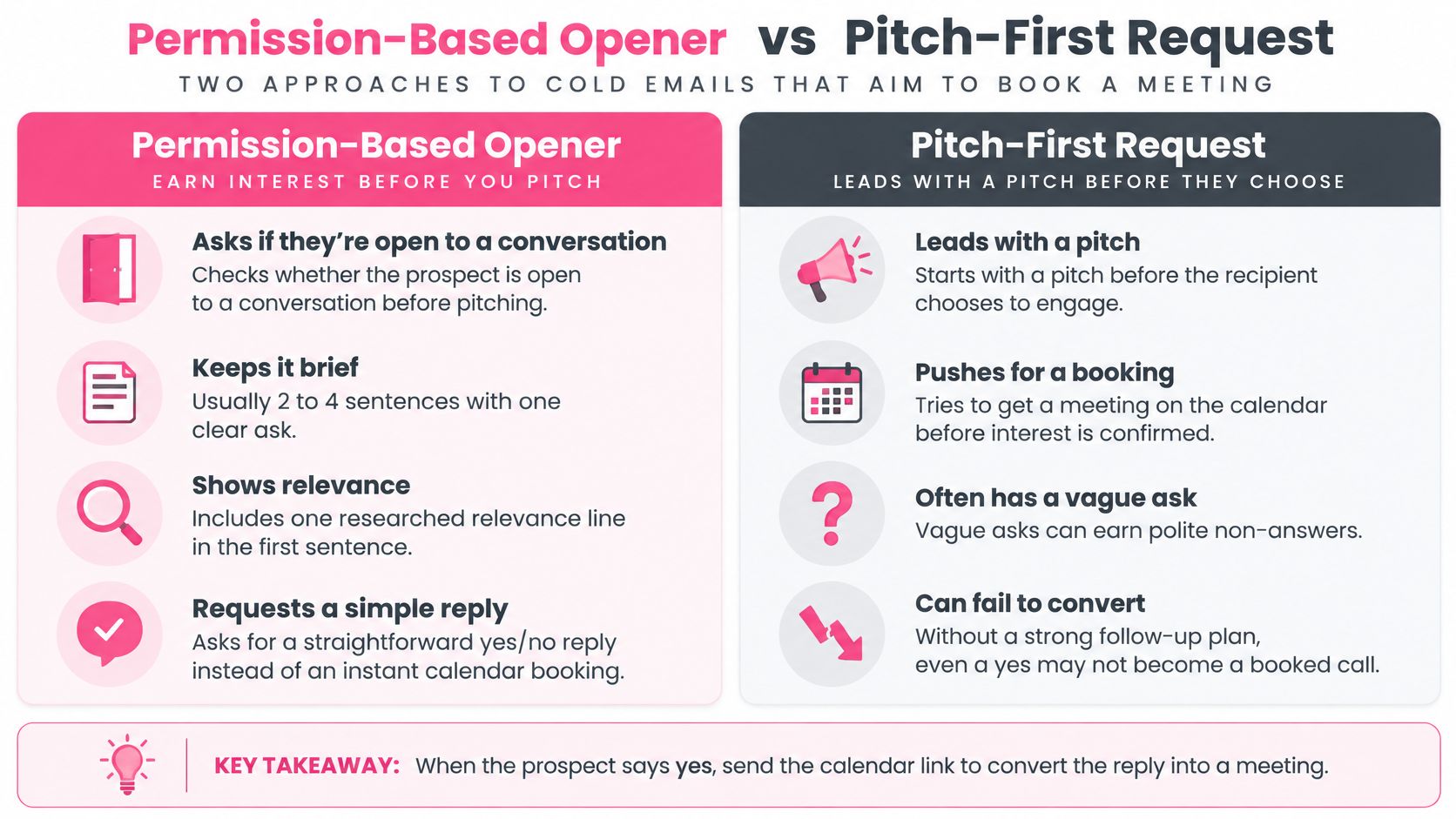
- Be specific in the permission ask: "Would a 15-minute call next week be useful?" beats "Can we talk sometime?"
- Earn the ask with one researched line: a hire, a launch, a gap on their site.
- Send the calendar link only after the yes: linking early converts a soft ask back into a hard one.
Practical rule: if the prospect doesn't know your name, your first CTA should be answerable with one word.
At Ever Outbound (we're pay-per-close), permission openers start the sequence and warm replies move to booking. Before you send your own version, run it through the cold email copy grader and cut whatever it flags as filler.
2. Quick Question Template
Technical buyers and busy operators don't read pitches. They answer questions. This template is barely an email at all, which is exactly why it slips past the mental spam filter.
Subject: Quick question about [Company]'s pipeline
Hi [Name], how are you currently handling follow-up for inbound leads that go quiet after the first call?
No intro paragraph, no credibility dump. The question does the qualifying for you, because only people who feel that problem will bother replying.
The Gap Between Reading and Replying
Opens flatter you. GetResponse's 2024 email marketing benchmarks recorded an average open rate of 39.64% against an average click-through rate of 3.25% across its measured email activity. Plenty of people look. Very few act. A question format attacks that gap directly, since replying to a question feels like conversation rather than compliance.
A sketch of what you're sending:
Keep the question under 20 words and anchor it to something observable, like a job post for two SDRs or a changelog entry shipping a new integration. Then propose a specific time window in email two, once they've engaged.
Short doesn't mean exempt. The FTC's CAN-SPAM compliance guide for business makes clear the law doesn't carve out business-to-business email, so even a two-line question needs accurate sender information, a non-deceptive subject line, and a working way to opt out.
Say an MSP notices a prospect posted a security engineer role. Ask how they're covering after-hours alerts until that seat is filled. You'll get a real answer or nothing, and both outcomes are useful. Test problem-named subject lines against question-format ones, then score replies with the lead qualification criteria before you book anything.
3. Problem-Agitate-Solve (PAS) Meeting Request
PAS earns its place when the buyer knows the problem exists but hasn't priced it. Consulting and advisory firms sell into this constantly: the pain is real, the urgency is missing, and the call never gets booked.
The structure runs three moves. Name the problem in the prospect's language. Show what it costs. Offer the fix and one next step.
Problem: Many agencies lose deals because leads go quiet after the first call. Agitate: Each unanswered proposal delays revenue and gives competitors time to win the account. Solve: We help agencies run outbound campaigns that book qualified calls on the calendar. Would a 20-minute call this week be useful?
Notice what the agitate line does. It attaches a cost, stalled revenue and lost accounts, without lecturing the reader about their pipeline. That one sentence carries the whole email.
Where Most Writers Wreck It
The agitate step is where people go purple. Three sentences of doom reads like a webinar funnel, and the reader unsubscribes to make it stop. One measurable consequence is enough.
Watch that unsubscribe number, because agitation is the copy style most likely to push it. Mailchimp's email marketing benchmarks put the average unsubscribe rate across all users at 0.22%, which gives you a rough ceiling for what normal irritation looks like before your targeting or your tone is the problem.
A walkthrough of the structure in action:
Match the problem to the role. A recruiting firm's owner cares about fill rate and time-to-placement. A cybersecurity buyer cares about audit exposure. Same skeleton, different nerve. If you can't name a cost the prospect already feels, PAS is the wrong template for this contact. Use the trigger-event or quick question formats instead.
Close with one clear step and two proposed times, not an open-ended "let me know." At Ever Outbound (we're pay-per-close), outreach leads with a specific problem your firm solves, then points to results for similar clients and a short discovery call.
Agitate the cost, never the person. "Your proposals go quiet" lands. "Your sales process is broken" gets you blocked.
4. Trigger-Event Meeting Request
Timing does most of the work here. A funding round, a new VP, a product launch, or a new office gives you a reason to email this week that couldn't have been written last month.
Subject: Congrats on the Series A, [Name]
Hi [Name], congratulations on the recent funding. Teams scaling after a round often need predictable pipeline before they hire more sellers. Would a 15-minute call next week make sense to compare notes?
Two sentences of value, one ask. The trigger sits in sentence one so the reader knows immediately why you're in their inbox.
Personalization That Actually Moves Replies
Company-level observation beats mail-merge flattery by a wide margin. In a benchmark covering more than 30,000 prospecting emails, Gong found company-based personalization tripled reply rates among director-and-above prospects, while industry-based personalization lifted replies by 88%, as documented in these B2B cold email benchmarks. First-name tokens aren't personalization. They're punctuation.
The moment you're aiming at looks like this:

- Verify before you send: check the company's own newsroom or press release, not an aggregator with a stale date.
- Connect the trigger to the offer: a Series A implies hiring and pipeline pressure. A new CISO implies a tooling review. If you can't draw the line in one sentence, skip the trigger.
- Refresh weekly: a "congrats on the round" email sent four months late reads like a bot with a slow cron job.
Say a staffing firm spots a manufacturer announcing a second plant. That's a hiring wave with a deadline, and your email arrives as the obvious answer to a problem they're already staffing around. Skip "great company" entirely. It's the compliment equivalent of a form letter.
5. Social Proof and Case Study Meeting Request
Trust is the whole product in services. When an agency or consultancy has no household name on the wall, a specific result from a comparable company does the persuading instead.
Subject: How [Client] booked 14 qualified calls in 30 days
Hi [Name], we recently helped [Client], a B2B services firm, book qualified calls with buyers in their segment. Would it be useful to see how they approached it and whether it fits [Company]?
The ask is a look, not a commitment. That's deliberate. Proof lowers perceived risk, and a low-friction CTA keeps it lowered.
Matching the Proof to the Prospect
A case study only works when the reader sees themselves in it. Show a 200-person SaaS result to a six-person consultancy and you've proven you can serve someone else.
Three filters I'd apply before choosing which story to send:
- Same industry, similar size: the closer the mirror, the shorter the email needs to be.
- Metrics they can act on: meetings booked, time to first call, pipeline created. Vague "growth" numbers invite skepticism.
- Permission to name: if the client hasn't approved the name, describe the company type instead. Never invent a logo, because the first follow-up question exposes it.
Keep the case study link optional and the email short. One line of result, one line of relevance, one question. If they want detail, they'll ask, and that reply is worth more than a click.
At Ever Outbound (we're pay-per-close), we use named case studies across verticals to show how booked, qualified meetings translate into closed revenue, and you can see the pattern in our client results and social proof. Our copywriters research each prospect and write with real context rather than dropping the same story into every send.
A number you can't defend on a call isn't proof. It's a liability with a deadline.
6. Referral or Mutual Connection Request

A real introduction transfers trust you haven't earned yet. That's the entire advantage, and it evaporates the second the connection turns out to be imaginary.
Subject: [Mutual Contact] suggested I reach out
Hi [Name], [Mutual Contact] mentioned you're looking at ways to improve pipeline predictability this year. I'd welcome 15 minutes to share how we've helped similar teams. Would next Tuesday or Wednesday work?
This template earns its place in one situation: a mutual contact has already told the prospect who you are. The context problem every other cold email has to solve is solved before you type a word, which makes the direct meeting ask appropriate here and presumptuous everywhere else.
Getting the Referral Right
Ask your referrer for a one-sentence endorsement you can quote, and get explicit permission to use their name. "I think you two should talk" is not permission to write "[Name] sent me."
Open with the connection in the first sentence and make it specific: what the referrer told you, and why it points at this conversation. Then keep the call short with a stated agenda. A vague 30-minute "chat" spends the goodwill the referrer lent you and returns nothing.
Track referral sources the way you'd track channels. Some connectors produce meetings, others produce polite silence, and you want to know which before you ask again. A coaching business owner who introduces you to three peers deserves a proper thank-you and a result update.
If you're weighing whether a partner's audience is warm enough to justify this approach, feedback from clients on the booking process shows what the handoff looks like once interested prospects land on a calendar. Borrowed trust is a loan. Repay it by being useful in the first fifteen minutes.
7. Breakup Email (Final Follow-Up)
The last touch often pulls the best replies, because you've stopped asking for anything. Removing pressure does what four bumps couldn't.
Subject: Should I close your file?
Hi [Name], I haven't heard back, so I'll assume now isn't the right time to improve outbound at [Company]. If that changes, reply here and I'll send a short overview. Either way, I wish you a strong quarter.
Send it three to five business days after your previous email, include one useful resource, and give a clean out such as "not a priority right now." No guilt, no "did you see my last message."
The Opt-Out Is the Point
A breakup email is also a compliance moment. Official FTC CAN-SPAM guidance states senders generally have 10 business days to stop emailing an address after an opt-out request, and requires a valid physical postal address plus clear notice that the message is an advertisement or solicitation. When someone says stop, your sequence stops that day, not next sprint.
Volume makes this mechanical rather than optional. Google's email sender guidelines classify a sender as bulk at approximately 5,000 or more messages to Gmail accounts within a 24-hour period, require one-click unsubscribe for marketing messages, and recommend keeping spam rates below 0.10% and never letting them reach 0.30%.
Closing a thread politely protects the domain you'll need next quarter. Nagging a dead thread taxes every future send.
Build the exit into the sequence from day one rather than improvising it at touch seven. Our email sequence generator lays out the spacing so the breakup lands as a planned final step, and replies come into a shared inbox our team and the AI Appointment Setter manage, so a "not now" gets logged instead of re-emailed.
How the seven cold email templates compare
| Item | Best For | Primary Ask | Best Stage |
|---|---|---|---|
| Permission-Based Opener | Senior buyers and cold prospects | Give a yes-or-no reply about interest | Early outreach |
| Quick Question Template | Technical buyers and busy operators | Answer one relevant question | Early outreach |
| Problem-Agitate-Solve (PAS) Meeting Request | B2B services with a clear buyer pain point | Book a meeting to discuss a solution | Initial outreach when the pain is known |
| Trigger-Event Meeting Request | Prospects with a recent, relevant company event | Schedule a short meeting | Timely outreach after a trigger event |
| Social Proof and Case Study Meeting Request | Agencies and services where trust matters | Meet to explore whether a similar result is possible | Initial outreach with relevant proof |
| Referral or Mutual Connection Request | Prospects with an authentic mutual connection | Schedule a short, specific meeting | Warm introduction |
| Breakup Email (Final Follow-Up) | Prospects who have not replied to earlier emails | Reply if interested or close the conversation | Final touch in a sequence |
Pick the Template, Then Let the Calendar Do the Work
Choose by information, not by preference. If you know nothing about the prospect, use the permission opener or the quick question. If you know something timely, use the trigger email. If you have a comparable result, lead with proof. If someone introduced you, ask for the call directly. And when the thread has gone quiet past your last useful idea, close it cleanly.
Then run them in order: opener, follow-up with a new angle, breakup. Three touches with three different reasons to care beats seven touches that all summarize to "please respond."
Copy is downstream of inbox placement. Sender guidance summarized in Twilio's email deliverability guide covers the Google and Yahoo requirements introduced in February 2024, with Microsoft joining in May 2025, emphasizing SPF and DKIM authentication, DMARC alignment, and valid DNS. Authenticate first, verify the list second, write third. A brilliant meeting template in the spam folder books nothing.
Measure the funnel in stages rather than staring at opens: replies, positive replies, qualified meetings, closed revenue. Opens distort under privacy protections and security scanners, and a healthy open rate with no replies usually means your targeting is wrong, not your subject line. If you're building the sending stack yourself, browse email marketing providers with authentication and suppression handling in mind before you buy on price.
At Ever Outbound (we're pay-per-close), the process runs four steps: we build your list of verified decision makers, write and send short copy on warmed domains, book interested prospects straight onto your calendar, and you show up to close. Campaigns launch about 14 days after onboarding because new domains and mailboxes need warmup for good inbox placement, and that patience is the difference between a sequence that runs for months and one that dies in week two.
Pick one template above, send it to ten relevant people this week, and read every reply. The patterns in those replies will teach you more than any swipe file. Then systemize what worked, and stop rewriting the same email from a blank page every Monday.
Ever Outbound Inc. builds verified prospect lists, writes the short meeting-booking copy described above, and runs the sending infrastructure and follow-ups that turn replies into qualified calls on your calendar. We're pay-per-close, so you pay a 5% commission only when a deal closes from our efforts, and your first 2 closes are commission-free. If you'd rather show up to calls than write touch number four, visit Ever Outbound Inc. and we'll walk you through how a campaign gets built for your market.