November 25, 2026
8 Cold Email Tips That Actually Get Replies in 2026
A sales rep uploads a fresh list of 500 prospects on Monday morning, hits launch, and sits back waiting for calendar notifications to roll in. Tuesday brings two out-of-office auto-replies. Wednesday brings a polite unsubscribe. By Friday afternoon, the inbox is so quiet you could hear a Slack notification drop in another time zone.
The list looked solid and the offer was decent, so what broke? Almost every cold outreach flop traces back to a handful of avoidable habits: generic openers that scream mass blast, bloated copy no busy executive will read on a phone, neglected domain health, and zero plan for follow-ups. Worse, most reps try to fix a silent campaign by tweaking their favorite sentence when the problem sits upstream in their list hygiene or DNS records.
These eight cold email tips walk through the full outreach lifecycle, from researching your first prospect list to measuring booked meetings and sending the final break-up note. Each tip includes a real trade-off so you know exactly when not to follow the rule. Whether you run outbound for a B2B SaaS team, an agency, a recruiting desk, or a cybersecurity firm, you can put every one of these steps to work this week without burning your domain or your reputation.
Table of Contents
- 1. Personalize Every Email With Specific Research
- 2. Keep the Email Short and Easy to Scan
- 3. Use One Clear, Low-Friction Call to Action
- 4. Build Multi-Step Sequences With Spaced Follow-Ups
- 5. Protect Deliverability Before Scaling Volume
- 6. Write Subject Lines That Look Like Internal Messages
- 7. Lead With the Prospect's Problem, Not Your Company
- 8. Test, Measure, and Optimize Against Booked Meetings
- How the eight cold email tips compare
- Turn These Cold Email Tips Into a Repeatable System
1. Personalize Every Email With Specific Research
Slapping a first-name merge tag onto a generic template isn't personalization. Prospects spot automated flattery in two seconds, and anything that reads like a mass blast gets archived or flagged as spam. Real personalization anchors your message to a concrete, verifiable business detail, such as a recent hire, a product launch, a funding round, open job listings, or a public challenge an executive discussed on a podcast.
The reply gap makes the extra homework worth it. According to Belkins' 2024 analysis of 5.5 million emails cited in Emailchaser's cold email statistics, personalized cold emails generated a 7% reply rate compared with 3% without personalization.
Smart targeting starts before you write a single opening line.

Consider how two different B2B teams apply this in the wild. A recruiting firm spots that a SaaS company just posted three senior engineering roles on its careers page, then reaches out offering to shorten that specific hiring sprint. A consultant watches a prospect's conference talk on customer churn and opens the email by referencing a single takeaway from that session before suggesting a quick conversation.
At Ever Outbound, we're pay-per-close, so we can't afford to waste sends on guesswork. Our research team verifies decision-makers and builds account-level hooks for each list before outreach begins, ensuring every message carries genuine context. Before you enrich or personalize any batch of contacts, run your data through our lead list cleaner so your research hours aren't spent on dead addresses or role accounts.
The Over-Personalization Trade-Off
More personalization isn't always better, and chasing weird personal details can backfire fast. Mentioning a prospect's office address, a random social post from two years ago, or an inferred personal detail feels like surveillance rather than business research. As outlined in NukeSend's 2025 AI email privacy guidance, AI-assisted scraping also raises privacy and compliance risks across frameworks like GDPR and CCPA/CPRA, while making it dangerously cheap to send confident, completely false claims at scale.
Skip deep individual research when you don't have a meaningful business trigger or when your deal size can't justify ten minutes of prep per contact. Use these guardrails instead:
- Apply minimal necessary context: Stick to one or two verifiable business facts tied directly to your reason for reaching out.
- Build segment-level hooks: Write specific angles for verticals, such as MSPs or cybersecurity teams, and customize only the opening line per account.
- Require human review for AI research: Spot-check automated enrichment before launch, because one wrong detail destroys trust immediately.
- Set a clear stop rule: If a prospect shows no real trigger, move them to a tightly targeted segment campaign instead of inventing fake flattery.
2. Keep the Email Short and Easy to Scan
A cybersecurity provider trims its cold pitch down to three crisp sentences: name one compliance gap, offer a free assessment, and ask for a simple yes or no. Across town, a B2B coaching firm deletes its entire "about us" paragraph and opens straight with the prospect's revenue target. Both teams instantly make life easier for a reader scanning messages between Zoom calls.
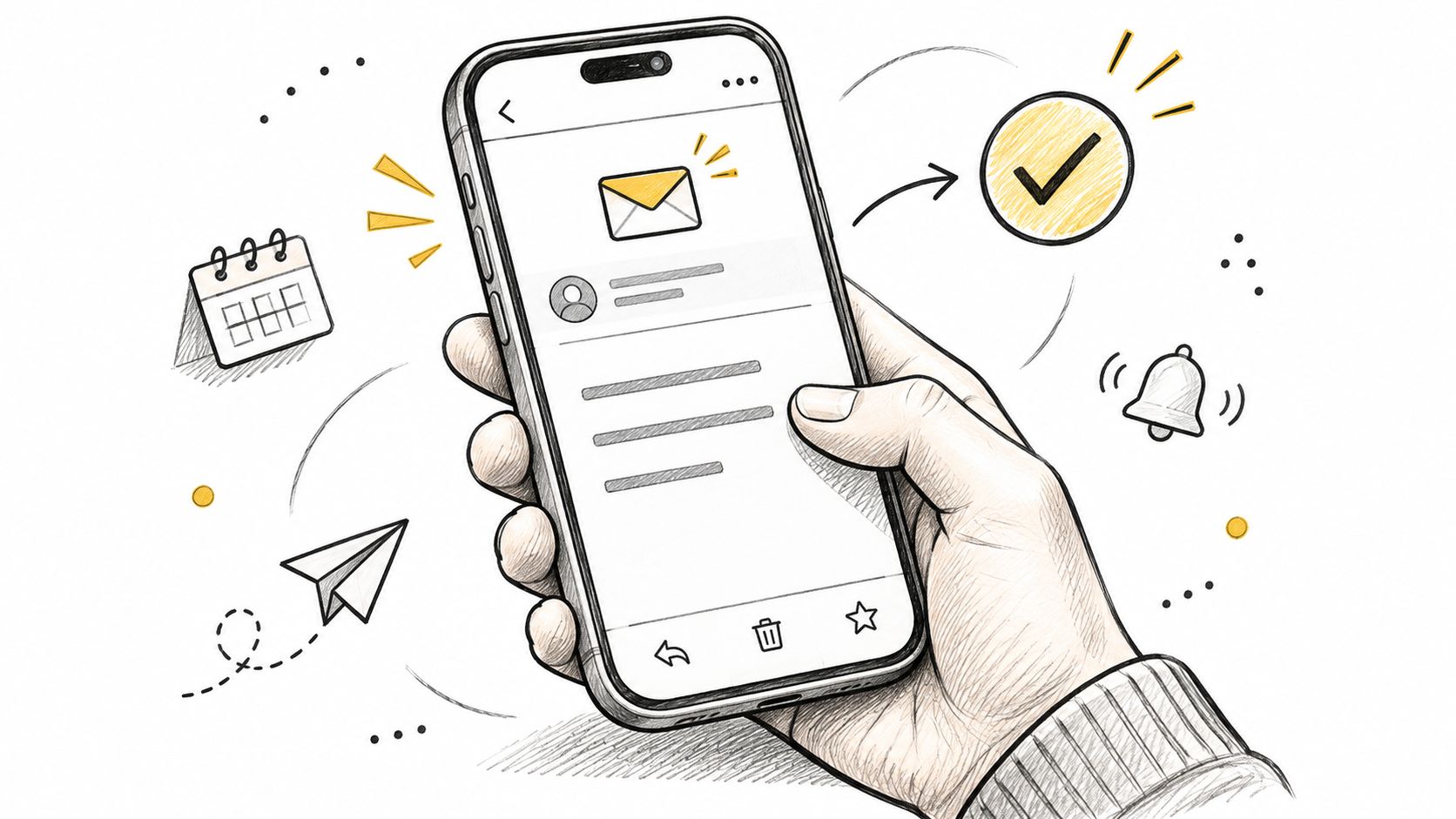
Most effective cold emails land between 50 and 125 words, written in plain language with short sentences and plenty of white space. Your recipient should grasp why you're writing within a few seconds on a smartphone screen. Put your sharpest sentence in the first two lines, because mobile inbox previews cut off everything after the opening snippet.
Always check how your draft looks in the palm of a hand before scheduling a send.
Read every draft out loud before it leaves your outbox. If you run out of breath mid-sentence, your prospect's eyes will bounce off the screen. Strip out filler adjectives like "cutting-edge" or "world-class" that add zero information, then run your text through our cold email copy grader to spot bloat and readability drags before launch.
If a prospect has to scroll twice on an iPhone just to figure out what you want, they won't scroll once.
When Longer Emails Beat Short Ones
Ruthless brevity has a real trade-off: cutting too deep can leave your message sounding cryptic, lazy, or devoid of proof. A 2024 survey of 1,869 U.S. adults reported by EmailToolTester's cold email statistics found that 36% would be most likely to respond to a longer cold email personalized with their name.
Don't force a complex technical pitch into 55 words if doing so removes the exact proof that earns a reply. When you're emailing a CTO about a specific security audit finding or pitching a high-ticket advisory engagement, a structured 150-to-200-word email with two tight bullet points of evidence often outperforms an ultra-short note. Keep it scannable, earn every extra word with concrete value, and save the company history for the sales call.
3. Use One Clear, Low-Friction Call to Action
Picture a cold email that asks a busy founder to read a linked case study, watch a four-minute Loom, answer three qualifying questions, and pick a 45-minute demo slot. Every extra decision adds friction, and when a prospect faces homework from a stranger, they pick the easiest option on the screen: delete.
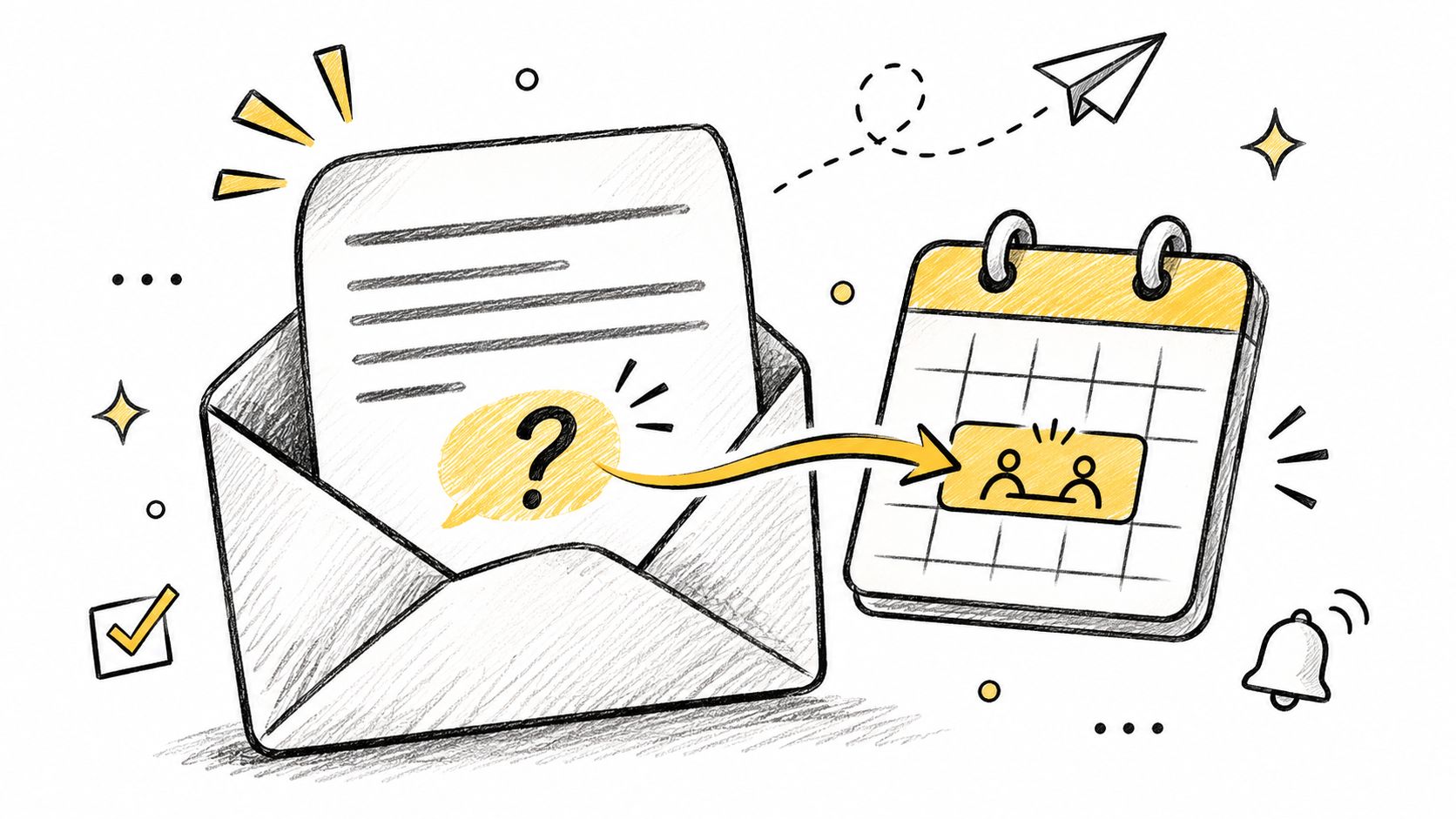
Each cold email should ask for exactly one clear next step. Low-commitment asks like "Worth a 15-minute call next week?" or "Should I send over a short breakdown?" work because they match the actual stage of the relationship. You're trying to start a conversation, not close a five-figure contract in thread one.
A staffing firm proves how clean this looks in practice by asking, "Are you currently hiring for operations roles this quarter?" before even mentioning a calendar link. Once a prospect replies "Yes, two roles," booking the call becomes effortless. A consultancy targeting tighter schedules takes a slightly more direct route by offering two specific time windows, such as Tuesday at 10 AM or Thursday at 2 PM, removing the back-and-forth guessing game.
Make saying yes feel as simple as tapping a calendar invite.
Keep your closing line disciplined with four quick checks:
- State the exact time commitment: Say "15 minutes" instead of asking for a vague "quick chat" or "demo."
- Strip out competing links and attachments: One email equals one action, and extra links also look noisy to spam filters.
- Offer two concrete windows when asking for time: Specific slots beat open-ended "Let me know whenever you're free" requests.
- Match the ask to the audience: Busy executives reply faster to a binary yes-or-no question than a multi-part intake form.
The Soft Ask Trade-Off
Ultra-soft CTAs ("Mind if I send a one-pager?") generate higher raw reply rates, yet they carry a hidden operational cost. They invite curious tire-kickers who love free PDFs and vanish the moment you propose an actual call. They also force your reps into extra inbox ping-pong just to convert an "Interested, send more info" into a booked meeting.
When your sales team is swimming in polite replies that never hit the calendar, ditch the soft interest check. Switch to a direct, low-friction time proposal with two specific 15-minute options so only prospects with real intent raise their hand.
4. Build Multi-Step Sequences With Spaced Follow-Ups
Most prospects don't ignore your first email because they hate your offer. They ignore it because they opened it while walking into a budget meeting, meant to reply after lunch, and buried it under 60 newer threads by 3 PM. Sending one email and giving up leaves the majority of your pipeline sitting untouched.
A disciplined sequence of three to five touches spaced several business days apart (for example, gaps of 2, 3, and 5 business days) gives busy buyers multiple clean chances to respond. The catch is that every follow-up must earn its spot with fresh value, a new angle, a short proof point, or a sharper question. Never burn a touch on lazy filler like "just checking in" or "bumping this to the top of your inbox."
Here's how real teams structure progression across a sequence. An MSP opens touch one with a tight downtime problem statement, follows up three days later with a two-sentence client case study, and sends a crisp closing question on touch three. A B2B SaaS team wraps its four-step cadence with a polite break-up email offering to close the prospect's file if the topic isn't a current priority, which routinely pulls replies from silent buyers who hate leaving loose ends.
Each step should advance the conversation instead of repeating the same pitch verbatim.
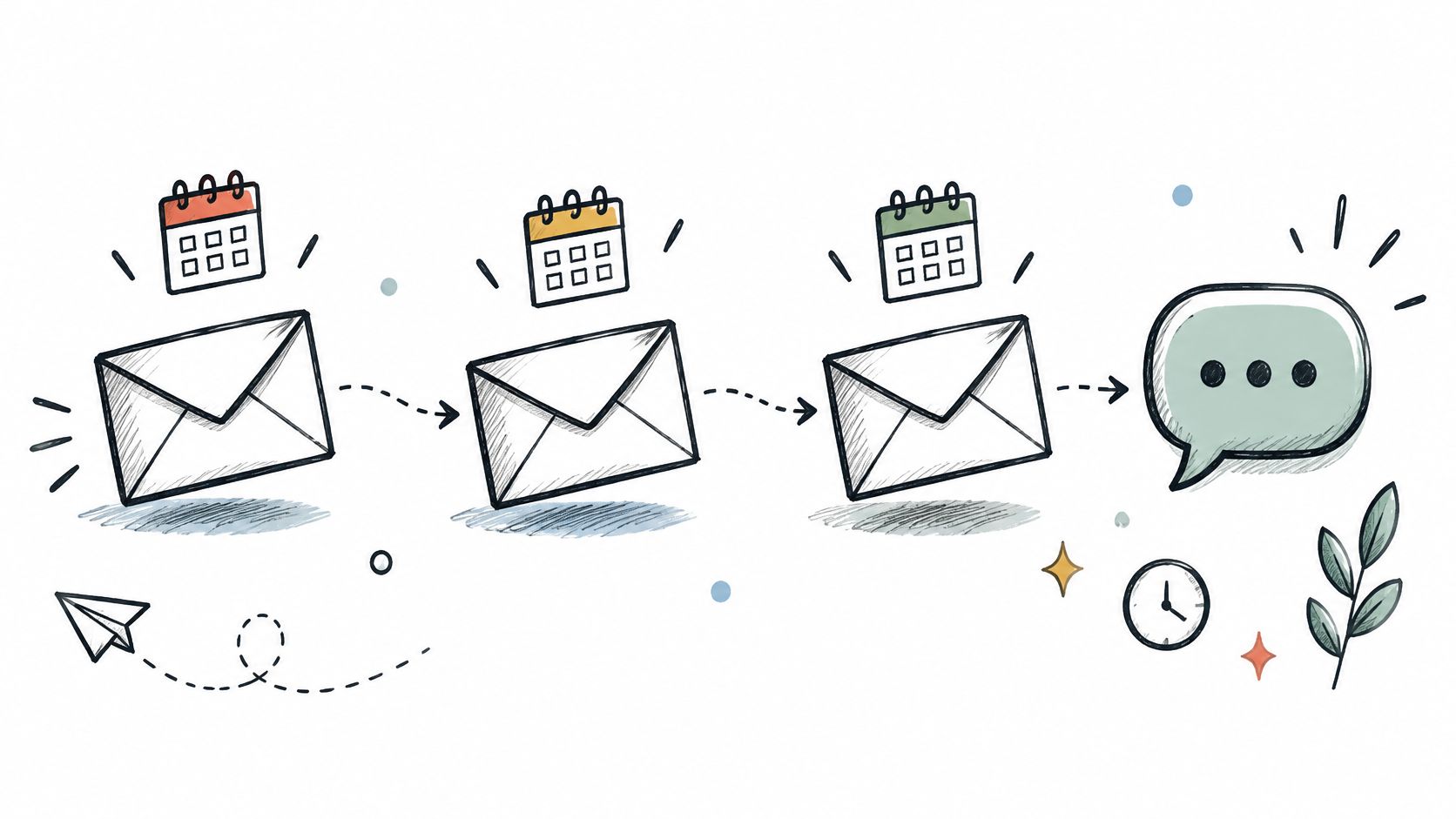
You can map out a structured three-step cadence in minutes using our email sequence generator, and refine your pacing with this breakdown of professional follow-up email structure and timing. Keep your follow-ups in the same email thread whenever possible so the prospect sees the original context without hunting through their inbox.
Operator rule: Configure your sending platform to pause the sequence automatically the second a prospect replies. Nothing kills a warm conversation faster than an automated "Did you see my last note?" firing two hours after they already booked a call.
Where Persistence Crosses Into Annoyance
There is a sharp ceiling on helpful follow-up. Pushing a cold sequence to seven, eight, or ten touches doesn't make you look determined; it trains recipients to hit the "Report Spam" button just to make you disappear.
Stop your sequence early whenever a prospect sends a clear "not interested," when an out-of-office reply directs you to a different owner, or when complaint signals creep upward on a specific list segment. A polite exit on email four preserves both your domain reputation and the chance to re-engage that account six months later when their priorities shift.
5. Protect Deliverability Before Scaling Volume
You can hire the sharpest copywriter on earth, and their words still won't book a single call if they land in the spam folder. Deliverability is now governed by strict mailbox-provider rules rather than clever wording tricks, and ignoring technical setup will torch a domain before your first week wraps up.
Under Google's Gmail sender guidelines that took effect on February 1, 2024, all senders emailing Gmail accounts must authenticate mail with at least SPF or DKIM, keep their user-reported spam rate below 0.10%, and stay below 0.30% (roughly three spam complaints per 1,000 delivered emails), or risk losing access to delivery support and mitigation. According to Google's bulk-sender authentication rules, anyone sending more than 5,000 messages per day to Gmail must implement SPF, DKIM, and DMARC together along with one-click unsubscribe.
Those unsubscribe rules carry a tight operational clock, too. As detailed in Google's one-click unsubscribe documentation, promotional and marketing messages from bulk senders must support one-click unsubscribe and honor opt-out requests within 48 hours. Yahoo enforces a parallel bar: Yahoo's sender best practices require every sender to authenticate with SPF or DKIM, keep spam complaints below 0.30%, maintain valid forward and reverse DNS records, comply with RFC 5321 and RFC 5322, and for bulk senders, deploy both SPF and DKIM plus a DMARC policy of at least p=none aligned with SPF or DKIM.
If DNS records still feel like alphabet soup, review email DNS basics from RedirHub before touching your domain registrar. This walkthrough also breaks down how authentication, warmup, and sending hygiene work together to keep outreach out of spam folders.
In practice, protect your main corporate domain by running outbound from secondary lookalike domains. A consultancy that communicates with clients on its main .com buys dedicated outbound domains for prospecting, warms up new mailboxes for several weeks before ramping volume, verifies every list to keep bounces low, and strips out spam-trigger patterns like ALL CAPS, repeated exclamation points, and excess links.
At Ever Outbound, we're pay-per-close, so inbox placement directly determines whether we ever get paid. Our managed infrastructure runs domain pools with daily sending capacity controls and deliverability monitoring across multiple mailboxes, and new campaigns launch about 14 days after onboarding specifically so fresh domains and mailboxes can warm up properly. You can audit your own sending setup right now with our email deliverability checker.
The Speed Versus Safety Trade-Off
Building proper infrastructure feels painfully slow when a founder wants leads by Friday. Waiting two to three weeks for domain warmup and capping daily volume per mailbox delays your first wave of replies, which is why impatient teams cut corners and burn their primary domain in 72 hours.
Never skip baseline SPF, DKIM, DMARC, and list verification, even if you send tiny batches. The only time you should skip building a sprawling pool of secondary domains is when you're a solo advisor sending a handful of one-to-one manual notes each week from an established, high-reputation inbox. The moment you scale into daily automated sequences, separate infrastructure is essential.
6. Write Subject Lines That Look Like Internal Messages
Scan your own inbox right now and notice which emails you open without hesitation. You skip the polished newsletter headlines with title-case hype and emojis. You click the short, lowercase-friendly lines that look like a colleague pinged you about a live project.
Strong cold email subject lines follow that exact pattern: short, specific, and plain. A recruiting firm gets opened with "Hiring for your Q3 sales team?" instead of "Transform Your Engineering Recruitment Pipeline Today!" A cybersecurity provider earns curiosity with "Your SOC 2 timeline" rather than "Award-Winning Compliance Automation Platform." Neither line tries to be clever, and both tell the recipient immediately why the note belongs in their day.
Keep your subject line process simple and testable:
- A/B test two or three variants per campaign: Pit a direct question against a short two-to-four-word topic reference.
- Keep the subject tied tightly to the body: Your opening line should pay off the subject immediately with zero bait-and-switch.
- Drop fake thread prefixes: Never tack
"Re:"or"Fwd:"onto a cold first touch to trick someone into opening. - Aim for plain internal phrasing: Use normal sentence case or lowercase instead of marketing title case and exclamation marks.
The Fine Line Between Casual and Deceptive
Chasing open rates with sneaky subject lines is one of the fastest ways to wreck your sender reputation and invite legal trouble. Faking a reply thread or inventing fake urgency might trick a few prospects into clicking, right before they slam the spam button out of pure irritation.
In the United States, misleading subject lines aren't just bad manners. The U.S. CAN-SPAM Act of 2003, effective January 1, 2004, applies to commercial emails and explicitly prohibits deceptive subject lines, as summarized in Google's compliance and sender guidelines. It also requires truthful sender and routing details, clear advertisement identification, a valid physical postal address, and a working opt-out mechanism that remains functional for at least 30 days, with penalties of up to $11,000 per violation.
There's also a stylistic trade-off to watch. Ultra-casual, cryptic lowercase lines like "quick question" can feel unprofessional to formal enterprise legal, finance, or healthcare executives. When selling to conservative buyers, trade casual ambiguity for crisp, buttoned-up specificity that names their exact project or compliance deadline.
7. Lead With the Prospect's Problem, Not Your Company
Open ten random cold emails in a B2B founder's spam folder, and eight of them start the exact same way: "Hi, my name is Alex and I'm reaching out to introduce Acme Solutions, a leading provider of..." Nobody cares who you are until they believe you can fix a headache currently sitting on their desk.
Flip the script by opening with a problem the prospect immediately recognizes and a credible path to fixing it. Look at how an outbound agency frames its opener: "Most agencies we talk to are paying for leads that never reach a calendar. We book qualified calls instead." Follow that with one substantiated proof point, and only then briefly mention your company name. Similarly, a cybersecurity firm opens by naming a common audit gap in regulated industries before offering a short, low-pressure assessment.
Describe the problem in the exact words your buyer uses on an internal team call, not the polished jargon sitting on your homepage.
Structure your body copy in a tight buyer-first sequence:
- Name the recognizable friction first: Anchor the email in an operational, revenue, or compliance headache relevant to their exact role.
- Back it up with one concrete proof point: Cite a named case study or a specific industry outcome, and only include a number when you can substantiate it.
- Introduce your company last and briefly: One clean line showing how you deliver the outcome beats three paragraphs of credentials.
The False Diagnosis Trade-Off
Leading with a pain point carries one glaring hazard: guessing wrong makes you sound arrogant or clueless. If you email a VP of Sales claiming "Your reps are probably struggling with low close rates" during the quarter they just smashed quota, you lose all credibility in sentence one.
Skip aggressive problem-led openers whenever you lack solid evidence that the prospect has that issue. Instead of diagnosing them blindly, use a peer-observation framing ("When we talk to mid-market SaaS teams scaling past 20 reps, X usually breaks first") or lead with a specific opportunity tied to a verified trigger like a new product launch.
8. Test, Measure, and Optimize Against Booked Meetings
Plenty of outbound teams celebrate a high open rate while their sales calendar stays completely empty. Open tracking has grown unreliable thanks to inbox privacy protections and security bots that pre-fetch tracking pixels, turning opens into a vanity metric. The only numbers that pay the bills are deliverability, reply rate, positive reply rate, and booked meetings.
Before you rewrite a single sentence of copy on an underperforming campaign, run a proper diagnostic. As highlighted in Mailgun's 2024 State of Email report, "write better emails" is terrible advice when your real problem is invisible spam filtering or damaged domain reputation. Follow a strict troubleshooting order: verify DNS, authentication, domain alignment, bounces, complaints, and inbox placement first; test audience targeting and offer relevance second; rewrite email copy last.
You also need to stop staring at blended campaign averages and start reporting performance by mailbox provider. According to Validity's 2025 Deliverability Benchmark Report, global inbox placement reached 89.8% for Gmail, 87.3% for Yahoo, and 77.4% for Microsoft. Because Microsoft filters far more aggressively than Gmail, a sudden drop in replies from enterprise prospects using Outlook signals a provider-level reputation or alignment issue, not a bad subject line.
Track delivery, bounces, complaints, positive replies, and booked calls separately for Gmail, Microsoft, and Yahoo inside a central weekly dashboard. Say a SaaS team splits 500 verified prospects evenly to test two distinct value propositions, keeping everything else identical, and keeps the angle driving more positive replies. Or an MSP notices that healthcare clinics book meetings at twice the pace of manufacturing accounts and shifts next month's prospecting budget straight into healthcare.
If you want to connect those reply metrics directly to pipeline economics, run your numbers through our meeting cost calculator, and pair your outbound data with inbound benchmarks like these lead generation tips for Melbourne businesses to see which channel acquires qualified calls most efficiently.
The Over-Testing Trade-Off
Obsessive tinkering ruins more cold email programs than laziness does. Swapping your subject line, opening hook, and CTA all in the same week makes it impossible to know which change moved the needle, and calling a winner after 50 sends is just reading tea leaves.
Change one variable per test, let it run long enough to gather meaningful reply data, and document every result in one shared tracker before moving to the next hypothesis. Don't run copy experiments at all until your infrastructure checks out green across every major mailbox provider.
How the eight cold email tips compare
| Item | Funnel Stage | Primary Benefit | Main Trade-off |
|---|---|---|---|
| Personalize Every Email With Specific Research | Awareness | Makes outreach relevant and credible | Requires time and accurate research |
| Keep the Email Short and Easy to Scan | Awareness | Makes the message quick to read and answer | Leaves little room to explain complex offers |
| Use One Clear, Low-Friction Call to Action | Conversion | Makes the next step easy to take | Can invite unqualified or noncommittal replies |
| Build Multi-Step Sequences With Spaced Follow-Ups | Consideration | Creates more opportunities to get a response | Poorly managed follow-ups can feel aggressive |
| Protect Deliverability Before Scaling Volume | Foundation | Helps messages reach inboxes and protects domain reputation | Requires technical setup, monitoring, and time |
| Write Subject Lines That Look Like Internal Messages | Awareness | Signals relevance and encourages opens | Generic or overly casual lines may be ignored |
| Lead With the Prospect's Problem, Not Your Company | Awareness | Shows relevance by focusing on the prospect's needs | Requires market knowledge and credible claims |
| Test, Measure, and Optimize Against Booked Meetings | Optimization | Identifies what drives qualified meetings | Needs disciplined tracking and sufficient data |
Turn These Cold Email Tips Into a Repeatable System
Cold email rewards boring consistency far more than bursts of creative inspiration. Resist the urge to launch five segments, twelve subject lines, and three offers on Monday morning. Pick one tight target segment, build one verified personalization hook, write one crisp email, and plug it into a four-step sequence with clean spacing.
Run that exact system for two full weeks before changing a single word of copy. Judge the results by positive replies, mailbox-provider placement, and qualified meetings on the calendar rather than chasing noisy open percentages. Once you have a real baseline, isolate one variable, test a clear improvement, and keep compounding what works.
Your Weekly Outbound Review Loop
Keeping outbound healthy takes less than an hour a week once the machine is running:
- Check infrastructure first: Review bounce rates, Google Postmaster Tools complaint signals, and provider-level placement across Gmail, Microsoft, and Yahoo before touching messaging.
- Audit positive versus negative replies: Look for patterns in objections so you can tighten your targeting or sharpen your offer for the next list batch.
- Clean and suppress promptly: Honor every unsubscribe immediately and keep opted-out contacts locked on a global suppression list.
- Double down on winning segments: Shift sending capacity toward the industries and job titles producing actual booked calls.
Of course, running domain pools, warming mailboxes, verifying decision-makers, writing fresh copy, and babysitting inbox replies takes serious weekly bandwidth. If building and maintaining that whole routine in-house pulls you away from serving clients and closing deals, partnering with a specialist makes practical sense.
At Ever Outbound Inc., we're pay-per-close: we only earn a commission when you close a deal from our efforts. Our team handles the entire four-step workflow for you, verifying decision-makers before a single email goes out, writing short, specific copy on warmed domains, and booking interested prospects straight onto your calendar so you can show up to close. That exact pay-per-close process is reflected in our Barrel Aged Ecommerce case study, which delivered 37 ready-to-buy prospects and 20+ qualified calls while their internal team stayed focused on sales conversations instead of prospecting.
Ever Outbound Inc. runs done-for-you B2B client acquisition on a pay-per-close model, combining human research, personalized multi-step copywriting, and managed sending infrastructure to book qualified sales calls directly onto your calendar. With plans starting at $97/month plus a 5% commission only when you close a deal, and your first 2 closes commission-free, our incentives stay completely aligned with your revenue. If you're ready to put these cold email fundamentals on autopilot without paying risky agency retainers, visit Ever Outbound Inc. to see how we can build your outbound pipeline.