October 13, 2026
What an Email Deliverability Consultant Actually Does

Your campaign was fine on Monday. By Thursday, replies had gone quiet, open rates had fallen off a cliff, and the team's first instinct was to blame the copy. Then you send a test email and there it is, sitting in spam like a parking ticket you didn't notice until the tow truck showed up.
That's the moment when the problem becomes clear: it isn't the subject line. It's the machinery behind the send, the reputation attached to the domain, and the way mailbox providers decide whether to trust you. An email deliverability consultant lives in that mess, pulling apart DNS records, complaint data, authentication, and provider behavior until the actual failure shows up.
If you've already started checking list quality, a practical companion is the guide to scaling email checks. And if you want a quick internal benchmark before diving into the weeds, the cold email grader is the kind of simple diagnostic that saves people from guessing for a week.
Table of Contents
- Why Your Best Emails Are Landing in Spam
- Core Deliverability Concepts Every Sender Should Know
- What an Email Deliverability Consultant Does Day to Day
- How a Consultant Diagnoses Inbox Placement Problems
- When to Hire One and What It Costs
- Questions to Ask Before You Hire Any Consultant
- The ROI of Getting Delivered and a Better Way to Pay
Why Your Best Emails Are Landing in Spam
The painful part is that bad deliverability often looks like bad marketing. The sequence still goes out, the copy still sounds sharp, and the audience might even be the same one that used to respond. Then the inboxes close up, one by one, and the campaign that was carrying your pipeline starts acting invisible.
The usual failure is infrastructure, not creativity
That is the wrong place to start rewriting. Email deliverability became its own technical discipline because mail moved far beyond a small set of trusted systems, and the standards stack grew into authentication, DNS, transport security, and reputation controls. A TU Wien study of the email standards ecosystem showed it expanding from fewer than 100 related RFCs roughly two decades earlier to nearly 500, and it also showed why acceptance by your own sending server tells you almost nothing about inbox placement TU Wien study.
The same study found that only 44.3% of measured providers could both resolve hosts over IPv6 and deliver email via IPv6, while 65.4% could perform IPv6 host resolution. Security support was uneven too, with just 41.5% using DNSSEC-validating resolvers, 89.7% accepting invalid TLS certificates, and only 31.7% using TLSA for DNS-based certificate verification.
That is the core lesson. Inbox placement depends on how providers interpret your identity, routing, encryption, and reputation, not on how persuasive your email sounds. A consultant earns their keep by tracing that chain instead of pretending copy fixes everything.
What the consultant sees first
A real operator starts with authentication pass rates, complaint patterns, provider-specific filtering behavior, and whether a domain pool is being burned by uneven sending. They look at the send path, not just the message.
Practical rule: if a campaign dies across multiple mailboxes at once, assume infrastructure until proven otherwise.
That is why the job is part investigator, part mechanic, part traffic cop. Good consultants know which signal matters first, and which fix is just a distraction. They also know when to stop blaming the wording and start checking mailbox-specific thresholds, pause rules, and whether multiple domains and distributed mailboxes are being pushed past sane limits. If your team is still sorting bad addresses by hand, use the guide to scaling email checks. If you want a quick internal benchmark before a deeper review, the cold email grader is a better first pass than another round of guesswork.
Core Deliverability Concepts Every Sender Should Know
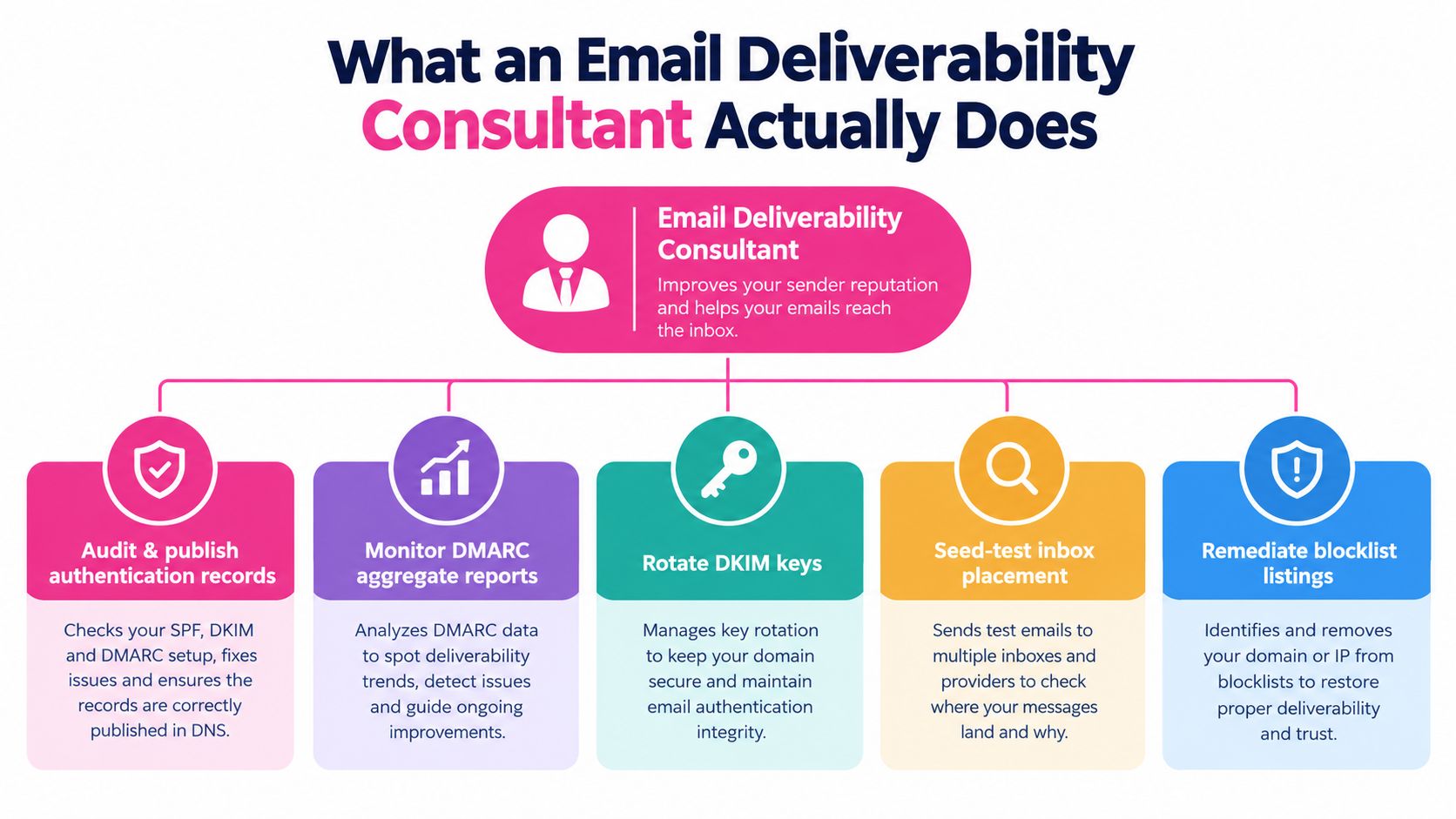
A sender with clean copy and a broken setup still ends up in spam. Mailbox providers judge the path into the inbox by identity, routing, encryption, and reputation. SPF says which servers may send, DKIM signs the message, and DMARC ties that proof to the visible From domain so a bad actor cannot authenticate one domain while posing as another Google support on sender authentication.
Think in controls, not buzzwords
Gmail and Yahoo tightened sender requirements in 2024, and that made authentication mandatory for bulk mail. Senders needed SPF or DKIM, while mass senders were expected to implement SPF, DKIM, and DMARC Mailgun 2024 State of Email. That is a gate, not a suggestion, and complaint handling matters just as much. Gmail's spam-rate guidance says to keep Postmaster Tools spam rate below 0.1% and avoid 0.3% or higher Gmail spam-rate guidance.
A consultant watches the control system, not just the checkbox. Google says correctly configured senders typically achieve at least 95% DKIM and DMARC success rates, which is a sane benchmark for whether the plumbing is working Google support on authentication setup.
DMARC deserves special attention because alignment matters. One authenticated identifier, SPF or DKIM, has to align with the visible From domain. If it does not, you authenticated the wrong identity, and mailbox providers read that as a trust problem.
The metrics that matter
Complaint rate is the tripwire. Gmail and Yahoo requirements were tied to a 0.3% spam-complaint threshold, which is three complaints per 1,000 delivered messages, and deliverability guidance commonly recommends staying below 0.1%, or one complaint per 1,000 messages, to protect sender reputation Mailgun 2024 State of Email. Before you trust your own read on these numbers, run your domain through the email deliverability checker for a baseline.
In plain English, this is the vocabulary a consultant uses:
Authentication pass rates tell you whether mailbox providers can trust who sent the mail.
Spam rate tells you whether recipients are punishing the message.
Bounce rate tells you whether the address list or sending stream is broken.
Inbox placement tells you where the message landed, which is the only part that really pays.
A delivery rate below the complaint threshold does not prove healthy deliverability. It only means you have not crossed the line yet.
What an Email Deliverability Consultant Does Day to Day
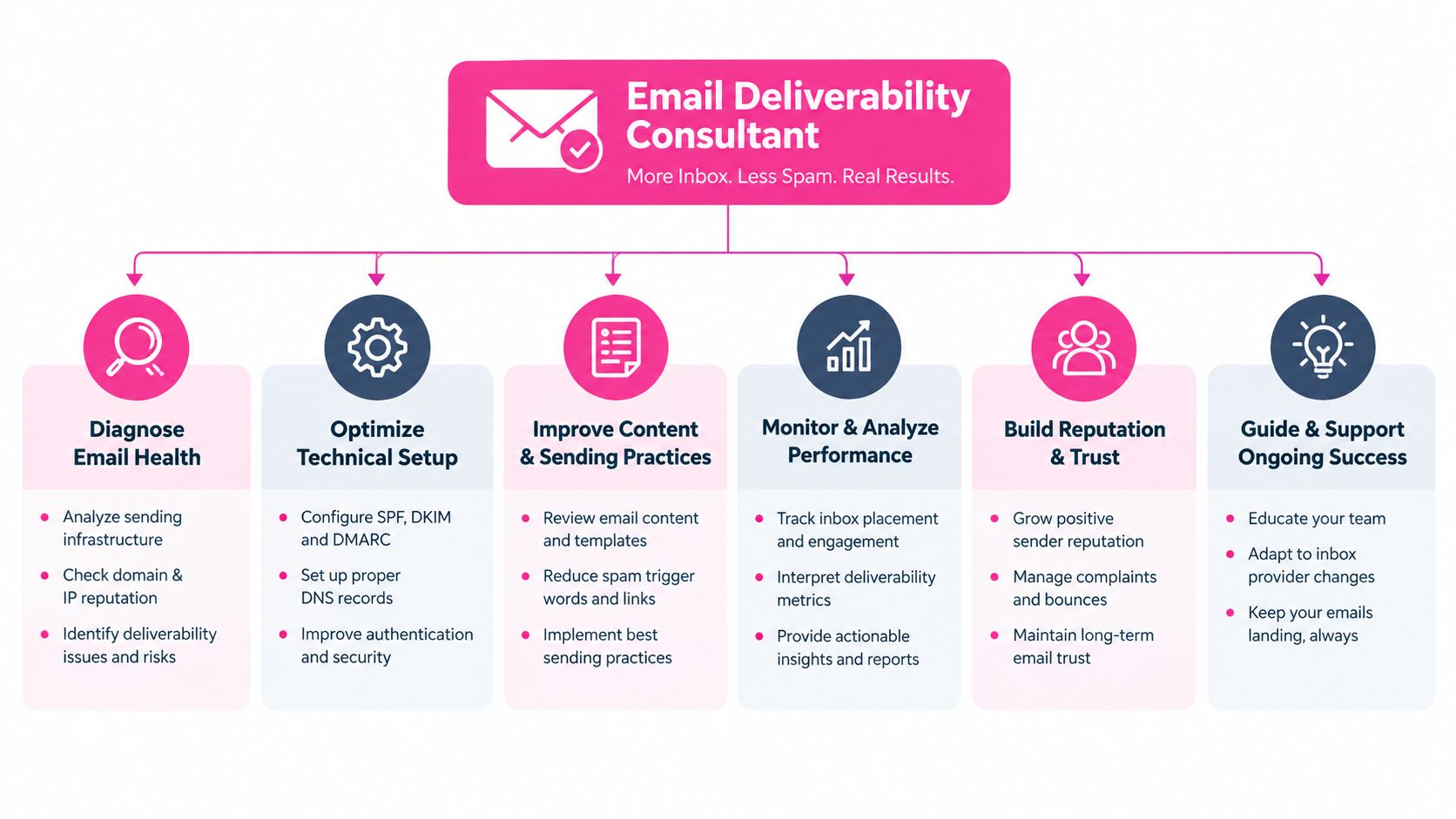
A competent consultant does not “fix inboxing” with one tweak. They control the full sending system, spot failure modes early, and stop reputation drift before mailbox providers start punishing every domain in the pool.
They build and protect the trust layer
Authentication comes first. A consultant inventories every legitimate sender, publishes SPF and DKIM, and sets DMARC at p=none so reporting can reveal what is real before enforcement begins. They then remove unauthorized sources, fix alignment failures, and only move to quarantine or reject after the reports are stable.
They also check the details teams usually ignore. SPF lookup-count limits can break a setup without warning, DKIM selectors need rotation, and DMARC aggregate reports show which providers are seeing the traffic and which sources are causing friction. If you only confirm that a record exists, you are doing half the job.
They manage sending as a system, not a folder
B2B outbound teams with multiple domains and distributed mailboxes need coordinated domain pools and tight mailbox-level sending limits. The work is practical. Segment by domain and mailbox, suppress complainers fast, and keep stale or unverified addresses out of the stream.
One mailbox drifting is enough to hurt the rest of the pool.
Pause the offender before the whole sending setup absorbs the hit. That is the kind of call a real consultant makes. Warmup vendors usually keep repeating the same script long after the warning signs are obvious.
They treat deliverability as risk management
Deliverability is ongoing measurement. Gmail Postmaster data, bounce patterns, complaint signals, and provider-specific filtering show whether the system is healthy or just quiet for now. A consultant watches those signals and adjusts volume, segmentation, and suppression rules before mailbox providers force the change for them.
How a Consultant Diagnoses Inbox Placement Problems
The diagnosis starts with the mailbox provider's evidence, not your dashboard vanity metrics. Gmail Postmaster Tools shows SPF, DKIM, and DMARC pass rates alongside spam-rate data, so it is a better starting point than open rates or reply counts Gmail Postmaster Tools.
The order matters
First, check whether the sending infrastructure is clean. A consultant looks for services that are not authorized in SPF, alignment failures by mailbox provider, and authentication that passes in one stream but fails in another. If a third-party sender is missing from SPF, that is not a minor configuration issue. It is a credibility leak.
Next, separate infrastructure problems from campaign problems. Hard bounces usually point to list quality or bad data. Soft bounce patterns can signal throttling, temporary blocks, or provider-level skepticism. The point is to identify the failure mode before changing subject lines like someone swapping spark plugs to fix a cracked engine block.
Complaint analysis matters too. Gmail's spam-rate definition covered earlier uses messages delivered to engaged recipients' inboxes and then marked as spam, not all attempted sends. That is why aggregate open rates can lie. A campaign can open well and still poison reputation if the wrong recipients mark it as spam.
Here is the correction sequence I expect from a real operator:
Suppress complainers immediately.
Remove stale and unverified addresses.
Narrow targeting to the segment most likely to respond cleanly.
Slow volume acceleration when signals diverge.
Rewrite misleading subject lines or offers if complaints keep appearing.
The goal is not a prettier dashboard. It is to stop the same mistake from repeating at the mailbox level.
Bad data and bad reputation usually travel together, so consultants often pair diagnosis with a lead list cleaner during cleanup.
When to Hire One and What It Costs
Hire help when the system starts making you money in the wrong direction. Sudden spam placement, throttling, a domain that tanks right after a volume spike, or a cold outbound launch built on multiple domains and no infrastructure are all valid triggers. If you're guessing whether the problem is deliverability or persuasion, you've already waited too long.
Engagement models are not interchangeable
A one-time audit is best when you need a clean diagnosis and a repair plan. It's cheap relative to the damage of flying blind, but it won't keep your reputation from drifting again.
A monthly retainer fits teams with ongoing sends, multiple streams, or constant vendor changes. The cost risk is higher, but so is the chance of catching problems before mailbox providers enforce them.
Hourly advisory works when your internal team can execute and just needs a senior operator to unblock hard issues. It's useful, but it can turn into expensive hand-holding if nobody owns the fixes.
Outcome-aligned models are the most honest when the vendor is also running outbound. If the consultant only gets paid when deals close, they have to care about list quality, targeting, replies, and deliverability, not just their own invoice.
| Deliverability Consultant Engagement Models Compared | Typical Scope | Cost Risk | Best Fit |
|---|---|---|---|
| One-time audit | Authentication review, provider diagnostics, reputation snapshot | Low upfront, limited ongoing support | Teams with a single issue and an in-house operator |
| Monthly retainer | Monitoring, remediation, reporting, suppression policy | Medium recurring cost | Ongoing outbound programs with multiple domains |
| Hourly advisory | Targeted troubleshooting and review | Variable, can get expensive fast | Teams with strong execution capacity |
| Outcome-aligned service | Managed sending, deliverability, and campaign execution | Lowest misalignment risk | B2B teams that want infrastructure and outreach handled together |
The market data tells the same story from another angle. Validity's 2025 benchmark found global inbox placement averaging 83.5%, with Microsoft at 75.6%, while Gmail placement declined from 89.8% in 2024 to 84.2% in Q4 Validity benchmark report. That's a reminder that “delivered” and “healthy” are not synonyms.
For pricing context, the Ever Outbound pricing page is one way to see how an outcome-linked model gets packaged for outbound operators, but the broader point is simple, choose the fee structure that rewards actual revenue movement.
My blunt recommendation
If you're cleaning up one broken domain, buy the audit. If you're running multi-domain outbound every week, pay for ongoing management. If you're trying to avoid retainer risk entirely and want the vendor accountable to booked business, use an outcome-linked model.
Questions to Ask Before You Hire Any Consultant
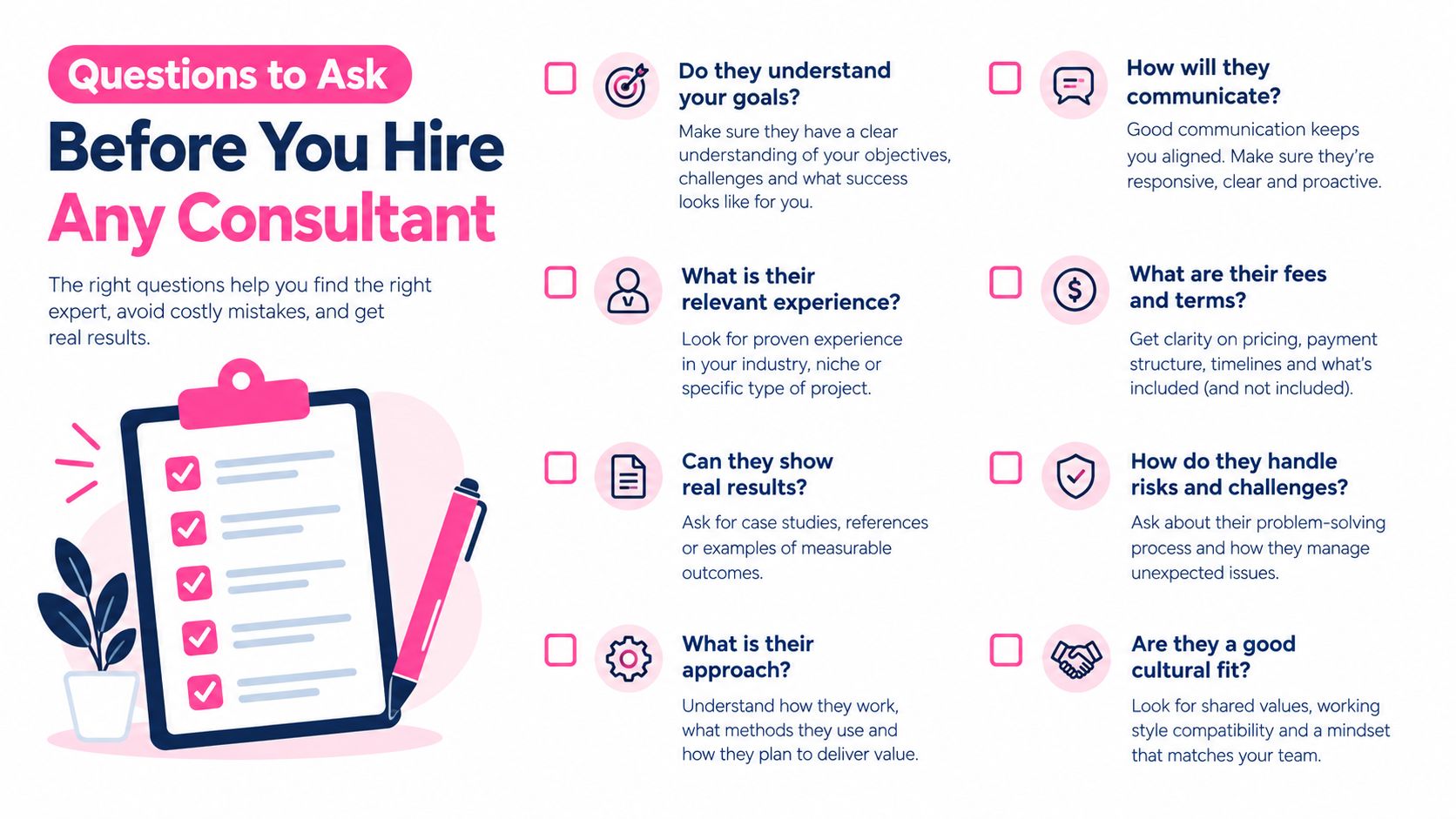
The fastest way to waste money is to hire someone who only knows template advice. Anyone can say “warm up slowly” and “clean your list.” A real consultant should be able to explain what they'll watch, what they'll pause, and what they'll do when mailbox providers disagree with each other.
Ask for operating thresholds, not slogans
Start with mailbox providers. Ask which providers they monitor separately and what thresholds trigger a pause. If they can't answer that clearly, they're guessing.
Ask how they handle DMARC rollout without breaking legitimate third-party senders. If the answer is “we set it and forget it,” keep your wallet shut.
Ask what their suppression process looks like. You want to hear immediate complainer removal, stale address cleanup, and disciplined handling of unverified records. Anything slower than that is a reputation leak in progress.
Then ask how they measure success. Complaint rate tells you about risk, inbox placement tells you about trust, and qualified replies tell you whether the audience cares. If they only talk about open rates, they're managing optics, not deliverability.
If a consultant promises 100% inbox placement, they're selling fantasy, not operations.
A good comparison point for service-style engagement models is the SDR pricing models guide, because outbound buyers should care about incentives as much as they care about deliverability mechanics.
Red flags that should end the call
Guaranteed inbox placement: nobody controls every mailbox provider.
Refusal to explain methods: that's secrecy, not expertise.
One-size-fits-all warmup: different sending realities need different controls.
No provider-specific thresholds: they're not monitoring the right signals.
No suppression discipline: they're willing to burn reputation for convenience.
A consultant who knows what they're doing won't be offended by those questions. They'll be relieved you asked them.
The ROI of Getting Delivered and a Better Way to Pay
Deliverability work pays for itself when it stops revenue from leaking out of the top of the funnel. Fix authentication, suppress complainers, and clean up bad data, and the same campaign often starts pulling more qualified replies because more of the right people see it. Rescue a domain pool before a launch, and you avoid the expensive embarrassment of paying for outreach that never had a chance.
The deeper point is this, deliverability is infrastructure, not a one-off project. It needs monitoring, discipline, and someone who gets punished when the system underperforms. That's why incentive alignment matters so much more than clever promises.
Ever Outbound Inc. runs managed, deliverability-first outbound with domain setup, warmup, monitoring, and client-facing execution, and it does it on a pay-per-close basis. You only pay a 5% commission when you close a deal, and your first two closes are commission-free. If you want a model that ties sending quality to outcomes instead of retainers, the cold email ROI calculator is a good place to pressure-test the economics.
If you need a team that handles outbound infrastructure, deliverability, research, copy, and booking in one managed system, visit Ever Outbound Inc. - on a pay-per-close basis. We build and run B2B outbound with deliverability first, then only get paid when deals close. If you want the work tied to outcomes instead of hours, that's the model to look at.