October 18, 2026
Email Marketing for Service Businesses That Books Real Calls
You're posting on LinkedIn between client calls, polishing the agency website, and watching another thoughtful post collect likes from people who aren't buying. Meanwhile, the pipeline meeting still ends with the same uncomfortable question: where's the next client coming from?
Email marketing for service businesses should help answer that question. But a sharper subject line won't fix a poorly chosen audience, a sending domain with broken authentication, or a dashboard that celebrates opens while your calendar stays empty. The useful version starts with the sending operation and ends with closed revenue.
Table of Contents
- Why Email Still Wins for Service Businesses in 2026
- Building Segments and Journeys That Match Real Buyers
- Crafting Offers and Sequence Templates That Earn Replies
- Engineering Deliverability Before You Scale Volume
- Automating Follow-Up and Handing Off to the Calendar
- Measuring What Actually Closes, Not What Opens
- When to Outsource and Your 30-Day Starter Plan
Why Email Still Wins for Service Businesses in 2026
For a small agency or MSP, attention and buying intent aren't interchangeable. Someone can appreciate your cybersecurity checklist without needing an IT partner. Someone else can urgently need help and never interact with your public content.
Email gives you a way to address a defined buyer with a relevant offer, then continue the conversation when their situation changes. That makes it useful for services where the buyer needs to discuss scope, trust the people delivering the work, and understand whether your approach fits.
The familiar gap between visible activity and commercial progress looks like this:

A relationship channel, not a checkout reminder
A consultancy isn't selling a sweater. Its buyer may need help defining the problem before they can evaluate a proposal. Your email should make that evaluation easier, not demand a sales call before providing anything useful.
In Gartner's survey of 632 B2B buyers conducted in August and September 2024, buyers preferred self-service for general learning but sought seller input for contextual tasks, including assessing organizational fit. That's a sensible design principle: provide useful information digitally, then offer human diagnosis when it matters.
Email's commercial history also predates today's marketing stack. On May 3, 1978, Gary Thuerk of Digital Equipment Corporation sent a promotional message to approximately 400 prospects through ARPANET; DEC attributed approximately $13 million in sales to it, based on its own reporting rather than an independent audit, according to this history of email marketing. The lesson isn't to imitate unsolicited mass sending. It's that a relevant professional audience can be commercially valuable without being enormous.
Fix the operation, not just the newsletter
The DMA's 2019 Marketer Email Tracker surveyed 197 UK marketers, who estimated £42.24 returned per £1 spent. That's a historical, UK-specific benchmark based on marketer estimates, not a forecast for your agency.
For an operator, the practical problems are more immediate:
- Weak segmentation: People with different problems receive the same pitch.
- Service-blind copy: Broad promises replace a concrete, believable next step.
- Fragile deliverability: The team scales before checking the sending infrastructure.
- Incomplete measurement: Marketing reports engagement while sales reports no opportunities.
Operator's test: If an email can't be connected to a buyer's problem and a commercial next step, it probably doesn't belong in the campaign.
For an adjacent industrial perspective, explore email marketing advice from Machine Marketing. Use it as a comparison resource, while keeping your own service offer and buying process at the center.
Building Segments and Journeys That Match Real Buyers
Start with one commercial outcome, such as a booked consultation or qualified estimate. Then decide who can plausibly take that action. Importing every contact into the same sequence is easier, but it makes the message do too many jobs.
A useful segment changes what you say, what you offer, or who handles the response. If it changes none of those, it may just be another spreadsheet column.
Build a worksheet your writers can use
Use the following fields as your contact-level worksheet:
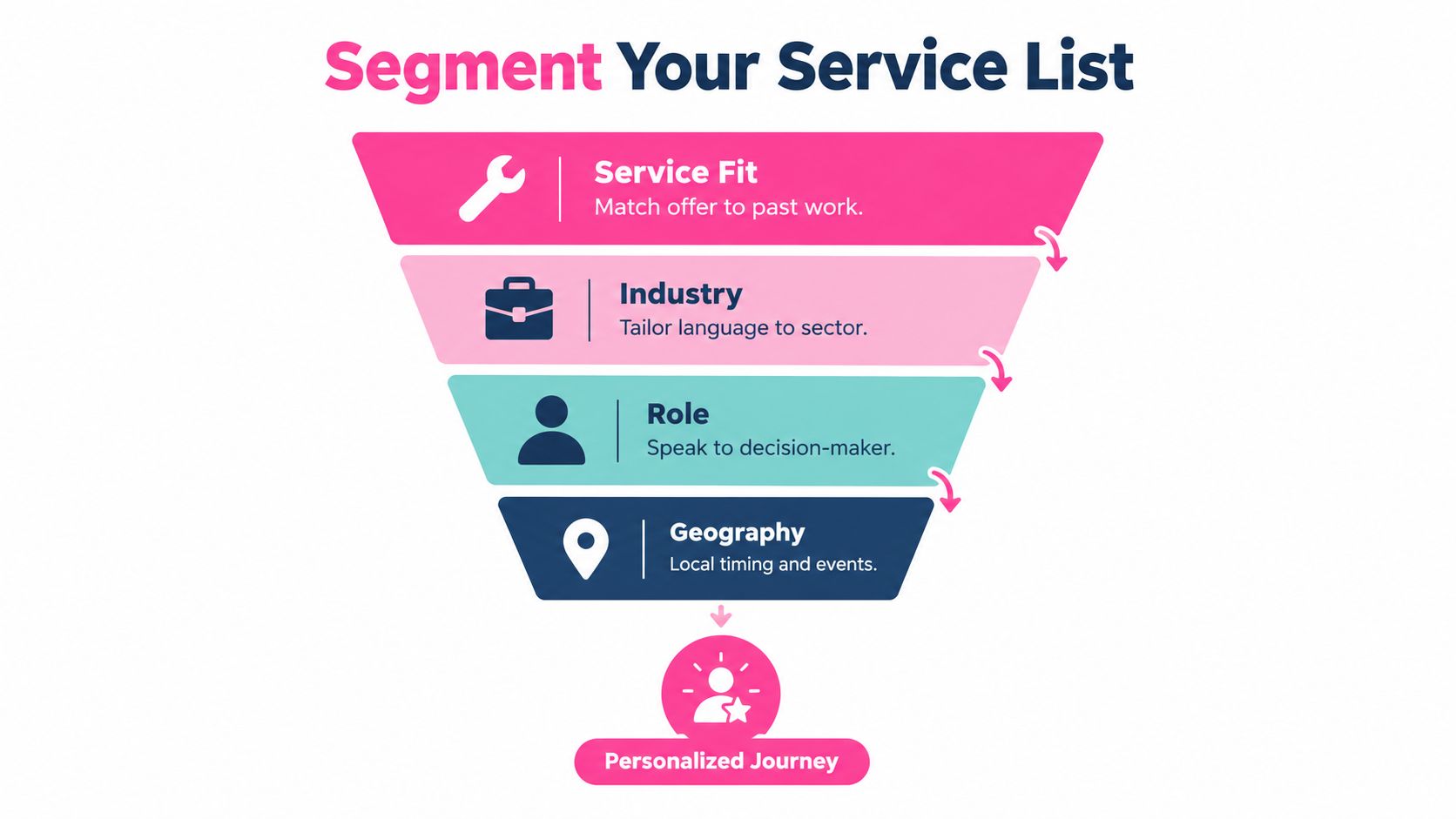
- Service fit: Which problem can you solve? An agency might distinguish positioning work from website implementation.
- Industry: What context changes the offer? An MSP serving professional firms shouldn't automatically reuse messaging written for manufacturers.
- Buying role: Who owns the decision? A recruiter's message to a hiring manager should differ from its message to procurement.
- Geography: Does delivery depend on location, working hours, or on-site coverage?
- Funnel stage: Is the contact learning, evaluating, negotiating, or already a client?
- Demonstrated intent: What did the person do, such as requesting an estimate or replying about a project?
Keep verified observations separate from assumptions. A published job opening can justify discussing hiring needs; it doesn't prove the company wants an external recruiter.
The core fit filters can be visualized before contacts enter a journey:
Five Journeys Every Service-Business List Needs
| Journey | Primary CTA | Suppress When | Success Metric |
|---|---|---|---|
| New lead | Request a fit consultation | Sales accepts the lead or they opt out | Qualified consultations |
| No-response prospect | Reply about the relevant problem | They respond, decline, or finish the sequence | Qualified replies |
| Active opportunity | Confirm the next decision step | Deal closes, is lost, or sales pauses outreach | Opportunity progression |
| Past client | Discuss a relevant new need | An account owner flags a conflict | Reactivated opportunities |
| Referral source | Make a suitable introduction | They decline or an introduction is underway | Accepted introductions |
The important distinction is journey versus segment. An agency founder in your target industry might begin as a prospect, become an active opportunity, and later enter a past-client journey. Their industry hasn't changed, but the appropriate conversation has.
Set movement rules before launch. A positive reply should stop prospecting and create a sales task. A booked consultation should stop booking reminders. A declined offer should record whether the objection concerns timing, fit, or a permanent preference not to hear from you.
For ambiguous responses, require human review rather than letting a keyword decide. “Not looking right now” isn't permission to restart the same pitch indefinitely. Record the context and, where appropriate, agree on a future follow-up.
Crafting Offers and Sequence Templates That Earn Replies
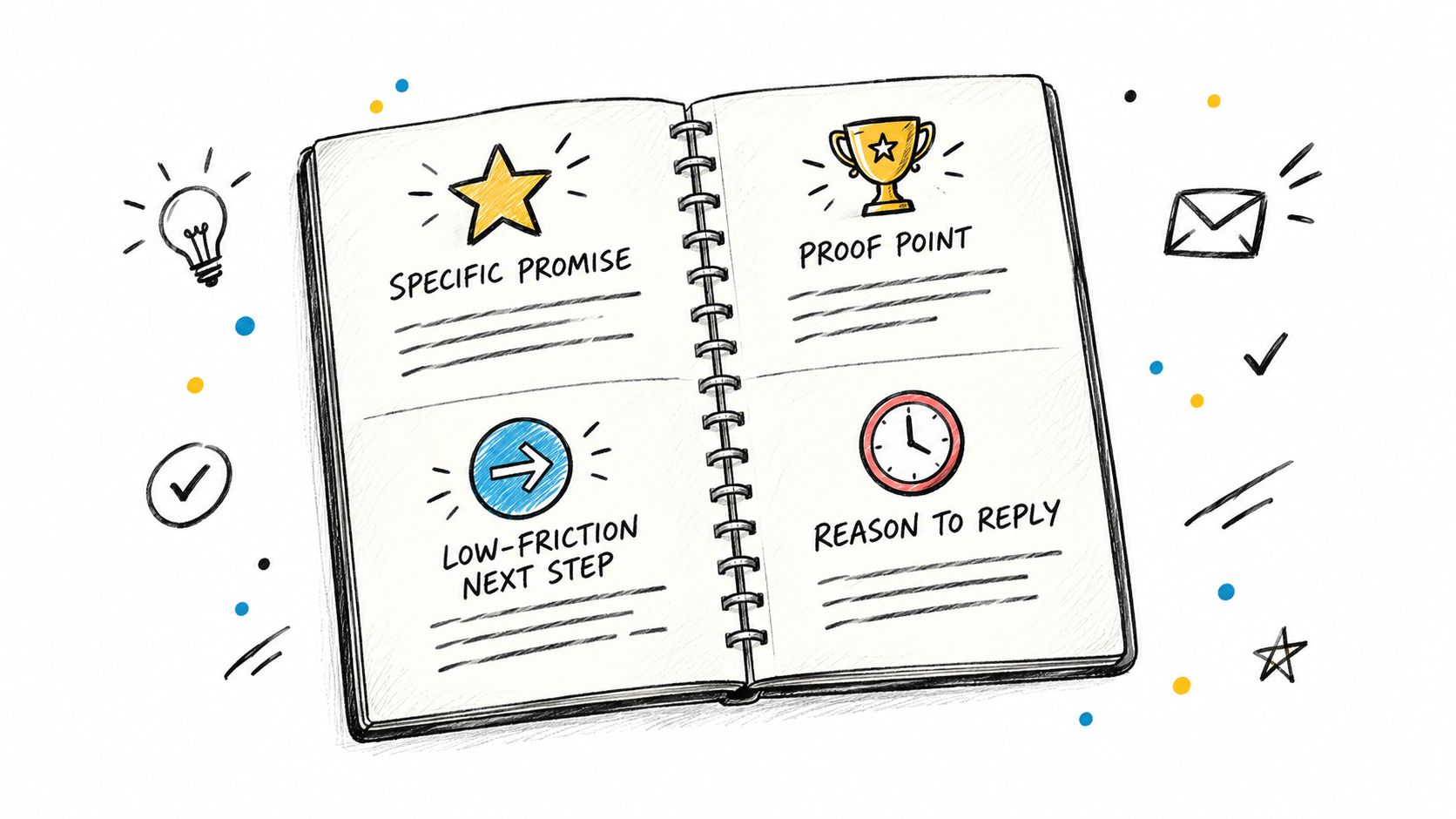
A service offer needs a specific promise, relevant proof, a low-friction next step, and an honest reason to act now. “We help businesses grow” doesn't give a buyer much to evaluate. “We'll review where your inquiry-to-consultation handoff loses context” describes an actual task.
These components should be clear before anyone writes the follow-up emails:
Proof must be real. Use an approved work sample, a documented process, or a relevant case study you can substantiate. If you lack outcome data, demonstrate how you work rather than inventing a success story.
Urgency also needs a basis. A known launch date can justify a timing question. Your desire to fill the calendar can't justify pretending availability is disappearing.
Cold agency outreach that starts with relevance
These illustrative drafts need verified personalization and actual supporting materials before sending. Each step introduces a different reason to respond rather than repeating “following up.”
| Step | Subject | Opening and body copy |
|---|---|---|
| Diagnosis | Your inquiry handoff | Hi [name], I noticed [verified observation about the inquiry process]. We help [specific segment] clarify the path from inquiry to consultation. Would a short handoff checklist be useful? |
| Relevant proof | An example of the handoff | Hi [name], here's an approved example of how we structure inquiry routing and qualification. The relevant part for [company] is [specific connection]. Would you like the annotated version? |
| Objection handling | Without rebuilding everything | Hi [name], this doesn't have to start with a website rebuild. We can first examine routing, response ownership, and qualification. Is one of those causing friction? |
| Consultation | Review the current process | Hi [name], if this is a live priority, we can review your current inquiry path together and identify what's worth changing. Would a fit conversation help? |
| Preference | Close the conversation? | Hi [name], I'll stop this sequence after this note. If the handoff isn't a priority, no action is needed. You can also reply to opt out of future outreach. |
For an MSP, replace the inquiry handoff with a relevant service issue, such as onboarding ownership. For a recruiter, focus on a specific hiring workflow. Change the diagnosis, not merely the industry noun.
Warm inbound follow-up that respects the download
An inbound guide download calls for a different opening. Deliver what the person requested before asking for their time.
- Delivery. Subject “Your guide.” “Hi [name], thanks for requesting the guide. The section on [relevant topic] is a useful starting point. What prompted you to explore this?”
- Application. Subject “Putting the checklist to work.” “Hi [name], start by mapping who owns each handoff. Would a blank worksheet help you apply the guide?”
- Proof. Subject “A worked example.” “Hi [name], this approved example shows how we approach [matching problem]. Is your process similar?”
- Offer. Subject “Want help assessing fit?” “Hi [name], if you're evaluating options, we can review your requirements and explain where our service would and wouldn't fit. Would that be useful?”
- Preference. Subject “Keep these updates?” “Hi [name], would you prefer practical resources, a conversation, or no further follow-up? You can unsubscribe using the option below.”
For a drafting starting point, use the email sequence generator, then check every observation, promise, and proof point yourself.
For a video resource alongside the written drafts:
Engineering Deliverability Before You Scale Volume
“Delivered” doesn't mean “seen.” A receiving server can accept your email without placing it in the inbox. Treating those events as equivalent can leave a team celebrating a technically successful campaign that prospects never encounter.
Validity's 2025 benchmark report put worldwide inbox placement at 83.5%, with 75.6% for Microsoft. Those benchmarks aren't predictions for your list, but they show why aggregate delivery rates aren't enough.
Authenticate and separate legitimate traffic
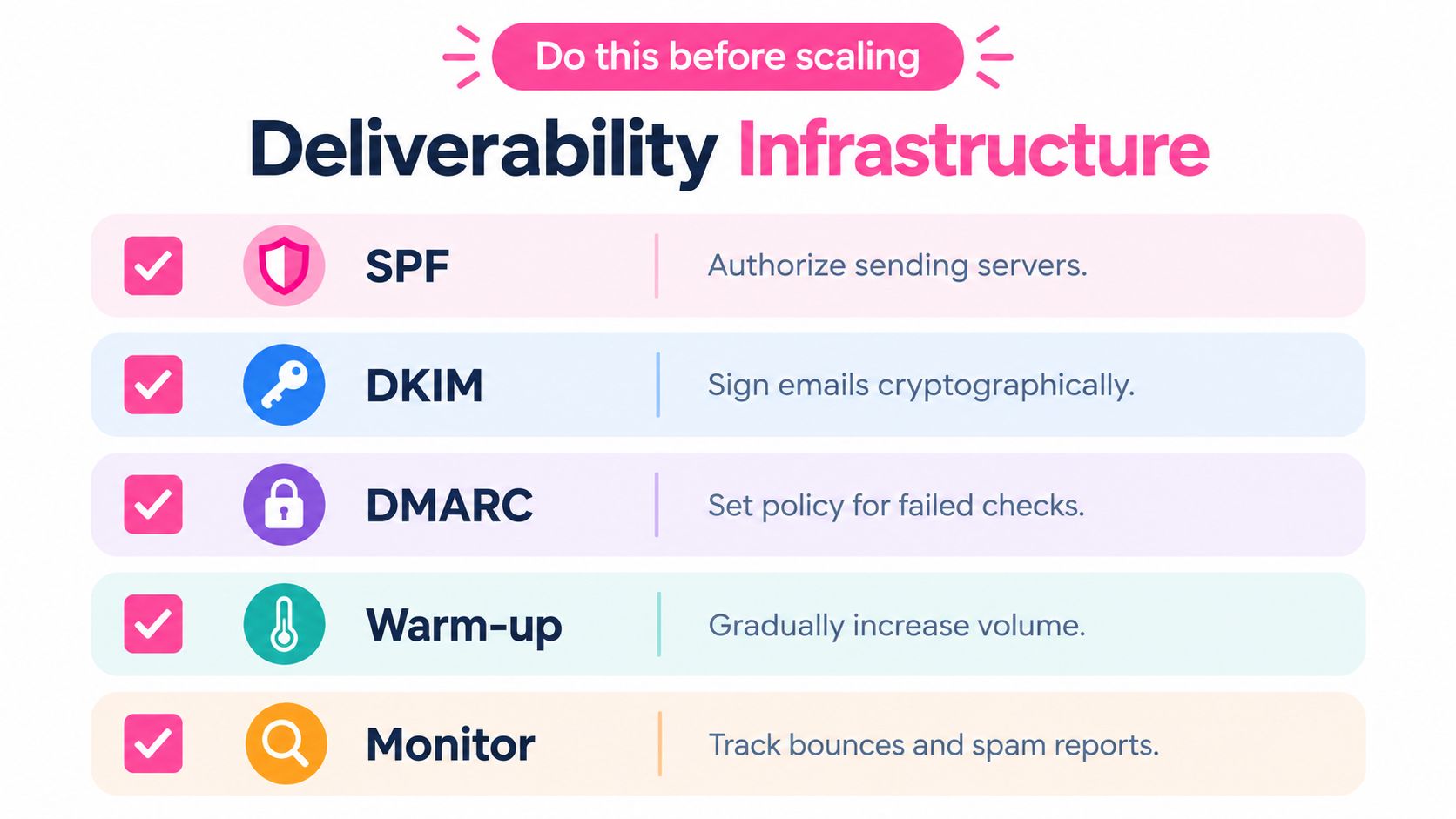
SPF identifies authorized sending servers. DKIM cryptographically signs messages. DMARC checks authentication alignment with the visible From domain and specifies how receivers should treat failures.
Authentication isn't a copywriting task. Someone needs to own the implementation, review reports, and check that every legitimate sending service still works.
- Inventory senders: Include your CRM, marketing platform, support system, invoicing service, and appointment tools.
- Implement SPF and DKIM: Scope authorization to legitimate services and enable signing for each sending stream.
- Introduce DMARC cautiously: Start with monitoring, investigate unauthorized sources and alignment failures, then progress toward quarantine or rejection after legitimate traffic passes consistently.
- Separate traffic logically: Don't mix newsletters, prospecting, and essential transactional messages into an undifferentiated operation.
- Validate the plumbing: Check recognizable From identities, reverse DNS, bounce processing, unsubscribe handling, and provider-level monitoring.
Watch for SPF lookup-limit problems, neglected DKIM selectors, and third-party platforms that break DMARC alignment. The email deliverability benchmark overview provides additional context for authentication and operational monitoring.
Use this checklist before increasing activity:
Know the provider rules before launch
Under Google's bulk-sender guidance, sending close to 5,000 or more messages to personal Gmail accounts within 24 hours can trigger bulk-sender classification, with traffic aggregated across the same primary domain. Requirements began in February 2024; Google recommends user-reported spam rates below 0.1% and avoiding 0.3% or higher, with mitigation eligibility potentially returning after rates remain below 0.3% for seven consecutive days.
For marketing and subscribed messages, Google's sender requirements require one-click unsubscribe for senders exceeding 5,000 messages per day, using the List-Unsubscribe-Post header with List-Unsubscribe=One-Click, alongside a clearly visible body unsubscribe link. Monitor complaints in Google Postmaster Tools rather than assuming a working unsubscribe footer is sufficient.
Permission-based newsletters and targeted B2B prospecting need distinct audience policies. Don't enroll researched prospects in a subscriber journey without notice, and don't assume technical authentication makes unwanted outreach acceptable.
Pause the affected stream when complaints, hard bounces, blocks, or inbox-placement indicators deteriorate. Investigate before adding volume.
Use the email deliverability checker as an initial diagnostic, not a replacement for provider-specific investigation. Review results by mailbox, provider, and segment so healthy traffic doesn't conceal a failing stream.
My operating preference is less volume with stronger qualification, not maximum volume with optimistic reporting. Gradual sending increases aren't a license to blast stale lists.
Automating Follow-Up and Handing Off to the Calendar
Automation should remove clerical work, not manufacture intent. A form submission can start an appropriate journey. A quote view can suggest a follow-up. Neither automatically means the person wants a meeting.
In Brevo's aggregated benchmarks across more than 175,000 active customers, automation emails recorded 30.63% opens and 7.39% click-through, compared with 20.73% opens and 2.27% click-through for standard campaigns. Treat that as directional evidence for behavior-led messaging, not a promise that switching on an automation will improve your results.
Give each trigger a job and a stopping condition
Connect the email platform, CRM, and calendar tool around contact status. The CRM should determine whether someone is still eligible for a message, while calendar events update the meeting record.
| Trigger | Appropriate action | Guardrail |
|---|---|---|
| Form fill | Deliver the requested resource and route by service fit | Don't send unrelated sales material |
| No-show | Offer a straightforward rescheduling option | Stop when they decline or reschedule |
| Proposal sent | Follow the agreed decision process | Let the opportunity owner control timing |
| Quote viewed | Ask whether scope or approval needs clarification | Confirm the activity is credible |
| Dormant account | Reopen a relevant conversation | Exclude disputes and do-not-contact records |
A tool such as Calendly can handle availability selection, but your routing logic still needs to establish who should attend and whether the request fits your service. Use the booking form to capture only information that helps prepare the call.
A quote-viewed workflow without the awkward chase
A practical mini flowchart looks like this:
Credible quote view → check opportunity status → check for a recent reply → send a contextual question → route the response.
If the prospect asks about scope, assign the reply to the proposal owner. If they explicitly request a conversation and already meet your qualification criteria, send the appropriate calendar invitation automatically. If their response is ambiguous, send it to a human reviewer.
The outgoing message should sound like a person who remembers the discussion: “Does the proposed scope match what your team needs, or is there an approval question we should address?” It shouldn't announce that you've been watching their clicks.
- Qualified interest: Offer the relevant calendar, confirm timezone, and record the booking in the CRM.
- Technical or commercial question: Assign a named owner rather than sending a generic booking link.
- Negative response: Stop the sequence and preserve the stated preference.
- Uncertain interpretation: Require review before sending.
AI-assisted drafting can summarize context and prepare a response. A person should verify claims, sensitive details, pricing, and any reply requiring judgment.
Audit the journey from acceptance through attendance. A consultation booking page is an endpoint, not the whole handoff: test confirmations, rescheduling, ownership, and whether automated prospecting stops once the meeting is booked.
Measuring What Actually Closes, Not What Opens
An open is a diagnostic signal, not a commercial outcome. Clicks can help identify useful content, but neither tells you whether the prospect had authority, attended a consultation, or signed a proposal.
Litmus's email marketing trends coverage reports that 15% of marketers still use open rate as a primary success measure despite privacy changes making opens less reliable. For a service business, that leaves too much of the buying process outside the dashboard.
Report the progression from response to revenue
Build a report that separates campaign activity from sales outcomes. Keep delivered messages and unique clicks available for diagnosis, but put the commercial stages where the team can't miss them.
- Qualified replies: Responses that establish relevant need or interest, not automatic acknowledgments.
- Meetings held and show rate: Distinguish booked appointments from attended conversations.
- Sales-accepted opportunities: Deals a salesperson confirms are worth pursuing.
- Proposal and close rates: Use clearly defined stage populations as denominators.
- Revenue and time-to-close: Connect the eventual contract to the original opportunity record.
- Cost per closed deal and revenue per recipient: Include execution costs, not just sending software.
Separate sourcing from influence
First-touch attribution identifies the interaction that initially brought the buyer into your tracked process. Last-touch attribution records the final tracked interaction before the chosen conversion. Assisted influence captures email's contribution to an opportunity that originated elsewhere.
An email might reactivate a referral-led opportunity without deserving all the credit for the deal. Conversely, an email-sourced opportunity shouldn't lose its origin because the prospect later typed your website address directly.
Store campaign and sequence identifiers on the contact and opportunity records, alongside dated replies, meetings, proposals, and stage changes. Preserve those relationships when the deal closes much later, and distinguish email-sourced revenue from email-influenced revenue rather than adding them together.
Reporting discipline: Agree on what qualifies as an opportunity before launch. Otherwise, the campaign manager and salesperson can report different versions of success.
For a professional-practice comparison, SimpleLab Digital's resource on how to grow your practice with email offers a useful adjacent reading path. Keep your reporting tied to your actual sales process rather than borrowing another sector's conversion assumptions.
When evaluating an appointment-based acquisition model, distinguish payment terms from performance evidence. A booked meeting is an intermediate outcome; judge the program by meeting quality and downstream revenue.
When to Outsource and Your 30-Day Starter Plan
Keep execution in-house when you have a clear offer, someone who owns deliverability, and capacity to handle replies consistently. Outsource when a lean team keeps postponing infrastructure work or founders are qualifying prospects between delivery emergencies.
Don't outsource an undefined offer and expect a vendor to solve every commercial problem. Ask who owns the domains, how negative replies are handled, what qualifies a meeting, and how campaign activity connects to closed deals.
Choose ownership before buying execution
Alongside an internal operator or specialist contractor, Ever Outbound, we're pay-per-close, is a managed option covering research, human-written outreach, sending infrastructure, and appointment setting. The first two closes are commission-free, followed by 5% per closed deal, as described in the publisher's acquisition-service comparison.
For a sector-specific comparison, explore Olivetree Marketing's email marketing for building and property. Use specialist resources to assess whether a partner understands your buyers, not just email software.
Put the starter month on the calendar
- Week one: Inventory senders, authenticate, and segment the list.
- Week two: Build a prospect sequence and an inbound nurture sequence.
- Week three: Connect behavioral triggers, reply routing, CRM stages, and calendar events.
- Week four: Review qualified conversations and opportunity progression, then decide what to keep in-house.
The first month should establish a controllable operation. Don't declare victory because it produced activity, or failure because a long-cycle deal hasn't closed yet.
At Ever Outbound Inc., we're pay-per-close, providing managed B2B outreach with prospect research, human-written sequences, sending infrastructure, and qualified-call booking. Visit us to discuss your offer, target buyers, and sales handoff so your email program is built around real conversations and closed deals, not a bigger open-rate chart.