October 18, 2026
How to Get Consulting Clients in 2026
“Network more” is lousy advice when you can't explain what someone should hire you to do. So is “post consistently” when your posts lead to a website that reads like a consulting dictionary. If you're figuring out how to get consulting clients, stop shopping for channels and start connecting your offer, evidence, outreach, and sales process.
A busy calendar isn't the objective. Signed engagements with clients you can serve profitably are. Build your acquisition process around that distinction, and you can stop treating business development like a slot machine.
Table of Contents
- Stop Collecting Tactics and Build a Client Acquisition System
- Design an Offer That Sells Itself
- Turn Referrals into a Repeatable Channel
- Run Outbound That Earns Replies Instead of Crickets
- Build Pipeline Insurance with Thought Leadership
- Stack Partnerships and a Close Process That Converts
- Your 90 Day Rollout Plan and Operating Metrics
Stop Collecting Tactics and Build a Client Acquisition System
The consultant running five disconnected tactics doesn't need a sixth. They need an operating system.
A LinkedIn post, podcast appearance, referral introduction, and cold email should all point toward the same commercial destination. If each presents a different version of your expertise, you're making buyers assemble your proposition themselves. Don't assign homework to someone who hasn't hired you.
Connect the commercial components
Build your acquisition system around offer, proof, channel, and close:
- Offer: Name the buyer, the expensive problem, and the outcome you're equipped to deliver. A prospect should recognize their situation without needing a discovery call.
- Proof: Show the starting conditions, your intervention, and documented results. Credentials belong here, but they aren't a substitute for relevant evidence.
- Channel: Choose routes to identifiable buyers. Referrals, LinkedIn, podcasts, and outbound are distribution decisions, not separate business models.
- Close: Define how you qualify an opportunity, diagnose the problem, scope the engagement, and secure a decision.
Wire those components together before expanding activity. The relationship between channels should look like this:
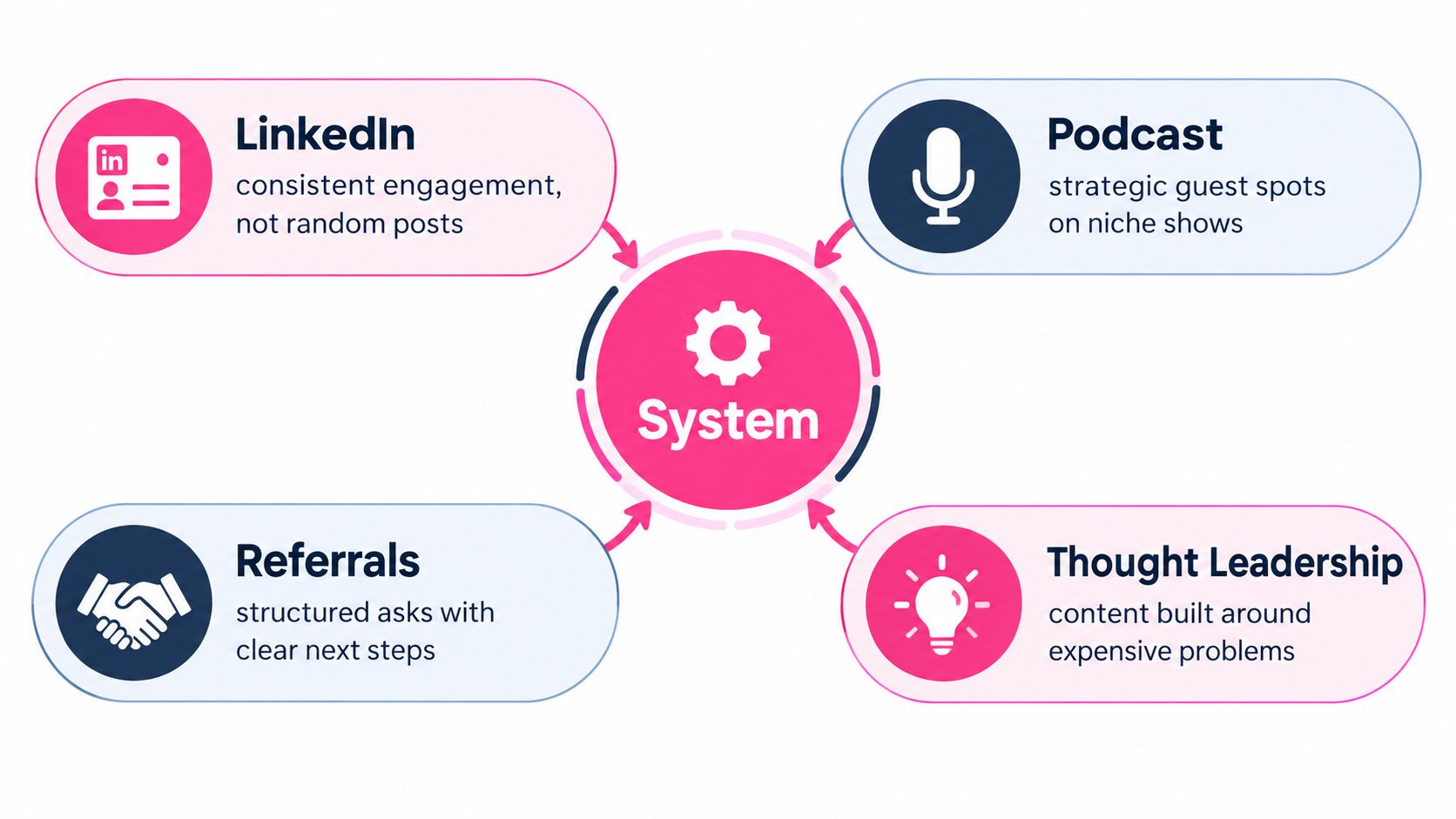
The website is part of the sales process, not a decorative expense. More than 80% of professional-services buyers visit a firm's website before contacting it, according to the buyer research summarized in Thinkable Group's analysis of consulting client acquisition. Sending prospects toward vague positioning wastes the attention you worked to earn.
Diagnose the leak before buying another tool
Look at the last opportunity that stalled. Did the buyer fail to recognize the problem, question your credibility, disappear before the meeting, or hesitate at the proposal?
Those are different problems. More outreach won't repair weak evidence, and another case study won't fix a proposal with unclear responsibilities.
Practical rule: Increase activity only after you know which stage needs more qualified demand and which stage needs better execution.
Use the consultant acquisition service overview as a reference when deciding which acquisition work to delegate. Keep responsibility for positioning and qualification yourself, even if someone else executes the campaign.
A solo consultant doesn't need an elaborate software stack. A clear offer page, relevant evidence, a working CRM, and a disciplined review habit are a sensible starting point.
Design an Offer That Sells Itself
“I help B2B SaaS companies grow” gives a buyer no reason to choose you. It doesn't identify the problem, the person who owns it, or the work you'll do. A strong offer connects those pieces, then gives referrals, outbound, and thought leadership a clear message to reinforce.
Your offer won't sell itself. It should make the right buyer recognize their situation before you start explaining your résumé.
Begin with conversations, not copy. Ask current and former clients what triggered their search, how they described the problem internally, and what nearly stopped them from hiring you. Use their answers to shape an ideal-client profile and a bounded engagement.
For example, an ICP sheet can specify industry, company size, economic buyer, buying trigger, and operating conditions. Include disqualifiers, such as missing implementation capacity or unavailable data. That keeps poor-fit opportunities from consuming the sales process.
Then define the work in plain language:
- Problem statement: Name an observable business issue. “Marketing isn't aligned” is vague. “Sales rejects inbound opportunities because teams use different qualification criteria” can be investigated.
- Offer box: State what you examine, what you deliver, what the client must contribute, and what falls outside scope.
- Outcome definition: Choose a metric for assessing progress and establish its baseline with the client.
Quantify what you can defend. A measurable outcome helps both sides assess progress; an unsupported performance guarantee weakens trust.
A fractional CMO example
Treat this as an illustrative positioning exercise, not a reported client result.
Broad: “I help B2B SaaS companies grow.”
Specific: “I help founders of mid-market cybersecurity SaaS companies diagnose why enterprise opportunities stall between demo and procurement, then align positioning, qualification, and buyer evidence with the actual decision process.”
The second version gives a referral partner a recognizable problem to listen for. It also gives a prospect a sharper starting point: is the procurement bottleneck caused by positioning or by the sales process? The offer now links the buyer's problem to a defined intervention.
No response-rate claim is needed. The improvement is specificity: a defined buyer, a recognizable problem, and work the consultant can explain and scope.
Build a proof page to support that offer. Show relevant project evidence, your method, engagement boundaries, and what you need from the client to begin. If you lack a comparable case study, publish a diagnostic walkthrough that demonstrates how you reason. Don't present it as proof of results you haven't achieved.
End with a positioning sentence someone can forward unchanged. If a referral partner has to translate your expertise before making an introduction, tighten the offer.
Turn Referrals into a Repeatable Channel
A referral should enter the same acquisition system as outbound: a clear offer, credible proof, a defined next step, and a way to measure what happens. Goodwill starts the conversation. A repeatable process turns it into pipeline.
Your offer should give people a specific problem to recognize and a reason to connect you. Research in Hinge's guide to rethinking referral marketing reports that 71% of buyers ask friends or colleagues when searching for a provider, and 81.5% of firms receive referrals from people who were never clients. Build relationships beyond your client list.
Start with the people who see your buyer's problem before you do. A former client may recognize the same issue in a peer; a complementary specialist may spot it while doing adjacent work. Ask each person to listen for a particular situation, not to promote your general availability.
For example, a fractional CFO may notice that a company's unreliable forecasts are blocking a growth decision. Give that CFO a simple cue for when your revenue consulting could help. Accountants and recruiters may spot leadership changes or capability gaps. Technology partners and former colleagues may see different buying signals. Tailor the request to what each person can observe.
Make the introduction easy to assess and easy to decline. Ask: “Do you know a founder at a cybersecurity SaaS company whose enterprise opportunities keep stalling during procurement? If someone comes to mind, would you be comfortable checking whether they'd welcome an introduction?”
Then offer a forwardable note:
I'd like to introduce a consultant who helps cybersecurity SaaS founders diagnose stalled enterprise deals. If that's relevant to your team, I can connect you for an exploratory conversation, with no expectation of an engagement.
That script sets a low-pressure next step. It doesn't make the referrer your salesperson, and it gives the prospect room to say no.
After an introduction, thank the referrer promptly and handle scheduling directly with the prospect. Send a brief status update when appropriate, while keeping confidential commercial details private. If the prospect doesn't respond, ask the referrer whether another follow-up would be welcome. Don't turn one introduction into repeated pressure on both people.
Track each referral in your CRM: source, introduction date, meeting status, proposal, outcome, and reason for loss. Use the guide on how to track referrals that convert to shape that workflow. Review introduction-to-meeting and meeting-to-close conversion, along with elapsed time. A manageable circle of people who understand your work beats a large directory of contacts who don't know whom to send.
Run Outbound That Earns Replies Instead of Crickets
Cold outbound deserves its bad reputation when consultants send generic capability decks to people with no observable reason to care. A prospect's first name isn't personalization. It's a mail-merge field.
Keep the targeting decision visible before you write the message:

Write around a buying trigger
Select a small account cohort with a verifiable change: a new executive, funding event, compliance requirement, geographic expansion, or visibly stalled initiative. Record the evidence, likely consequence, affected stakeholder, and uncertainty before drafting outreach.
Gartner reports that 73% of B2B buyers actively avoid suppliers sending irrelevant outreach, and 61% prefer an overall rep-free buying experience, in its survey of B2B buying preferences. Earn a conversation by helping the buyer investigate, not by demanding attention.
An illustrative message might read:
Your enterprise expansion announcement caught my attention. If procurement now involves more security stakeholders, your existing sales materials may not answer their approval questions. I'd check where opportunities stall and which evidence buyers request. Is that a current issue, or is the team already handling it?
The message distinguishes observation from hypothesis. You know about the announcement. You don't know the internal bottleneck.
Follow with useful material: a diagnostic question, relevant methodology, or documented case pattern. Coordinate email and LinkedIn rather than sending duplicate pitches through both. Feather's collection of actionable lead gen ideas for founders can help broaden your experiments without abandoning the buyer profile.
For another format to review alongside your written message, use the video below:
Respect the infrastructure
Google classifies senders reaching approximately 5,000 messages to personal Gmail accounts within 24 hours as bulk senders; its Gmail sender guidance requires SPF, DKIM, DMARC, domain alignment, and easy unsubscribing, and advises keeping reported spam below 0.1% while preventing it from reaching 0.3%. Don't treat those thresholds as sending targets.
Monitor complaints, suppress unsubscribed recipients, and control volume. Use the cold email grader when reviewing drafts, but verify every claim yourself.
- Message quality: Track positive replies and qualified meetings by segment and hypothesis.
- Commercial quality: Track attendance, opportunities, and closed revenue. A polite reply isn't pipeline.
Keep outbound in-house when you can research accounts and manage follow-up consistently. Ever Outbound, where we're pay-per-close, is one managed option when execution competes with delivery work: you only pay commission when a deal closes, and your first two closes are commission-free, as described in the service and pricing overview. Delegating execution doesn't remove your responsibility to qualify and close.
Build Pipeline Insurance with Thought Leadership
A strong offer and a well-run outreach process still leave gaps: buyers may need proof before they reply, and partners need something credible to share. Thought leadership fills those gaps when it answers a costly question better than a generic sales message.
Treat it as pipeline insurance, not passive income. A useful asset keeps demonstrating your judgment when you are not in the room, and gives other channels evidence to point to.
The commercial case is meaningful. In 2024 Edelman–LinkedIn thought leadership research, 75% of respondents said thought leadership prompted them to research an unfamiliar product or service, 73% considered it more trustworthy than traditional marketing materials, and 86% were moderately or very likely to invite a strong publisher into an RFP process.
Start with the decisions your target buyers struggle to make. A revenue consultant might address how to diagnose pipeline quality, distinguish positioning problems from qualification problems, or assess readiness for enterprise selling. Build a small portfolio around those questions, then select the format that best helps a buyer act.
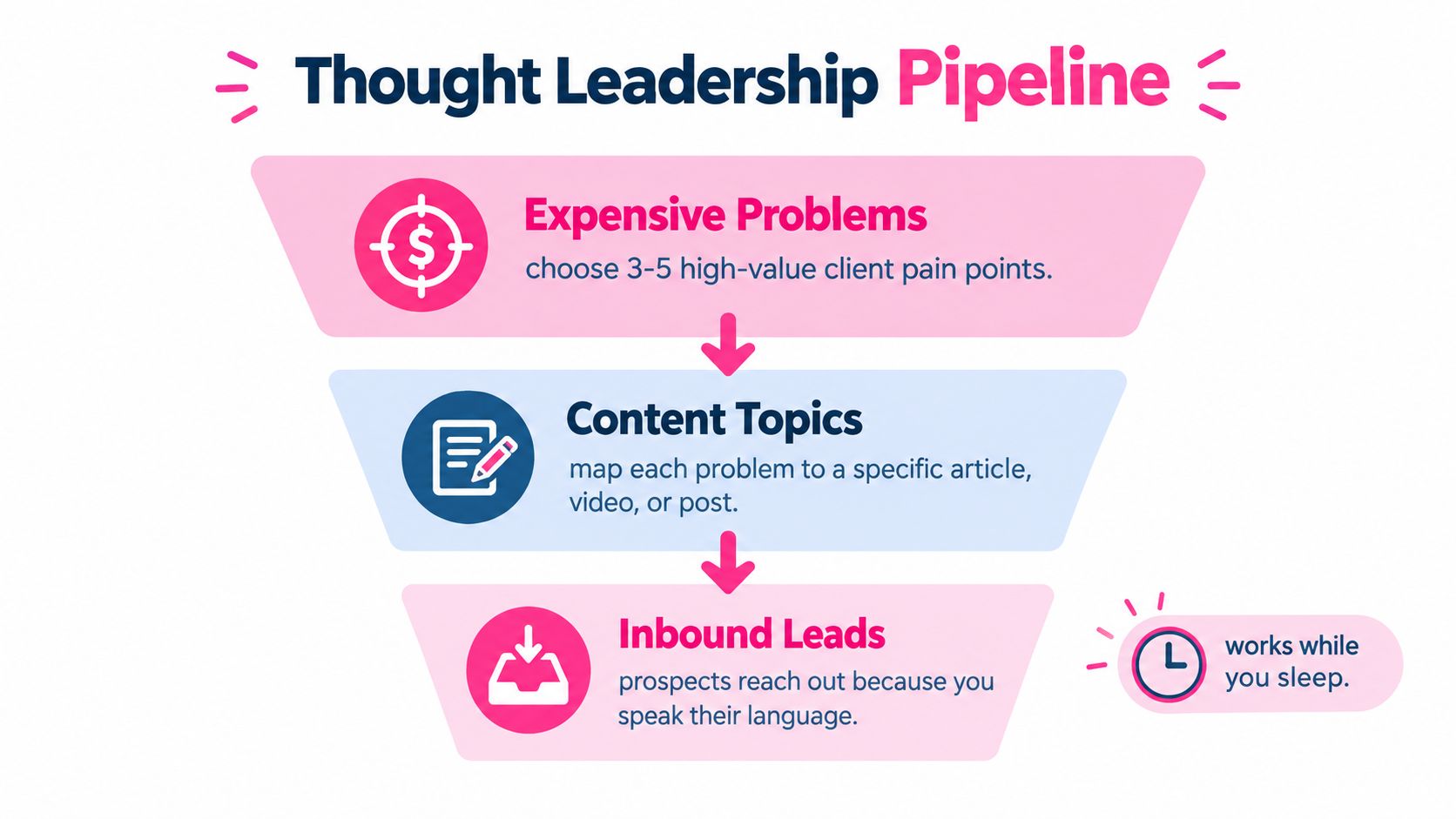
A diagnostic framework can lay out the questions, evidence, and decision branches you use, including where the diagnosis can fail. A benchmark report needs measurements you legitimately collected, plus clear methodology and limitations. Without suitable data, publish a qualitative briefing instead. A client teardown should explain the intervention and its trade-offs, with permission or appropriate anonymization. Never present a hypothetical as client work. An executive briefing can take a position on a costly decision, explain the reasoning, and state where the recommendation does not apply.
A teardown often shows more judgment than a celebratory case study. Buyers see how you diagnosed the problem, not just the outcome. Keep documented results in a social proof library, separate from educational material. Your argument shows how you think; the evidence shows what happened in real engagements.
Give each asset a job across the acquisition system. Publish the full piece in a stable location, then adapt its strongest argument for LinkedIn, a newsletter, or a relevant prospect conversation. For speaking opportunities, use Podmuse podcast lead generation to identify options. Choose audiences by buyer fit, not follower count.
Partners should have a reason to share the material even when you are not selling. That standard keeps the content useful, strengthens proof across channels, and gives interested buyers a clear next step.
Stack Partnerships and a Close Process That Converts
A partner channel works when it reaches a buyer as a decision takes shape. Shared audiences are a weak reason to collaborate. A marketing agency and an accountant may serve the same businesses yet encounter different needs. Choose partners for problem adjacency, sound professional standards, and selective introductions.
Set the commercial terms before you announce anything. For a webinar or shared diagnostic, agree on the buyer, topic, follow-up owner, and handling of client information. Document and appropriately disclose any referral compensation.
Three models can work, provided each has clear boundaries:
- Reciprocal introductions: Define a good-fit prospect in both directions. Don't promise equal lead volume or refer someone unsuitable to repay an imagined obligation.
- Joint education: Address a connected buyer problem from distinct perspectives. A fractional CFO and a revenue consultant, for example, could explain how forecasting assumptions affect opportunity qualification.
- Shared delivery: Set scopes, ownership, client communication, and fees before work starts. Unclear responsibilities can erase the margin.
Every introduction puts the partner's reputation on the line. Decline poor-fit work promptly, and explain why.
The handoff should lead into a decision, not a stack of sales material. Gartner found that B2B buyers are 1.8 times more likely to complete a high-quality deal when they use supplier-provided digital tools with a sales representative rather than independently, according to its B2B buying journey research. Put useful evidence in the buyer's hands, then discuss what it means for their situation.
Buyers reportedly use an average of 4.8 methods to vet professional-services providers, as summarized in Mixology Digital's B2B buying statistics. Prepare relevant methodology, engagement boundaries, and FAQs before the call. The Merci Beaucoup Consulting case study offers an example of how to organize engagement evidence. Use its structure as a reference, never its results as your own.
On the call, establish the current condition, business consequence, prior attempts, decision owner, and capacity to implement. Then ask how the organization will approve the work and who else needs to assess it.
Don't write a proposal until you understand what the buyer needs to decide.
Build the proposal around the diagnosed problem, intended outcome, scope, exclusions, client responsibilities, commercial terms, and approval process. Distinguish commitments you control from outcomes that depend on client execution.
Finish with a named owner and an agreed next action. “I'll send something over” leaves the opportunity without a decision path.
Your 90 Day Rollout Plan and Operating Metrics
Treat the next 90 days as an execution window, not a revenue guarantee. Ship the minimum viable system while continuing to serve clients. Don't spend the entire period selecting software.
Sequence the work
90-Day Consulting Client Acquisition Plan
| Week | Primary Focus | Output to Ship | Metric to Watch |
|---|---|---|---|
| 1–2 | Offer and proof | ICP sheet, positioning sentence, offer page, relevant evidence | Qualified inquiries |
| 3–6 | Referrals and outbound | Partner asks, trigger-based account cohort, tested messages, thought leadership asset | Qualified meetings booked |
| 7–10 | Partnerships and closing | Joint educational activity, discovery checklist, proposal structure | Show rate and proposal-to-close rate |
| 11–13 | Review and refinement | Channel analysis, revised hypotheses, documented operating process | Revenue per channel |
Use the outbound volume planner to plan activity against your meeting capacity. Volume should fit your ability to research, respond, sell, and deliver.
Review outcomes, not busyness
Review the CRM weekly. Record original acquisition source and meaningful assisting touches separately, so a referral-supported outbound opportunity doesn't get counted twice.
Watch qualified meetings booked, show rate, proposal-to-close rate, and revenue per channel. Add delivery margin before deciding which engagements you want more of. Don't shut down a channel merely because its early opportunities haven't had time to reach a decision.
Choose the next experiment from the actual bottleneck. If meetings are qualified but proposals stall, investigate approval requirements before sending more emails.
Keep tomorrow's checklist short:
- Choose a buyer: Start with a client type whose problem you understand.
- Ship the offer: Make the scope and outcome understandable without explanation.
- Activate a route: Launch a specific referral ask or trigger-based outreach experiment.
- Record the evidence: Track what buyers do, where they hesitate, and why.
You don't need another half-finished tactic. You need a repeatable process you can operate when client delivery gets busy.
Ever Outbound Inc. provides done-for-you B2B acquisition for consultants, and we're pay-per-close, with human-led prospect research, outreach writing, and appointment setting. Visit to discuss a defined consulting offer and target buyer, so you can delegate campaign execution while staying responsible for qualification, sales conversations, and closing.