November 2, 2026
How to Write a Cold Email That Gets Replies in 2026
Your prospect has just opened a second location, hired a new operations lead, or announced a product launch. You've got a plausible reason to reach out, and about one inbox preview to prove it isn't another message that begins “I hope this finds you well.” That's where how to write a cold email stops being a wordsmithing exercise and becomes a test of relevance, honesty, and restraint.
A strong message gives one person a clear reason to read, a credible connection to a business problem, and one easy next step. The clever line is optional. The accurate one isn't.
Table of Contents
- Research One Trigger Before You Type a Word
- Subject Lines That Get Opened Without Lying
- The Five Parts of a Cold Email With a Full Sample
- Compliance and Deliverability Checks Before You Send
- Follow-Ups That Add Something New
- Track Positive Replies and Send Your First Ten
Research One Trigger Before You Type a Word
The lines that get a cold email deleted in under two seconds all fake familiarity. "I loved your company's journey" tells the prospect you ran a mail merge and called it research. Real personalization is one recent, verifiable business trigger that gives the message a reason to exist, and it works like a constraint: if a detail can't survive a quick check, it doesn't belong in the email.
Find a business trigger. Look for a funding announcement, a role that's hiring, a product change, a new market, or a visible operational bottleneck. Good: the careers page lists three open customer success roles. Bad: praising an "inspiring growth story" when the only evidence is a profile headline.
Turn the trigger into one hypothesis. Connect what you found to a possible cost, risk, or missed opportunity. Good: "Hiring three CSMs at once can make onboarding hard to coordinate." Bad: "Your growth is definitely costing you customers." The first is a question worth answering. The second claims you audited their business from a job post.
Verify the detail. Check a second reliable source before the claim goes in the email. A funding announcement confirmed on the company's own news page is sturdier than an aggregator snippet that may be months old. One wrong detail reads worse than no personalization, and it carries a deliverability cost too: recipients who feel misled report spam, and complaints damage sender reputation faster than weak copy ever will.
Aim the hypothesis at the recipient's role. A head of customer success cares about ramp time for new hires; a CFO cares about what slow ramping costs. I'd write the same trigger differently for each, because a line that lands as relevant for one reader lands as generic for the other.
Use one detail, then stop. Business context earns attention. Family photos, school names, and weekend posts read like research conducted for the wrong reasons, and personal data scraped for effect creates a compliance problem before the email is even judged on its offer.
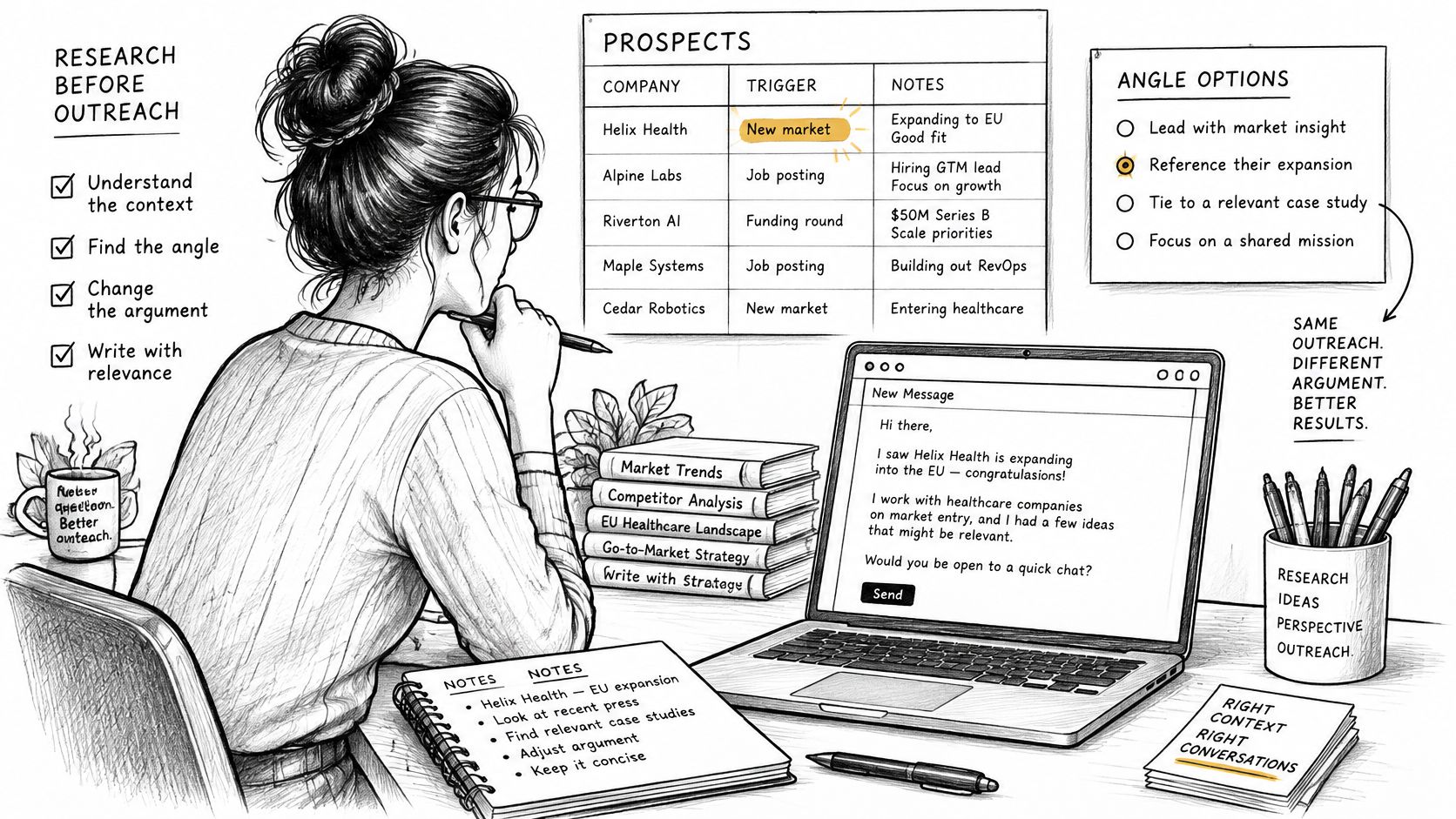
In 2024, personalized cold-email campaigns achieved reply rates of up to 18%, compared with approximately 9% for generic templates, according to Gaidme's personalization analysis. Treat that as a reported result rather than a promise for your list. If you're building an ecommerce prospect segment, ecommerce lead generation strategies can help you decide who to target and why. Before sending, run the addresses through the lead list cleaner so a dead address never gets the chance to bounce. Then reuse the checklist: trigger, hypothesis, source, role angle, one detail.
Subject Lines That Get Opened Without Lying
Clever subject lines are overrated. A subject line has to earn an open without writing a cheque the email can't cash. “Quick question” can work, but it doesn't tell the reader much. A real topic or trigger does, and it gives the first sentence somewhere honest to go.
Personalized subject lines were reported to be 26% more likely to be opened in 2024, according to data summarized by Gaidme's subject-line analysis. That's a reason to make a subject relevant, not permission to fake familiarity. A reply-thread disguise such as “Re:” or “Fwd:” might provoke a glance, but it also tells the prospect you're willing to mislead them before they've read a word. Not an ideal opening reputation.
Use a clear topic, a real business trigger, or a question the body answers:
- Role-specific question: “Who runs onboarding for your second Leeds site?”
- Trigger reference: “Saw your second site open in March.”
- Short topic label: “Hiring workflow for logistics teams.”
- Direct problem question: “Is slow warehouse hiring costing you shifts?”
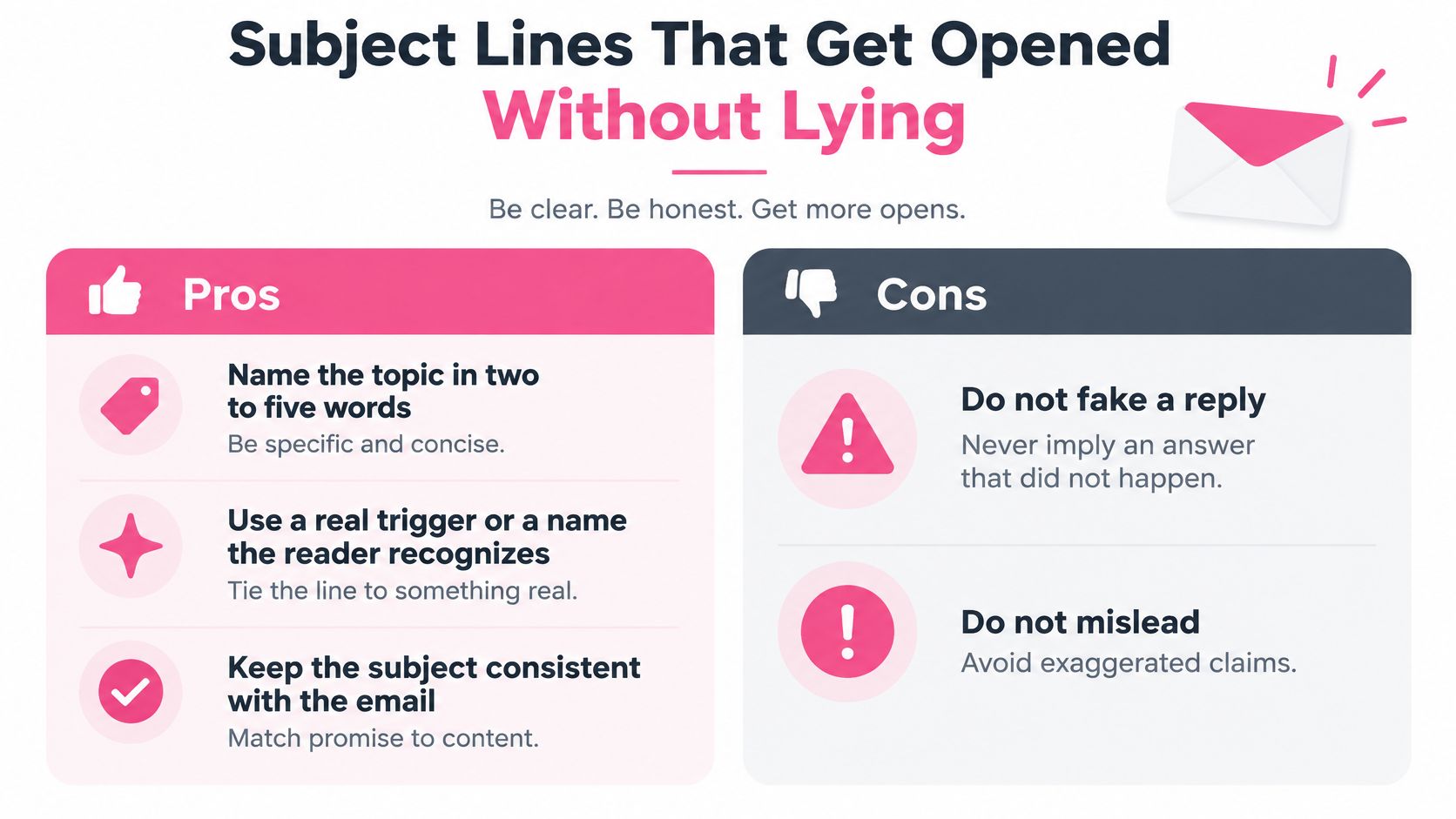
Each line names a subject the email can discuss. Keep the subject to a few specific words where possible, and don't suggest you've met, imply a reply, or inflate the stakes. Readers who feel tricked are more likely to report the message than start a useful conversation, and complaints can affect whether later emails reach the inbox.
The subject is a promise. The first sentence should deliver on it immediately, not wander through a greeting and a company biography. Read the subject aloud beside the first line. If the two don't match, rewrite the subject.
Here's a short video to pair with the examples:
The Five Parts of a Cold Email With a Full Sample
| Part | Job | Word budget | Example line |
|---|---|---|---|
| Subject line | Signal the topic honestly | 4-7 words | Hiring for two sales roles in Leeds? |
| Opening line | Show one real trigger you noticed | 1 sentence | Saw your Manchester office opened in March. |
| Problem bridge | Link the trigger to one cost | 1-2 sentences | New hires may wait for account access. |
| Proof point | Give verifiable evidence, or leave a placeholder | 1-2 sentences | [Verified result from a similar client] |
| Ask | Make one low-friction request | 1 sentence | Worth a short look at how you'd handle it? |
| Sender line | Identify you, your company, and a physical postal address | 1-2 lines | [Name, company, and postal address] |
The table is a working skeleton, not a reason to stuff every row with sales copy. A study of 5,187 cold emails recommended keeping the first message below 150 words and introducing the sender early; treat its findings as directional rather than a universal performance guarantee, as discussed in the cold-email study.
A sample you can adapt
Subject: Second site hiring workflow
Saw your logistics company opened a second site in Leeds. I'm Alex from Northline Recruitment, a Leeds-based recruitment firm.
As the new location ramps up, coordinating hiring and onboarding across two sites may create extra work for your operations team.
[Add one verified result from a similar logistics client, or remove this sentence if you can't substantiate it.]
Would a short conversation about your hiring workflow be useful?
Alex Morgan
Northline Recruitment
[Valid physical postal address]
If this isn't relevant, reply and I'll stop contacting you.
Why each line earns its place
The subject names the actual topic. The opening establishes the trigger and identifies the sender rather than making the reader wait through a suspenseful origin story. The problem bridge presents a hypothesis, not a claim about the company's internal operations. The bracketed proof point must be replaced with something specific and verifiable; if you don't have it, cut it rather than inventing a polished-sounding result.
The ask is one question the recipient can answer without accepting a meeting on the spot. The sender line makes the business identifiable and includes the address. The opt-out gives the reader a clear way to end the conversation.
Three familiar mistakes ruin this structure. Listing every service makes the prospect sort through your offer for you. Stacking three calls to action creates indecision. Opening with a long company introduction delays the point until the reader has already left.
For a quick copy check, run the draft through the cold email grader.
One reader, one problem, one ask. Read the email aloud at normal speed and cut every sentence that doesn't move toward the ask.
Compliance and Deliverability Checks Before You Send
Compliance isn't footer housekeeping. It shapes the sender identity, the subject, the close, and whether the recipient can make your messages stop. Under the U.S. CAN-SPAM Act, commercial cold email needs a clear opt-out method even when the recipient never subscribed. The FTC's CAN-SPAM compliance guide says the method must keep working for at least 30 days, and senders must honor opt-outs within 10 business days. It can't require a fee or extra personal information beyond an email address.
Run this checklist before launch:
- Include a valid physical postal address. Your footer should tell recipients who you are and where your business is located. A logo isn't a postal address, however confidently it's designed.
- Use an accurate sender identity and subject. The From name should match the actual person or business, and the subject should describe the email rather than impersonate a reply.
- Make opting out simple and visible. Give recipients a working way to decline, without a fee or a scavenger hunt through your website.
- Process opt-outs promptly. Suppress the contact within the legal deadline, and keep the opt-out mechanism operational after sending.
- Authenticate your sending domain. Google requires bulk senders to use SPF, DKIM, and DMARC, with domain alignment for the From address, according to its Gmail sender requirements.
- Support one-click unsubscribe for bulk marketing to personal Gmail accounts. Google's rules apply at approximately 5,000 messages in 24 hours; a link in the email body alone doesn't meet the one-click requirement.
- Keep complaint rates below the cited threshold. Gmail-related guidance sets a target below 0.3%, as summarized in Broadcom's deliverability guidance. Complaints are a sign to review targeting and copy, not a cue to send louder copy.
- Warm new domains and mailboxes, then start small. Broken authentication can sink a perfectly written email before a human sees it.
For teams reviewing footer language, email disclaimer templates for 2026 can help with the wording. Use the email deliverability checker to inspect the sending setup before copy goes live.
Follow-Ups That Add Something New
| Follow-up | Send on day | New angle | Length target |
|---|---|---|---|
| First follow-up | Day 3 | Share a short case or relevant statistic | Under 50 words |
| Second follow-up | Day 7 | Ask a different yes-or-no question | Under 50 words |
| Third follow-up | Day 12 | Offer a useful resource, then a breakup line | 30-40 words |
A dataset covering more than 20 million cold emails reported that 42% of replies came from follow-ups, while 48% of sales representatives sent no follow-up at all. In that analysis, campaigns with three to five follow-up steps had an 8.3% reply rate, compared with 4.1% for campaigns without follow-ups, according to Woodpecker's cold-email statistics. The figures aren't a guarantee for your audience. They do show why an unanswered first email shouldn't automatically end the attempt.
The first follow-up should add something concrete, such as a short relevant case or a statistic you can cite. “Following up” isn't new context; it's just the original email wearing a smaller hat. The second should offer a different, easy-to-answer question: “Are you planning to hire for the new site this quarter, yes or no?” The last can share a useful resource, then make it clear you'll stop.
For example, a sequence might read:
- First follow-up: “Following up on my note about your second site. [Short case or statistic you can cite.] Would a two-line summary be useful?”
- Second follow-up: “Different question: are you planning to hire for the new site this quarter, yes or no?”
- Third follow-up: “[Useful resource, such as a one-page hiring checklist.] If this isn't a priority, I'll stop here. Thanks for your time.”
Stop if someone opts out or asks you not to contact them. Once the planned sequence ends, don't keep nudging because the calendar has an empty box. You can sketch a cadence with the email sequence generator.
If you could send a follow-up to anyone in the same industry without changing a word, it isn't specific enough to send.
Track Positive Replies and Send Your First Ten
A reply is not automatically a good result. Separate deliverability (bounces, authentication failures, and spam complaints), unique human reply rate, positive or qualified reply rate, and booked-meeting rate. Count objections, out-of-office messages, and unsubscribes separately. An auto-reply isn't a prospect asking for a meeting, despite what a cheerful dashboard may imply.
Benchmarks can look wildly different because senders use different denominators and definitions. Hunter reported a 4.5% average sequence reply rate across 31 million emails in 2025, while other datasets ranged from 0.45% to 3.43% using different methods, as summarized in InfraMail's cold-email analysis. Compare like with like and use unique human replies per recipient as your baseline. Then judge the campaign by qualified conversations and booked meetings, not raw replies.
Pick one segment of about fifty prospects, send ten researched emails, and review the outcomes after a week. Sort each human reply into positive, objection, or not now. Answer positive replies promptly with one scheduling question, and remove anyone who opts out from every sequence. The outbound volume planner can help you plan a controlled start. If you're clarifying who handles what after the first reply, this guide to what remote sales representatives do offers useful context.
If you'd rather hand off the execution, we're Ever Outbound, a pay-per-close outbound service. We build a list of verified decision makers, write and send short copy on warmed domains, book interested prospects onto your calendar, and you show up to close the deals. Email campaigns launch about 14 days after onboarding to allow new domains and mailboxes to warm up; LinkedIn campaigns launch within 72 hours.
If writing, sending, and following up on cold email is taking time away from closing, Ever Outbound Inc. runs done-for-you B2B acquisition on a pay-per-close basis. We build and verify the prospect list, write personalized copy, manage outreach, and book qualified calls so you can focus on the conversations that turn into customers.