November 3, 2026
Lead Generation for Agencies: The 2026 Playbook
23% of surveyed senders reported deliverability challenges from Gmail and Yahoo's newer requirements, according to Mailgun's State of Email Deliverability. That's a useful correction to the agency growth fantasy: before anyone admires your positioning, your message has to reach them.
Lead generation for agencies isn't a contest to collect contacts or decorate calendars. It's a choice of sales motion, a tested offer, a safe sending operation, and a qualification contract that sales agrees to before anyone books a call. Open rates don't pay retainers. Clients do.
Table of Contents
- Where Agency Pipeline Actually Comes From
- How to Position an Offer Cold Prospects Take
- White Label Outbound Versus Building It In House
- Inbox Problems and Follow Up Fixes
- How to Hand Qualified Calls to Sales
- Pick a Model and Book the First Cohort
Where Agency Pipeline Actually Comes From
Agencies have already voted on outbound, and the result is grim. In SparkToro's 2024 survey of 612 agency owners and consultants, 60% of digital agencies had conducted outbound sales activity, while only 10% considered those efforts very effective. Sending mail isn't the same as running a motion.
Demand hasn't disappeared either. 38% of surveyed agencies said new-business opportunities increased in 2024, up from 29% in 2023, according to RSW/US's agency new-business report. "Nobody's buying" is a weak default diagnosis when buyers are still spending.
Choose a motion before choosing software
Agency lead motions and what the benchmarks say
| Motion | Fits when | Benchmark signal | Failure mode |
|---|---|---|---|
| Expertise content | Buyers need a point of view first | 87% of surveyed B2B marketers said content generated demand and leads, according to the CMI and MarketingProfs 2024 benchmark | Publishing with no offer or follow-up |
| Landing pages | You already have intent traffic | 44% of marketers most commonly used landing pages to generate leads; 16% identified lead generation as their primary goal in HubSpot's 2024 State of Marketing | Judging the page by traffic |
| Outbound email | You can name one niche and one offer | Broad adoption, limited reported effectiveness among surveyed digital agencies | Spray sequences and irrelevant mail |
| Referrals | You already have happy clients | No referral-specific split in the survey data; volume rides on client goodwill | Calendar dies when introductions pause |
The HubSpot findings tie publishing, capture, and measurement into one motion. They don't make a landing page a distribution strategy. A page still needs visitors with intent, and that traffic has to come from somewhere you control.
Every motion has a prerequisite. A case study needs a reader with a relevant problem. An outbound campaign needs a reachable market and a reason to respond. Referrals need someone willing to introduce you.
Match the channel to your constraint
If clients already recommend you, make introductions deliberate rather than abandoning a productive channel. Goodwill is real pipeline. It just isn't one you control.
If you can name a narrow buyer and explain a concrete problem you solve, outbound gives you a testable route into that market. Size the send by working backward from sales capacity rather than forward from a quota that looks impressive on a pricing page.
Decide what counts as a qualified call before the first reply lands. If sales hasn't agreed to that definition in writing, a full calendar is a rescheduling problem wearing a costume.
Practical rule: Choose one primary motion that creates conversations and one assist motion that helps prospects trust you.
Commit to both for the next 30 days before judging them. A month is long enough to test the motion and too short to grade it on revenue.
How to Position an Offer Cold Prospects Take
A cold prospect doesn't owe you an explanation of why your service menu failed to excite them. Make the relevance obvious before asking for their calendar.
Use this offer-building flow to keep the message connected to a buyer's actual situation.
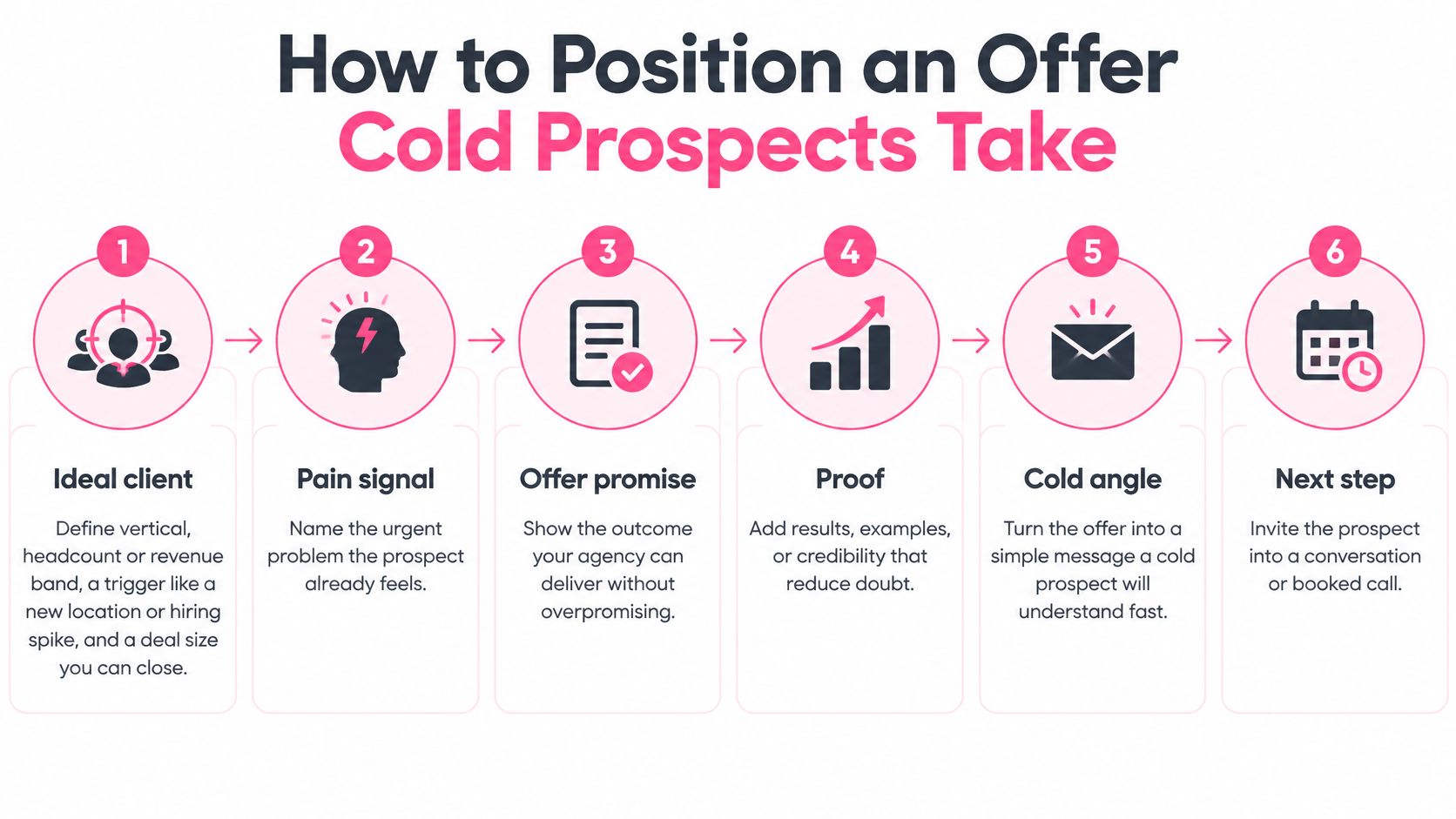
Build something a buyer can recognize
Define the ideal client with observable filters. Specify vertical, headcount or revenue band, a visible trigger, and a deal size your agency can support. Say a home-service marketing agency serves HVAC, plumbing, and roofing companies. Start its test with HVAC businesses opening another location, not every contractor with an email address.
Choose one initial persona. For that campaign, write to the owner who cares about booked jobs and staffing capacity. Don't cram the owner, office manager, and marketing director into the same message. You can involve other stakeholders once you understand how the account buys.
Connect pain, proof, and a small next step. Lead with missed after-hours calls, add a genuine result from a comparable client if you have one, and offer a booked-job audit. A hypothetical opening might ask whether callers who reach voicemail ever become scheduled work. Don't invent a missed-revenue estimate to make the email look researched.
Delete the service menu. 73% of B2B buyers surveyed by Gartner said they actively avoid suppliers that send irrelevant outreach, according to its B2B buyer survey. That survey also found buyers seek seller input for contextual decisions, including whether an offering fits their organization. A booked-job audit earns that conversation; a list of branding, SEO, websites, and social packages doesn't.
Run a controlled test. Give one vertical, one offer, and one persona a two-week test window. That's a recommended experiment, not an industry performance benchmark. Keep plumbing and roofing in separate cohorts so you can tell whether the HVAC angle works instead of averaging unrelated buyers together.
Keep the sequence only when it produces useful intent. Look for positive replies, relevant questions, and qualified bookings. If owners respond but won't meet, inspect the next step. If the wrong businesses respond, inspect the list. Opens alone don't justify another round of sending.
Make the first email easy to answer
Run the draft through the cold email grader, then read it aloud. Remove anything you wouldn't say directly to an owner between jobs.
A diagnostic should have a boundary: what you'll inspect, what the buyer will learn, and what happens afterward. Otherwise, a free audit becomes unpaid consulting with a scheduling link attached.
For a practical companion to the offer exercise, use this walkthrough.
Finish with a sentence you could paste into the first email: We help HVAC owners identify where after-hours inquiries fall out before becoming booked jobs. Would a short booked-job audit be useful?
White Label Outbound Versus Building It In House
Choose an operating model by the work your team can reliably own. Buying outside execution won't remove the need for a credible offer, available salespeople, or someone willing to inspect rejected meetings.
The comparison below separates execution from accountability.
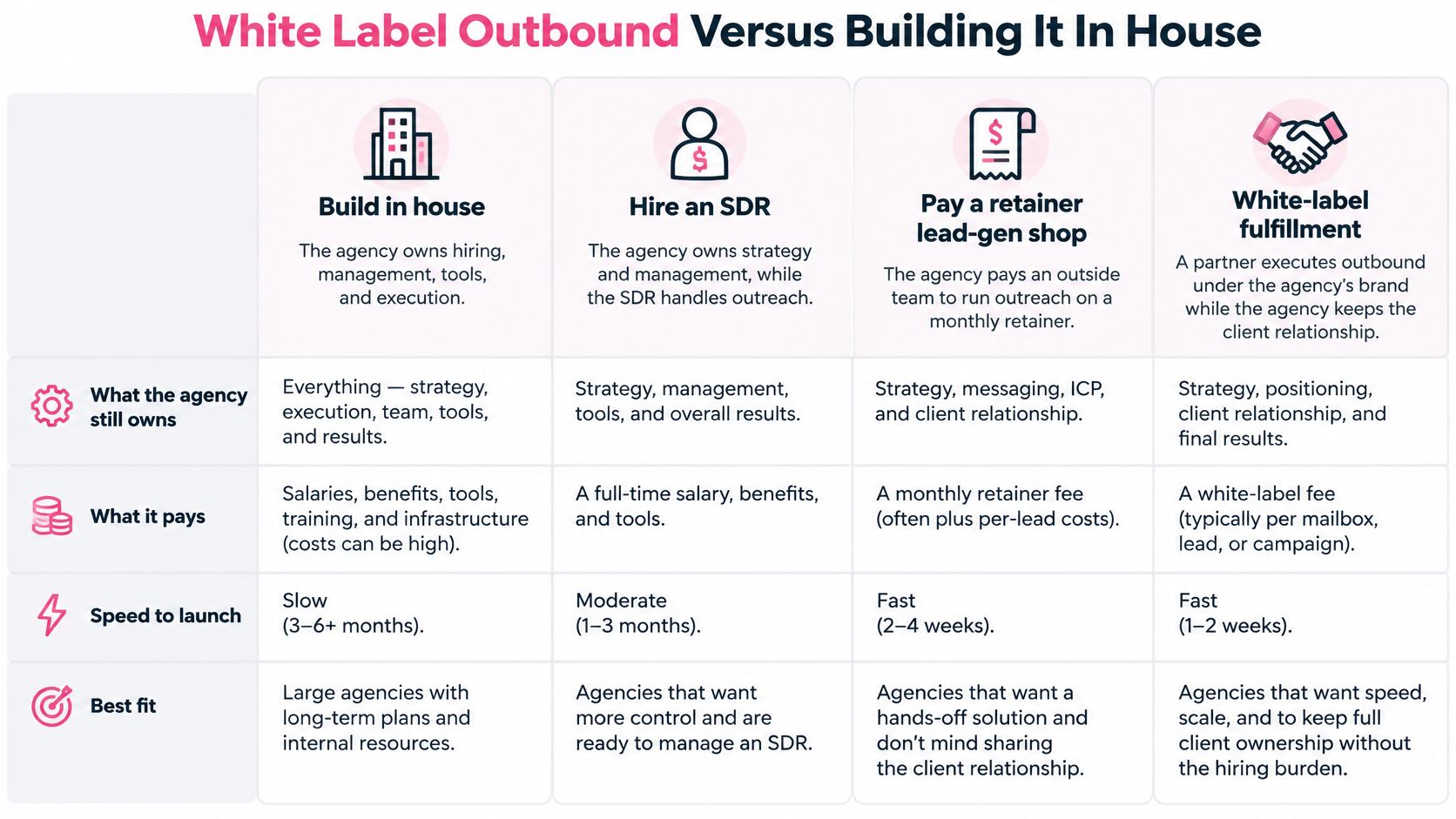
Buy the capability you're missing
Four ways agencies run outbound
| Model | You still own | You pay for | Best when | Main risk |
|---|---|---|---|---|
| Build it in house | Lists, domains, copy, and replies | Tools, inboxes, and staff time | You have operators and a niche | Deliverability and inconsistent follow-up |
| Hire an SDR | The offer and the close | Salary, ramp, and management | You can coach a seller weekly | Quiet months before any qualified call |
| Retainer lead-gen agency | The sales conversations | A monthly fee whether deals close | You want activity and will audit it | Paying for sends, not revenue |
| White-label pay-per-close partner | The brand, the margin, and the close | Commission only when a deal closes | You have a closer but no outbound desk | No niche, no show-up, or fuzzy qualification |
The white-label row describes the performance-compensation model, not every possible account fee. Compare total costs before declaring any arrangement commission-only.
Build when an operator has time to maintain lists, monitor infrastructure, and handle replies. Hire when you can coach someone, not merely hand over a login and hope they discover your positioning. Outsource when execution is the bottleneck and your closer already knows how to turn a qualified conversation into business.
For branded fulfillment, Hyperleap AI's white label chatbot guide is a useful adjacent resource on matching an outsourced customer-facing experience to your brand. Apply the same scrutiny to outbound: sender identity, reply tone, escalation ownership, and reporting should feel coherent to the client.
Judge proof by the outcome it measures
At Ever Outbound, we're pay-per-close. Our white-label operating model lets agencies retain their brand and client relationship while we handle execution.
Job Calls, a marketing agency for home service contractors, got strong lead flow in 2 weeks. Other client results include The Tax Engineers with 2 closed deals in 2 weeks, highMpact with 5 Dream Clients in Month 1, and Beeline Copy with 2 Closed Deals and Consistent Booked Calls.
BoostUrBusiness recorded 6 Closed Deals in 4 Weeks, T6 Marketing recorded 10–20x ROI within 4 Weeks, and Left Mind Media recorded 34 Calls in the First Month and an 11% Click-Through Rate. These are individual outcomes, not interchangeable metrics or a forecast for your agency.
“We started an client acquisition campaign and I was a little skeptical at the start but after our system was up and running it was worth it right away. In the first month they managed to book us meetings and land 4 clients on yearly retainers.”
Jack Henri Perron, Founder, Perron Marketing Group
Clicks indicate engagement, calls indicate conversations, and closed deals indicate sales. Don't let a provider swap one for another halfway through the review.
Every model must pass the same commercial test: sales accepts the qualification rules before launch. Without that agreement, you're buying an argument about what counts as a lead.
Inbox Problems and Follow Up Fixes
Keep reported spam rates below 0.1% and intervene before they reach 0.3% or higher, as Google's email sender guidelines recommend. A rising complaint rate is an operating problem, not a brief for the copywriter. Those same guidelines classify bulk senders as anyone sending roughly 5,000 or more messages to personal Gmail accounts within 24 hours, with one-click unsubscribe required on qualifying marketing and subscription mail. Staying under that line is not permission to send mail people didn't ask for.
Check infrastructure before rewriting copy
When replies die, the copy is usually the wrong first suspect. Separate prospecting infrastructure from client correspondence and transactional mail, then confirm the plumbing: SPF and DKIM configured, DMARC published and aligned, valid forward and reverse DNS, TLS in transit, and messages that follow RFC 5322.
Audit those records with an email deliverability checker or your DNS provider's tools, and have whoever owns sending resolve what surfaces before you raise capacity. These are operating controls, not subject-line tweaks.
Ramp new domains gradually instead of sending at full volume on day one, and watch Google Postmaster Tools alongside delivery failures and complaints. Skip the moves that read as evasion: URL shorteners hiding destinations, identical sequences at high volume, fresh domains rotated in to continue behavior recipients already rejected.
Thin pipeline symptoms and the fix
| Symptom | Likely cause | Fix |
|---|---|---|
| Spam complaints reach the unacceptable range above | Unwanted or concentrated sending | Pause that domain and tighten the list |
| Complaints creep toward the recommended ceiling | Excessive volume, similarity, or poor relevance | Cut daily capacity and review targeting |
| Hard bounces climb | Stale or unverified contacts | Stop, re-verify, and suppress |
| Opens look healthy but replies are dead | Possible inbox-placement or tracking issue, not necessarily the offer | Check authentication and Postmaster before rewriting |
| Interested replies go cold | Slow routing or delayed human response | Assign an owner and respond promptly |
| Only one contact is reached per account | Incomplete stakeholder mapping | Identify other relevant buying contacts |
| Meetings get rejected by sales | Agreed criteria never applied | Filter on the agreed role, problem, and timing before booking |
Healthy opens don't prove inbox placement. Dead replies don't prove an infrastructure failure. Diagnose before prescribing, or you'll spend a week polishing copy that recipients never had a fair chance to read.
Report the stages separately
Report sent, delivered, inboxed where measurable, replied, qualified, booked, and closed by domain and campaign. Mark inbox-placement estimates as estimates, because a server accepting your mail is not the same event as a prospect seeing it.
For white-label work, keep monitoring and suppression rules distinct per client. A shared dashboard is convenient. A shared blind spot is not. Domain pools reduce concentration risk, but no pool repairs an offer recipients don't want.
For the operational side of reply handling, Captiwate's guide to faster lead responses pairs well with the infrastructure checklist above.
Put these pause decisions into the standup:
- Spam rate: Stop or segment when complaints threaten the operating limit.
- Hard bounces: Halt the affected list when failures climb and investigate verification.
- Unqualified replies: Pause expansion after a week of replies without qualified meetings. Review targeting and the offer before buying more capacity.
How to Hand Qualified Calls to Sales
A booked meeting is an appointment. A qualified opportunity requires evidence. Sales should sign the acceptance criteria before the campaign begins, not discover them while staring at a calendar full of strangers.
Use this handoff flow to make ownership and rejection rules visible.
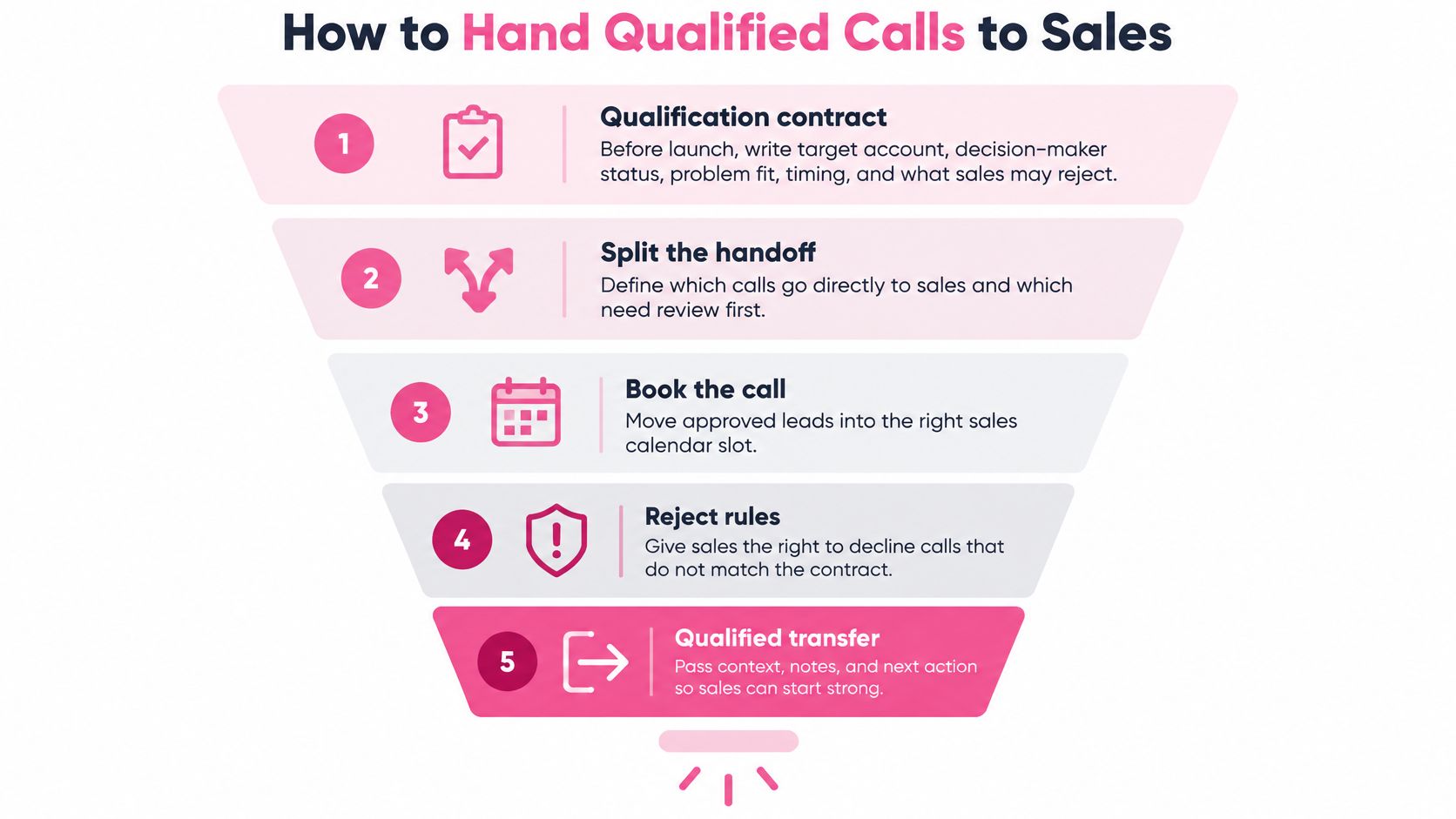
Agree on acceptance and response standards
Write the qualification contract. Define the target account, decision-maker status, problem fit, timing, and valid rejection reasons. Record whether the attendee can approve spending or must bring in someone else. A junior researcher isn't automatically a bad contact, but they shouldn't be sold internally as the budget owner.
Split the response clock. Research from MIT and InsideSales cited by LeadAngel's lead-response-time guide found leads contacted within five minutes were 21 times more likely to qualify than those contacted after 30 minutes. That's lead-response research, not a guaranteed lift for cold campaigns. Separate processing time, including enrichment, matching, routing, and assignment, from representative response time so a fast closer doesn't conceal a slow router.
Book only calls that pass. Put the prospect's stated problem, relevant context, and reason for meeting into the calendar invitation. Use the pre-qualification process to make the gate explicit. Give sales a rejection field with defined reasons, not an unrestricted bad lead button.
For assignment mechanics, the guide to faster lead follow-up with CapyScout is useful when enrichment and routing delays happen before a salesperson ever sees the record. Name an owner for that processing stage.
Preserve context through the sale
Multi-thread the account deliberately. Gong data summarized in HubSpot's sales statistics reports that 77% of deals are multi-threaded, with successful deals containing twice as many buyer contacts as unsuccessful deals. Ask who else needs to evaluate the decision. Don't interpret multi-threading as permission to bombard colleagues with duplicate pitches.
Recover no-shows without chasing indefinitely. Send a same-day note with useful context and offer a next-day slot. Then stop the automatic chase unless the prospect re-engages. This is a recommended operating policy, not a universal attendance benchmark.
Record commercial outcomes and attribution accurately. Log source, held meeting, opportunity, close, time-to-close, and revenue. Add a self-reported source field so the buyer can mention content, a referral, or another touchpoint the tracking system missed.
Sales may reject a meeting for violating the agreed contract. Disappointment alone isn't a rejection reason.
Use the call to assess fit, constraints, and the decision process. A pitch-deck recital tells you little about whether the buyer can move forward.
Hold a weekly 20-minute cohort review as an operating discipline. Inspect accepted, rejected, showed, and closed outcomes, with rejection notes attached. That gives the agency, salesperson, and fulfillment partner something more useful than competing recollections.
Pick a Model and Book the First Cohort
Lock three choices before buying another tool: the niche, the operating model, and the qualification contract. If your team can't agree on those, additional software will make disagreement easier to automate.
An operator with time should start with a verified decision-maker list, authenticated sending infrastructure with a controlled ramp, and a short sequence for a single persona. Have suppression rules, reply ownership, and pause decisions ready before launch. Warmed domains aren't a substitute for permission-sensitive targeting or monitoring.
Give the experiment a commercial boundary
Define the cohort by its launch window, audience, and offer. Keep those labels attached as prospects move through the CRM so you can compare actual opportunities rather than a blended monthly total.
Use the meeting cost calculator to inspect economics, including staff time and the meetings sales won't accept. Cheap bookings become expensive when a senior closer spends the week explaining why the prospect shouldn't have been booked.
- Build this week: Assign an operator to the list, infrastructure, sequence, and reply queue.
- Partner this week: Bring a clear offer, an available closer, and signed acceptance rules.
- Delay expansion: If neither route has a named owner, fix ownership before increasing spend.
Choose execution without outsourcing judgment
At Ever Outbound, we're pay-per-close, offering fully done-for-you client acquisition from $97 a month, with the first 2 closes commission-free and then 5% per close. The monthly starting price is separate from the close-based commission, so include both when comparing economics.
Our process has four moves: we build a list of verified decision makers, write and send short copy on warmed domains, book interested prospects straight onto your calendar, and you show up to close the deals. Onboarding starts with a short form about your offer and ideal client; we handle lists, copy, sending, and bookings.
Our comparison materials cover Leadbird, GrowthX, Anevo Marketing, Revenue.inc, Cleverly, hiring an SDR, a lead-gen agency, cheaper agencies, and doing it yourself. Compare responsibility, costs, qualification, and sales capacity rather than selecting the most flattering activity forecast.
Use an initial booked call to inspect how campaigns are built and what the first month should look like. Then commit to a 30-day cohort you can audit, while allowing longer-cycle opportunities to mature rather than marking every unclosed deal as a failure.
Choose this week: build the cohort with a named internal owner, or book a partner to run execution. Either way, finish with evidence, not another strategy document.
At Ever Outbound Inc., we're pay-per-close, with a managed team handling prospect research, outreach, sending infrastructure, and qualified-call booking. Visit us with your niche and offer, and use the first conversation to examine campaign execution, qualification rules, and what your agency will still own when the calls arrive.