November 8, 2026
Lead Generation for Coaches: A Niche-by-Niche Playbook
You've posted useful advice, refreshed your coaching page, and sent messages that took longer to write than you'd care to admit. Someone finally replies asking for details. You send a brochure, return to client work, and discover later that the conversation has gone beautifully, completely nowhere.
That's the awkward part of lead generation for coaches: getting a reply isn't the same as getting a booked call. You need a specific buyer, an offer they understand, proof you can defend, and a way to turn interest into a conversation before everyone gets distracted.
Table of Contents
- Match Your Coaching Niche to a Lead Plan
- Segment Your Audience Before You Pitch
- Prove Results Without Risky Claims
- Write a Three-Email Outreach Sequence
- Answer Replies Fast and Book the Call
- Pick One Channel and Book Your First Five Calls
Match Your Coaching Niche to a Lead Plan
The 2023 ICF Global Coaching Study, conducted with PricewaterhouseCoopers, estimated 109,200 coach practitioners worldwide in 2022, according to AoEC's account of the findings. A page promising personal growth therefore competes in a substantial professional category, not an empty corner of the internet.
Your first decision isn't which platform to master. It's which buyer, problem, and entry offer belong together.
An executive sponsor needs a business reason to approve coaching. An individual considering a career change needs confidence that you understand their situation. Giving both the same free consultation pitch saves writing time but leaves the buyer doing the translation.
Lead plan by coaching niche
Treat these as starting offers to test, not universal prescriptions.
| Niche | Likely buyer | Offer that books calls | Proof to show | Primary channel |
|---|---|---|---|---|
| Executive coaching | CEO or HR sponsor | 30-minute leadership gap call | Named retention or promotion outcomes | LinkedIn and warm referrals |
| Career transition coaching | Individual professional | Free career-gap audit | Interview-to-offer counts | Instagram and alumni email lists |
| Founder business coaching | Owner of a 5-50 person firm | Revenue diagnostic call | Revenue results with a stated denominator | Cold email |
| Corporate team coaching | HR director | Eight-to-twelve person pilot cohort | Engagement survey change | HR consultant partnerships |
| Life coaching | Individual client | Free discovery session | Client story with context | Podcast guesting and content |
Find the row that matches your last five clients, then test only that row for 30 days. If you're new, choose the row supported by your strongest relevant expertise rather than your largest imagined audience.
Keep the entry offer bounded. A leadership gap call should identify a leadership issue and a sensible next step, not become unpaid organizational consulting with a calendar invitation attached.
Practical rule: Sell the usefulness of the first conversation, not the entirety of your coaching philosophy.
For a fitness-adjacent practice, Gym Membership Tips' guide to grow your online presence as a trainer is a relevant companion for thinking about visibility. For organizational work, keep your coaching and training acquisition plan focused on the sponsor who can authorize the engagement, not just the person who'll enjoy the sessions.
Segment Your Audience Before You Pitch
A first-time manager and a scaling CFO can both need leadership coaching. They rarely need the same pitch, buy through the same process, or respond to the same reason for a call.
Segmentation means changing the proposition, not just inserting a different city into the greeting.
Build segments around buying conditions
Start with the conditions that shape the purchase:
- Buyer type: Separate individuals paying personally from organizational sponsors approving a business expense.
- Geography and time zone: Adapt your language, examples, availability, and outreach practices to the prospect's location.
- Specialization: Distinguish career transitions, leadership development, founder decisions, and personal goals.
- Business stage: A solo operator and a team of ten have different delegation problems and purchasing processes.
Then qualify each prospect before adding them to a list:
- Budget: Who controls the budget?
- Relevant experience: Have you addressed this problem for clients? If your experience is limited, describe it accurately and offer a tightly scoped pilot.
- Authority: Can you identify the decision-maker by title?
- Availability: Can you reach them during your working hours?
These checks keep your list connected to buyers you can plausibly help. They also prevent a common mismatch: pitching an individual contributor when an organization's sponsor controls the purchase.
Find names with a reason to belong
Build lists from past-client referrals, industry association directories, LinkedIn filters for title and company size, and conference attendee lists you're permitted to use. Record each contact's source, role, organization, location, and reason for fit. Clean the list with a reputable email-list validation tool to remove invalid and duplicate addresses, then check whether each person still holds the relevant role. A valid address can still reach the wrong buyer.
For example, a coach might separate first-time managers from scaling CFOs. The manager's message could focus on delegation and difficult feedback; the CFO's could address developing finance leaders and reducing dependence on the CFO's own decisions.
Each segment needs a distinct reason to reply. Write a one-sentence definition for each, then use 100-150 verified contacts per segment as an initial test batch. If you can't explain why a person belongs, leave them off the list.
Prove Results Without Risky Claims
In January 2025, the U.S. Federal Trade Commission proposed expanding rules covering deceptive earnings claims to include business coaching and investment opportunities, requiring substantiation for likely-earnings claims and access to that substantiation on request. That was a proposal, not a reason to describe every proposed provision as current law.
The FTC's enforcement materials also identify allegations involving atypical testimonials and unsupported revenue claims. A persuasive success story isn't automatically representative proof.
Your proof block should resemble a client record, not a lottery advertisement.

Publish the denominator
Consider a hypothetical career-coaching example: twelve of the forty clients who finished the program received a raise within six months. That's more informative than saying clients get raises, but it still leaves a question: what happened to clients who didn't finish?
State who was measured, who was excluded, and why. Segment outcomes by offer, client type, starting point, and timeframe, so buyers can judge whether the result resembles their situation.
When revenue attribution is unclear, use evidence you can support: retention, promotions, completed milestones, documented behavior changes, or hours saved. Distinguish client-reported outcomes from independently documented ones, and don't credit coaching for every favorable event that happened afterward.
Run every claim through this check:
- Typicality: Is this result typical or the best case?
- Denominator: Can you show how many clients were included?
- Timeframe: Is the measurement period stated?
- Verification: Could a stranger check the supporting evidence?
- Permission: Has the client agreed to publication?
For examples to examine critically, the coaching business insights from Wispra provide another place to consider how coaching stories are presented. Apply the same scrutiny to your own client proof collection: context matters more than dramatic typography.
State credentials without embellishment
The 2025 International Coaching Federation study found that 73% of coaches say clients increasingly expect professional credentials; separately, the ICF's account of its 2023 study reported that 80% of coaches agree clients expect certification or credentials.
These are different findings, not a trend calculation. State your credentialing status plainly in every proof block, and never imply a credential you don't hold.
Inflated claims may attract curiosity, but they also give disappointed prospects reasons to complain, distrust you, or withhold referrals. Transparent evidence is a stronger foundation for a relationship than a promise you'll later have to explain away.
Write a Three-Email Outreach Sequence
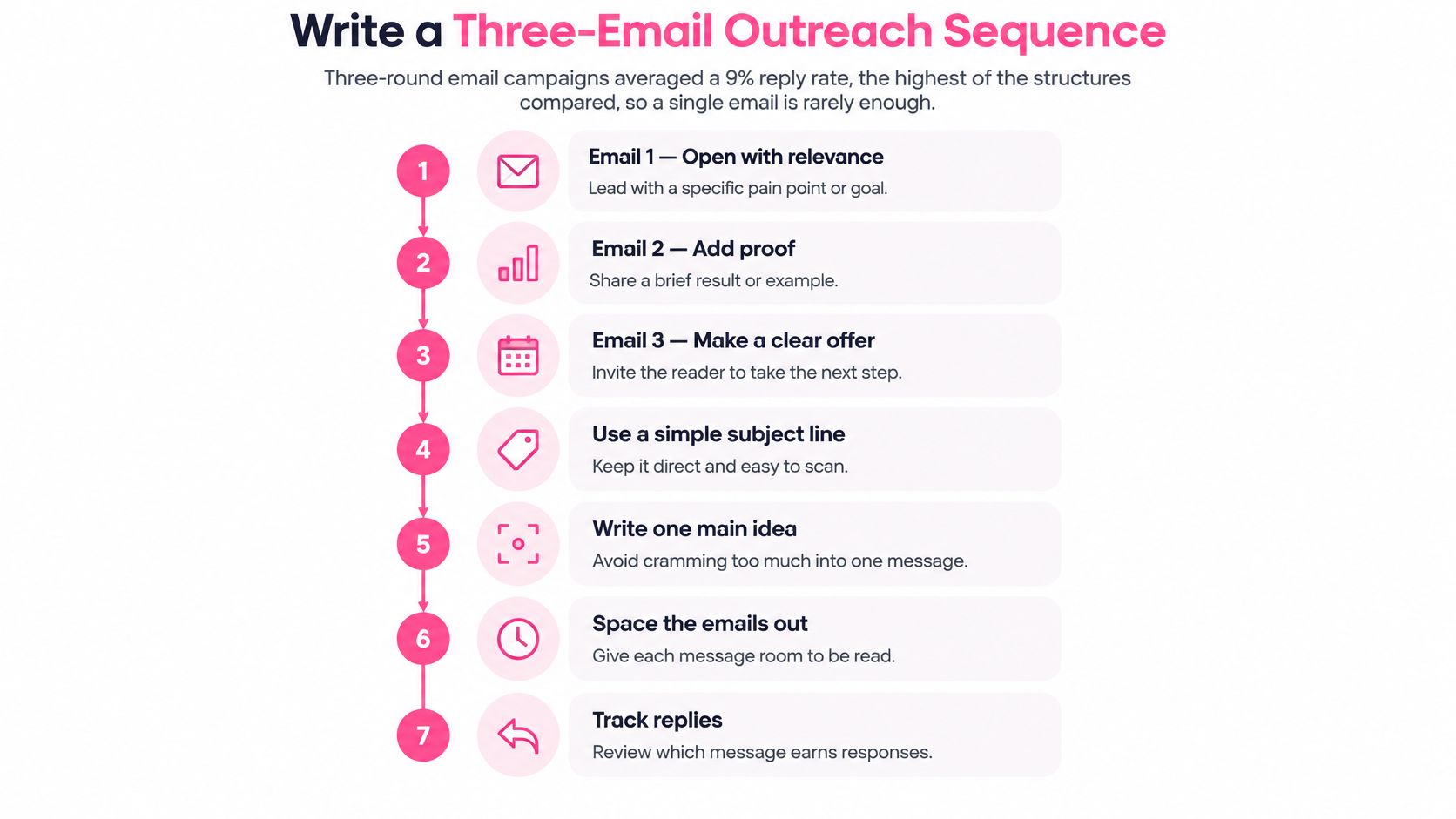
Cold-email campaigns using three email rounds averaged a 9% reply rate, the highest among the structures compared in a Belkins analysis cited by HubSpot's sales-statistics summary. That's a campaign average, not a coaching benchmark or a promise that a particular sequence will work.
Use structured follow-up rather than making your first message carry the entire sale. List quality and offer specificity deserve more attention than finding a magical number of follow-ups.
This visual provides a compact reminder of the sequence-building essentials.
Build the sequence around a decision
Choose your opener. Lead with a specific problem, a defensible result for a similar client, or an invitation to a short discovery call. Pick one approach, because an email shouldn't read like a buffet of reasons to hire you.
Keep email one under 90 words. Name the segment, one concrete problem, and one question. For a hypothetical company advertising three manager openings, try: Your team is hiring several managers. How are you helping new leaders handle delegation and feedback?
Send email two three days later. Add a proof point with the client's starting position and timeframe, using only a result you can document. Explain its relevance rather than attaching a testimonial and hoping the recipient supplies the logic.
Send email three a week later. Make the close low-pressure: Should I close this out, or would a short call be useful? Don't manufacture urgency or pretend you've reserved a precious appointment nobody requested.
Make compliance part of the copy. Use accurate sender details and subject lines, clearly identify advertising, include a valid postal address and working unsubscribe process, and honor opt-outs within 10 business days under the FTC's CAN-SPAM guidance. Check applicable local requirements too, since U.S. rules aren't a global permission slip.
Stop when the situation changes. A reply should pause automation so a human can respond in context; an opt-out or bounce should suppress further sequence messages. Continuing the pitch after someone answers makes the personalization look like a costume.
Review by segment after each 100 sends. Treat that as an operating checkpoint, not statistical certainty. If a segment remains weak after two sequence tests, revisit the audience and offer before adding another email.
Use an email-sequence drafting tool to organize a first draft, then remove unsupported claims and details that don't help the buyer decide.
Protect delivery before increasing volume
Google's sender requirements require bulk senders sending approximately 5,000 messages daily to personal Gmail accounts to meet requirements including SPF, DKIM, DMARC, valid forward and reverse DNS, TLS, and spam rates below 0.30% in Google Postmaster Tools. From-header alignment matters too.
Authenticate your sending domain before launching, rather than waiting until scale forces the issue. Infrastructure can support relevant outreach; it can't make unwanted messages welcome.
For another format to review alongside your draft, watch the accompanying video.
Answer Replies Fast and Book the Call
Route every inquiry into one queue. Put form fills, assessment responses, and discovery-call requests into a shared CRM view or spreadsheet. Assign an owner so everyone doesn't assume someone else answered.
Acknowledge automatically, then respond personally. Aim for a human response within five minutes during covered hours. An automated receipt confirms delivery; it doesn't answer a buying question.
Plan persistent, contextual follow-up. For appropriate, permission-compatible inquiries, plan at least six contact attempts across phone, email, and professional social channels before marking the lead cold. Stop immediately when someone declines or opts out, and don't turn one inquiry into an unsolicited cross-platform siege.
Classify every response. Use qualified, unqualified, nurture, or disqualified, with a reason attached. Acknowledge messages appropriately, but don't send another pitch to someone asking you to stop.
Measure each transition separately. Track inquiry-to-conversation, conversation-to-booking, booking-show, and booking-to-client rates. Otherwise, you can't distinguish poor qualification from a booking process that asks interested prospects to perform administrative gymnastics.
Response window benchmarks
The lead-response analysis and separate audit of 2,241 U.S. companies summarized by Omago's lead-response review provide the following timing benchmarks.
| Response window | What the data shows | What to do |
|---|---|---|
| Within 5 minutes | Conversion about 8x higher than later first attempts; only 0.1% of inbound leads engaged this fast | Reserve response slots in the prospect's working hours |
| Within 1 hour | 37% of the audited U.S. companies responded this fast | Set phone alerts for new replies |
| Never | 23% of audited companies never responded | Log every reply, including the ones you decline |
| Average among responders | 42 hours | Set an operating target of a median under one hour |
The eightfold figure concerns lead contact and qualification, not guaranteed closed-client conversion. It also shouldn't be presented as a measured lift for coaching cold-email replies.
The practical lesson is to make interested inquiries visible and actionable. Report median first-response time by source and time zone, separating automated acknowledgments from meaningful human contact.
Turn a vague reply into a useful next step
Say a prospect asks you to send details. A useful response might be:
Happy to. What would a win look like for you in the next 90 days? I can send the relevant outline, and if it fits, would Tuesday morning or Thursday afternoon suit a short call?
Give the slots with the prospect's time zone. Include enough information to answer their request rather than withholding everything until they book.
Use a lead-qualification workflow to capture desired outcome, buyer authority, timing, and fit. Ask what you need to route the conversation, not every question you'll eventually ask during coaching.
Block response time during your prospects' working hours, not only your own. If you can't cover a market reliably, narrow your geography or assign coverage before adding more inquiries.
Pick One Channel and Book Your First Five Calls
Choose the channel that fits your niche and test it for 30 days before adding another. The first five booked calls are an operating milestone, not a forecast.
For an email-led test, use this opening week:
- Monday: Define one segment and build a list of 100 verified contacts.
- Tuesday: Draft your three-email sequence and a proof line that passes your claim check.
- Wednesday: Load the sequence, test it, and enable reply alerts.
- Thursday: Send the first batch and log every reply in one queue.
- Friday: Review replies, qualification reasons, and response times.
Don't add a second channel until the first has produced five booked calls. If it isn't working, fix the proposition before multiplying the workload.
For fitness-focused offers, Zee Palm's resource on how to attract more online coaching clients offers a complementary perspective. Use additional resources to sharpen the chosen approach, not to collect another unfinished marketing project.
If you'd rather hand off execution, Ever Outbound, we're pay-per-close, uses a human team to build lists, write copy, run sequences, nurture interested replies, and book qualified calls directly onto your calendar. You complete a short onboarding form about your offer and ideal client; pricing starts at $97 per month, your first two closes are commission-free, and then a 5% commission applies to deals you close from our efforts.
Delegating trades some day-to-day control for time. Choose based on the hours you can consistently give outreach, not enthusiasm on a quiet Monday.
At Ever Outbound Inc., we're pay-per-close, and we handle the work between identifying suitable B2B prospects and booking qualified coaching conversations. Visit us with your offer and ideal-client profile to discuss a campaign built around relevant buyers, defensible proof, and timely follow-up.