November 2, 2026
Lead Generation for MSPs: Channels, Targets and Pilots
Referrals are still carrying your MSP pipeline. A client mentions you at the right lunch, a partner makes an introduction, and suddenly there's a promising conversation on the calendar. Then the introductions go quiet, and next month's forecast looks less like a plan and more like weather.
That's the referral ceiling: trusted, valuable, and hard to schedule. Lead generation for MSPs needs another engine beside it, one built around identifiable buying triggers and judged by qualified meetings, not a pile of names or a flattering open rate.
Table of Contents
- Which Lead Channels Fit an MSP Right Now
- Which Accounts to Target First by Size and Industry
- How to Make the First Message Prove Value
- Deliverability Rules to Set Up Before You Send
- How to Run a Staged Outbound Campaign
- Turning Replies into Demos and Trials
- Run a 30-Day Pilot Before You Commit Budget
Which Lead Channels Fit an MSP Right Now
| Channel | Lead quality | Pipeline predictability | Time to first meeting | Best used when |
|---|---|---|---|---|
| Referrals | High | Low | Fast | Existing clients can introduce you |
| Events and webinars | High | Low to medium | Slow | A local buyer group gathers in one place |
| SEO and content | Medium to high | Medium | Slow | Buyers research heavily before they talk to anyone |
| Paid search and social ads | Medium | High | Fast | You need a fast test of one specific offer |
| Cold email | Medium | High | Medium | You have a defined ICP and verified contacts |
| LinkedIn outreach | Medium | Medium | Medium | You know the named decision-makers |
| Partner co-selling | High | Medium | Medium | A vendor or distributor shares a customer list |
Referrals earn their place because trust arrives with the introduction. The trade-off is that you can't reliably forecast when one will happen. Events work similarly, with the added constraint of a calendar: useful conversations can come from a local group or webinar, but they cluster around the event rather than arriving evenly.
SEO and content are the patient option. B2B buyers often arrive with an initial shortlist already in mind: a 2022 Google and Bain study of B2B buyers found that 86% had a preferred vendor list before formally shopping, and 92% ultimately purchased from that list. Buyers also conducted 69% of their research online, which makes a clear website and useful proof part of sales, not decoration. For MSPs, that channel can compound, but it's a poor fix for an empty calendar this week.
Paid search and social advertising can put a specific offer in front of people quickly, but attention isn't the same thing as a booked meeting. Cold email offers more control over who hears the offer and when. LinkedIn outreach can add credibility and reach named decision-makers; use it as a deliberate sales channel, not a substitute for an actual reason to contact someone. This LinkedIn outreach guide for MSPs can help you structure that work. Partner co-selling can move faster than a cold introduction when a vendor or distributor has relevant customer relationships to share.
The market is broad, but that doesn't make indiscriminate outreach wise. A U.S. Economic Census analysis counted $112.8 billion in combined 2022 revenue across IT infrastructure and network management, plus IT technical support, up from $76.2 billion in 2017; it also counted tens of thousands of establishments across those service categories, according to The Uptime Report's Census-based market analysis. That scale points to opportunity and competition. Targeting matters more than sending to everyone with a business email.
Decision rule: Pick one channel that can fill the calendar this quarter and one that can compound over time. Measure both by meetings: per hundred contacts for outreach, or per event for in-person and webinar activity.
If you're weighing an SDR, an agency, a lower-cost provider, or doing outbound yourself, compare the actual work and incentives, not just the headline fee. Ever Outbound also compares options such as Leadbird, GrowthX, Anevo Marketing, Revenue.inc, and Cleverly. We're pay-per-close, so the fee applies only when a deal you close came from our outreach. For MSPs exploring a concrete AI service offer rather than another vague innovation pitch, this resource on how to resell governed AI services to clients offers a useful starting point.
Which Accounts to Target First by Size and Industry
Start with buyers who already use MSPs for security support. In Barracuda's 2025 survey, 85% of organizations with 1,000 to 2,000 employees relied on MSPs for security support, compared with 61% of organizations employing 50 to 100 people. That makes larger organizations a promising starting audience for a security-led campaign, though it doesn't mean every smaller business is a poor prospect. The same Barracuda report on MSP customer insight found that local government and education were the industries most likely to outsource cybersecurity to MSPs, at 84% and 78%, respectively.
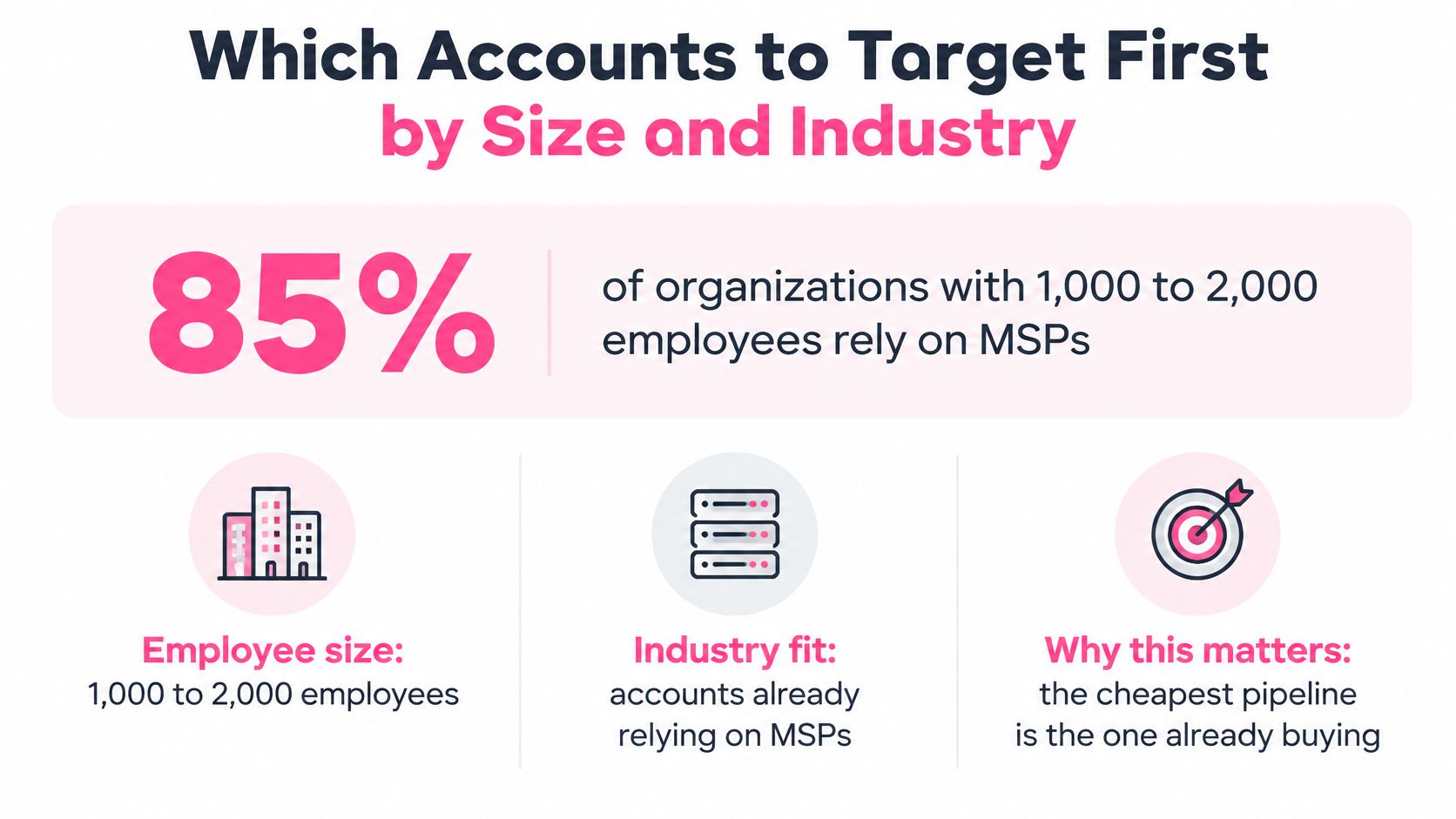
The buying stage matters as much as the company profile. Barracuda found that 73% of surveyed organizations already outsourced security services to an MSP, while another 18% were evaluating providers. Put evaluators near the top of your list. They have a live reason to assess vendors, whereas a business with an incumbent and no visible reason to change may be a sensible account for later, not a first-wave prospect.
Build a few distinct audiences, each with a named trigger. A local-government sequence tied to a security requirement shouldn't read like an education sequence, and neither should sound like an email to a company replacing a struggling provider. Start with a single problem your service addresses, the evidence you can show, and why the timing is relevant to that account.
- Recent incident: Offer a focused conversation about incident readiness, recovery planning, or the gap the event may have exposed. Don't imply you know confidential details that aren't public.
- Compliance requirement: Tie the message to the specific preparation work you perform, such as organizing evidence or reviewing security controls.
- Merger or expansion: Focus on integration, access management, support coverage, or the operational friction created by combining environments.
- Security-tool sprawl: Lead with the work involved in bringing overlapping tools together and making them easier to manage.
- Provider dissatisfaction: Look for a credible switching signal, such as a renewal conversation or recurring service issue. “We do IT support” isn't a switching trigger.
A useful starting point is to separate accounts by employee count, industry, and buying stage, then build copy for each segment rather than treating a prospect list as one audience. Keep the list manageable enough that a salesperson can explain why every account is there. The managed IT services industry page can help frame your market and audience choices.
If you can't name the trigger, don't send to that segment yet. A company's size or industry can make it a plausible fit, but a relevant reason to talk is what turns a plausible fit into a sales conversation.
How to Make the First Message Prove Value
A prospect can like your company and still reject your offer if the value feels like a slogan. Kaseya's 2026 MSP findings reported that 19% of MSPs identified difficulty demonstrating value as their biggest challenge, nearly double the 10% reported the prior year. The same report found that 48% of MSPs said AI and automation was the leading client need for 2026, ahead of security at 42% and backup at 36%. Those are market-level findings, not a license to pitch every service to every account. Use them to choose an angle that matches the buyer's situation, as detailed in the Kaseya 2026 State of the MSP report.
Security-tool sprawl gives a more specific opening for some prospects. Barracuda's 2025 report found that 52% of organizations turned to MSPs when their security tools became unmanageable, and 92% were prepared to pay more for help integrating those tools. That points to an operational problem a buyer can recognize, not a generic claim that your team is “security-focused.” The source is the Barracuda 2025 MSP Customer Insight Report.
Use a three-part message
- Name the trigger. Mention the relevant situation you can reasonably identify, such as a new compliance requirement or growing tool complexity. Don't pretend to know what the prospect's internal systems look like.
- Offer one measurable outcome. Say what the conversation could help clarify: overlapping tools, audit-preparation tasks, backup resilience, or an unresolved service bottleneck.
- Show a proof point. Bring a relevant example, a short explanation of your approach, or a focused agenda for a discovery call. Keep the evidence tied to the problem, not a parade of certifications.
For example, an MSP contacting an organization with a complex security stack could offer to discuss which tools overlap and how the team handles integration. An AI-focused message should be equally concrete: name the workflow, explain the operational improvement you can assess, and avoid promising “AI transformation” without a defined use case. The cold email grader can help you check whether your draft makes its point plainly.
Write one message for one segment. Save other service angles for the discovery call, where the prospect's answers can tell you whether they're relevant.
Deliverability Rules to Set Up Before You Send
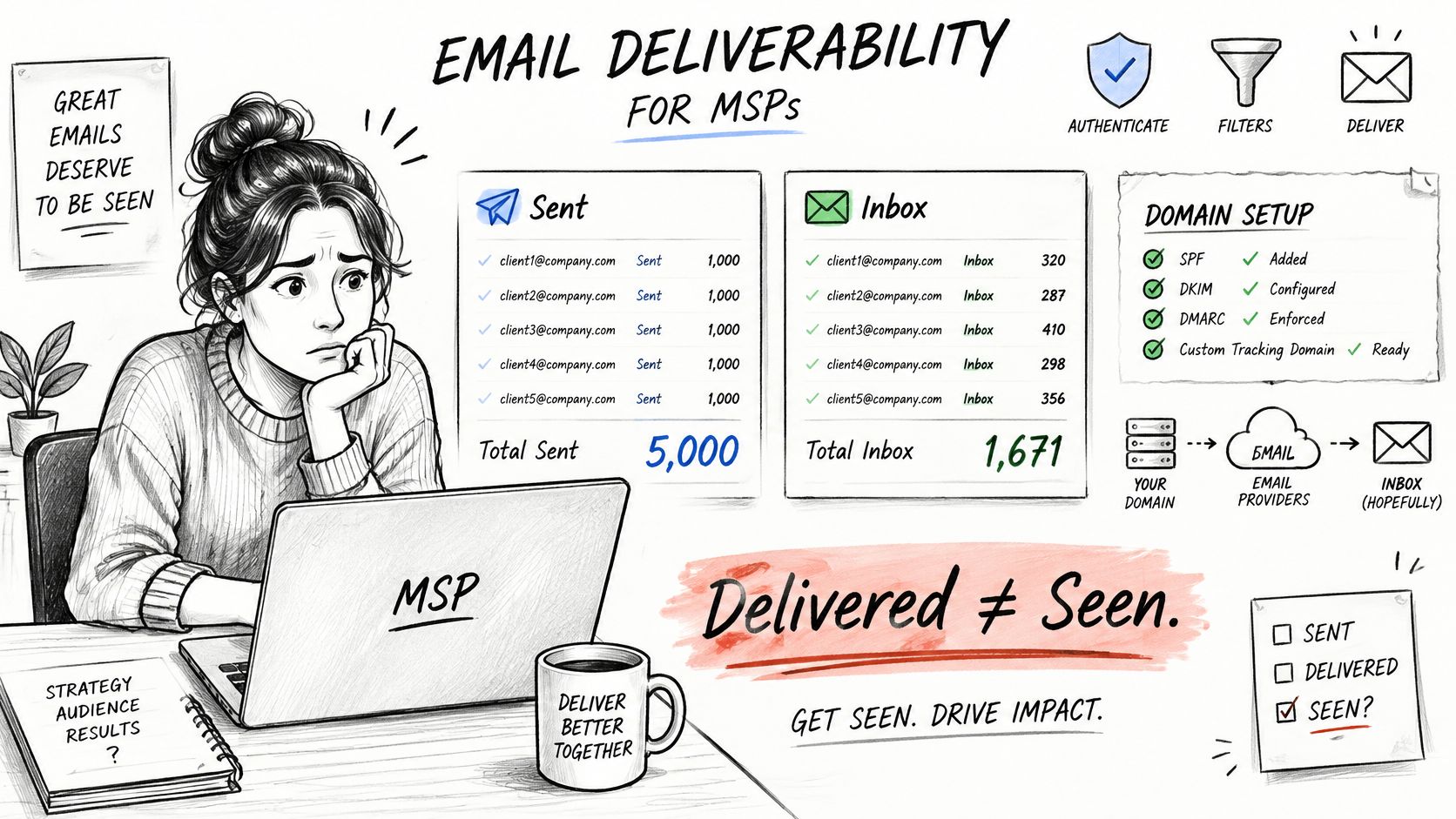
Delivered doesn't mean seen. An industry benchmark cited in the available data reported 98.16% delivery but only 84.3% inbox placement, so a send report can look healthy while a substantial share of messages miss the inbox. The same source places broad-platform cold-email replies around 3.4%, while a separate campaign dataset counted 0.29% positive replies. Those measures aren't interchangeable: total replies can include objections and other responses, so plan around positive replies and booked meetings rather than a headline reply rate. The figures come from Marketful's B2B email marketing statistics.
Build the infrastructure before the sequence
Google's Gmail sender requirements have applied since February 1, 2024. Bulk senders must configure SPF, DKIM, and DMARC; marketing and subscribed messages need one-click unsubscribe and a visible unsubscribe link; and the From domain must align with the SPF or DKIM domain for messages sent directly to personal Gmail accounts. Read Google's Gmail sender guidelines, then make authentication, opt-out handling, and suppression part of your campaign setup rather than a cleanup project after launch.
Use separate sending domains or a controlled domain pool, and configure SPF, DKIM, and DMARC for each sending domain. For the less glamorous server-side details, Server Scheduler's mail server DNS guidance for platform engineers explains why mail-server identity and sending configuration deserve attention too.
- Warm each mailbox gradually. Build sending activity over two to three weeks before beginning the campaign so you don't shock a new mailbox with a sudden burst.
- Clean the list. Remove invalid addresses and previous unsubscribes across every audience and sending mailbox. A suppression list needs to follow the campaign, not sit in one person's spreadsheet.
- Set volume limits. Cap daily sends per mailbox and raise them only while bounce and complaint signals remain healthy.
- Pilot one segment. Send a small test to one vertical with one message version. That makes it easier to diagnose whether a problem comes from the list, copy, or infrastructure.
- Compare outcomes by cohort. Review positive replies and booked meetings by mailbox and segment. Opens are a weak basis for deciding what to scale.
- Pause unhealthy cohorts. Rising bounces or complaints call for a stop and investigation before that activity affects other mailboxes or domains.
Broad purchased lists, identical copy across unrelated verticals, and scaling before inbox placement stabilizes are common ways to make outreach less reliable. Use the email deliverability checker as part of your pre-send review, then keep monitoring after launch.
How to Run a Staged Outbound Campaign
A campaign works best when every contact follows a defined path. If you change the audience, copy, offer, and call to action at once, you won't know which change affected the result. Use five stages and record the outcome at each one.
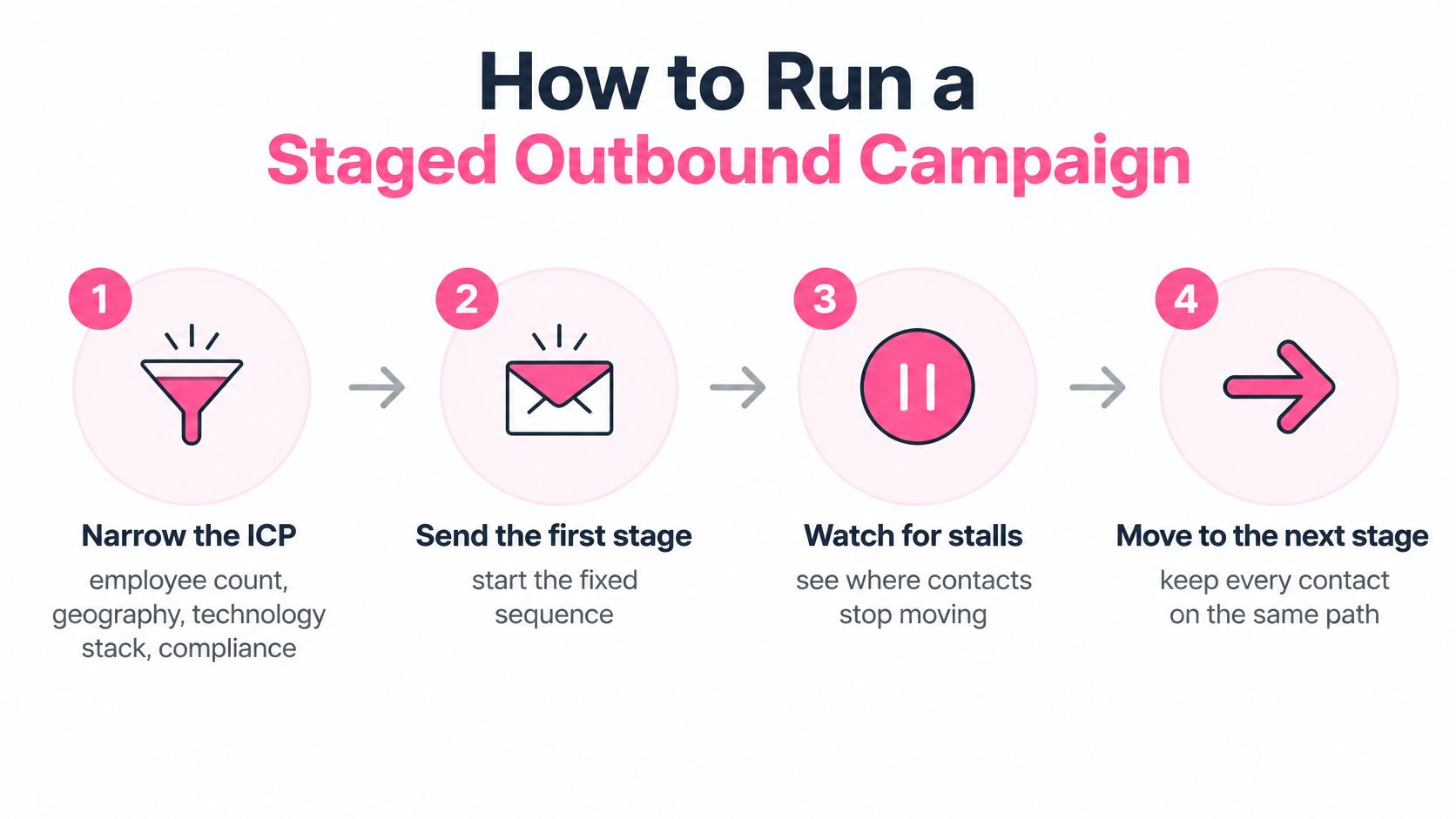
- Narrow the ICP. Filter accounts by employee count, geography, technology stack, compliance exposure, and likely IT pain. Drop an account if it fails two of your chosen fit filters; a bigger list isn't better if it includes companies with no plausible need.
- Verify the contact and trigger. Confirm that the person owns or influences the problem, and check the reason for contacting that company before writing the message. A wrong contact can turn a sound offer into a wasted sequence.
- Send a short, problem-specific sequence. Use three to four emails over about two weeks, with each touch tied to a concrete concern such as unresolved tickets, backup resilience, or audit preparation. Generic “IT support” language gives a busy buyer no reason to engage.
- Classify every reply. Mark responses as positive, neutral, objection, referral, or unsubscribe, then give each category its own next step. This keeps a real buying signal from getting buried among automated replies and polite rejections.
- Measure qualified outcomes by cohort. Track booked meetings and qualified opportunities by segment and campaign version, not opens or total replies. Test one variable at a time, such as the vertical, trigger, offer, or call to action, and stop scaling a segment that doesn't produce qualified conversations.
Use meetings as the planning baseline
An independent 2025–2026 B2B campaign dataset reports about 0.84% personal replies, 0.29% positive replies, and 0.11% booked meetings per contacted prospect. Its top-quartile campaigns reached at least 0.51% positive replies, a reminder that the quality of targeting and offer can materially affect campaign results. These are planning benchmarks, not guarantees; the B2B cold-email conversion benchmark also makes clear why personal replies and positive replies shouldn't be treated as the same metric.
| Stage | Rate per contact | Count per 10,000 | How to use it |
|---|---|---|---|
| Personal replies | 0.84% | 84 | Activity check, not a success measure |
| Positive replies | 0.29% | 29 | Realistic planning baseline for a well-matched list |
| Booked meetings | 0.11% | 11 | Forecast pipeline from this number |
For a campaign reaching 10,000 matched prospects, that dataset's baseline works out to 29 positive replies and 11 booked meetings. An automated out-of-office response isn't buying intent. Neither is a meeting with someone who lacks authority, need, timing, or budget. A booked slot is a useful conversion milestone, but a qualified opportunity is the more meaningful test of whether your targeting works.
Turning Replies into Demos and Trials
| Reply type | What it usually means | Next move |
|---|---|---|
| Positive | Interested and asking for a time | Reply within hours with two specific times and an agenda |
| Neutral | Wrong person or unclear ownership | Ask for the right name or a referral in one sentence |
| Objection | Has a provider or sees no need | Ask one question about the switching trigger |
| Referral | Another person should own this | Thank them, then reach out with their name and context |
| Unsubscribe | Wants no further contact | Suppress immediately across all mailboxes |
A positive response deserves a prompt, useful reply. Offer two specific meeting times and a one-line agenda so the prospect can decide without a long scheduling exchange. A short guide to procurement considerations, such as this Freshsales buying guide for procurement teams, can also help you think through what information buyers may need when they compare vendors.
A neutral reply like “Who handles this?” is a routing question, not a rejection. Ask for the right person's name in one sentence and make it easy for the contact to point you in the right direction.
If someone says they already have an MSP, don't launch into a list of reasons your company is better. Ask one focused question about what might prompt a change, such as a contract renewal, a recurring failure, or a recent incident. If the answer is “nothing,” accept that timing and follow your permitted contact rules rather than manufacturing urgency.
For a referral, thank the person who connected you and contact the named individual with that context. For an unsubscribe, suppress the address immediately across mailboxes and domains. That request is operational, not a cue to try a different sender address.
Make the next step useful
A demo without an agreed problem and next step is a calendar event, not progress. Offer a focused discovery call that ends with a written risk summary, a review of tool overlap, or a pilot scope with success criteria agreed up front. Keep the deliverable clear enough that the prospect knows what they'll leave with.
When prospects reply with interest, our team follows up promptly and books qualified calls directly onto the client's calendar. That handoff matters: the person who expressed interest shouldn't have to chase your team to get a useful conversation scheduled.
Run a 30-Day Pilot Before You Commit Budget
A pilot should answer a business question, not merely prove that your email tool can send messages. Pick one segment with a named trigger and a proof point, then give it a defined run. The point isn't to make a weak offer look busy; it's to learn whether this audience has a reason to talk now.
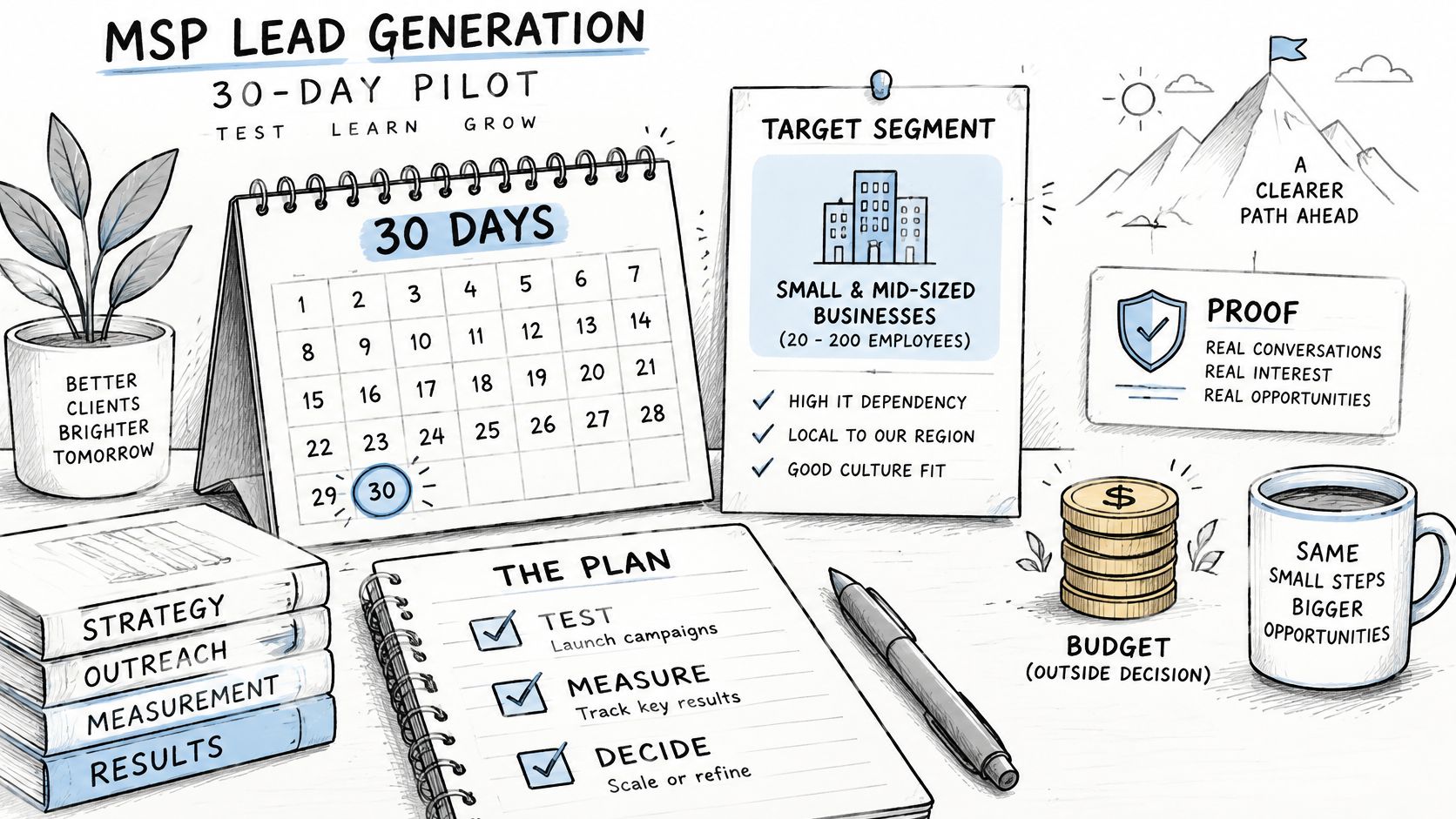
Before launch, choose what would make the pilot worth continuing. Use positive replies per thousand contacts and booked meetings by campaign cohort as the main indicators, and define what counts as a qualified conversation. Keep the list, sequence, and reply categories consistent enough that your results say something about the segment rather than reflecting a different process every week.
Run the sequence over four weeks and check mailbox health weekly. Review classified replies and meetings held, not opens. A full calendar can still hide the problem if the meetings are with the wrong people or nobody turns up.
A simple decision rule keeps the review honest:
- Scale when the segment produces qualified conversations and your sending health remains sound.
- Rewrite the trigger or offer when prospects fit the audience but don't respond with meaningful interest.
- Stop when the trigger fails to appear in the market or the segment repeatedly produces conversations that don't qualify.
Use a cold email ROI calculator to think through the economics alongside the campaign outcomes. Ever Outbound offers fully done-for-you client acquisition from $97 per month, with the first two closes free and then 5% per close. That pricing doesn't remove the work on your side: your team still needs to attend the calls we book and close the deals.
The pilot is only useful if someone owns the follow-up. Put meeting coverage on the calendar before outreach begins, agree how quickly replies get handled, and decide who records outcomes in your CRM. If you can't make room for conversations, don't pay to generate more of them yet.
You can use the video below as another perspective while you assess your plan.
This week, write down the trigger, proof point, and reply sequence for one audience, then send the first 50 contacts. Give those prospects a relevant reason to talk, and judge the pilot by the conversations that make it onto the calendar.
Ever Outbound Inc. runs done-for-you B2B client acquisition for MSPs, including prospect research, personalized outreach, reply handling, and qualified meeting booking. If you want a pipeline measured by closed business rather than a pile of leads, visit Ever Outbound Inc. to discuss your outbound approach.