October 19, 2026
Lead Generation for Recruiters That Actually Books Calls

The calendar is open, the job order looks promising, and the prospect list is long enough to feel productive. But the first batch of emails gets little response, candidate conversations stall, and the meetings that do happen don't reliably turn into placements. That's the familiar trap: activity looks like progress, right up until you check the jobs filled and fees earned.
Lead generation for recruiters is a two-sided revenue system. You need a dependable way to find candidates who fit real roles, and a separate way to win clients with hiring needs. The work doesn't end when someone replies or a meeting lands on the calendar. It ends when a qualified job order becomes a placement.
Table of Contents
- The Two-Sided Reality of Recruiter Lead Generation
- Where Recruiters Find Candidates Worth Contacting
- Scoring Client Signals Instead of Scraping Companies
- Running Outreach Sequences That Earn Replies
- Turning Replies Into Placements Without Losing the Lead
- Deliverability and Tech Stack That Protects the Pipeline
- Your 30-Day Recruiter Lead Generation Plan
The Two-Sided Reality of Recruiter Lead Generation
A recruiter can have a full candidate database and an empty client calendar. Another can book conversations with hiring managers but have nobody suitable to submit when a requisition arrives. Both have a lead-generation problem, but the bottleneck sits in a different pipeline.
The candidate pipeline starts with a specific role or a carefully chosen talent segment. The recruiter identifies people with the right skills and experience, checks whether the opportunity makes sense for them, and earns enough trust to start a useful conversation. Candidate outreach needs relevant role details, accurate contact information, and a reason for the person to engage.
The client pipeline starts with a company and a plausible hiring need. The recruiter identifies the people who can engage an agency, looks for evidence of current or likely demand, and qualifies whether the opportunity can become a real job order. That conversation needs to establish more than interest in meeting. It needs to uncover authority, budget, process, and timing.
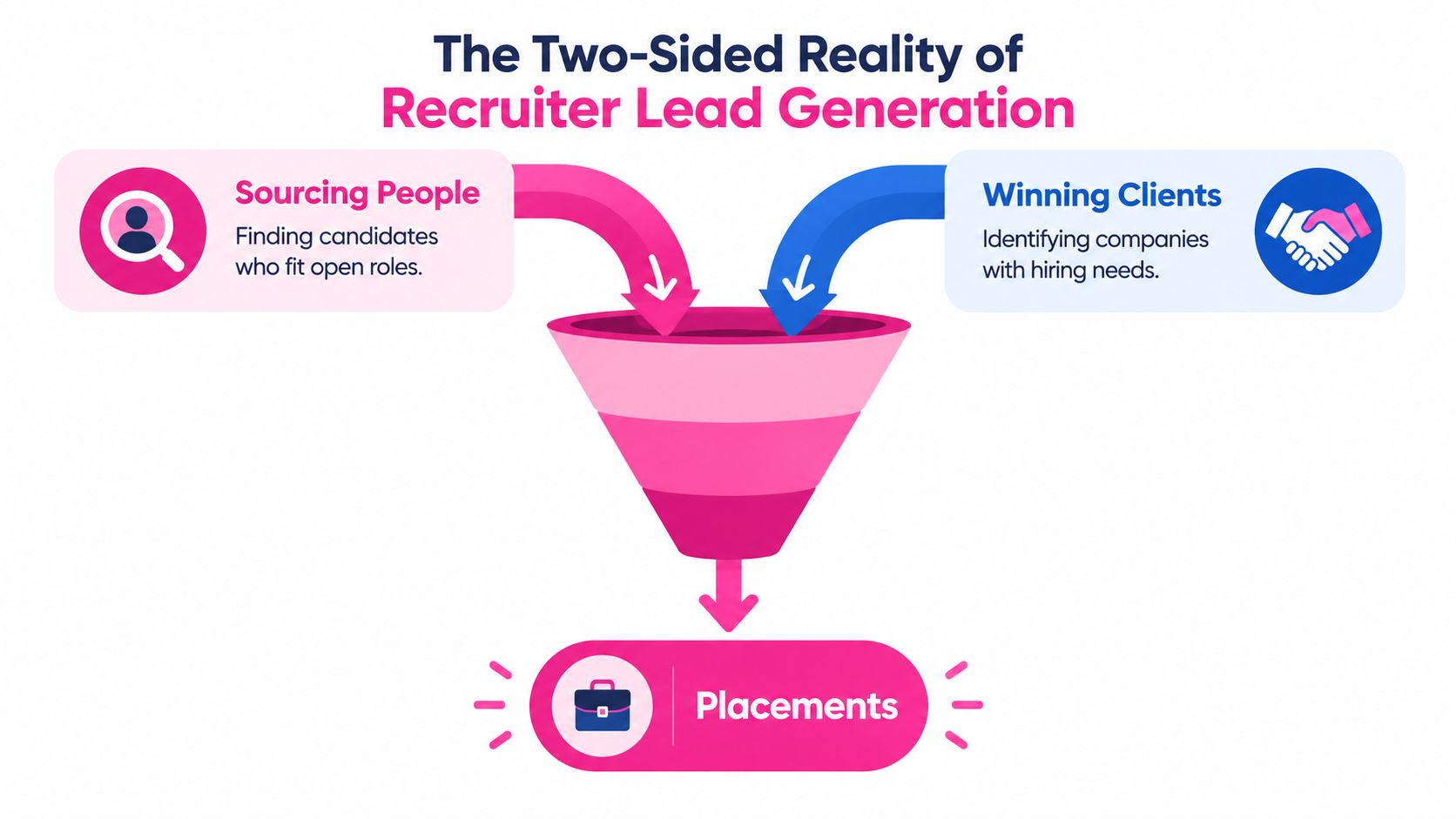
Two funnels, different economics
Treating these pipelines as interchangeable is a costly mistake. Candidate replies can indicate interest in a role, but they don't prove that a client will approve a search. A hiring manager's reply can earn a meeting, but it doesn't mean there's an approved requisition or a workable route to a placement.
Track them separately. Candidate campaigns need measures such as qualified conversations, screens, submissions, and candidate progression. Client campaigns need measures such as qualified conversations, accepted job orders, interview progress, and placements. The right measures depend on what that campaign is meant to produce.
Operational rule: Keep separate lists, copy, and dashboards for candidates and clients. A reply rate can help diagnose outreach, but it can't tell you whether both sides of the business are producing revenue.
This distinction changes the daily work. A recruiter with a live engineering role may need to source candidates first. An agency with an inconsistent flow of new requisitions may need to spend more time finding hiring signals and qualifying employers. The calendar fills reliably only when both funnels have a clear owner and a defined next step.
Where Recruiters Find Candidates Worth Contacting
A retained search for a controls engineer and a contingency desk filling support roles should not share a source map. SHRM's Talent Access Benchmarking Report, based on data collected from April to November 2021, found that organizations used employee referrals for 89% of nonexecutive recruiting, company websites for 86%, paid job boards for 75%, LinkedIn for 67%, free job boards for 66%, and social media for 60%, according to SHRM's Talent Access Benchmarking Report. Those figures show channel reach, not guaranteed fit for a specific desk.
Match the channel to the role
Referrals and career pages can produce candidates who already understand the employer, which helps when speed matters and the brief is stable. Job boards tend to surface active applicants, so they can fill a pipeline quickly while missing passive candidates with scarce skills. LinkedIn and other social channels reach professionals who are not checking listings, but the recruiter has to earn attention with a specific reason for contact.
Executive sourcing runs on a different mix. SHRM's Talent Access Benchmarking Report, cited above, also found that executive search firms and professional networking were each used by 50% of organizations, with internal applicants at 47%, LinkedIn at 46%, and company websites at 44%. For senior hires, the practical trade-off is clear: broad posting can create volume, while targeted relationships and specialist search often create access to candidates who will not apply.
A sourced candidate only produces revenue when the client side has a live need, an approvable profile, and a process that can move. For niche technical work, focused communities and careful LinkedIn research often beat a wide job-board push. Recruiters in emerging fields can study how specialist teams build a talent pipeline for Web3, then adapt the discipline to their own market.
Build the mix around live searches
Start with the roles the desk fills repeatedly. Track which sources produce candidates who meet the brief, respond, accept a screen, and reach submission. Count progression, not profiles collected. A high-volume search and an executive search may sit in the same agency, but they need different source weighting, different message angles, and different expectations for time to reply.
LinkedIn is most useful when candidate research and outreach stay connected: identify the person, check the signal, write to the specific situation, and run LinkedIn outreach as a targeted workflow. The better question is not which platform wins in general. It is which combination gives this search access to qualified people before the client loses patience or the candidate accepts elsewhere.
Scoring Client Signals Instead of Scraping Companies
You export 400 mid-market companies in your niche, load them into a sequencer, and send the same opener to every VP of Talent on the list. Three weeks later you have two replies and a burned domain. The list was never the problem. Nothing in it told you which of those 400 accounts had a live reason to talk to a recruiter this quarter.
A company list tells you who might buy recruiting services. A hiring signal tells you when. That timing gap is where the client side of the pipeline loses revenue: pitches land before a requisition exists, or weeks after the hiring manager already signed a competitor.
Industry coverage from Agency Leads describes generic-pitch reply rates as declining from about 4% in 2022 to below 1.5% so far in 2026, while outreach tied to a specific account-level hiring signal reportedly produced 6-9% replies. These figures come from vendor-affiliated coverage, so treat them as directional rather than independently validated. The durable takeaway holds either way: a specific, relevant reason to contact an account beats a generic claim that your agency can help. Agency Leads' coverage of recruiting lead generation
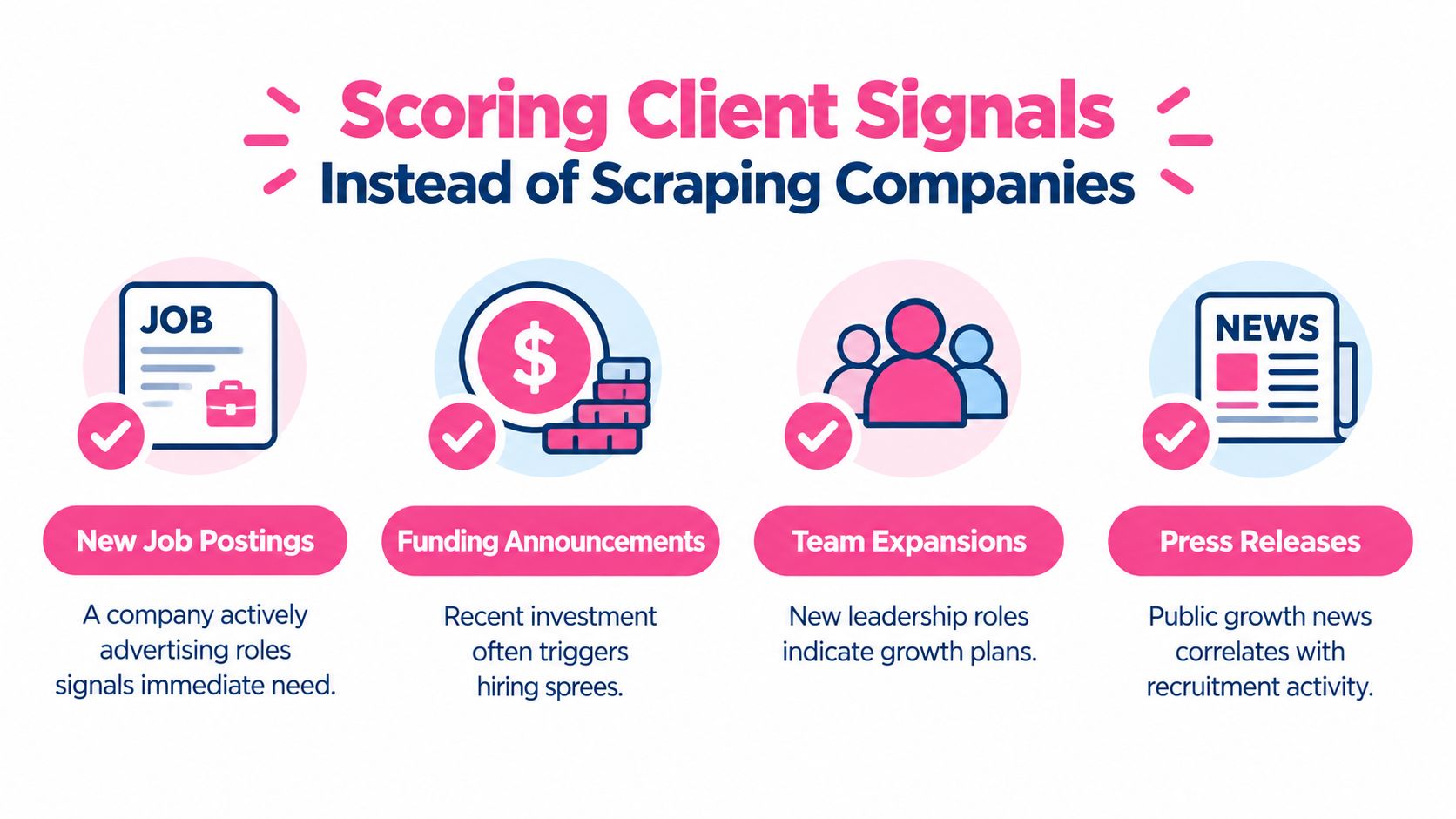
Use a consistent account-scoring method
Score each account against four questions before it enters any sequence:
- Signal freshness: Is the evidence recent enough to justify outreach now? A job posting from last week carries more weight than a funding round from eight months ago.
- Role relevance: Does the signal connect to roles your desk fills? A growth announcement means little if the hiring is in a function you never touch.
- Decision-maker fit: Have you identified a person who owns the hiring need and can engage an external recruiter?
- Urgency evidence: Do several public indicators point to a current or approaching need, or are you stretching a single event into a narrative?
New job postings, visible team expansion, leadership changes, funding announcements, and geographic moves are all worth logging. None of them proves a company has an approved requisition or wants agency support, and I've seen plenty of funded startups run every search through internal referrals for a year. The evidence decides whether a conversation is worth seeking. A disciplined cold qualification process keeps that judgment consistent across the desk instead of leaving it to whoever built the list that day.
Skip an account when the signal is stale, irrelevant, or thin. When two or three relevant indicators line up, move the account to the top and write the opener around what you observed, without claiming to know their internal plans. Signal-based targeting earns replies because the message is true, not because it sounds confident.
Running Outreach Sequences That Earn Replies
A single cold email is a test of one message, not a complete campaign. In a benchmark covering nearly 8 million recruiting outreach sequences, Gem reported a 78.3% cumulative open rate, a 21.3% reply rate, and a 7.9% interested-reply rate. The first message alone produced an 8.3% reply rate and a 3.9% interested rate; after the second message, cumulative results reached 15.8% replies and 6.2% interested replies. The benchmark is directional, not a guarantee for every role, market, list, or sender. Gem's recruiting email benchmarks

Build the sequence around relevance
Start with a segment narrow enough to support a useful message. For candidates, sort by role, seniority, geography, skills, and likely job-change motivation. For client outreach, keep the account signal and decision-maker in view. Verify contact details before launch; a polished message sent to the wrong person or an invalid address is still wasted effort.
Make the first message short and specific. For a candidate, connect the opportunity to something concrete in their background. For a client, name the relevant hiring evidence and ask a straightforward question rather than forcing a sales call as the only possible response. Schedule follow-ups that add new context or clarify the reason for reaching out. Repeating the same pitch with “just checking in” doesn't give the recipient much to work with.
Hireez's 2025 benchmark, based on more than 2.7 million recruiter-sent emails, reported a 58.3% average open rate, a 15.2% reply rate, and positive intent in 41.8% of replies. It reported a 17.6% reply rate for AI-supported emails versus 13% for other messages. That makes AI a tool to test, not permission to send unreviewed personalization or invented claims. Hireez's 2025 email outreach benchmark
For a first campaign, test one variable at a time: the subject line, opening sentence, call to action, message length, or follow-up timing. Keep a human review step for claims about roles, compensation, and company plans. A sequence tool can help organize the work; for example, recruiters can use an email sequence generator to prepare a draft, then edit it against the actual account or candidate.
The video below adds another perspective on the outreach process.
Classify every reply as interested, neutral, objection, or opt-out. Respond quickly to positive and ambiguous answers, and suppress opt-outs rather than sending another scheduled touch. Track delivered messages, unique replies, interested replies, booked screens, show rate, qualified submissions, and placements separately. Opens can help diagnose a campaign, but the commercial question is whether it produces qualified conversations and candidates who progress.
Turning Replies Into Placements Without Losing the Lead
A booked meeting moves a deal forward, yet it proves nothing about revenue. Recruitment Network reported that business-development activity fell 10.4% in a reported period while completed meetings per 1,000 business-development calls rose from 58.2 to 62.6. More efficient booking did not, by itself, show that more placements followed. The Recruitment Network's account of staffing business development
The drop-off shows up after the first conversation, in the stretch where the recruiter has the least control. Agency Leads' 2025 recruiting-industry report, cited earlier in the client-signals section, found that 44% of respondents cited clients taking too long to make offers, and 32% cited delayed or absent feedback. The same report identified a lack of qualified leads as a leading business problem.
Both failure modes sit past the reply stage. Candidate replies fill the pipeline, but client behavior decides whether any of that pipeline gets billed.
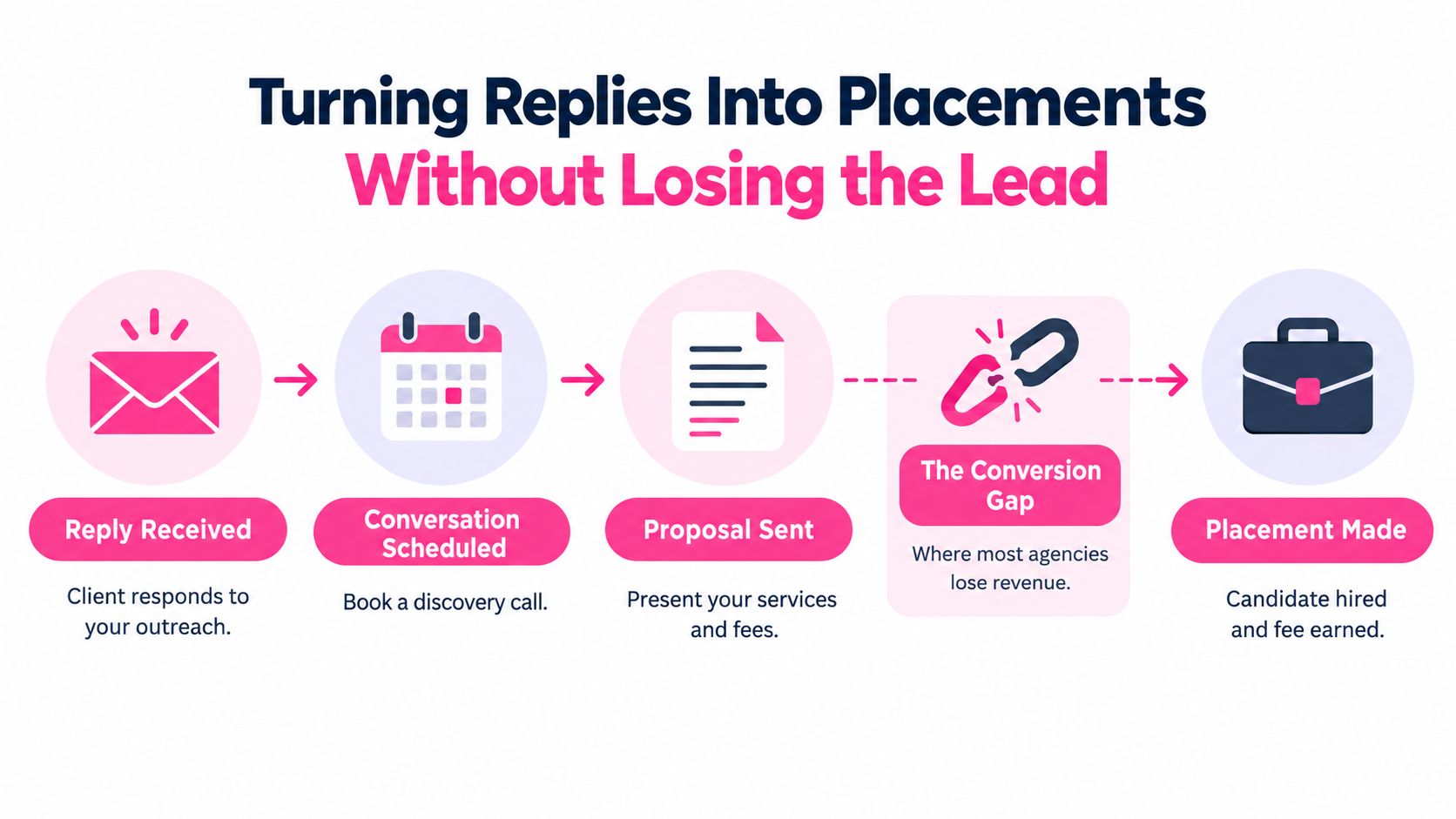
Qualify the job before accepting it
A client conversation becomes commercially useful when it establishes whether the agency can deliver and get paid. Ask direct questions before committing sourcing time:
- Approved requisition: Is there a live role with a genuine hiring mandate, rather than a speculative conversation?
- Compensation: Is the budget realistic for the level and skills required?
- Interview process: Who will interview, what stages are required, and how will candidates receive feedback?
- Decision authority: Is the person in the conversation authorized to engage an external recruiter and move the hire forward?
- Timeline: When does the client expect to review candidates, interview, and make a decision?
These answers reveal whether a promising reply can become an accepted job order. They also expose warning signs, such as a compensation range that doesn't match the role or a contact who can't describe how candidates will be evaluated. I've seen teams burn two weeks of sourcing on a req that was never approved because nobody asked the first question on that list.
Before accepting the search, agree on service expectations in writing. Document how quickly the client will review submissions, who provides interview feedback, how changes to the role get communicated, and what happens if priorities shift. A sourcing plan can't rescue a job order when the employer repeatedly rewrites requirements or leaves finalists waiting without a decision.
A calendar full of meetings can disguise a weak pipeline. Judge client acquisition by qualified job orders and placements, not by appointments booked.
Connect campaign sources to job-order acceptance, candidate submissions, interviews, offers, fills, and revenue. That chain separates outreach that produces a pleasant conversation from outreach that produces a job the team can fill. A structured lead qualification process keeps the assessment consistent across recruiters instead of letting each rep apply a personal standard.
Deliverability and Tech Stack That Protects the Pipeline
Good copy won't help if the message doesn't reach the inbox. Gmail's sender rules require authentication for mail sent to personal Gmail accounts. Since February 1, 2024, senders must use SPF or DKIM, while bulk senders must use SPF, DKIM, and DMARC. Gmail also requires valid forward and reverse DNS records, a TLS connection, and DMARC alignment between the From domain and the authenticating domain. Gmail's sender requirements
Protect the sender reputation
Authentication is the baseline, not a guarantee that every message lands in the inbox. Industry deliverability guidance sets a spam-complaint rate below 0.1% as the target and identifies 0.3% as a threshold never to exceed. It also calls for a one-click unsubscribe mechanism in marketing messages. Braze's Gmail deliverability guidance
Keep sending practices controlled and relevant. Use a sending setup that separates campaign activity from essential business correspondence, review list quality before launch, and maintain a suppression list that updates across outreach tools. Set sending limits based on infrastructure and reputation rather than assuming that more volume is better. Monitor replies and complaints so the team can pause a campaign when the audience or copy is producing poor signals.
Tag contacts and outcomes by campaign cohort in the CRM. Without that record, a deliverability problem can look like a copy problem, and a poor list can be mistaken for weak market interest. A technical email deliverability check can support routine reviews, but it doesn't replace sound targeting, accurate data, or appropriate opt-out handling.
Your 30-Day Recruiter Lead Generation Plan
Turn the system into a focused rollout. In week one, choose the roles and client segments your agency can serve well. Write down the candidate profile and the client profile separately, including geography, seniority, skills, and the decision-makers you need to reach.
In week two, build a client list from observable hiring signals and review each account for freshness, relevance, decision-maker fit, and urgency. Prepare candidate segments separately, then verify contact details before outreach. For client accounts, record the evidence behind each prospect so the first message stays accurate.
In week three, write a four-step sequence with a relevant opening and follow-ups that add context. Use AI to assist with research or drafts, but have a person check personalization and factual claims. Set up and verify sending-domain authentication before the campaign goes live.
In week four, launch, review replies, and qualify conversations promptly. Track candidate progression and client job orders on separate dashboards, then inspect where prospects stall: message response, booked conversation, approved requisition, interview feedback, or placement. If your team lacks the capacity to research accounts, write copy, protect sending infrastructure, and manage replies, a managed partner is another option. Ever Outbound provides done-for-you B2B client acquisition on a pay-per-close basis, with a human research, copywriting, and appointment-setting team using AI and managed sending infrastructure. Its plans start from $97 per month plus 5% commission on closed deals, and the first two closes are commission-free.
Use this checklist to get the first campaign moving:
- Define the ICP: Decide which client types and roles your agency can realistically serve.
- Build the account list: Score 200 prospects using relevant hiring signals before outreach.
- Prepare the sequence: Launch a four-step campaign with AI-supported personalization reviewed by a person.
- Protect delivery: Set up SPF, DKIM, and DMARC on a new sending domain and verify the configuration.
- Set the outcome: Work toward booking the first three calls, then qualify them for genuine job-order potential.
Ever Outbound Inc. runs done-for-you outbound campaigns for recruiting and staffing firms, including prospect research, personalized outreach, reply management, and appointment setting on a pay-per-close basis. If you want support building a signal-based client pipeline without taking campaign execution off your team's plate, visit Ever Outbound Inc..