November 4, 2026
Lead Generation vs Demand Generation: Who Really Wins
The popular advice is to build demand first and collect leads later. That sounds sensible until you're staring at an empty sales calendar and payroll is approaching. It also assumes lead generation can't create demand, which is a strange conclusion when a useful cold email can introduce a problem the buyer hadn't considered.
Say an agency launches a downloadable checklist. Contacts arrive, the dashboard turns green, and sales starts calling people who only wanted the checklist. Meanwhile, a persistent follow-up sequence teaches potential future buyers to ignore the agency's name. Lead counts can rise while future demand falls. The useful question in lead generation vs demand generation isn't which discipline wins. It's whether your acquisition program creates qualified conversations without making tomorrow's buyers less willing to have one.
Table of Contents
- Lead Generation and Demand Generation Side by Side
- Why Demand Comes Before the Lead
- Metrics and a Holdout Test for Anonymous Demand
- Tactics for Each Stage and Where They Overlap
- Email Rules That Protect Your Outbound Pipeline
- Which One to Prioritize for Your Situation
- Build a Two-Layer Funnel This Quarter
Lead Generation and Demand Generation Side by Side
Lead generation captures identifiable interest. Demand generation builds awareness and preference before someone identifies themselves. They're jobs within the same revenue system, not opposing schools of marketing.
The difference becomes tangible when you inspect what the team delivers. A contact record gives sales somebody to approach. A useful explanation, credible case study, or memorable point of view gives that person a reason to listen.
Lead generation and demand generation compared
| Dimension | Lead generation | Demand generation |
|---|---|---|
| Core question | Who will talk to us now? | Who will consider us when they buy? |
| Primary output | Named contacts, replies and booked calls | Awareness, preference, shortlist presence and pipeline influence |
| Buyer state targeted | Buyers actively evaluating a solution | Buyers not yet ready to act |
| Typical time horizon | Days to a few weeks for initial responses | Several months to years for preference building |
| Main metrics | Cost per lead, meeting rate, opportunities created | Target-account reach, branded search, assisted pipeline, win rate |
| Failure mode | High volume of low-fit contacts | Activity that never connects to pipeline |
Treat those time horizons as planning expectations, not delivery promises. A buyer can recognize a problem immediately and still need internal approval before taking action.
What a healthy-looking pipeline can hide
Say your team offers a broad business-growth template. A freelancer downloads it, a student saves it, and a company outside your service area requests access. Each becomes a lead, but none necessarily becomes an opportunity.
Now suppose sales automatically enrolls every downloader in a demo sequence. The team has confused permission to receive a resource with readiness to discuss a purchase. More aggressive follow-up may produce more replies while leaving the right future customers irritated.
The commercial model matters, too. Comparing pay-per-lead arrangements means asking what qualifies as a lead and who carries the risk when that contact never becomes a meaningful conversation. At Ever Outbound, we're pay-per-close, so closed business matters more than a growing spreadsheet.
The verdict: If you need conversations this month, start with lead generation; if future buyers don't know your name before they shortlist vendors, build demand alongside it.
Why Demand Comes Before the Lead
Say an operations director starts investigating why client onboarding keeps stalling. She reads a consultant's explanation, sends it to finance, and discusses it with the implementation team. Nobody fills out a form, but several colleagues now associate that consultant with the problem.
That's not an imaginary edge case in how vendor consideration develops. Google and Bain's B2B buyer research found that 92% of B2B buyers already have a shortlist of preferred vendors before a formal buying process begins, and the average buying committee includes 17 cross-functional stakeholders.
The sequence below captures the important distinction: consideration can exist before capture.
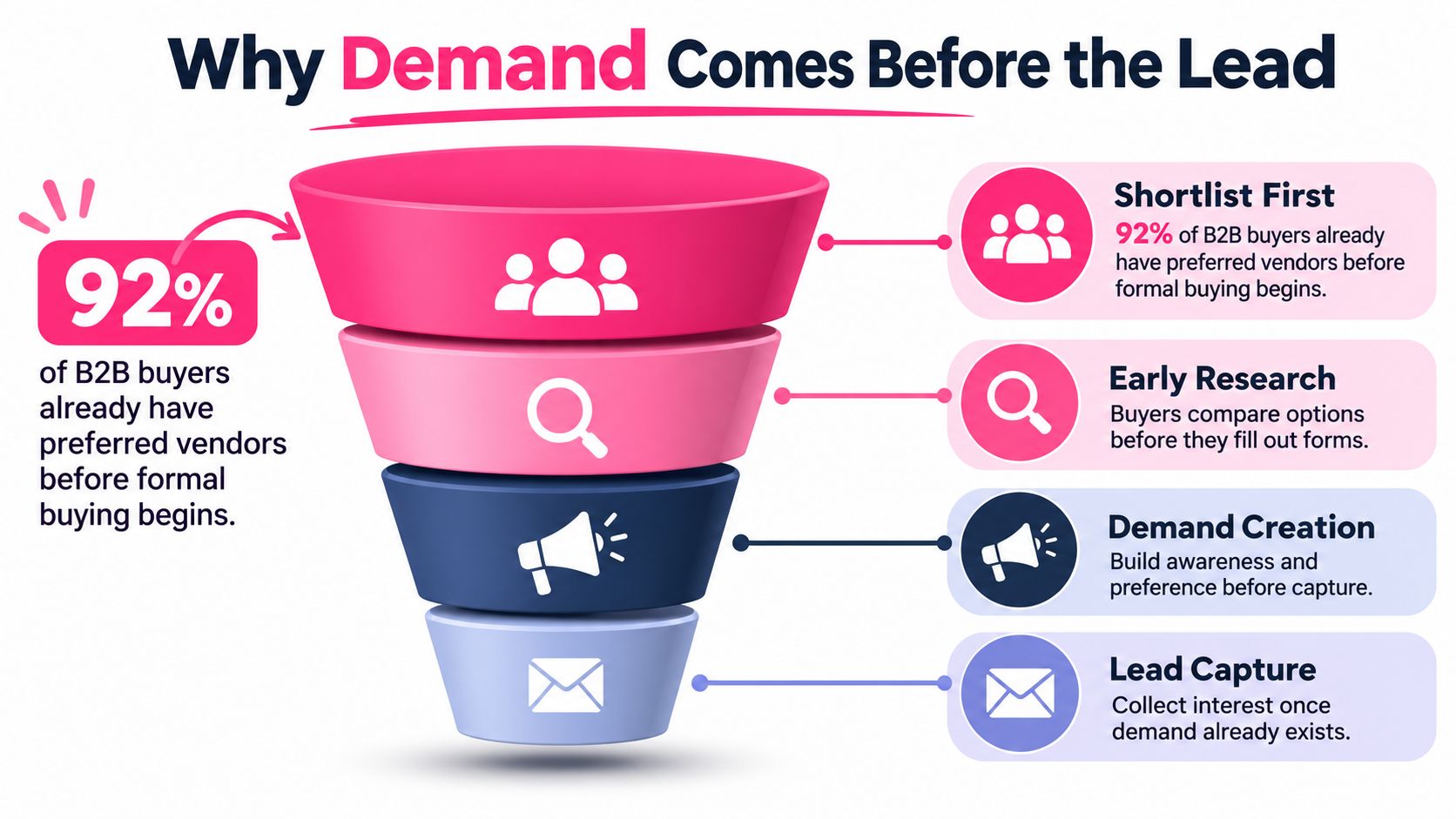
Recognition, identification and qualification
Follow the operations director through the purchase rather than through your marketing software.
- Recognition and preference: She finds a useful explanation and shares it internally. Colleagues begin using the consultant's language to describe their problem.
- Identification: She registers for a workshop or replies to an email. Marketing can finally attach a name to interest that already existed.
- Qualification and revenue: Sales checks whether the company has a suitable problem, an achievable project, and a workable buying process.
The form submission is a visible event, not necessarily the beginning of persuasion. If finance has already rejected your approach, the director's enthusiasm alone won't carry the deal.
The same distinction applies to timing. LinkedIn's B2B Institute explains the 95-5 Rule: roughly 95% of potential buyers aren't ready to purchase at a given moment, while about 5% are in-market in a quarter, with approximately 20% potentially in-market over a full year.
Those are planning proportions, not a universal census of every category. Their practical value is reminding teams that a well-matched company can be a future customer without being a current sales opportunity.
Where outbound blurs the boundary
An email about stalled onboarding can introduce the problem and offer a conversation simultaneously. The recipient might book immediately, forward the explanation internally, or remember the sender when the problem becomes urgent.
For another explanation of the distinction, this video provides a useful companion to the buying journey.
Don't force every recipient into the same follow-up path. Someone asking for implementation details needs a different response from someone saying the topic matters but the project isn't approved.
Practical reading: A lead is one person inside a buying group. Demand is the condition of that group.
Metrics and a Holdout Test for Anonymous Demand
A pipeline can look busy while future buyers grow less interested. Say a café owner sees more form fills after a campaign, but fewer people search for the business by name or arrive through direct traffic. Lead volume rose; signs of independent demand weakened.
Separate capture efficiency from commercial influence. Define each metric, name an owner, and keep the reporting window consistent.
Separate the operating metrics
Review lead performance weekly
- Conversion and cost: Visitor-to-lead conversion and cost per lead.
- Qualification: Lead-to-marketing-qualified-lead rate and marketing-qualified-to-sales-qualified-lead rate.
- Sales acceptance: Accepted meetings and opportunities created.
- Commercial outcome: Closed-won revenue, reported separately from booked calls.
Review demand indicators quarterly
- Audience coverage: Target-account reach and engaged contacts.
- Buying-group engagement: Content consumption across relevant roles.
- Independent interest: Branded search lift and direct traffic.
- Pipeline contribution: Assisted pipeline and win-rate improvement.
The measurement imbalance can leave teams with a clearer view of form fills than lead quality. Content Marketing Institute's B2B benchmark found that marketers tracked conversions at 73%, email engagement and website traffic at 71% each, and website engagement at 69%, while 52% explicitly tracked lead quality.
Anonymous evaluation makes that gap more consequential. 6sense's guide to changing buyer research reports that about 3% of website visitors self-identify through form fills, while buyers consume an average of 13 content pieces before engaging.
Ask new opportunities how they first heard about you and what prompted them to take a meeting. Keep those answers separate from first-touch CRM sourcing, then compare them with account-level engagement. Neither field proves what caused the opportunity.
Run a controlled account comparison
A 90-day holdout can help test whether a targeted demand campaign changes account behavior. It does not guarantee every sales cycle will finish within that period. Choose comparable target accounts, assign them randomly where feasible, and keep the holdout out of the campaign while maintaining equivalent sales treatment.
Record baseline performance, then compare exposed and unexposed groups on:
- Meeting rate: Meetings relative to assigned accounts.
- Sales-cycle duration: Time through consistently defined sales stages.
- Opportunity-to-close rate: Won opportunities relative to qualified opportunities.
- Revenue per account: Closed revenue across the entire assigned cohort.
Compare the cohorts rather than relying only on last-touch attribution. Log accidental exposure, and continue observing opportunities that remain open after the initial test.
An outbound volume planner can help you consider how a contact plan fits the available account universe. Outbound can also create demand: a relevant message may introduce a problem before a prospect is actively looking for a solution. Ever Outbound builds prospecting and messaging from scratch when a client expands into a new vertical or geography, and can scale outreach to 3x a client's pipeline without hiring a single SDR or buying a single ad. A holdout comparison still needs to show whether the campaign changed outcomes in your market.
Tactics for Each Stage and Where They Overlap
A case study isn't just something sales attaches after a demo. It can help an unfamiliar buyer decide whether your company deserves attention in the first place.
In the Demand Gen Report 2025 Demand Generation Benchmark Survey, 57% of B2B marketers selected case studies as their top content format for demand generation. Proof belongs before the sales conversation as well as inside it.
Tactics mapped to the job they do
| Tactic | Main job | Primary discipline | Metric to watch |
|---|---|---|---|
| Case studies | Build trust before contact | Demand generation | Engaged target accounts and sales mentions |
| Paid search and social | Raise recognition in the category | Demand generation | Branded search lift |
| Webinars and events | Educate buying groups and capture registrants | Both | Registrants from target accounts |
| Gated content offers | Convert active interest into contacts | Lead generation | Visitor-to-lead conversion rate |
| Cold email sequences | Start conversations with named decision makers | Lead generation | Reply and meeting rate |
| LinkedIn outreach | Introduce a problem or point of view, then ask for a reply | Both | Connection acceptance and reply rate |
Choose the job before the channel
Start with case studies that explain the customer's situation, the intervention, and the outcome. Use paid search and social to distribute a relevant message, while separating category-recognition campaigns from ads targeting buyers already looking for a provider.
Webinars and events give colleagues a shared explanation they can discuss internally. Gated offers work best when the resource justifies the information requested, not when a form blocks the only useful paragraph on the page.
Cold email gives you a direct route to named decision makers. LinkedIn outreach can combine a useful observation with a modest invitation to respond, rather than opening with a lengthy company introduction.
For SaaS teams deciding how to assemble those channels, Fetchin's B2B SaaS lead generation strategies for 2026 offers a channel-planning resource. Judge any suggested tactic by its role in your buying journey, not by how fashionable it sounds.
Put the overlap to work
Say a consulting firm hosts a monthly webinar on failed software handovers. Attendees from suitable accounts receive a relevant case study, followed by a clear invitation to discuss their own handover process.
Someone who asks a technical question gets a technical answer, not the same generic booking reminder as everybody else. Our outbound workflow follows interested replies through contextual follow-up and appointment setting.
Every demand asset should offer a capture point, and every lead tactic should point to proof. A capture point can be an optional next step; it doesn't have to be a gate across the content.
Email Rules That Protect Your Outbound Pipeline
A clean prospect list can still end up in spam. If recipients keep marking messages as spam, sending more won't repair the campaign. Protect inbox access first, then judge whether the outreach is working.
Google's sender FAQ defines bulk senders as those sending close to 5,000 or more messages to personal Gmail accounts within 24 hours. It recommends keeping spam rates below 0.1% and says they should never reach 0.3% or higher. Google also describes daily reporting and restoration of mitigation eligibility after rates stay below the higher threshold for seven consecutive days.
Use the following visual as an infrastructure check, not as a reason to send more.
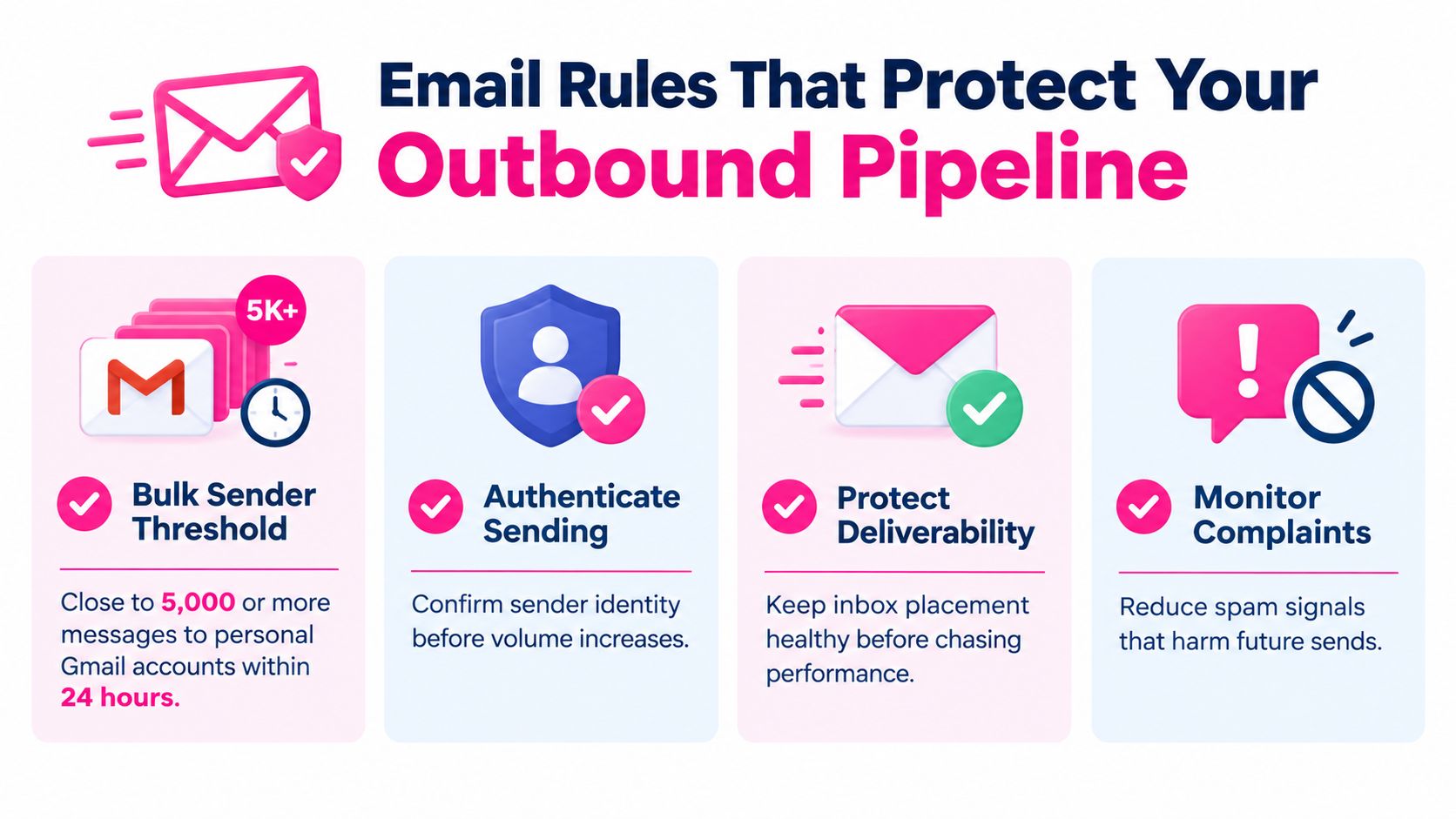
Run these checks before launch
- Classify expected volume. Count messages to personal Gmail accounts across your sending operation and determine whether bulk-sender requirements apply.
- Authenticate the sending domain. Ask the sending administrator to verify SPF, DKIM, and DMARC as appropriate. The mailX SPF checker can help inspect SPF, but it does not check the other authentication measures.
- Make leaving easy. Configure one-click unsubscribe for applicable commercial messages and test suppression across active sequences.
- Monitor complaints. Set an alert in line with Google's recommended spam-rate ceiling, then assign someone to investigate in Postmaster Tools.
- Test opt-out processing. Unsubscribe a test contact and confirm that scheduled messages stop.
Google's bulk-sender announcement requires authentication and easy one-click unsubscribe for bulk commercial senders, with unsubscribe requests processed within two days. A deliverability preflight review can help surface issues before launch; someone on your team or a deliverability specialist must own the fixes.
Add the compliance layer
The FTC's CAN-SPAM compliance guide requires clear opt-out instructions, a mechanism that works for at least 30 days after sending, no fee or extra personal information beyond the email address, and honoring requests within 10 business days. The law also applies to small commercial campaigns. Personalizing a message does not remove that obligation.
Keep suppression records connected to list imports so an opted-out contact doesn't reappear in a later campaign. These safeguards address email operations and CAN-SPAM, not every jurisdiction's requirements.
A campaign can be well targeted and still lose inbox access if complaints go unchecked.
Which One to Prioritize for Your Situation
A founder with an empty calendar and a revenue leader entering an unfamiliar market don't have the same immediate problem. Giving both the same channel prescription is how teams buy activity they can't use.
Forrester reports that 94% of business buyers use AI in their buying process and describes generative AI or conversational search as a more meaningful information source than vendor websites, product experts, or sales. Don't assume your website visit is the first opportunity to influence a buyer.
Match the investment to the constraint
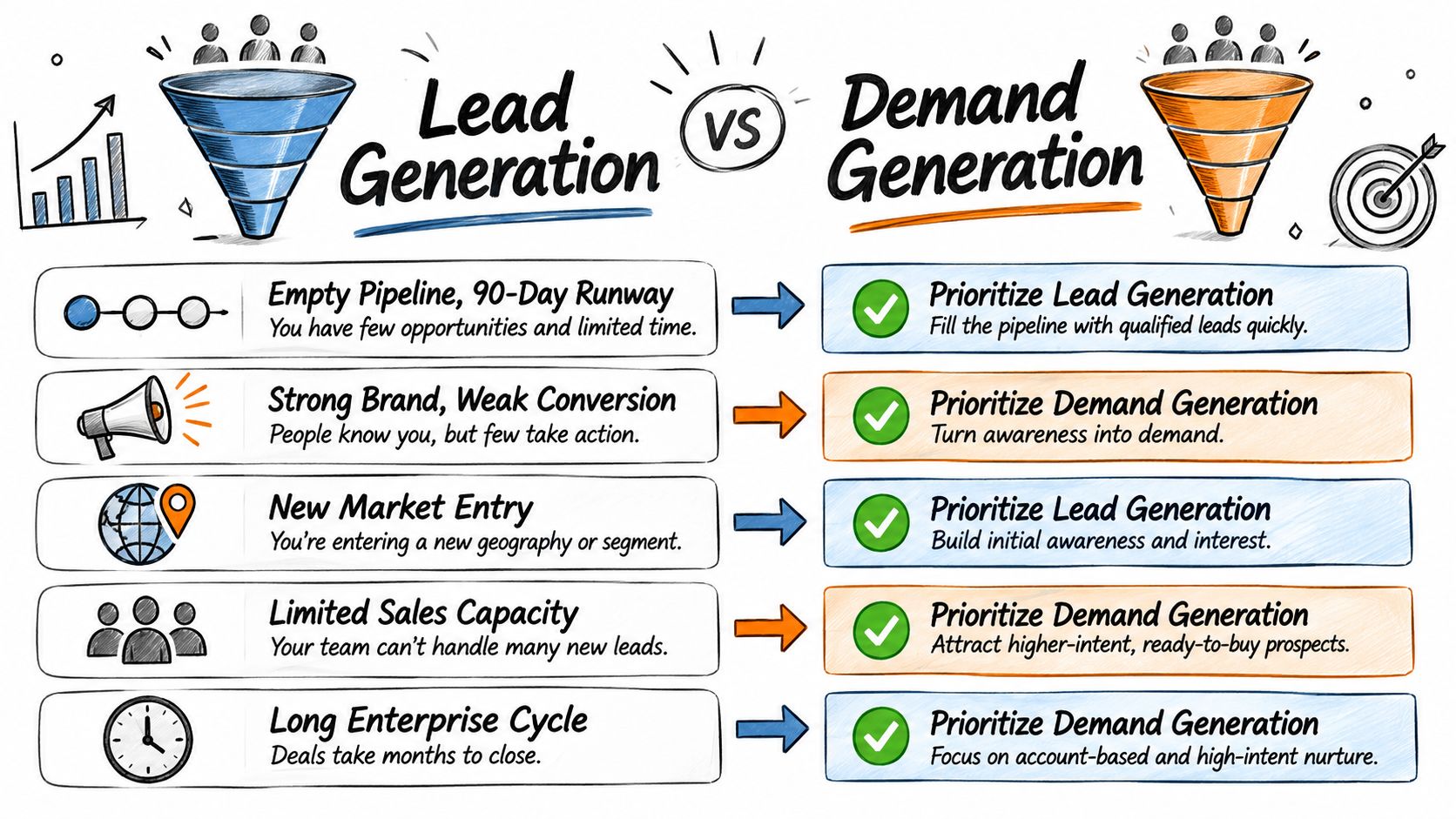
- Empty pipeline with a 90-day runway: Start with lead generation, using a tight list of verified decision makers and an offer tied to a recognizable problem. Judge progress through accepted meetings and qualified opportunities, not imported contacts.
- Entering a new vertical or geography: Lead with demand because familiarity is missing, but use outbound to introduce a specific problem, point of view, or use case. Support that introduction with relevant case studies and follow up according to the interest expressed.
- High-ticket product with a large buying committee: Run both, making educational material useful to the people evaluating delivery, financial risk, and implementation. Use lead capture to identify respondents without mistaking them for the entire decision-making group.
- Known brand with a weak win rate: Recognition may not be your bottleneck, so inspect qualification, competitive losses, and sales follow-up before buying more attention. Check whether opportunities have a genuine problem you can solve and whether your team helps buyers through the purchase.
- Small team with a limited budget: Prioritize narrow lead generation and reuse existing customer proof rather than launching a sprawling publishing program. Choose a segment where your offer and evidence are already relevant.
Use this scenario comparison to keep the decision anchored in the business constraint.
Give outbound separate success tests
Ask whether cold accounts recognize the problem and engage with the point of view. Then ask whether the resulting conversations become qualified opportunities.
Those questions prevent two different mistakes: abandoning useful market education because it didn't book an immediate meeting, and celebrating curious replies that never develop commercially. Job Calls, a marketing agency for home service contractors, got strong lead flow in 2 weeks; Sage Mind Marketing, a digital marketing agency for purpose-driven brands, doubled its annual revenue using our service. Those are distinct outcomes, not interchangeable measures or universal forecasts.
The right starting point depends on which gap is bigger, not on which label sounds more modern.
Build a Two-Layer Funnel This Quarter
Build around a defined buying group rather than a channel shopping list. Demand generation should increase visibility and preference across suitable accounts, while lead generation turns active interest into qualified conversations through relevant invitations and responsive follow-up.
Give each layer an accountable job
Define buying groups in the CRM. List target accounts and the roles involved in evaluating, approving, and implementing your offer. This prevents a responsive individual from becoming your entire account strategy.
Set up separate dashboards. Maintain a weekly lead view for replies, meetings, and opportunities, plus a quarterly demand view for account reach, branded search, and win rate. Separate views let the team distinguish execution problems from slower changes in consideration.
Launch the account holdout. Document assignment rules, baseline performance, campaign exposure, and the outcomes you'll compare before launch. Add a consistent self-reported attribution question to intake; you can create online forms with Kiwiform to collect that answer without turning it into an elaborate questionnaire.
Assign outbound both conversation and education work. Start relevant discussions with verified decision makers and introduce the problem your strongest proof addresses. Define meeting-ready leads clearly so appointment setters and sales agree on what belongs on the calendar.
Choose a target segment and record its baseline meeting rate before launching the holdout. If you want prospecting handled end to end, our team can run it while yours keeps the comparison honest.
At Ever Outbound Inc., we're pay-per-close, providing done-for-you B2B prospect research, personalized outreach, managed sending infrastructure, and qualified appointment setting. Visit us to discuss a campaign that starts relevant sales conversations while giving future buyers a credible reason to remember your name.