November 28, 2026
Lead Qualification Process: Stop Wasting Calls in 2026
The most popular lead qualification advice is still some version of BANT on the first call. Ask about budget, authority, need and timeline, write the answers down, then decide whether to keep going. It sounds disciplined. In practice it produces a confident score built on one person's polite guesses, and the score gets treated as fact for the rest of the quarter.
Here's the uncomfortable part. A lead can answer every one of those questions perfectly and still never buy, because the person answering has no budget access, the "need" is a preference rather than a cost, or the trigger they described was invented to end the call politely. Qualification breaks when you treat a conversation with one contact as evidence about an account.
The reframe that fixes it: qualification is not a score you assign to a lead. It's an evidence standard you apply to an account before you spend an hour of your week on it.
Table of Contents
- The Five Checkpoints Behind Every Qualified Lead
- Check Fit and Record the Evidence
- Map the Buying Group Before You Trust a Need
- Respond Fast and Judge Timing Before the Call
- Fixing False Positives from AI Signals and Deliverability
- Decide to Advance, Nurture or Disqualify This Week
The Five Checkpoints Behind Every Qualified Lead
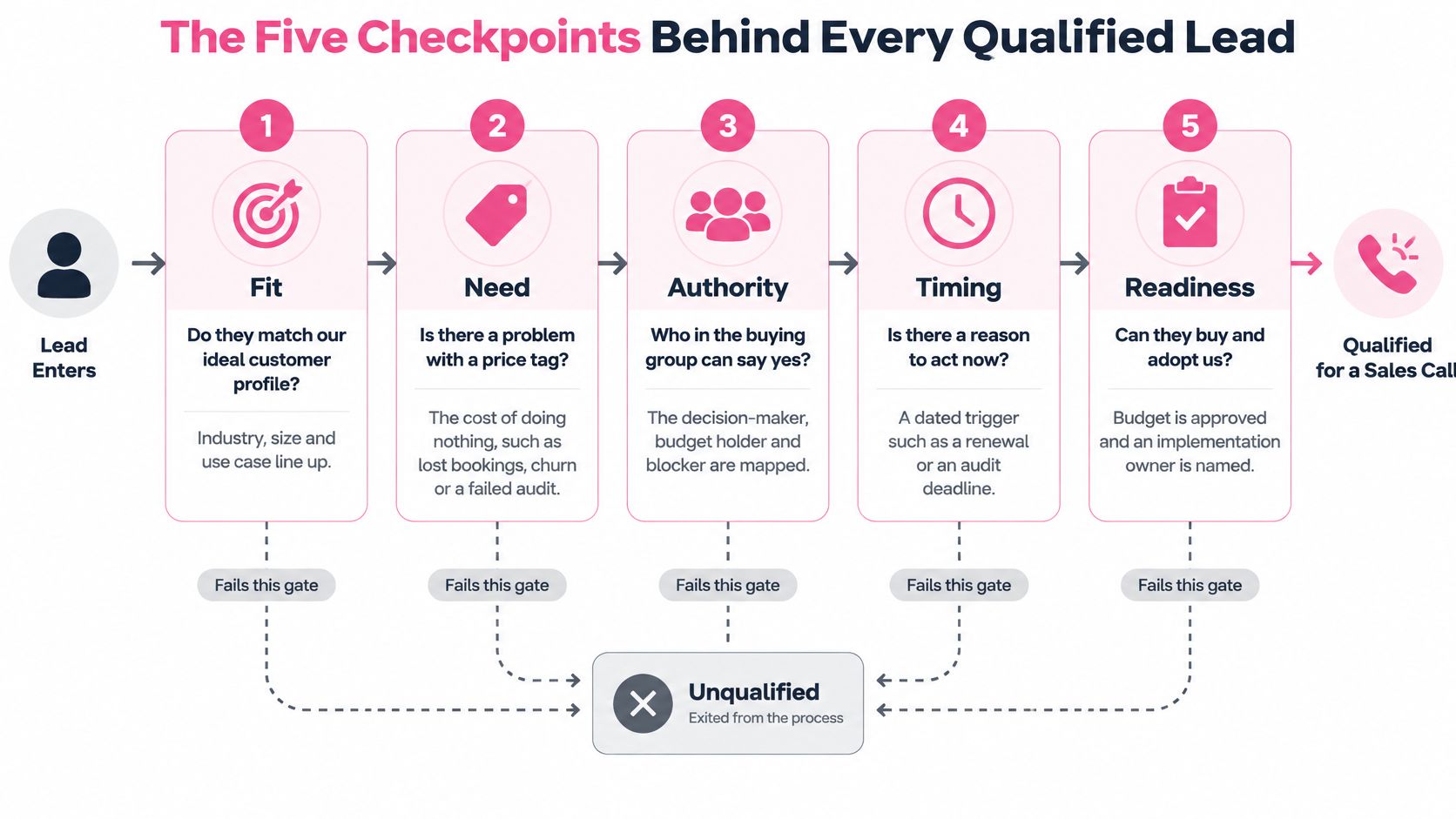
A lead earns a sales call only after passing five checkpoints in order: fit, need, authority, timing and readiness. In order, because the cheap checks come first and the expensive ones last. Fit and authority can be settled from data you already hold. Need and readiness require a human conversation, so you save those calls for accounts that survive the free filters.
| Checkpoint | Question it answers | Evidence to collect | Advance when |
|---|---|---|---|
| Fit | Does the account match our ideal client? | Industry, headcount, revenue, location | Matches every must-have criterion |
| Need | Is there a problem with a real business cost? | Pain stated in the prospect's own words | Prospect names a cost of doing nothing |
| Authority | Who signs, and who else is involved? | Titles, buying group roles, approval path | Economic buyer identified or engaged |
| Timing | Why now, and what forces a decision? | Trigger event, deadline, budget cycle | Named trigger or dated decision window |
| Readiness | Will they take a concrete next step? | Accepted meeting, shared data, agreed date | Next step booked with a named owner |
The stakes justify the discipline. Roughly 25% of marketing leads are sales-ready when generated, only 39% of firms consistently apply qualification criteria, and about 55% of leads are left unworked or handled inadequately, according to this lead quality statistics summary. Read those three numbers together and the job becomes obvious. Most of your qualification work is deciding what not to call, and that filtering often isn't happening.
Run the cheap checks first
Fit is a database query. Authority is a look at the org chart plus one question. Neither needs a calendar slot. Need, timing and readiness need a real exchange, which is why teams that run checkpoints out of order burn their best hours on accounts that were never going to pass fit.
The second reason for the order is honesty. Once you've spent forty minutes on a discovery call, you want the lead to be qualified. Running fit last invites you to rationalise a bad account because the call already happened.
Two outcomes, no third option
Every lead ends in one of two states. It advances with a dated next step and a named owner, or it gets classified with a reason code that tells you which checkpoint failed. "Maybe later" is not a state. It's a decision you haven't made yet, and it will sit in your pipeline report for four months pretending to be revenue.
The advance rule, in one sentence: no lead is called until fit, need, authority, timing and readiness each have a recorded answer, two buying-group roles are active on the account, and a dated next step exists.
Copy the five checkpoints into your CRM as required fields this week. Not as a scoring widget, as five fields nobody can skip. The moment a rep can move a record to "qualified" with three of the five blank, the process is decorative.
Check Fit and Record the Evidence
Start with the account record, not the phone. The first pass is a filtering job you can do in a spreadsheet, and it should reject more records than it keeps.
- Pull the firmographics you already have. Industry, headcount, revenue, location, and whether you can service them from where you operate.
- Reject anything outside your must-have criteria and write a reason code. "Outside target industry" and "no serviceable location" are different failures and they point at different fixes.
- Confirm the contact's role by function, not seniority. A VP of something irrelevant outranks a team lead who owns the problem. Rank relevance above title every time.
- Check for a plausible use case. If you can't describe in one sentence what this account would use you for, you don't have a lead. You have a name.
- Mark the record fit, nurture or reject. Three values. Not eleven pipeline stages invented by someone who left the company.
Before any of that, clean the list itself. Run it through a lead list cleaner so you're rejecting accounts on merit rather than on records with dead mailboxes and duplicate domains.
Two layers of evidence, kept apart
Once the account passes fit, score intent signals: reply quality, a pricing request, a specific implementation question, meeting acceptance, repeat visits to a product page. These are useful and they are also the easiest thing in the whole process to misread.
Keep the layers separate in the CRM. Firmographic facts are verified and dated. Behavioural signals are logged with their source and recency. Neither layer alone advances a lead. A verified 200-person agency with zero engagement is a target. A three-person startup with a warm reply and eleven page views is still the wrong company.
Worked example: a managed IT provider built for 50-person offices gets a warm, enthusiastic reply from a four-person firm asking for the cheapest break-fix service. Headcount fails the must-have filter. The reply is real, the interest is real, and the account still gets a reason code and a nurture tag, not a calendar invite.
And a deliverable email address is not a qualified contact. It's a technical prerequisite. Plenty of perfect inboxes belong to people who will never buy anything from you.
Audit your own filter
After roughly 50 rejections, pull them and read the reason codes. If one filter is catching accounts that later turn up as customers, your criteria are wrong, not the leads. If a filter catches nothing, it isn't a filter, it's a sentence in a document nobody reads.
At Ever Outbound we target prospects by revenue, industry and role, and we're pay-per-close, so a call to anyone outside that profile costs us as much as it costs the client. That's the discipline the filter is for.
Map the Buying Group Before You Trust a Need
A marketing agency gets a call with a contact who loves the pitch. Fifteen minutes in, the contact admits they don't know who approves spend, can't name the budget owner, and has never taken a proposal to their managing director. The pitch was good. The lead was a false positive.
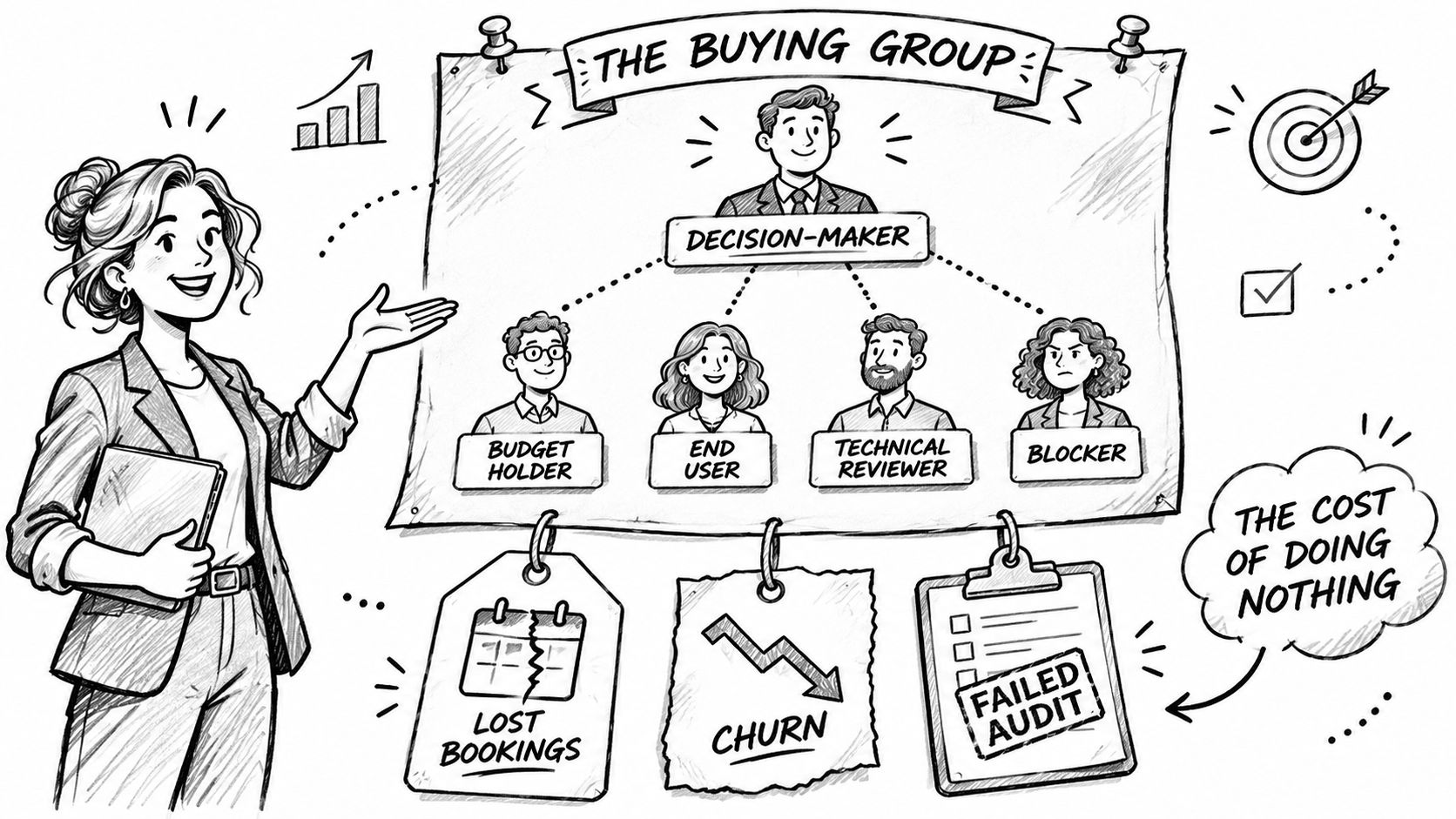
A need is a problem with a price tag. Lost bookings, churn, a failed audit, a compliance deadline, a competitor undercutting them. If the contact can't name the cost of doing nothing, you're discussing a preference, and preferences don't survive a budget review.
One friendly contact is not a decision
Research on B2B buying behaviour reports an average buying group of 10.2 people, with sellers first engaged only around 59% of the way through the evaluation process, and the eventual winner already on the initial shortlist in roughly 92% of completed purchases, per Intent Amplify's State of B2B Marketing analysis. If a committee of that size is deciding, a single enthusiastic contact tells you almost nothing about whether the account will buy.
| Role | Question to confirm | Red flag |
|---|---|---|
| Economic buyer | Who signs off the budget? | Contact cannot name anyone above them |
| User | Who uses it daily and what breaks without it? | No one outside the contact is affected |
| Blocker | Who could stop this, and why? | The question is never raised |
| Procurement | What is the approval path and timeline? | Timeline is unknown or keeps moving |
| Internal champion | Will you introduce me to the decision-maker? | Enthusiasm without any access |
The advance rule for accounts
Advance when at least two roles are active, including someone with budget authority or a credible path to it. Nurture when the contact is enthusiastic but has no access, and put a re-check date on it. Disqualify when nobody on the call can name the problem in concrete terms.
That's the whole test, and it kills a lot of calls that would otherwise have produced a proposal nobody reads.
In the agency example, the call should end with a request to meet the owner, not with a proposal. Sending the deck to someone who can't approve it is how a pipeline gets full of documents with no decision behind them.
Record every role as named, unknown or absent. Unknown is honest and it tells the next person what to ask. Absent is a finding. Blank is a lie, because it hides the fact that nobody checked.
If you want calls where the buying group is already mapped, that's what meeting-ready leads are meant to look like.
Respond Fast and Judge Timing Before the Call
Timing and readiness are not the same checkpoint. Timing is the trigger that makes a decision urgent: a renewal date, an audit, a funding round, a system that just failed. Readiness is the prospect agreeing to a specific next step. A lead can have one without the other, and speed decides whether you find out before a competitor does.
| Response window | Reported effect on qualification | Study basis |
|---|---|---|
| Within 5 minutes | 21 times more likely to qualify than a reply after 30 minutes | 2007 Lead Response Management Study, 15,000+ leads |
| Within 1 hour | Nearly 7 times as likely to qualify as a reply after an extra hour | Harvard Business Review, 1.25M+ leads |
| 24 hours or more | More than 60 times less likely to qualify than a first-hour reply | Harvard Business Review, 1.25M+ leads |
Those figures come from the Harvard Business Review lead response analysis, which examined more than 1.25 million internet-generated leads across 42 U.S. companies, and from the 2007 Lead Response Management Study behind it, which covered more than 15,000 leads across six companies. The same analysis found calling within five minutes made representatives 100 times more likely to reach the lead.
The routine that hits the window
- Timestamp the reply on arrival. Not when someone notices it. The clock starts at the prospect's send button.
- Route to one named owner within minutes. Shared inboxes are where leads go to be nobody's job.
- Reply to what they said. Quote their words back. A generic "thanks for your interest" resets the clock you just won.
- Attempt a human conversation on their preferred channel within the first hour. Phone if they gave a number. Reply thread if that's where they live.
- Run the five checkpoints during that conversation. Speed gets you the exchange. The checkpoints decide what happens after it.
- Book a dated next step or trigger nurture. Every conversation ends in a calendar entry or a sequence with a re-check date.
Where speed quietly dies
- Routing queues. A lead that lands in a shared queue at 4:55pm on a Friday has effectively arrived Monday.
- Timezone-blind scheduling. Your "immediate" follow-up at 9am local hits a prospect who started their day six hours ago.
- Generic autoresponders. They confirm receipt and communicate that nobody read anything.
- Counting dial attempts instead of conversations with decision-makers. Fifty dials to gatekeepers is not fifty touches of progress.
Track median and 90th-percentile response time per segment, not just the average. The median hides the tail, and the tail is where the deals you lost are sitting. If enterprise replies take three times longer than mid-market, you have a staffing problem disguised as a process problem.
If the reply handling is the bottleneck, an AI setter with human oversight can hold the first hour while your team sleeps, as long as a person still runs the checkpoints.
Fixing False Positives from AI Signals and Deliverability
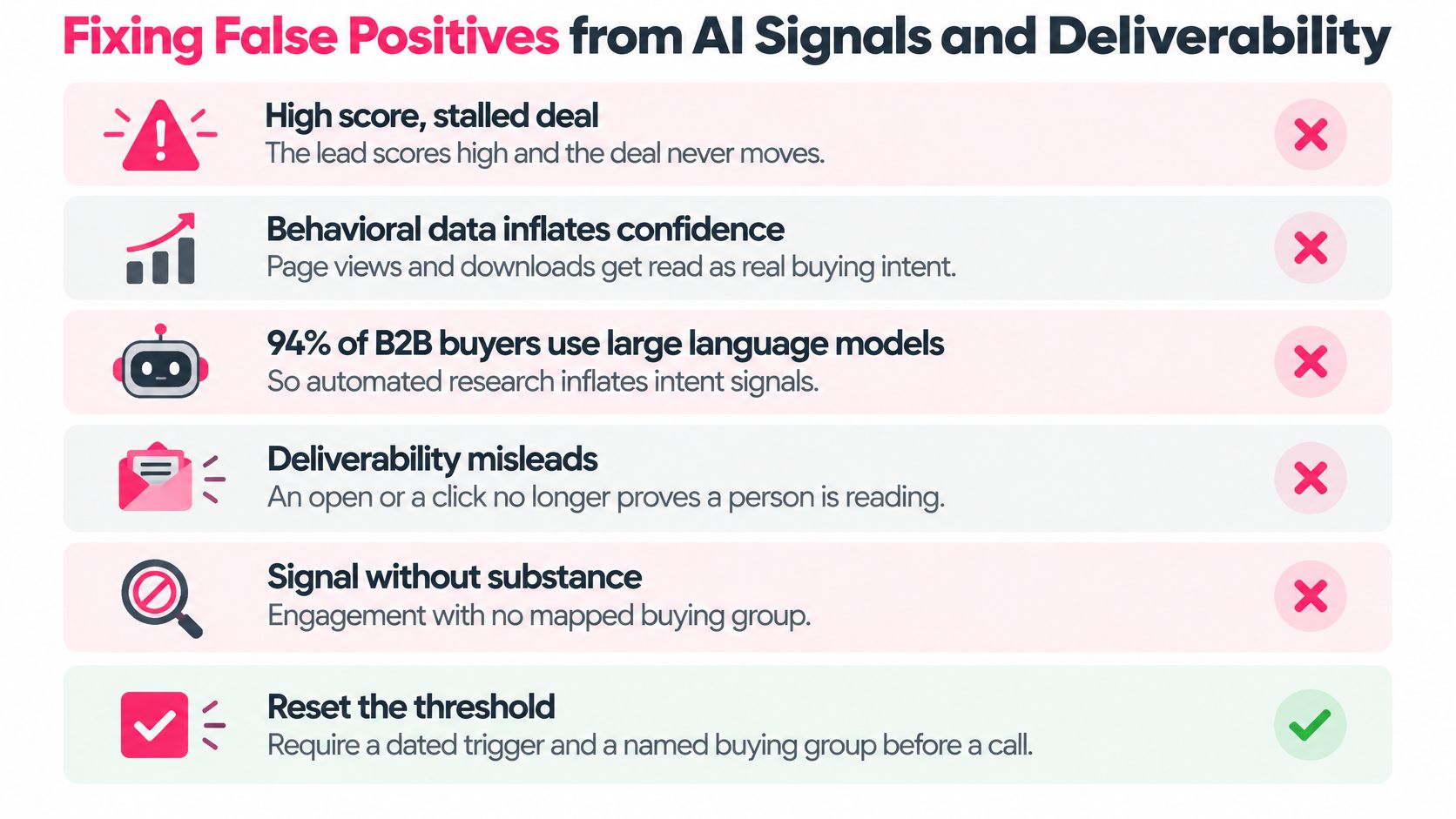
The most expensive failure in modern qualification is a lead that scores high and never moves. The score wasn't wrong about activity. It was wrong about meaning. Page views, downloads and reply opens now measure research as often as they measure intent, and a model trained on those signals will confidently rank tire-kickers above buyers.
Buyers use AI to evaluate, not to decide. Research cited by 6sense on GenAI and B2B buyer research finds that 94% of B2B buyers use large language models during the buying process, while also finding they use them to inform evaluation rather than make the final decision. So an account deep in AI-assisted comparison shopping looks, in your CRM, exactly like an account with a live project.
Separate observed facts from model inferences
Observed facts are things a human confirmed or a system verified: role, stated business problem, implementation trigger, named buying committee members, an agreed next step with a date. Model inferences are everything else, including the score, the intent grade and the "likely to buy" badge.
Log the source, recency and confidence of every signal that feeds a decision. Then require a human to confirm or reject any AI recommendation to advance, and record the rejection with a reason. Rejections are the training data for your next threshold change.
The question worth asking: not "can AI qualify leads?" but "which evidence is strong enough to let AI recommend progression, and when must a human overrule it?"
The downgrade path
When a prospect can't confirm urgency, can't name an authority, or can't describe a credible business consequence, move them down to nurture. Not sideways, not into a "warm" bucket that nobody owns. Down, with a date and a reason. The absence of confirmation is evidence.
Deliverability is a qualification gate
An unauthenticated sending domain never reaches the decision-maker, so it can't qualify anything. Google's email sender guidelines have required SPF or DKIM from every sender delivering to Gmail since 1 February 2024, and require SPF, DKIM and DMARC aligned with the From domain from bulk senders.
Then watch complaints. Google asks bulk senders to keep their spam rate below 0.3% as measured in Postmaster Tools, as this summary of Google and Yahoo's 2024 requirements sets out. A campaign that books meetings while generating complaints is borrowing against next quarter's inbox placement. Reduce volume and fix targeting before you cross that line, not after. Check your setup with an email deliverability checker before the next send.
The one-day fix
Add a required evidence type field to every advance decision: verified fact, buyer-confirmed, or model inference. Anything marked inference can't be the only reason a call is booked. Then compare qualified-to-closed-won rate by segment each month to see whether the standard is holding.
Decide to Advance, Nurture or Disqualify This Week
Three outcomes. Each one has a rule, and each one leaves a trace.
- Advance. All five checkpoints recorded, at least two active buying-group roles including someone with budget or a path to it, a dated next step with a named owner, and an evidence type logged.
- Nurture. Fit confirmed, but timing or authority unknown. Set a re-check date and write down exactly which answer you're waiting for.
- Disqualify. Fails fit, or refuses any next step. Log the reason code so the pattern becomes visible across a month of records.
The audit that follows is the part people skip. Pull the last 20 leads and score each one against the five checkpoints. Count how many advanced that shouldn't have. Then fix the weakest checkpoint first, which is almost always authority or timing, because those are the two that need a conversation to confirm and the two reps are most tempted to assume.
Put a number on the cost of getting it wrong. Run the calls you booked against a meeting cost calculator and compare what each one cost to build, in list time, copy and follow-up, against what it returned. When an unqualified call costs real money rather than a vague hour of your day, the checkpoint that keeps letting it through gets fixed fast.
The line to remember: qualification is the decision to spend your time, not a score.
If you'd rather not rebuild list verification, copy and follow-up from scratch, we run that work end to end at Ever Outbound, where we're pay-per-close. Our process has four steps: we build your list of verified decision makers, write and send short copy on warmed domains, book interested prospects straight onto your calendar, and you show up to close. You get notified the moment a prospect is interested or books a call.
Ever Outbound Inc. runs done-for-you B2B outreach for agencies, consultants, SaaS teams and service businesses, and we're pay-per-close: you pay a 5% commission only when a deal closes, and your first two closes are commission-free. We verify decision makers, write the copy, manage sending domains and qualify replies against fit, need, authority, timing and readiness before anything reaches your calendar, so the calls you take are ones worth taking. Visit Ever Outbound Inc. to see how the campaigns are built and what the first month looks like.