October 14, 2026
Outbound Lead Generation Agency: How to Choose in 2026
83% of B2B leaders said omnichannel selling was more successful than face-to-face-only selling, and 20% of buyers said they would spend more than $500,000 through a fully remote or digital sales model. An outbound lead generation agency runs targeted email, phone, and multi-channel outreach to book qualified sales calls on your calendar, but the pricing model decides whether their incentives are aligned with yours.
You're probably looking at a stack of sent emails, a few polite replies, and a calendar that still feels too quiet. That's the core tension with an outbound lead generation agency, not whether they can “do outbound,” but whether they can turn prospecting into revenue without making you pay for noise.
Table of Contents
- What an Outbound Lead Generation Agency Actually Does
- Pay-Per-Close vs Retainer and Why Pricing Shape Matters
- Inside the Delivery Chain From Offer to Booked Call
- Deliverability Is an Engineering Problem, Not a Volume Problem
- Booked Meetings Are Not Demand, and Qualification Is Where Agencies Hide
- Questions to Ask and a Decision Checklist for Choosing a Provider
- What a Good Engagement Looks Like in the First 90 Days
What an Outbound Lead Generation Agency Actually Does
A founder can stare at an empty calendar for weeks and still get a retainer invoice that looks healthy on paper. That mismatch is why outbound exists in the first place, it is supposed to turn a vague market into actual conversations, not just activity.
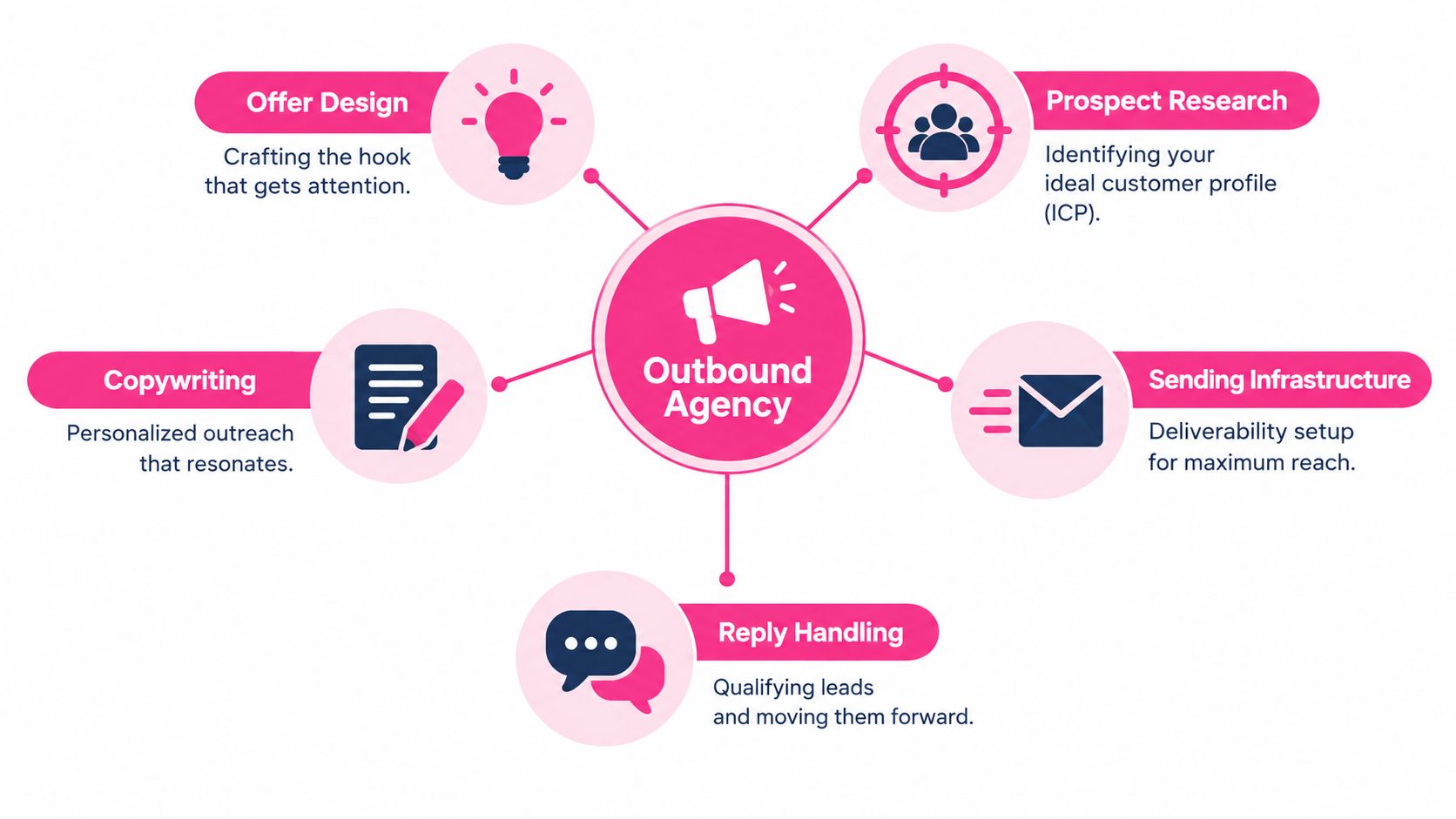
An outbound lead generation agency is a stitched-together operation. It usually covers offer design, prospect research, copywriting, sending infrastructure, reply handling, and appointment coordination in one motion. That is the actual product, not just “more emails.” The service mix matters because every handoff changes the outcome.
What sits inside the engagement
| Service Block | Typical Owner | What Good Looks Like |
|---|---|---|
| Offer Design | Strategist, founder, or agency lead | A clear hook that matches a real pain and a believable next step |
| Prospect Research | SDR, researcher, or data operator | Tight ICP fit, verified contacts, and obvious relevance |
| Copywriting | Human writer with sales context | Short, specific outreach that earns a reply |
| Sending Infrastructure | Deliverability operator | Authenticated domains, controlled volume, and healthy inbox placement |
| Reply Handling | Setter, SDR, or hybrid team | Fast triage, clean qualification, and no lost interest |
| Appointment Booking | Setter or coordination team | Calendar handoff that preserves context and intent |
A modern agency doesn't just send. It researches, writes, filters, follows up, and books. If you want to see how a serious operator frames that work, look at the way Ever Outbound's about page describes its delivery model, then compare that to the silent gaps in most vendor pitches.
For a useful deep dive into voice-led motion inside outbound, the AI voice agent deployment guide is a good adjacent read because it shows how phone can fit into a broader outreach system without replacing the rest of it.
Practical rule: if a provider can't explain who owns the research, the copy, the sender reputation, and the booking handoff, they're selling you a headline, not a system.
Why agencies still matter in 2026 is simple. In-house teams are expensive to hire, slow to ramp, and hard to keep consistent. Agencies exist because many buyers want the advantage of a live outbound machine without building the whole machine themselves.
Pay-Per-Close vs Retainer and Why Pricing Shape Matters
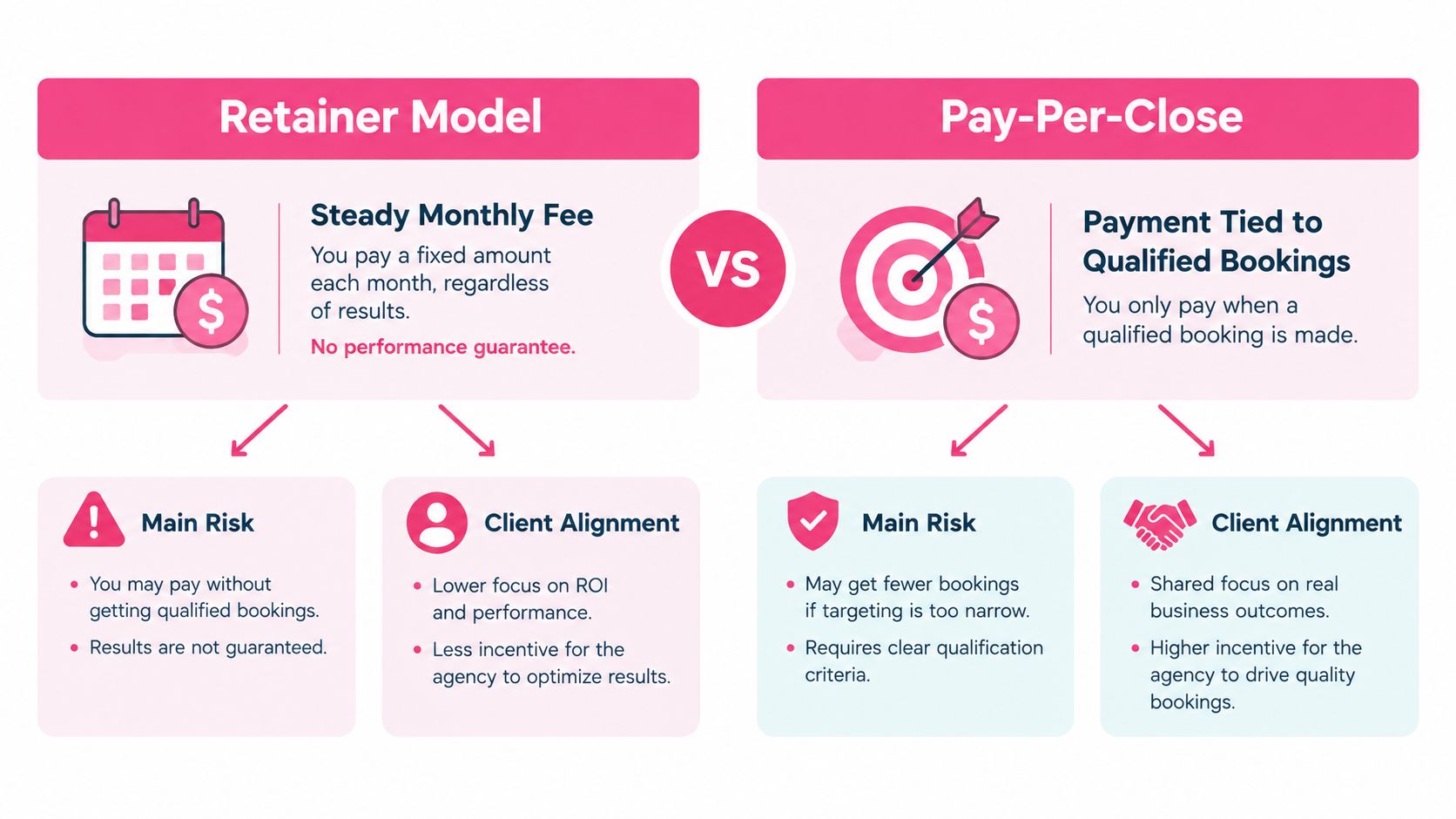
Pricing shape decides where the pressure lands. A retainer agency gets paid when the month runs. A pay-per-close agency only wins when the client closes, so the model forces harder choices on targeting, follow-up, and accountability.
The operating difference
A retainer model pushes risk onto the buyer. If the list is weak, the copy is bland, or the follow-up drags, the agency still collects. That usually leads to the same failure modes, too much activity, too little judgment, and too little pressure to improve the parts that create revenue.
A pay-per-close model changes the incentives. The agency has to care about who gets contacted, how replies are handled, and whether meetings turn into closed business. That is why Ever Outbound is pay-per-close, and the first 2 closes are commission-free. If you want to see what clean terms look like, compare them with Ever Outbound's published pricing. It is the cleaner alignment when you want outbound to behave like a revenue function instead of a media buy.
Retainer vs pay-per-close side by side
| Dimension | Retainer Agency | Pay-Per-Close Agency |
|---|---|---|
| Incentive | Paid for activity | Paid for closed business |
| Risk | Mostly on the client | Shared through outcome dependence |
| Targeting pressure | Often weaker | Much stronger |
| Qualification discipline | Inconsistent unless enforced | Usually tighter because bad meetings hurt both sides |
| Best fit | Teams buying capacity | Teams buying accountability |
| Failure pattern | Busy dashboards, weak pipeline | Fewer excuses, more scrutiny |
A retainer can make sense when you need a lot of creative, strategic, or testing work and you are willing to manage the risk yourself. If you care about revenue alignment, retainer is the weaker structure most of the time.
Hybrid models sit between the two. Some charge a base fee plus performance, others bill per booked meeting. Those can work, but they often hide disputes about attribution, close windows, and what counts as a qualified opportunity. Read the contract as if you are going to argue over it later, because if the campaign works, you may.
The test in any outcome-based agreement is simple. Who owns the evidence when a deal closes? If the agency cannot show where the lead came from and how it moved through the CRM, the pricing model is only branding.
Inside the Delivery Chain From Offer to Booked Call
A serious outbound operation starts before a single message goes out. The first question is whether the offer is worth interrupting anyone for, because even flawless delivery can't save a weak market angle.
From research to sequence launch
Good teams begin with offer-market fit, then move into lead sourcing and verification. That means researching the right accounts, checking whether the contacts are worth pursuing, and building a list that won't poison the sender reputation later. Once that's set, the agency writes copy, reviews it with the client, and only then moves to setup and launch.
The next checkpoint is infrastructure. Domains need time, sequencing needs restraint, and mailboxes need controlled throughput. After launch, the work shifts to reply triage, qualification, calendar booking, and show-up coordination. If any of those handoffs are sloppy, the campaign leaks value.
The line between human-led and AI-led execution matters here. The best systems use human research and human copy, then use AI as a multiplier for personalization and reply sorting. What they don't do is hand the whole motion to automation and hope the market doesn't notice.
If a vendor can't explain what happens after a positive reply, you're not buying appointment setting, you're buying a half-finished sequence.
That's why a resource like CleanMyList's guide to boosting cold email reply rates is worth reading alongside any agency pitch. It helps you judge whether the provider is improving response quality or just stacking send volume.
The simplest way to score a provider is to ask what gets measured at each handoff. If they can't name the checkpoint, they probably can't control it. For a clearer picture of the operating flow, Ever Outbound's process overview shows the kind of sequence discipline buyers should expect from a real delivery team.
Deliverability Is an Engineering Problem, Not a Volume Problem
The inbox is not a neutral place. It's a governed environment with rules, thresholds, and failure modes, and outbound teams ignore that at their own expense.
The rules that actually matter
Google treats senders approaching 5,000 messages per day to personal Gmail accounts as bulk senders, and bulk senders need proper authentication and an easy unsubscribe path. Since February 1, 2024, senders must authenticate with SPF or DKIM, while bulk senders must use SPF, DKIM, and DMARC. Google also recommends keeping user-reported spam below 0.1% and avoiding 0.3% or higher, because that's where mitigation becomes unlikely and rejection risk rises. Google's bulk sender guidance makes this explicit.
Those rules translate into actual operating discipline. Domain segmentation matters. Suppression lists matter. Complaint monitoring matters. So do warmup, mailbox throughput, and a recovery playbook for when one sending identity starts to degrade.
Google's sender requirements for bulk mail also require one-click unsubscribe for commercial and promotional email and say unsubscribe requests need to be processed within two days. That means an agency can't just “send more” when results slow down. It has to protect the infrastructure that lets the outreach land in the first place.
Why agency-owned infrastructure matters
A 2025 benchmark report found that only 18.2% of the top 10 million domains had valid DMARC records, and just 7.6% enforced a quarantine or reject policy. That's a weak baseline, and it explains why inbox placement is a real operating risk, not a side issue. The report also makes clear that delivery to a mail server is not the same thing as landing in the inbox. Validity's benchmark report is blunt about that gap.
If an agency can't answer these questions, don't hire it:
- Who owns the domains and sender reputation?
- What happens when a mailbox starts to fail?
- How are complaints monitored and acted on?
- When does sending pause instead of pushing harder?
- How is inbox failure separated from campaign failure?
The right answer isn't more volume. It's more control. Ever Outbound's deliverability checker is the kind of tool that belongs in the conversation before launch, not after the sender score has already taken a hit.
Booked Meetings Are Not Demand, and Qualification Is Where Agencies Hide
A booked slot is not demand. It's only a conversation, and too many agencies hide behind the language of “meetings booked” because it sounds better than “opportunities that may or may not fit.”
Activity, output, outcome
A strong outbound program separates activity from output and output from outcome. Activity is the sending and follow-up. Output is the reply or the booked call. Outcome is revenue, or at least a meeting that had a real shot at becoming revenue.
A serious qualification framework defines authority, need, urgency, and budget before the meeting gets booked. It also records disqualification reasons in the CRM, because bad-fit conversations should teach you something instead of disappearing into a spreadsheet. For a tighter way to think about fit, ContentBuck's guide on identifying prospects with buying intent is useful context.
The metrics that should not be mixed
| Layer | Example Metric | Who Owns It |
|---|---|---|
| Activity | Emails sent, calls placed, replies handled | Agency |
| Output | Positive replies, booked meetings, show rate | Agency and client together |
| Outcome | Opportunities created, deals closed, revenue by campaign | Client, with agency accountability where applicable |
Buyer behavior matters. McKinsey reported that by 2021, buyers were using multiple channels during a purchase and could use up to 10 or more channels, about double the number reported five years earlier. The same shift is why agencies need to give prospects enough context to self-qualify instead of relying on a setter to force interest into a calendar slot. McKinsey's omnichannel research backs that direction clearly.
A good setter protects sales capacity. A bad one fills the calendar with people who never should've booked in the first place.
That's also where compensation gets tricky. If the agency is paid only on a calendar booking, it has a reason to maximize volume. If it's paid on close, it has a reason to care about qualification, show rate, and downstream revenue. Ever Outbound's qualification framework belongs in this conversation if you want the agency side to stay tied to actual business outcomes.
Questions to Ask and a Decision Checklist for Choosing a Provider
The sales call should feel like an audit, not a vibe check. If the provider can't answer the basics cleanly, you already know enough.
The questions that expose weak operators
Start with pricing. Ask whether the model is retainer, pay-per-close, or hybrid, and then ask what happens when attribution gets disputed. Ask who pays for domains, who owns the mailboxes, and who bears the cost if a domain gets burned.
Then move to execution. Ask how they define a qualified meeting, where CRM evidence lives, what the reply-handling latency is, and how quickly they respond when intent is high. Ask what their complaint-rate monitoring looks like, what triggers a pause, and how they separate campaign performance from inbox-placement failure.
Finally, ask about accountability. You want to know the close window, refund or dispute handling, and whether they'll share the qualification script before launch. If they won't, they're asking you to trust the output without seeing the operating logic.
Use this checklist in the call
- Pricing mechanics: Retainer, pay-per-close, or hybrid, and exactly when money changes hands.
- Domain ownership: Who owns the sending identities and what happens if one deteriorates.
- Authentication coverage: SPF, DKIM, and DMARC handled or left for the client.
- Complaint monitoring: How often spam signals are checked and what threshold pauses outreach.
- Reply speed: How fast positive interest gets a human response.
- Qualification standard: What counts as a real meeting, not just a booked slot.
- Attribution evidence: Which CRM fields prove the lead source and close path.
- Dispute handling: What happens if both sides disagree on whether a deal counts.
- White-label support: Whether the provider can fulfill under another brand if needed.
The strongest agencies don't get defensive when you ask these questions. They welcome them because clean terms prevent messy relationships later. If you're comparing vendors, pay attention to who can explain the mechanics without drifting into vague promises.
What a Good Engagement Looks Like in the First 90 Days
A good outbound engagement should feel increasingly precise, not just increasingly busy. In the first month, the offer gets aligned, the list gets built, and the team learns where the message is too broad or too clever.
By day 60, the sequence should be calibrated enough to show what resonates and what gets ignored. Qualification starts to tighten, bad-fit prospects get filtered out earlier, and the calendar should contain fewer random names and more plausible buyers. That's when the agency earns its keep.
By day 90, you should see pipeline visibility, attribution reconciliation, and a more honest picture of which motions create real business. If the agency is still talking mostly about sends and replies by then, something's wrong. If the conversation has shifted to revenue and close quality, you're finally looking at a real operating partner.
The main point is simple. An outbound lead generation agency is an advantage, not magic. Pay-per-close is the right structure when you want incentives aligned, but it still fails if deliverability breaks or qualification is sloppy.
Show up to the calls the agency books and make them count.
If you want outbound built around pay-per-close economics, human research, deliverability control, and qualified appointment setting, Ever Outbound Inc. can run the outbound side while your team focuses on closing. They're built for B2B teams that want done-for-you outreach without retainer risk, and the model is designed so you only pay when deals close from their efforts.