November 19, 2026
Outbound Sales Strategy: A Practical Guide for B2B Teams
Every outbound teardown ends in the same place. Someone pulls up a subject line, the room agrees it reads a little flat, and a rewrite gets assigned. Six weeks later the reply rate has moved a couple of tenths of a point and nobody brings it up again.
That reflex is the most popular advice in this category, and it's usually aimed at the wrong thing. Copy is the most visible part of an outbound sales strategy and the least likely to be the broken part. A sharp subject line cannot rescue a list of job titles with no trigger behind them. A clever offer cannot survive a sending domain that Gmail has already decided to distrust. And a seven-touch sequence built on a weak offer fails politely, with a pile of "thanks, not right now."
Table of Contents
- The Five Parts Every Outbound Strategy Needs
- Picking Your Targets and a Hook They Cannot Ignore
- Writing Outreach That Earns a Reply
- Protecting Deliverability and Staying Legal
- Sequencing Touches and Following Up Fast
- Measuring What Actually Fills Your Calendar
- Pilot One Segment Before You Scale
The Five Parts Every Outbound Strategy Needs
Say a consulting firm spends three weeks rewriting its cold emails. New subject lines, tighter openers, a wittier sign-off. The campaign relaunches, the reply rate barely moves, and nobody can explain why. The list was built on job titles with no trigger behind them, the offer asked for a meeting in sentence one, and the sending domain had never been warmed. The copy was never the broken part.
Outbound programs fail on assembly far more often than on writing. Five decisions get made by five different people at five different times, nobody checks that the pieces fit, and the campaign ships looking finished.
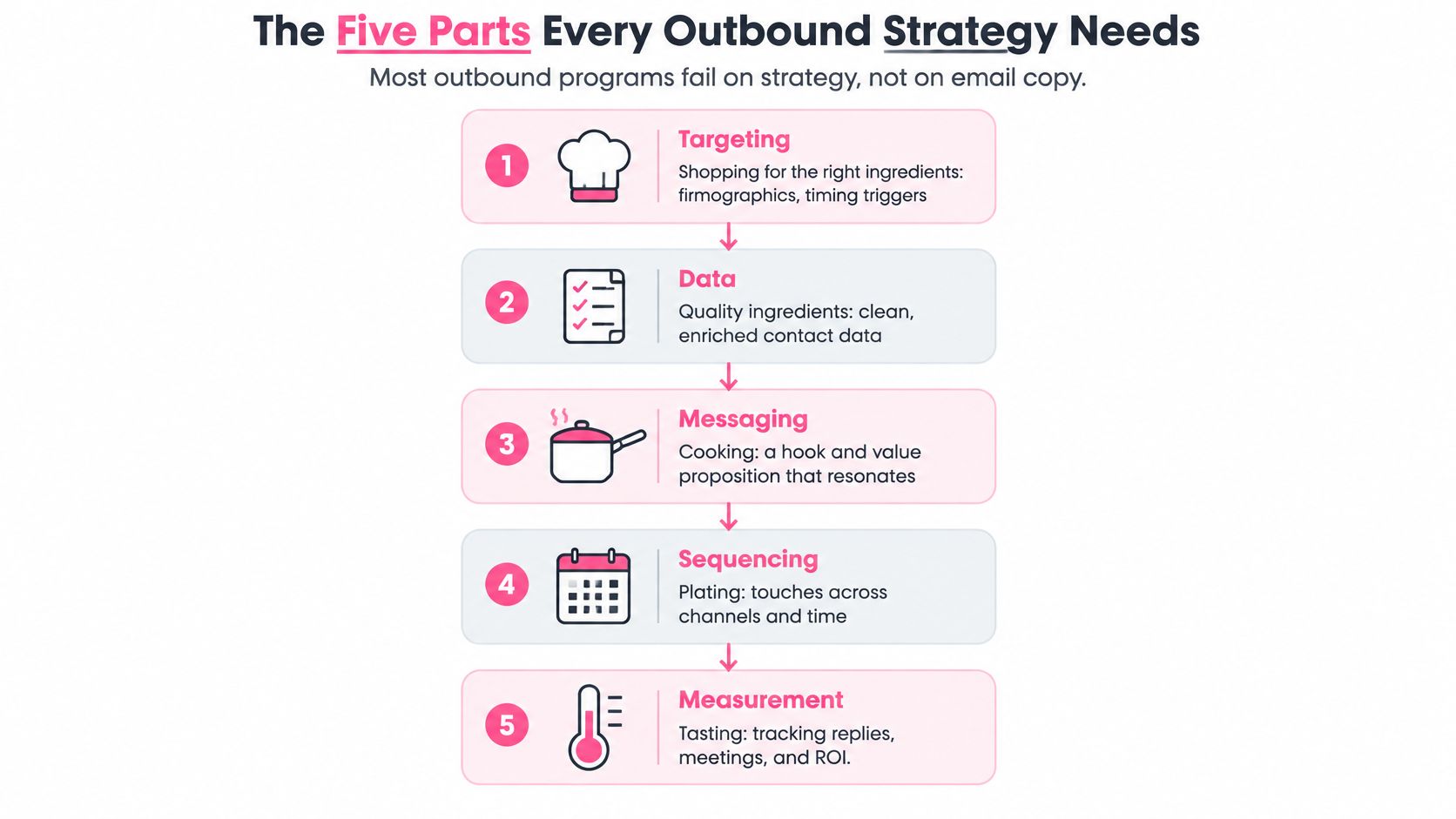
The system works like a kitchen. Targeting is the shopping list, because the wrong ingredients sink dinner before anyone turns on the stove. The offer is the dish itself, the thing a stranger wants. Outreach is the menu card that makes the dish sound worth ordering. The sequence is the service, the pacing of courses and what happens when a table goes quiet. Measurement is the tasting, the only step that tells you whether any of it worked.
The components stack in a fixed order, and the breaks almost always happen at the joints between them.
| Component | Question it answers | Typical failure |
|---|---|---|
| Targeting | Who deserves a first touch? | Lists built on job titles alone |
| Offer | What does the prospect get for replying? | Asking for a meeting in the first message |
| Outreach | How do the first messages sound? | Generic templates with a name swapped in |
| Sequence and follow-up | When and where do we touch again? | One email, then silence |
| Measurement | Is the pipeline actually growing? | Counting leads instead of meetings |
Read that top to bottom and the dependency is obvious. A brilliant offer sent to the wrong list earns polite declines from people who were never going to buy. Immaculate copy pushed through an unauthenticated domain lands in a folder nobody opens. Sequence design cannot compensate for an offer that demands twenty minutes before giving anything back. Each link assumes the one before it held.
The rule that saves the most budget: score each of the five parts from one to five, then fix the lowest score first, even when the highest score is the one you most enjoy working on.
Multi-channel is the baseline, not the upgrade. McKinsey's B2B Pulse research found that 83% of B2B leaders rated omnichannel selling at least as effective as traditional methods, up from 54% at the start of the pandemic, and that buyers were using 10 or more channels during a purchase, roughly double the count from five years earlier, according to McKinsey's hybrid selling research. A plan built on one email and one call is under-built.
Dollar size stopped being the objection years ago. McKinsey's omnichannel B2B analysis found more than 70% of customers preferred conducting business remotely, 97% were willing to make digital self-serve purchases worth more than $50,000, and 20% would spend more than $500,000 through a fully remote model, per McKinsey's omnichannel B2B analysis. Remote outbound opens big deals. It just has to be built to hold them.
The window you're working in keeps moving. A global study of nearly 4,000 B2B buyers by 6sense put the average buying cycle at 10.1 months in 2025, down from 11.3 months in 2024, so there's less slack in the chain than there used to be. Buyers are also doing more of the early work themselves: Responsive's 2025 survey of 350 B2B buyers reported that 47% used AI during time-sensitive stages such as market research and questionnaire drafting. Your first touch now competes with a chatbot that answers in four seconds.
Audit in order, fix the lowest score first
Take an honest pen to your current program. Does targeting name a segment and a trigger, or a job title and a territory? Does the offer give something away, a benchmark, a diagnostic, one observation that proves homework, or does it ask for time before giving anything? Do the emails read like one human wrote to another, or like a mail merge with better fonts?
Then look at the last two links. Does the sequence touch more than one channel across two weeks, or does it send once and hope? Does measurement report meetings booked, or contacts attempted? Financial institutions running intelligence-led programs tend to score highest on measurement and lowest on offer, which makes intelligence-led growth for financial institutions a useful read alongside your own scores.
Fix the one at the bottom. Then run it again next month, because the lowest score moves.
Picking Your Targets and a Hook They Cannot Ignore
Say you sell bookkeeping services to dental practices. A list of every practice owner in your state is a profile. A list of practice owners who just hired a second associate, opened a new location, or lost their office manager is a strategy. The first list tells you someone exists. The second tells you they are in motion, and motion is where the money is.
Triggers worth building around tend to rhyme. A funding round means new budget and a mandate to spend it. A hiring spree means a process that just broke. A new office means a territory someone now has to cover. A leadership change means the new arrival has ninety days to look decisive and is hunting for visible wins.
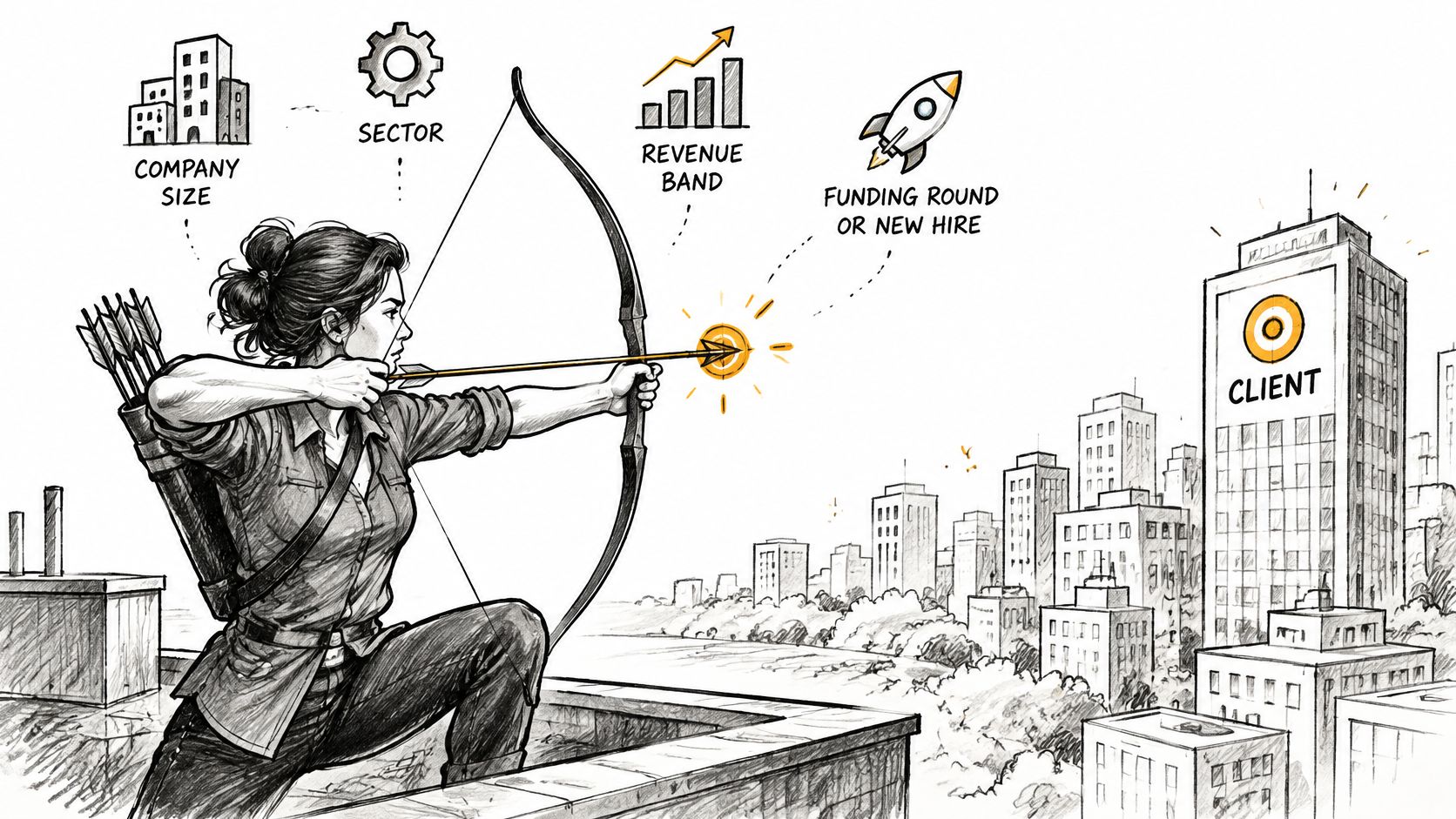
Build the list around both halves, profile and timing, and every downstream step gets easier because the copy finally has something true to point at. This is the first link in the chain, and weak targeting cannot be rescued by strong writing, since there is nothing real to say. Ever Outbound hand-picks and verifies ideal prospects using AI-enhanced targeting to build laser-focused lists of decision-makers, rather than renting a database export and calling it a strategy.
Then the offer. An offer is the thing a stranger receives for replying: a benchmark, a diagnostic, a comparison framework, or one observation specific enough that they can tell you did homework. It costs you nothing to send and costs them nothing to accept, which is precisely why it works. And it still fails aimed at the wrong segment, because the chain breaks at whichever link is weakest.
What the buyer actually wants before a human appears
A 2025 Gartner sales survey found that 61% of B2B buyers prefer an overall rep-free buying experience and 73% actively avoid suppliers that send irrelevant outreach. That second number should shape your opening line more than the first.
Buyers still want a seller when the question is whether the offering fits their organization, because that is a context question no pricing page answers. So the first touch gives, and the meeting request arrives only after a fit question surfaces. Ask for the call in line one and you lose the reply you were trying to earn.
Three signals decide which message goes out.
- Profile match, no trigger. Send education. A relevant benchmark or teardown, no ask, no calendar link.
- Trigger verified. Invite a short reply. One question that takes fifteen seconds to answer.
- Fit question raised. Offer the meeting. Now the call is the buyer's idea, not yours.
Run this as a test rather than a rollout. Pick three segments, build one offer for each, send a small batch for two weeks, and compare positive replies against qualified conversations. Then score yourself on four things: the segment has a name, the trigger has a name, the offer has a name, and the reply path has a name. Any unnamed item is the one that will drift.
Before any send, clean the list. A verified list is the difference between a campaign and a complaint. Ever Outbound's lead list cleaner strips dead addresses and duplicates before a single send, which protects the domain and the sender reputation you spent weeks warming.
The walkthrough below shows how these first touches get sequenced once the list is clean and the offer is set.
Writing Outreach That Earns a Reply
Personalization is not a tone of voice. It's a treatment you apply to one layer of a message at a time and then measure. Treat it as a vibe and you'll spend three hours per email customizing accounts that were never going to buy.
Store personalization as data, not adjectives. Three fields do most of the work: a role-specific problem in the buyer's own vocabulary, a company trigger you can verify with a timestamp, and a concrete hypothesis about economic impact that a CFO could argue with. Once those live in structured fields, copy can be generated consistently, audited by a human writer, and tested against a generic control.
The payoff is measurable. LinkedIn's sales research found personalized subject lines lifted response rates by 30.5%, and personalized message bodies lifted them by 32.7%, according to LinkedIn's findings on sales outreach emails. Those are not small numbers in a channel where a point of reply rate is usually a good quarter.
The experiment most teams get wrong: it isn't personalized versus unpersonalized. It's one personalization layer varied at a time, with sender, domain, offer, audience, send volume and sequence length all held constant.
The same email, written twice
Generic version, the one that gets deleted: "Hi Sarah, hope you're doing well. I wanted to reach out about how we help companies like yours drive efficiency across their operations. Do you have 20 minutes this week?"
Specific version, same length, same offer: "Sarah, your careers page has listed four implementation roles since January, which usually means onboarding is running behind the sales team. We benchmarked onboarding capacity across 30 mid-market SaaS teams last quarter. Want the two-page summary? Reply 'send it' and it's yours."
Same sender, same domain, same audience. One variable changed: whether the observation is specific and verifiable. That's the layer you test first, because it's the cheapest to produce and the easiest to disprove.
A writing checklist that keeps copy honest
- One idea per email. If you can't summarize it in a sentence, the prospect can't either.
- Under 90 words. Long enough to show work, short enough to read on a phone between meetings.
- One question. Two questions split attention and halve the reply rate.
- Plain-text signature. No logo blocks, no banner images, no tracked formatting that trips filters.
- A visible opt-out. One line, obvious, no friction.
Judgment calls on tone are easier when you score the draft before sending. Our cold email grader flags the usual offenders: passive openers, stacked questions, and asks buried below the fold. If you're extending this discipline to social channels, these notes on how to personalize your LinkedIn outreach campaigns cover the profile-level details email writers tend to overlook.
Keep the decision rule blunt. Retain a personalization layer only when it improves qualified conversations, not total replies. Watch unsubscribe, spam-complaint and invalid-address rates alongside it, because a lift in replies that comes with a lift in complaints is a net loss dressed as a win.
Protecting Deliverability and Staying Legal
Volume is a permission, not a lever. Every mailbox carries a reputation, and reputation decides whether your carefully written message reaches an inbox or a folder people check twice a year. Google turned that from folklore into published requirements.
Since February 1, 2024, senders delivering email to Gmail personal accounts must authenticate sending domains with SPF or DKIM and maintain valid forward and reverse DNS records, also called PTR records, per Google's sender requirements for email senders. Google also advises keeping user-reported spam rates below 0.1% and preventing them from reaching 0.3% or higher. Bulk senders pushing more than 5,000 messages a day to Gmail accounts face additional rules: stronger authentication, one-click unsubscribe, and hard compliance with those spam thresholds. Cross 0.3% and delivery support or mitigation can become unavailable, and bulk senders stay ineligible until their spam rate sits below 0.3% for seven consecutive days.
That recovery window is why infrastructure gets treated as a system. Authenticated domains, several mailboxes, a domain pool, gradual warmup and daily sending caps aren't bureaucracy. They're the cushion that lets you keep sending when one mailbox has a bad afternoon.
The legal floor under every campaign
U.S. commercial email runs on the CAN-SPAM Act, and the FTC's CAN-SPAM compliance guide spells out what every message needs: accurate header information identifying the sender, no deceptive subject lines, a valid physical postal address, and a clear opt-out that works by reply or a single webpage with no fee and no extra personal details required. Honor opt-outs within 10 business days, and keep the mechanism live for at least 30 days after the send.
The operating sequence follows from all of this.
- Authenticate every sending domain before the first send, with SPF or DKIM plus forward and reverse DNS in place.
- Spread volume across mailboxes and a domain pool so no single identity carries the whole campaign.
- Warm new inboxes gradually, starting small and increasing only while complaint rates stay quiet.
- Set daily sending caps per mailbox and respect them even when the list is bigger.
- Suppress unsubscribes immediately, not at the end of the week.
Compliance is a data problem before it's a legal one. If your suppression list lives in a spreadsheet someone updates on Fridays, the ten-day clock is already running against you.
Teams dialing as well as emailing run into a separate rulebook on consent and call recording, so a TCPA and PCI compliance checklist belongs next to your email policy rather than in someone's head. Then set a recurring calendar item to run the email deliverability checker across every active domain. Here's the reference table, which is worth pinning where the person who hits send will see it.
| Requirement | Threshold | Applies to |
|---|---|---|
| Spam-complaint target | Keep below 0.1% | All senders to Gmail |
| Spam-complaint ceiling | 0.3% or higher removes delivery support | Bulk senders |
| Bulk sender trigger | More than 5,000 messages per day | Gmail bulk requirements |
| Recovery period | Below 0.3% for seven consecutive days | Bulk senders regaining eligibility |
| Authentication | SPF or DKIM, plus forward and reverse DNS | Gmail personal accounts since February 1, 2024 |
| Opt-out honored | Within 10 business days | Commercial email under CAN-SPAM |
| Opt-out availability | Working for at least 30 days after send | Commercial email under CAN-SPAM |
| Postal address | Valid physical address in every message | Commercial email under CAN-SPAM |
Sequencing Touches and Following Up Fast
A sequence isn't a blast with delays. It's a rhythm, and each beat has a different job. The first touch earns attention. The middle touches warm the thread, surface objections, and add proof. Later touches re-engage, stay visible, and eventually close the loop so the prospect gets a clean exit and you get a clean list.
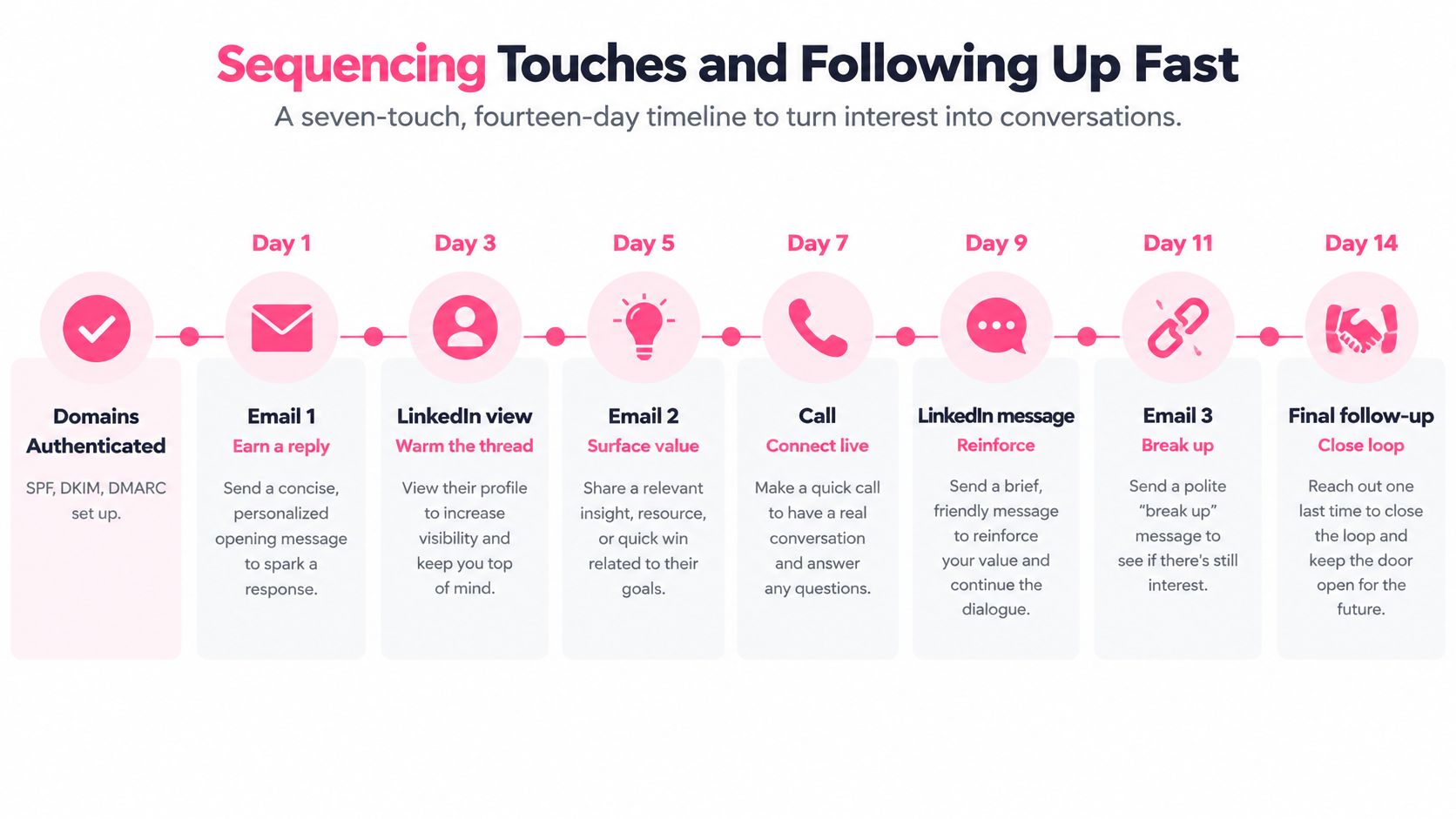
| Day | Channel | Touch | Goal |
|---|---|---|---|
| Day 1 | Personalized observation plus a self-serve asset | Earn a reply | |
| Day 3 | Connection note referencing the email topic | Warm the thread | |
| Day 5 | Short follow-up with one new proof point | Surface objections | |
| Day 7 | Phone | Call attempt if a verified number exists | Start a conversation |
| Day 9 | Shorter bump with a different angle | Re-engage | |
| Day 12 | Value-add comment or message | Stay visible | |
| Day 14 | Breakup note | Close the loop |
Two rules keep this from becoming harassment. The sequence stops instantly on any reply, and a clear "no" gets suppressed rather than recycled into next quarter's list. That second part is harder than it sounds, because sales teams hate writing off a name, so the name gets requeued and the prospect gets the same email in July.
A breakup note is not a guilt trip. It says you'll stop, thanks for the time, and leaves the door open. It's the highest-reply email in most sequences precisely because it removes the obligation to respond.
Reply speed is a sales event
A positive reply is not a lead. It's a countdown. An analysis of roughly 1.25 million leads across 42 companies found that firms attempting contact within one hour were nearly 7 times more likely to qualify a lead than firms waiting an additional hour, and more than 60 times more likely than firms waiting at least 24 hours, as reported in this review of the lead response time research.
That study examined inbound inquiries, so apply it to the moments where intent already exists: a warm reply to your cold email, a referral, an asset download followed by a question. Speed doesn't create demand from silence. It stops demand from evaporating.
Set an actual service level. First human-quality response within 5 to 10 minutes during staffed hours, with an automated acknowledgment and a scheduling link outside them. Route the reply through AI-assisted triage, then human review for qualification and context, then booking. No daily batch, no "I'll clear the inbox after lunch."
Our own process follows that shape: we build your list of verified decision makers, write and send short copy on warmed domains, book interested prospects straight onto your calendar, and you show up to close the deals. The handoff only works when the clock is short.
Measure the pieces separately: time to first automated response, time to contextual human response, reply-to-qualified-meeting rate, and qualified-meeting-to-close rate. Split each by reply intent, geography, business hours and lead source, because a blended average hides a high-value account waiting two days. Averages lie; segments don't. And before you rebuild the cadence by hand, the email sequence generator will draft the seven-touch skeleton you can then edit with actual judgment.
Measuring What Actually Fills Your Calendar
Vanity counts exist because they're easy to collect. Contacts attempted feels like progress. Meetings booked is progress. The gap between them is where most reporting flatters itself.
HubSpot reports that 32% of daily cold callers and 50% of regular cold callers see appointment-conversion rates in the 6% to 10% range, per HubSpot's sales statistics. Read that carefully: those figures describe the share of cold-calling activity that converts into appointments, not email results. Use the band as a direction check on booked conversations, never as a promised outcome from a cold email program.
Build the funnel in a fixed order, because reordering it lets people hide.
- Contacts attempted. The denominator. Should be smaller than last quarter's.
- Positive replies. Human-written, not auto-responders or "unsubscribe."
- Qualified conversations. A real exchange about fit, problem, timing.
- Meetings booked. On the calendar with a named attendee.
- Meetings held. The only number a founder trusts.
- Deals closed. Revenue, eventually.
A large list is not pipeline. It's inventory. The question is whether targeting, messaging, follow-up and qualification together produce booked conversations at or better than your benchmark band.
The weekly review in four steps
Run it in this order and resist the urge to skip ahead. Deliverability health first, with user-reported spam under 0.1% and every domain authenticated. Reply quality second, reading actual replies rather than counting them, because ten "not now" messages are worth less than one "can you send the benchmark?"
Third, meeting rate against the benchmark, which is where you learn whether replies convert into conversations. Fourth, the segment with the weakest stage, found by splitting results by source and segment rather than staring at a total. Fifteen minutes, same order, every week.
The diagnostic that resolves most arguments: if replies rise while meetings stay flat, the problem is the offer or the list, not the subject line. You're attracting the wrong people or promising the wrong thing. Rewriting the copy is the comfortable move and the wrong one.
Before you change anything, model the math. The cold email ROI calculator turns reply rate, meeting rate and close rate into a revenue number, which tends to end debates about whether a 0.4% reply lift matters.
Pilot One Segment Before You Scale
One decision for this month: pick a single segment, a single offer and one sequence, and run it for 30 to 45 days before touching anything else. No second segment. No second domain pool. No new channel. The temptation to widen arrives around day nine, right when early results look promising and statistically meaningless.
Week one, name the segment, the trigger and the self-serve offer out loud, in writing, to someone who'll hold you to it. Week two, build the verified decision-maker list and warm authenticated domains rather than sending from a cold identity. Weeks three and four, run the sequence and review four numbers only: contacts attempted, positive replies, qualified conversations and meetings booked.
Then apply the gate. Scale when reply-to-qualified-meeting rate holds steady and user-reported spam stays under 0.1%. If meetings stall while replies climb, change the segment or the offer before adding volume, because more of the wrong thing is still the wrong thing. Treat the appointment benchmark from your weekly review as a directional check, not a target you're owed.
That gate is unglamorous and it's the reason some pilots never scale. A segment that produces friendly replies and no meetings is a segment to drop, and dropping it early is cheaper than defending it for a quarter.
If you'd rather have the chain built and run for you, that's what we do. Ever Outbound is pay-per-close: the monthly fee covers infrastructure and tooling, and we make our money when you close, so the pilot gate and our revenue point the same direction. We walk you through how a campaign gets built and what to expect during a booked call.
Which single segment would you test first, and what trigger would you wait for before you send?
Ever Outbound Inc. builds and runs the whole chain for B2B teams: verified decision-maker lists, an offer designed for cold traffic, short copy sent from warmed domains, and AI-assisted appointment setting that books qualified calls onto your calendar. It's pay-per-close, with a 5% commission only when you close a deal and your first 2 closes commission-free, so the targeting, the messaging and the follow-up all get judged by the same question you ask. If you'd rather spend next month closing calls than building sequences, visit Ever Outbound Inc. and book a walkthrough of how your campaign would be assembled.