November 7, 2026
Performance Based Marketing Agency: Models Compared
Say you sign an agency retainer, pay for six months, and receive forty lead lists. Your sales calendar is still empty. At the review meeting, the account manager presents a beautiful activity report, which is awkward because your accountant doesn't accept impressions as payment.
That's the attraction of a performance based marketing agency: connect the bill to something closer to revenue. But the important question isn't whether the agency charges for results. It's which result triggers payment, who controls it, and who loses money when the campaign disappoints.
Table of Contents
- Six Performance Pricing Models at a Glance
- Who Carries the Risk When Results Stall
- What Counts as a Closed Deal and Who Verifies It
- Contract Terms That Decide Whether You Get Paid Fairly
- Deliverability and Compliance Limits to Write Into Your Plan
- Which Model Fits Your Agency Situation
- Confirm the Model and Run a 30-Day Test
Six Performance Pricing Models at a Glance
The owner holding those lead lists didn't necessarily buy bad work. They bought research and execution while expecting sales conversations. The contract paid for one thing; the owner judged another.
Before comparing proposals, identify the event that earns the agency its fee. Affiliate Landscape's guide to how performance marketing agencies work offers useful context for distinguishing outcome-linked billing from conventional agency services.
Performance pricing models compared
| Model | Agency is paid when | Who carries qualification and close risk | Client cost predictability |
|---|---|---|---|
| Pay-per-close | A deal the client closes triggers commission | Mostly shared, with the agency bearing acquisition cost | Low fixed cost, variable payout |
| Revenue share | Attributed deals generate revenue, paid as a percentage | Client carries delivery and close risk | Variable, can exceed fixed fees |
| Pay-per-lead (CPL) | Each lead is delivered | Client carries qualification and close risk | Predictable per lead, unpredictable value |
| Pay-per-meeting | Each meeting is booked | Client carries show-up and close risk | Predictable per meeting |
| Monthly retainer | A fixed monthly fee comes due regardless of results | Client carries all outcome risk | Most predictable cost |
| Hybrid base plus success fee | A small monthly base comes due, plus a bonus when deals close | Shared between both parties | Base is known, success fee varies |
The reading rule: the further a model moves risk onto the agency, the less fixed cost the client generally pays, and the more both parties must trust attribution.
Ever Outbound compares these same pricing models, including pay-per-meeting, pay-per-appointment, meeting-ready leads, pay-per-lead, agency retainers, and performance-based arrangements. We're pay-per-close, so the first row is our own model. Weigh our position accordingly.
Compare the invoice with the promise
A predictable bill isn't necessarily a profitable bill. Equally, a variable commission isn't automatically cheaper than a retainer once the campaign succeeds.
The useful test is what happens when prospects don't qualify, meetings don't happen, or contracts don't get signed. That's where the pricing label meets the actual situation.
Who Carries the Risk When Results Stall
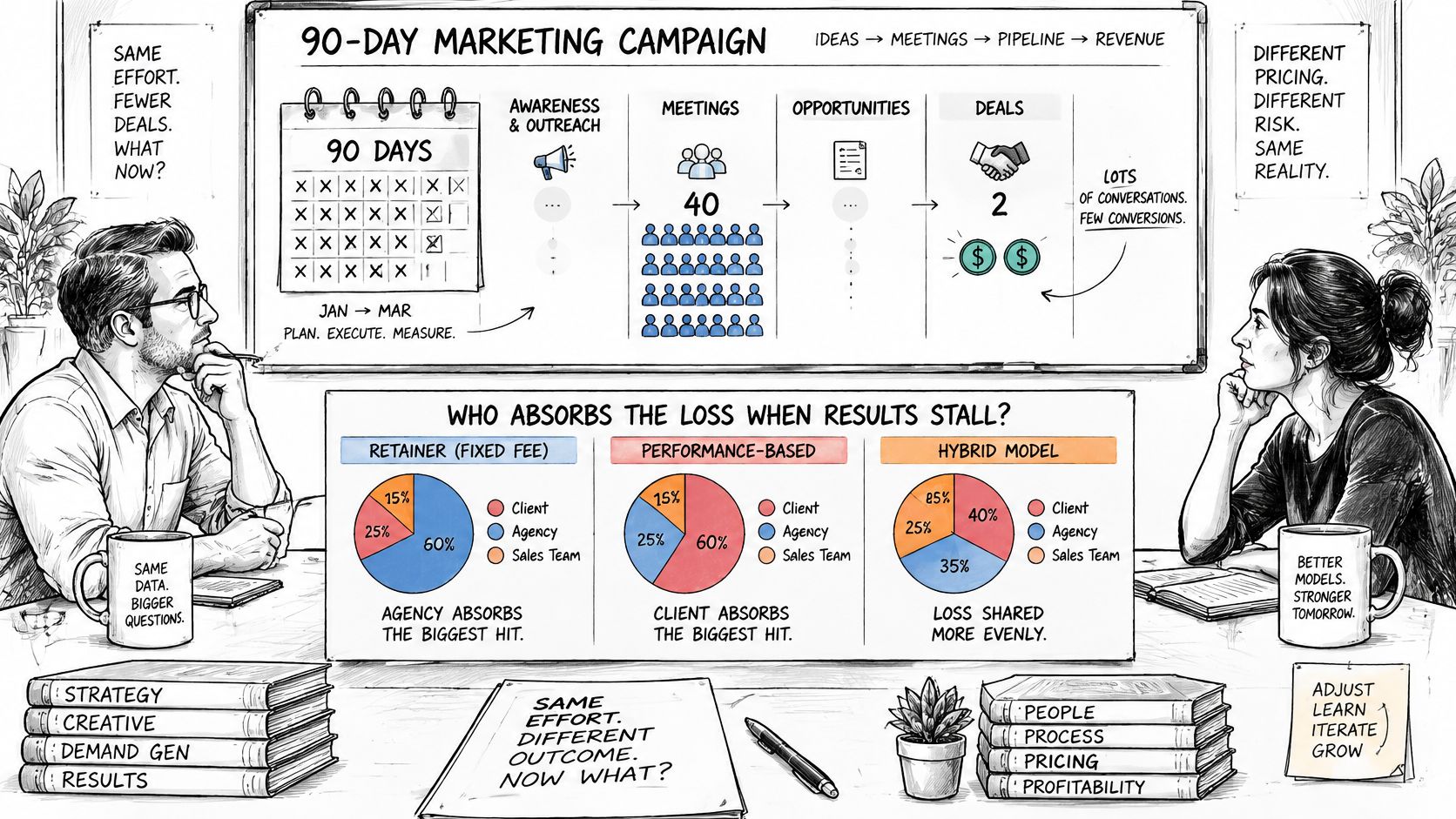
Say a 90-day campaign books 40 meetings and closes two deals. That's a hypothetical, not a benchmark. The agency calls it a productive quarter; the owner wonders whether the remaining conversations were worth the sales team's time.
The same outcome produces different losses under each contract.
Follow the money after a disappointing campaign
- Pay-per-close: The agency earns commission on the closed deals, not the unsuccessful conversations. It absorbs acquisition work that didn't produce a payable result, while the client still loses sales time and carries sales-cycle and close-rate risk.
- Revenue share: The agency participates when attributed revenue arrives. The client must still close the business, deliver the work, and protect its margin, so sharing revenue doesn't mean sharing every commercial risk.
- Pay-per-lead: The agency earns for delivered leads that satisfy the contract. Without strong acceptance criteria, it can fulfill the order while the client absorbs weak qualification and conversion.
- Pay-per-meeting: The agency gets paid for the booked calls under the agreed rules. Unless attendance or replacement terms say otherwise, the client carries no-show risk as well as close risk.
- Monthly retainer: The client pays throughout the campaign, including the unsuccessful stretch. A retainer-based lead generation arrangement can fund consistent execution, but it doesn't transfer the financial consequences of weak sales.
- Hybrid base plus success fee: The client funds part of delivery through the base. The agency earns additional compensation only when the agreed outcome happens, splitting the downside rather than pretending somebody has abolished it.
Control matters more than the label
Performance incentives aren't a new invention: the Association of National Advertisers reported adoption peaking at 61% of advertisers in 2013, with later adoption at 41% in 2022. These arrangements generally supplement fixed or labor-based fees rather than replacing them completely.
That makes operational sense. An agency can control prospect selection and follow-up, but it can't independently fix an uncompetitive product or make the client send a proposal.
There's also a less visible failure point: messages may never reach inboxes. Both parties can argue about copy or sales technique while overlooking delivery.
Practical rule: Match the fixed-fee share to the work and uncertainty the client expects the agency to carry, then tie the success fee to outcomes the agency can meaningfully influence.
What Counts as a Closed Deal and Who Verifies It
A prospect accepts a calendar invitation. The agency marks a conversion. The salesperson takes the call and discovers the prospect wants a free tutorial, not a purchase.
Nobody needs to be dishonest for that disagreement to happen. They only need different definitions of success.
Give each stage an owner
- Booked meeting: The agency's outreach produces a conversation confirmed on the calendar. The agency owns booking accuracy, including the intended contact and agreed meeting criteria.
- Sales-accepted opportunity: The client's sales team accepts the opportunity after the first call. The salesperson owns the acceptance decision and records why it qualifies for further work.
- Qualified opportunity: The client confirms its own requirements for budget, authority, need, and timing. The client owns these criteria; the agency shouldn't substitute a friendly reply for buying intent.
- Closed-won deal: The client records a signed contract in its CRM. Sales owns the commercial record, while the designated reviewer checks the evidence before commission becomes payable.
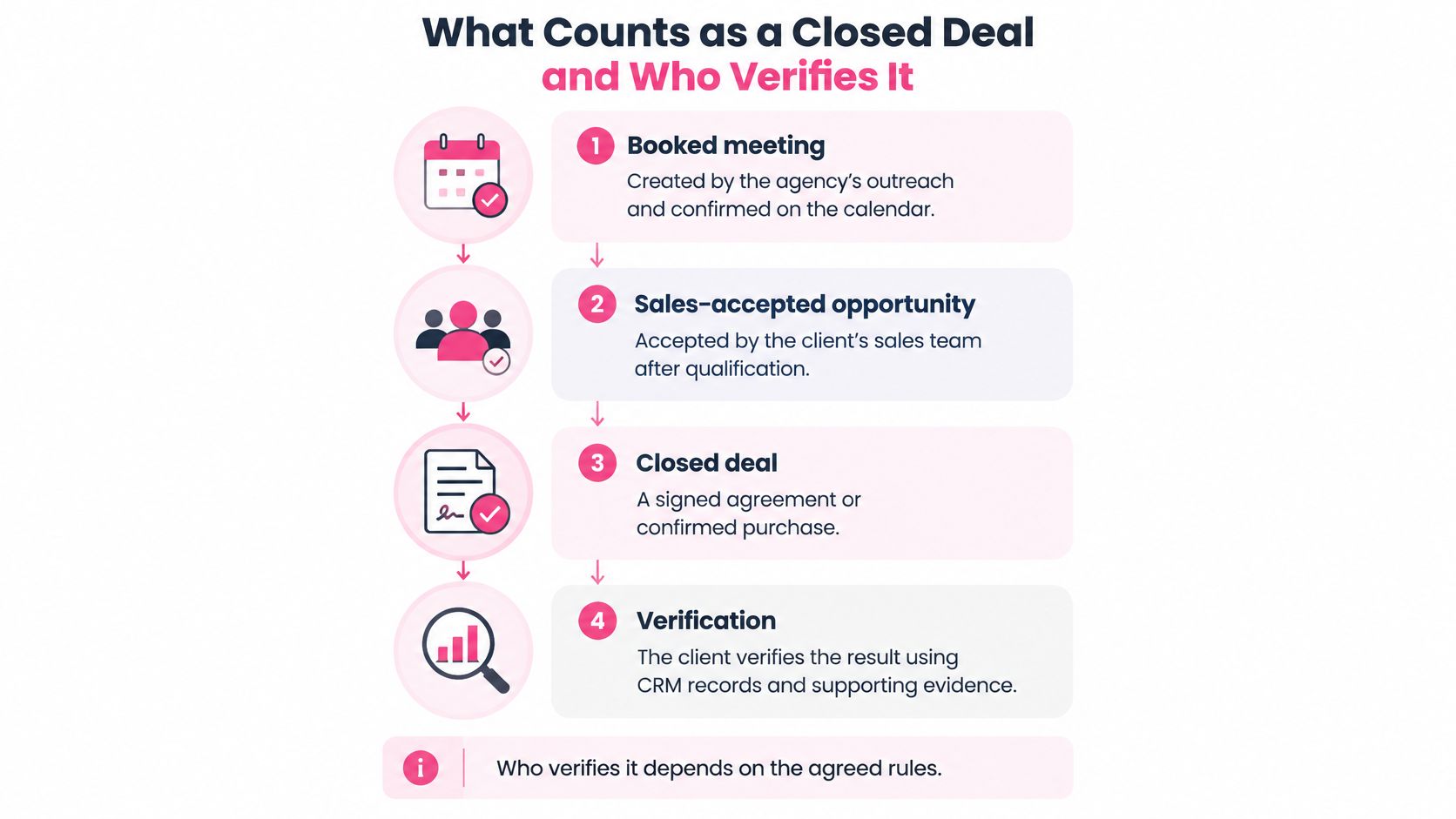
A booking is evidence of interest, not evidence of revenue. Paying per lead or meeting means paying before realized commercial value exists. Our pay-per-close model moves the commission event further downstream, which makes reliable deal verification especially important.
Reconcile records, not screenshots
The attribution problem is substantial: Visionary Marketing's B2B attribution analysis reports that 84% of organizations struggle to unify data across platforms, while 71% say privacy and cookie changes make attribution harder. For an outbound agreement, a shared CRM record with supporting evidence is more useful than treating a platform conversion badge as the final verdict.
Capture the contact and account, CRM source field, first outbound-touch date, sales-acceptance date, signed agreement, and relevant deal value. Preserve the outreach thread so the reviewer can connect the campaign to the opportunity.
Our API's /v1/meetings endpoint returns the booked calls shown in the dashboard. It accepts since, until, page, and per_page, filtering by when the call was booked, not necessarily when the meeting happens.
In a weekly reconciliation, the client matches those bookings to CRM contacts and opportunities. A prospect already in an open sales process gets flagged, not automatically credited; a duplicate contact gets merged without creating another payable acquisition.
What evidence proves that a closed deal came from you, and when does the commission become payable?
A useful answer names records, reviewers, and payment conditions. “Our dashboard tracks everything” isn't enough.
Contract Terms That Decide Whether You Get Paid Fairly
Say the prospect signs, finance pays the agency, and the customer immediately cancels. Or the customer signs after the campaign ends and both parties claim the agreement supports their position.
These aren't exotic edge cases. They're ordinary contract questions wearing expensive shoes.
Put the payable event beyond argument
Commission base. Specify whether the percentage applies to total contract value, first-year revenue, collected revenue, or gross profit, because the same rate can produce very different invoices.
Qualifying event and source of truth. Name the payable CRM stage, required supporting evidence, record owner, and reviewer so an enthusiastic status update can't accidentally become a payment obligation.
Attribution window and multi-touch rule. Define the eligible period and decide how credit works when a prospect responds to agency outreach and the client's own marketing.
Exclusions. Agree how existing pipeline accounts, inbound overlap, duplicate contacts, and previously active customers are identified before outreach begins.
Clawbacks. Specify how refunds, chargebacks, and early churn affect commission, including the applicable period and whether adjustments become credits or repayments.
Late-closing deals. State how many months after the campaign an eligible deal can close and still earn commission, rather than leaving a permanent claim attached to every contacted account.
Audit rights. Allow proportionate access to CRM exports, outreach threads, and sending logs so either party can investigate disputed credit without exposing unrelated customer information.
Response-time commitment. Assign positive replies to a named owner with coverage hours and escalation rules; the Voiso synthesis of lead-response research reports that contact within five minutes produced odds of reaching a lead about 100 times higher than waiting 30 minutes.
Pricing floor and introductory terms. Record any base fee, minimum commitment, or commission-free closes explicitly, because a free opening offer doesn't explain the ongoing bill.
Work the arithmetic before signing
At Ever Outbound, we're pay-per-close, with a 5% commission on closed deals and the first two closes commission-free. That describes the success-fee structure, not permission to ignore other plan charges.
For a hypothetical comparison, two $20,000 deals close commission-free. A third $20,000 deal generates $1,000 commission at 5%.
Put that calculation beside the retainer proposal and compare the same service period, scope, and expenses. A commission comparison that omits base charges is no more useful than a retainer comparison that omits prospecting tools.
Get every clause in writing before the first campaign starts. A friendly kickoff call isn't an attribution policy.
Deliverability and Compliance Limits to Write Into Your Plan
A campaign can look commercially weak when prospects never receive the messages. Rewriting the opening line won't rescue an email that lands in spam.
Inbox placement affects campaign results, and the sender remains responsible for compliance even when another company runs the campaign.
Outbound compliance requirements by rule
| Rule | Requirement | Applies to |
|---|---|---|
| CAN-SPAM | Honor opt-out requests within 10 business days | Commercial email sent to US recipients |
| CAN-SPAM | Keep the unsubscribe mechanism working for at least 30 days after send | Commercial email sent to US recipients |
| CAN-SPAM | Civil penalty of up to $53,088 per violating email | Each separate violating email |
| UK PECR | Consent rule does not apply to corporate subscribers | Unsolicited B2B email to incorporated companies |
| UK PECR | Specific consent or soft opt-in required | Sole traders and some partnerships |
| Gmail bulk-sender rules | SPF and DKIM authentication required | Senders delivering 5,000 or more messages a day to Gmail |
The FTC's CAN-SPAM compliance guide sets out the deadlines and penalty ceiling, as well as requirements for truthful headers, non-deceptive subject lines, advertisement identification, and a clear opt-out route. The ICO's B2B marketing guidance distinguishes corporate subscribers from sole traders and some partnerships, while explaining identity, opt-out, and data-protection obligations.
Under Google's sender guidelines, bulk senders must authenticate with SPF and DKIM. Google recommends keeping user-reported spam rates below 0.1% and avoiding 0.3% or higher. Authentication does not establish consent, and a technical pass does not make unwanted outreach lawful.
Diagnose before increasing volume
Use separate sending domains or controlled mailbox pools to limit exposure, not to evade complaints. Ramp volume gradually, authenticate each domain, maintain suppression lists, and review complaints and bounces daily.
Pair technical email deliverability checks with mailbox-provider monitoring and campaign-level reporting rather than treating a clean result as guaranteed inbox placement.
- Healthy delivery, weak positive replies: Review segmentation, the offer, and whether the message gives the recipient a relevant reason to respond.
- Rising bounces or complaints: Reduce volume and audit list quality, suppression handling, and sending infrastructure before testing more copy.
- Reputation-protection pause: Document who authorizes it, what remediation is required, and what evidence permits restarting.
Write operating thresholds into the agreement. A justified pause should trigger a recovery process, not become a contractual failure that pressures the team to keep sending.
Which Model Fits Your Agency Situation
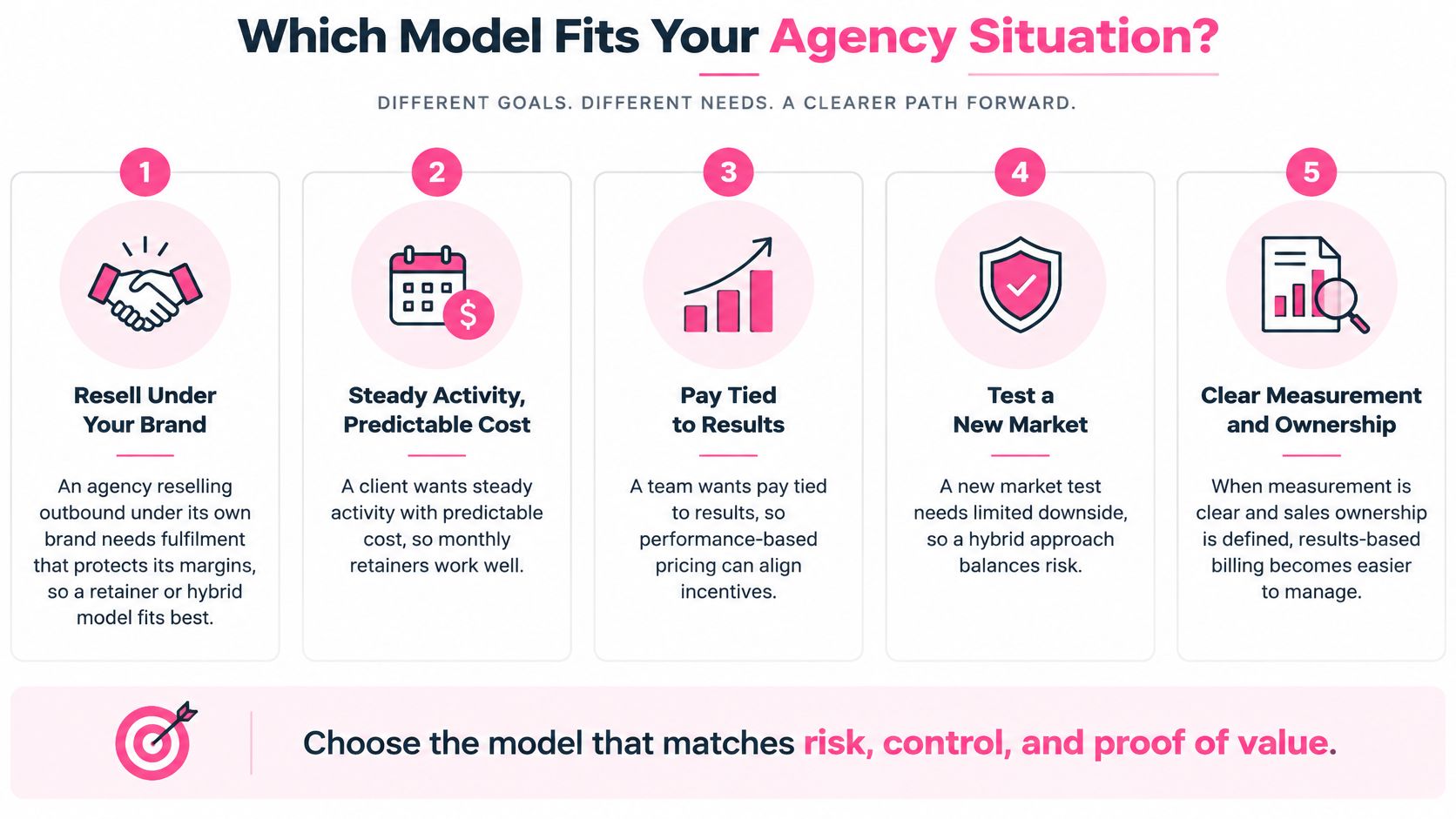
A creative agency reselling outbound and a SaaS founder selling enterprise contracts aren't buying the same economic arrangement. One needs room for resale margin; the other needs acquisition spending that accommodates a long buying process.
Start with the operating situation, not whichever pricing page has the most reassuring headline.
Model fit by situation
| Situation | Best-fit model | Why |
|---|---|---|
| Agency reselling outbound under its own brand | Retainer or fixed-fee white-label | Protects margin on client work |
| B2B SaaS with long cycle and high contract value | Pay-per-close | Commission follows large deals if attribution rules are strong |
| Consulting or recruiting with variable deal sizes | Revenue share or hybrid | Payout tracks deal value |
| No internal prospecting, comparing options | Benchmark SDR hire, in-house, cheaper agency, performance agency | Compares cost and control before committing |
| New segment or geography | Pay-per-meeting or hybrid base | Keeps the test affordable |
Match the agreement to the operating job
For an agency reselling outbound, a known fulfillment cost makes client pricing easier. Our white-label partnership supports agencies reselling acquisition under their own brand; compare the actual fulfillment terms with a fixed-fee alternative instead of assuming every white-label offer uses the same billing model.
For a B2B SaaS founder, pay-per-close can align commission with large signed contracts. But a long cycle also requires patient campaign funding and a clear agreement about opportunities that mature after outreach ends.
A consulting or recruiting firm may sell engagements with sharply different values. Revenue share can reflect those differences, while a hybrid can fund research work that remains necessary even when the eventual deal is smaller.
Compare alternatives without comparing unlike scopes
If nobody internally prospects, compare an SDR hire, in-house outbound, a cheaper agency, and a performance agency using the same responsibilities. Include management time, research, tools, infrastructure, reply handling, and sales ownership.
We provide comparisons covering Leadbird, GrowthX, Anevo Marketing, Revenue.inc, Cleverly, hiring an SDR, lead generation agencies, cheaper agencies, and doing it yourself. Our approach is to replace unreliable dependence on referrals, ads, or agencies that don't deliver with an acquisition engine the client controls, not another lead spreadsheet.
For an unfamiliar geography or segment, buy a bounded learning exercise. Pay-per-meeting or a hybrid can fund that test; pay-per-lead economics require particular care when nobody yet knows which contacts will become credible opportunities.
Capstacker's discussion of milestone-based pay for marketing agencies is useful when intermediate achievements deserve compensation but full revenue attribution remains difficult.
Choose the model that matches risk, control, and proof of value, not the one that sounds most risk-free.
A validated offer and predictable close rate make pay-per-close easier to price responsibly. When the offer remains unproven, the client should expect to fund more of the experimentation.
Confirm the Model and Run a 30-Day Test
Don't replace one vague agency agreement with a more exciting vague agency agreement. Give the test a defined purpose and a decision date.
Set the rules before launch
- Write the payable event in one sentence, naming the CRM stage and date that trigger payment.
- Choose the model that fits your close rate and cash position, not just your preferred invoice format.
- Sign the attribution terms, exclusions, clawback conditions, and audit rights before outreach starts.
- Assign a response-time target for positive replies and a deliverability threshold that triggers a pause.
- Run a 30-day test with weekly reviews separating delivered messages, positive replies, meetings, and closed deals.
- At day 30, keep, adjust, or switch the arrangement. For long sales cycles, judge execution and opportunity progression without pretending the full revenue outcome is already known.
Apply the cost test
Commission is cheaper than a retainer only while eligible closed-deal value stays below the retainer divided by the commission rate, ignoring any base fee. For example, a hypothetical $3,000 monthly retainer equals 5% commission on $60,000 of closed deals; above that monthly value, the retainer costs less on fees alone.
Ever Outbound is pay-per-close, with plans starting at $97 per month plus 5% commission on closed deals, and the first two closes commission-free. Ask us the same contract questions as any other provider.
Every plan includes Ideal Client Profile identification, cold traffic offer creation, master copywriting, an outreach engine, self-healing sending infrastructure and warmup, surgical prospecting, personalized outreach at scale, A.I. appointment setting, and CRM and pipeline setup. Plans also include a real-time agent dashboard, a 40% cold sales closing process, 7-figure growth automations, and 1-1 lightning team support; those named process components aren't guarantees of your close rate or revenue.
At Ever Outbound Inc., we're pay-per-close, providing done-for-you B2B outreach with human research, copywriting, managed sending infrastructure, and AI-assisted appointment setting. Visit us to compare the plan economics and bring your CRM stages, sales cycle, and attribution questions, so the agreement measures the business you want to win.