October 17, 2026
Sales Appointment Setting Service: How It Books Deals
You can feel this problem before you can name it. The CRM is busy, the inbox is busy, and the calendar is full of meetings that looked promising right up until nobody showed up, nobody advanced, and nobody bought. That's the moment teams start shopping for a sales appointment setting service, because the core issue isn't attention, it's turning attention into conversations that belong on a salesperson's calendar.
A founder sees the same pattern in agencies, SaaS, and consulting shops. Marketing brings in interest, a rep follows up, a few calls get booked, and then the pipeline turns into a graveyard of weak-fit meetings and slow replies. A solid service fixes the handoff between outreach and revenue, but only if it's built to qualify, respond fast, and keep deliverability clean.
Table of Contents
- When the Pipeline Stalls and Who Actually Fixes It
- What a Sales Appointment Setting Service Actually Does
- Comparing Pricing Models Without the Marketing Gloss
- KPIs That Actually Predict Closed Revenue
- Implementation Steps from Offer to Calendar
- Case Study Snapshots Across Three B2B Verticals
- Why Email-Only Playbooks Are Quietly Failing
- Vendor Evaluation Checklist and Sample SLA Terms
When the Pipeline Stalls and Who Actually Fixes It
The pain usually shows up after the team has already done the hard part. Ads are running, outbound is live, the lead list is built, and the calendar still looks thin in the places that matter. Or worse, it looks full, but the meetings are soft, polite, and dead on arrival.
A marketing agency owner usually tries to solve that by hiring another SDR. That rarely fixes the root problem. If the offer is vague, the targeting is loose, or follow-up is slow, another rep just creates more activity around the same leak. A specialized external team is often the better move because the bottleneck isn't volume, it's the conversion from outreach to a useful sales conversation.
The cleaner way to think about it is the bridge between outreach and revenue. Appointment setting sits between lead generation and discovery, where interest becomes a scheduled conversation with the right person. That's also why a broader look at automated sales is useful, because automation can increase throughput, but it won't rescue a weak offer or a bad response process.
The goal is not to book a slot. The goal is to book a conversation that a seller can actually use.
For agencies, SaaS teams, and consultants, that distinction matters. A sales appointment setting service earns its keep when it turns messy top-of-funnel activity into meetings with fit, context, and next steps. Without that, your team just pays to stay busy.
What a Sales Appointment Setting Service Actually Does
A sales appointment setting service runs four connected jobs, research, copywriting, deliverability, and reply handling. Each one depends on the one before it. If the list is weak, the message misses. If deliverability slips, the best copy never reaches the inbox. If reply handling is slow or sloppy, the meeting never gets booked.
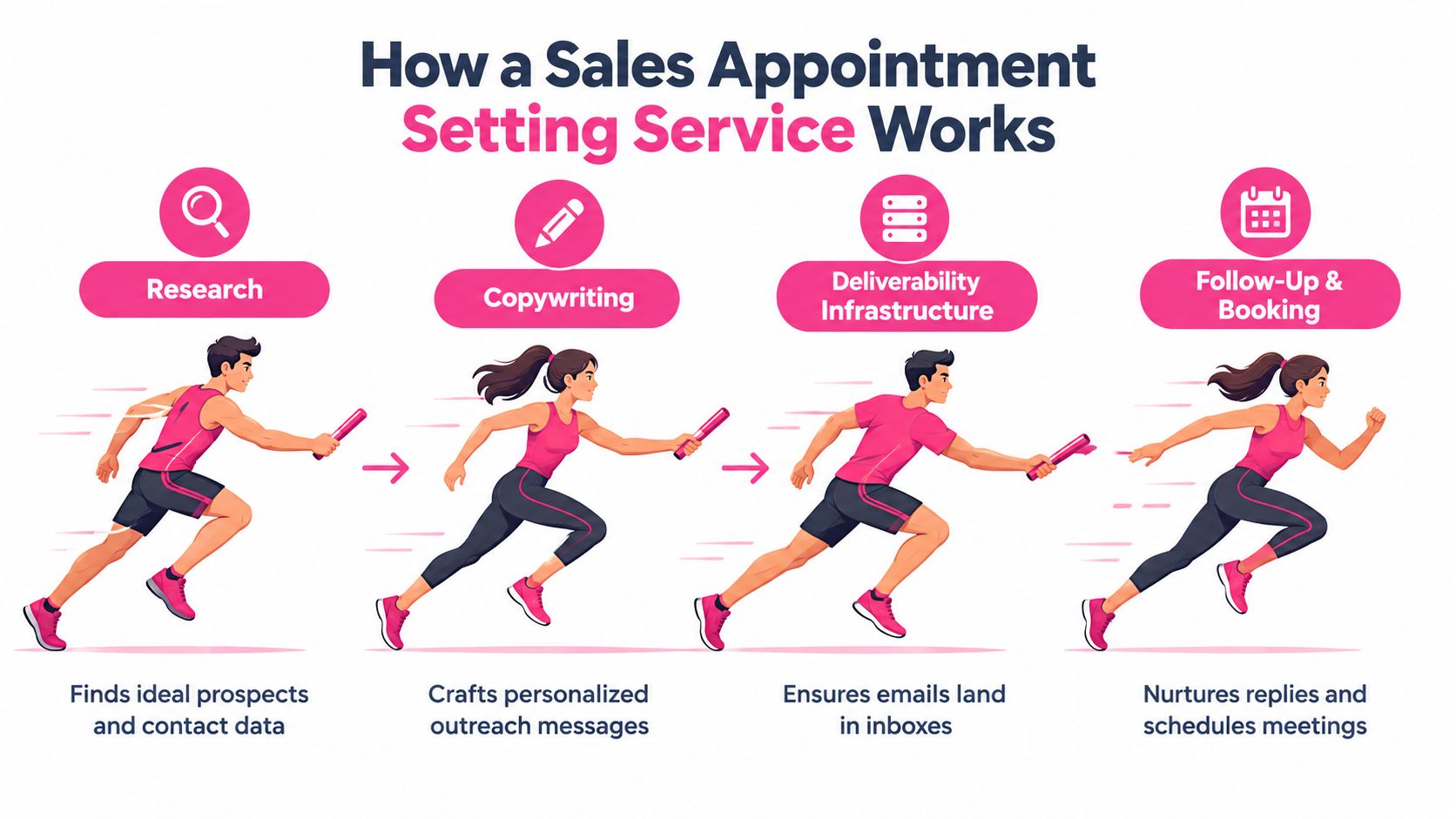
The work starts before outreach. A good team sharpens the offer, identifies the right account types, and builds a list that is relevant, not just large. Then copywriting turns that targeting into messages that sound specific enough to earn attention without reading like template sludge.
The workflow that matters
- Research and list building. The team identifies companies, roles, and contact data that fit the ideal customer profile.
- Message development. Writers shape the outreach so it matches the buyer's situation, not just the product's features.
- Deliverability setup. Mailboxes, sending domains, and complaint monitoring keep the campaign from dying before it starts.
- Reply handling and booking. Setters qualify the response, manage objections, and schedule the meeting.
That workflow only works when the team treats booked time as the starting line. A meeting has to be qualified, timed well, and handed off with enough context for the seller to move quickly. Otherwise, the calendar fills with polite conversations that never reach revenue.
Human-only shops can work, but they often break at scale. AI-only tools can move fast, but they usually struggle when a prospect raises a real objection or gives an unclear yes. Hybrid managed services are more useful because software can sort patterns while people handle judgment calls.
For a practical reference point, master B2B appointment setting with BAMF is useful reading because it frames the function as a structured sales motion. Ever Outbound is pay-per-close, which matters because the incentive is tied to closed deals, not just meetings.
Comparing Pricing Models Without the Marketing Gloss
Most pricing pages hide the true question. Who eats the downside if meetings are weak, deals stall, or the follow-up process breaks? That's the lens buyers should use, because incentives matter more than glossy feature lists.
| Model | Who Carries Pipeline Risk | Typical Commitment | Watch Out For |
|---|---|---|---|
| Retainer | Mostly the buyer | Monthly or longer-term | You can pay for activity even when meetings don't convert |
| Pay per meeting | Shared, but often fuzzy | Per booked meeting | Calendar volume can outrun quality |
| Pay per lead | Mostly the buyer | Per contact or inquiry | Leads can be unqualified and expensive to clean up |
| Pay per close | Mostly the provider | Outcome-based | The provider has to work harder on targeting, follow-up, and qualification |
If you're already good at closing and only need help filling the top of the funnel, pay-per-close is the most aligned structure. Ever Outbound operates on a pay-per-close basis, clients pay a 5% commission only when a deal closes from booked meetings, and the first two closes are commission-free. That pricing keeps the risk where it belongs, on the side that controls the outbound motion.
A retainer still makes sense in a few cases. New markets are messy, long ramp cycles need patience, and some teams want a broad strategic partner before they can measure outcome-based economics cleanly. But if your sales team can already handle opportunities, a pay-per-close structure is usually the smarter bet because it stops you from subsidizing activity that doesn't turn into revenue.
For a deeper comparison framework, the pricing guide for revenue leaders is worth a look because it forces the incentive question before the feature question. If you want the simplest decision rule, use this one.
If the vendor gets paid before the deal closes, you should expect them to optimize for bookings. If they get paid on close, they have to care about fit.
You can also compare this with Ever Outbound's pay-per-meeting option if you want to see how the economics change when the goal shifts from booked calls to downstream revenue.
KPIs That Actually Predict Closed Revenue
Most dashboards are flattering junk. Email volume, raw replies, and booked meetings by themselves don't tell you whether the pipeline is healthy. They tell you that someone sent things.
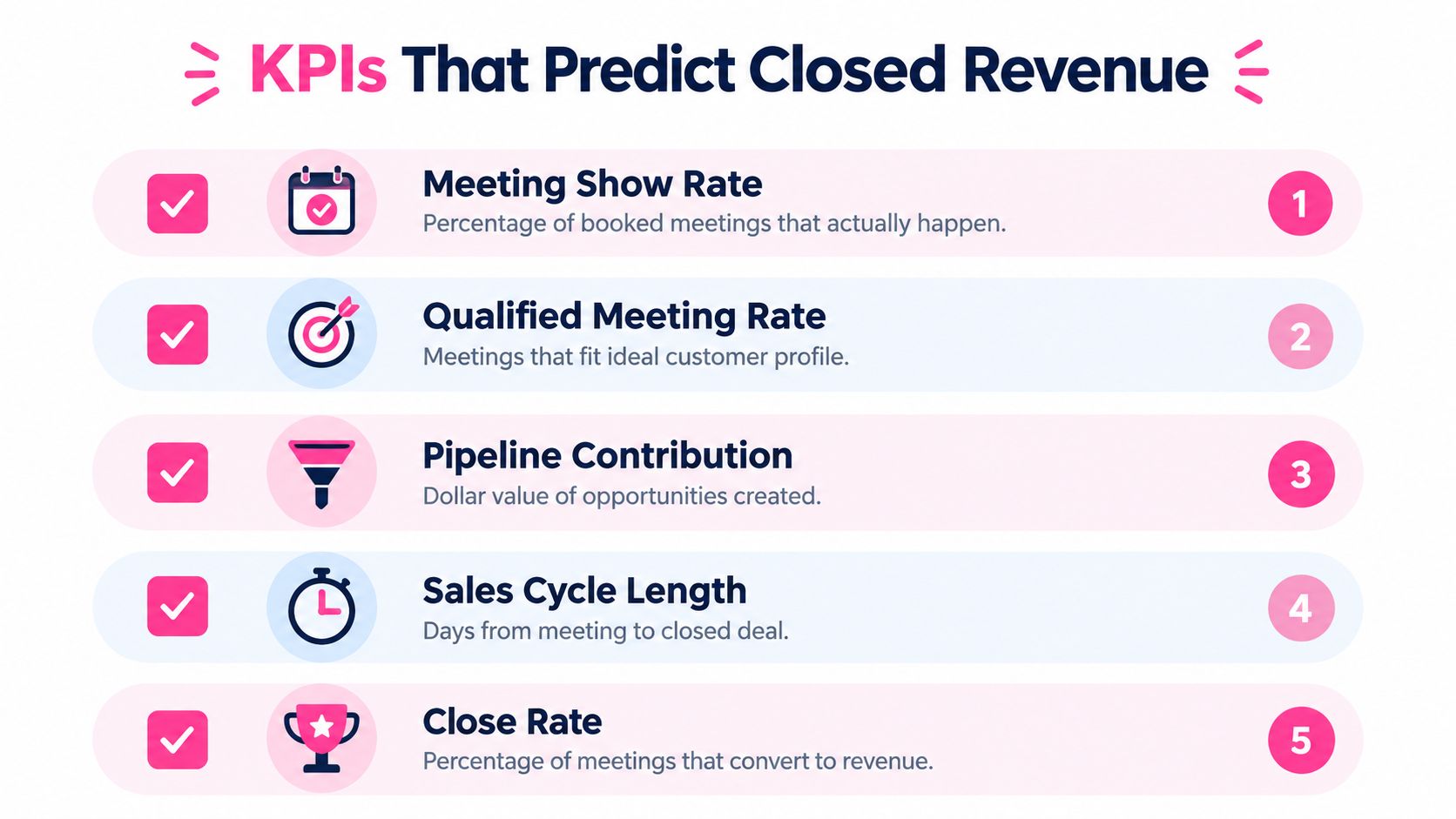
The better scorecard is smaller and harder to fake. Track qualified meeting rate, show rate, time-to-first-response, time-to-booking, opportunity creation rate, and closed revenue attribution. Those numbers reveal whether the problem is targeting, follow-up, or the offer itself.
Time-to-response deserves special attention. A Harvard Business Review analysis of about 1.25 million online leads across 2,241 companies found that firms contacting an inquiry within one hour were nearly seven times more likely to qualify it than firms waiting another hour, and more than 60 times more likely than firms waiting 24 hours or longer. That's not a nice-to-have, it's the difference between catching intent and watching it cool off. The analysis on lead response speed makes the point plainly.
A weekly review should answer four questions
- Are the meetings qualified? If not, the list or offer is off.
- Are people showing up? If not, the booking and confirmation process is weak.
- How fast are replies handled? If this drifts, intent decays.
- Which channel contributes? If you can't tell, you're guessing.
Use Ever Outbound's meeting cost calculator to pressure-test whether your current funnel math makes sense. The point isn't to celebrate activity, it's to isolate the leak before you pour more money into the top.
Implementation Steps from Offer to Calendar
Start with the offer, not the sequence. If the promise is fuzzy, no amount of outreach polish will save it. The buyer needs a clear reason to talk, and that reason should match a specific segment, business trigger, or pain point.
Then build the target list with care. You want verified companies, relevant roles, and a reason they should care right now. After that, write the sequence in a way that sounds like a human who understands the buyer's situation, not a robot chasing a quota.
The infrastructure piece matters more than many organizations admit. Google classifies senders sending approximately 5,000 or more messages per day to personal Gmail accounts as bulk senders and requires SPF, DKIM, DMARC, and an easy unsubscribe mechanism. It also recommends keeping the user-reported spam rate below 0.1% and preventing it from reaching 0.3% or higher. Google's bulk sender guidance and its policy details for bulk senders make the operating rules clear.
Launch checklist
- Shape the offer. Make it specific to one buyer type and one outcome.
- Build the list. Verify the names, roles, and fit before launch.
- Authenticate the mail. Set up the sending environment before the first send.
- Warm and monitor. Watch complaint and bounce signals daily.
- Wire booking handoffs. Make sure calendar and CRM workflows are ready before replies start coming in.
Deliverability is infrastructure, not housekeeping. If your sender reputation slips, your campaign loses reach before prospects ever see the pitch.
A managed service should also track response and routing in real time, not once a day after the damage is done. How Ever Outbound works is a useful example of what a full handoff can look like when outreach, reply handling, and booking are connected instead of scattered.
Case Study Snapshots Across Three B2B Verticals
An agency owner I'd trust more than most vendors started by changing one rule, every booked call had to meet a defined standard before it hit the calendar. The result wasn't more meetings for the sake of it, it was fewer bad ones and a cleaner handoff to the closer. The lesson is simple, if you don't define qualified before launch, your team will define it later, usually after wasting time on the wrong calls.
A SaaS team fixed response discipline next. Their replies used to sit until later in the day, which meant prospects cooled off, competitors got there first, and the next step drifted. Once the team treated response speed like a core operating metric, opportunity creation improved because the first real conversation happened while intent was still warm.
A consultant entering a new geography used a different sequence entirely. Phone, email, and LinkedIn weren't treated as separate campaigns, they were sequenced around buyer behavior and reply sentiment. That switch helped the team stop blasting the same message everywhere and start using the channel that fit the moment.
Highmpact's case study page is a useful reminder that vertical-specific execution beats generic scripts. The common thread across all three examples is not clever copy, it's tighter definition, faster follow-up, and a better fit between offer and buyer context.
Why Email-Only Playbooks Are Quietly Failing
Email-only still survives because it's easy to scale, not because it's the strongest way to book meaningful meetings. The available meeting-source data points the other way, with 85% of tracked B2B meetings coming from phone calls, 8% from email, and 7% from LinkedIn. That doesn't mean email is dead, it means email by itself is usually too weak to carry the whole motion. The multichannel meeting-source analysis backs that up.
Gartner's buyer research adds the missing context. 61% of B2B buyers prefer a rep-free buying experience, 73% avoid suppliers that send irrelevant outreach, and 69% report inconsistencies between a seller's website and its sales reps. Gartner's 2025 buyer survey release is a warning to anyone still running fixed cadences without judgment.
The answer is not more noise. It's better sequencing.
- Call when the buyer shows active intent. Use the phone when timing matters and the account is warm.
- Email when the message needs room. Use it for clarity, proof, and follow-up.
- Pause when the response is negative or unclear. Bad persistence kills trust.
- Hand off to self-serve when the buyer wants distance. Don't force a live conversation onto someone who doesn't want one.
Human-supervised orchestration beats automation alone. AI can triage replies and spot patterns, but people still need to decide whether a prospect deserves a call, a proof asset, a concise answer, or no further contact. That is the practical version of managed outbound, and it is the one that protects both conversion and brand.
Vendor Evaluation Checklist and Sample SLA Terms
A serious buyer should ask for the operational details before signing anything. If the vendor can't define a qualified meeting, show how they handle suppression, or explain how quickly they route replies, you're buying hope, not a system.
Use this checklist:
- Qualified meeting definition. Ask what makes a meeting count and what gets rejected.
- Reporting cadence. Weekly is the minimum if you want to catch problems early.
- Deliverability ownership. Clarify who monitors spam, bounces, and sender reputation.
- Response-time handling. Get a clear commitment on how fast positive replies are touched.
- Data suppression rules. Make sure opt-outs and uninterested contacts are removed immediately.
- White-label terms. Agencies should confirm whether client-facing fulfillment can be hidden under their brand.
- Termination terms. Know how to exit if quality slips.
A simple SLA should include measurable language around booked meeting quality, response handling, and reporting frequency. If the provider can't put numbers on those items, the service is too vague to manage. If they can, you'll know whether they're selling a calendar-filling motion or a real pipeline system.
For agencies comparing fulfillment partners, this vendor comparison resource is useful because it frames the choice around operating model, not just price. A short FAQ is worth keeping in the contract pack too, especially for ramp timelines, white-label fit, and what happens if the first batch of meetings doesn't convert.
Ever Outbound Inc. provides a pay-per-close B2B client acquisition service built around qualified meetings, reply handling, and managed outbound execution. If you want a sales appointment setting service that ties cost to closed deals instead of raw calendar volume, visit Ever Outbound Inc. and see how the model fits your pipeline.