November 6, 2026
10 Sales Prospecting Tools Worth Your Time in 2026
You don't need seven sales prospecting tools. You probably need two that talk to each other, or none if you'd rather pay for closed deals than run the machine yourself. Most bloated stacks fail in a boring way. One tool finds people badly, another sends to them badly, and the CRM faithfully records the wreckage. That last part matters, because CRMs became the home base for this whole category. Adoption among companies with more than 11 employees rose from about 12% in 2008 to approximately 91% by 2021, according to FounderJar's CRM statistics roundup, so every tool below either feeds your CRM or fights it.
Read each entry through one question first. Who should use this? Some picks win on data quality, some on execution, and one skips the tooling problem entirely. I've flagged the honest limitation for each, because that's where your money leaks. If you want a second opinion before you commit, the sourced software comparisons for sales teams are worth a skim alongside this list.
AI hasn't changed that logic, it's just raised the stakes. A Salesforce survey of 4,050 sales professionals across 22 countries found 87% of sales organizations used some form of AI for work including prospecting, forecasting, lead scoring, or drafting emails, per MaxIQ's sales statistics summary. Everyone has the shiny layer now. Coverage, verification, and follow through still separate the winners.
Table of Contents
- 1. Ever Outbound Inc.
- 2. Apollo.io
- 3. LinkedIn Sales Navigator
- 4. ZoomInfo Sales
- 5. Cognism
- 6. Lusha
- 7. UpLead
- 8. Clay
- 9. Hunter
- 10. LeadIQ
- Sales Prospecting Tools at a Glance
- Build Your Stack, or Skip the Stack Entirely
1. Ever Outbound Inc.
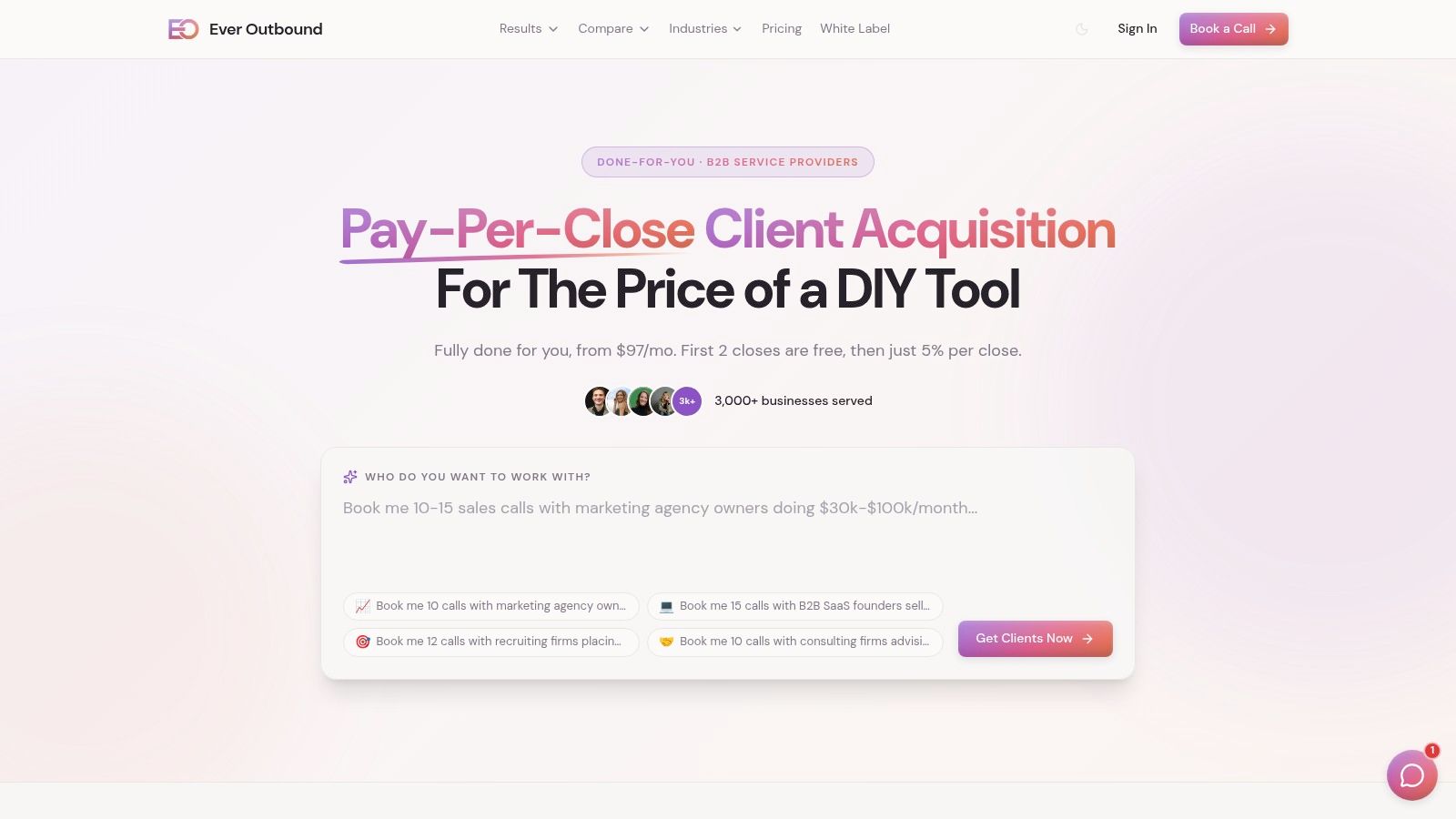
Most entries on this list sell you a faster way to run outbound yourself. Ever Outbound Inc. sells the outbound and gets paid when it turns into revenue. It's a fully managed B2B client acquisition service on a pay-per-close model: plans from $97/month plus 5% commission on closed deals, with the first two closes commission-free. A human research, copywriting, and appointment-setting team runs the work, using AI as a multiplier for research, enrichment, and first drafts. Judgment on targeting, messaging, and qualification stays with people, which is exactly where fully automated outreach tends to embarrass itself.
Who Should Actually Use This
Pick this if you want qualified calls on the calendar without hiring SDRs or babysitting domains, sequences, and inboxes. Delivery covers cold traffic offer creation, verified prospect research, personalized copywriting, domain setup and warmup, deliverability monitoring, follow-ups, AI-assisted appointment setting, and calendar booking. You show up to the calls and close. Agencies can resell the service white label under their own brand, which is a different economic game than adding another seat to a stack you still have to operate.
The traction argument behind AI-assisted outreach holds up. Salesforce's 2026 State of Sales reports that nine in ten sales teams either use AI agents already or expect to adopt them within two years, and among teams using agents for prospecting, 92% say AI benefits that work, according to the Salesforce State of Sales report. The edge isn't owning AI. It's wiring it to verified lists and booked meetings.
Pricing deserves a straightforward answer. The monthly floor is small enough that the commission is the actual cost, and 5% of a closed deal is minor on a $5,000 retainer and significant on a $200,000 contract. The honest limitations: you don't learn to run outbound yourself, you don't own the sending infrastructure or the lists, and any campaign is only as good as the offer underneath it. If your offer is weak, no amount of verified prospecting rescues it. Best fit verdict: founders and agencies who'd rather close than operate a prospecting stack, and who are fine trading a slice of won revenue for zero outbound headcount.
2. Apollo.io
Apollo.io is where most small teams start, and for once the popular choice makes sense. It combines a B2B contact database, enrichment, and email sequencing in one seat, so a founder or a two person sales team can find prospects in the morning and email them after lunch. There's a free plan and published paid tiers, which beats the quote based obstacle course you'll meet further down this list.
The catch is data trust. Contact quality varies by segment, and Apollo won't save you from your own list hygiene. Benchmark summaries put a single data provider's coverage at only about 50% to 70% of records, while waterfall enrichment across providers can reach approximately 85% to 95%, per Sci-Tech Today's prospecting statistics. Translation, verify important records before they touch a sequence, or your bounce rate becomes your brand.
- Strength: One platform for search, enrichment, export, and sequences, with common CRM integrations.
- Weakness: You own deliverability, deduping, and verification, and specialist enterprise platforms go deeper on engagement.
- Stacking note: Pair Apollo with a verifier first, not another database. Our head to head on running Apollo yourself versus managed outbound lays out the labor math.
Best fit verdict: small and midsize teams that want one login and will accept imperfect data in exchange for speed.
3. LinkedIn Sales Navigator
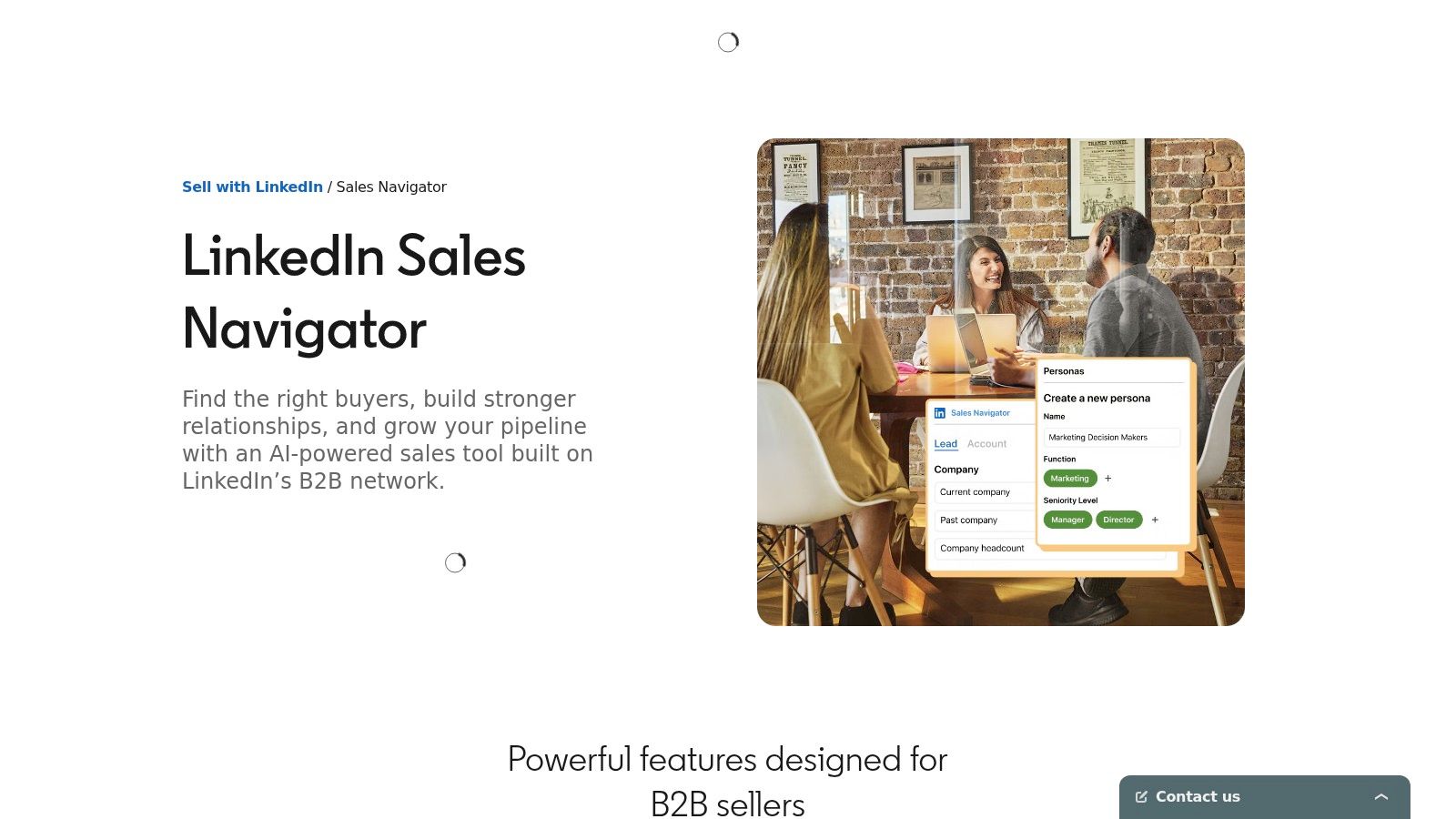
LinkedIn Sales Navigator is the best place to confirm you're chasing the right human. First party professional profiles tell you who holds the title today, how teams are structured, and who just changed jobs. Advanced lead and company search, change alerts, InMail, and relationship paths make it a targeting and research layer, not an email database.
Treat its signals with some skepticism, though. Account level activity can show that someone at a company is exhibiting buying behavior without identifying who that person is, a limitation flagged in Amplemarket's AI prospecting tools guide. Reps waste afternoons personalizing to the wrong employee because a dashboard glowed green. Use Navigator to build the buying group, then prove each person belongs in it.
A signal tells you where to look. It doesn't tell you who can sign.
Pricing is per license, and it climbs for team collaboration and the CRM workflows on Advanced Plus. You'll still need a separate source for verified work emails and phone numbers. Our breakdown of LinkedIn as one channel inside a wider outbound system shows where it earns its keep.
Best fit verdict: reps selling considered deals who need role accuracy and relationship context before they write a word.
4. ZoomInfo Sales
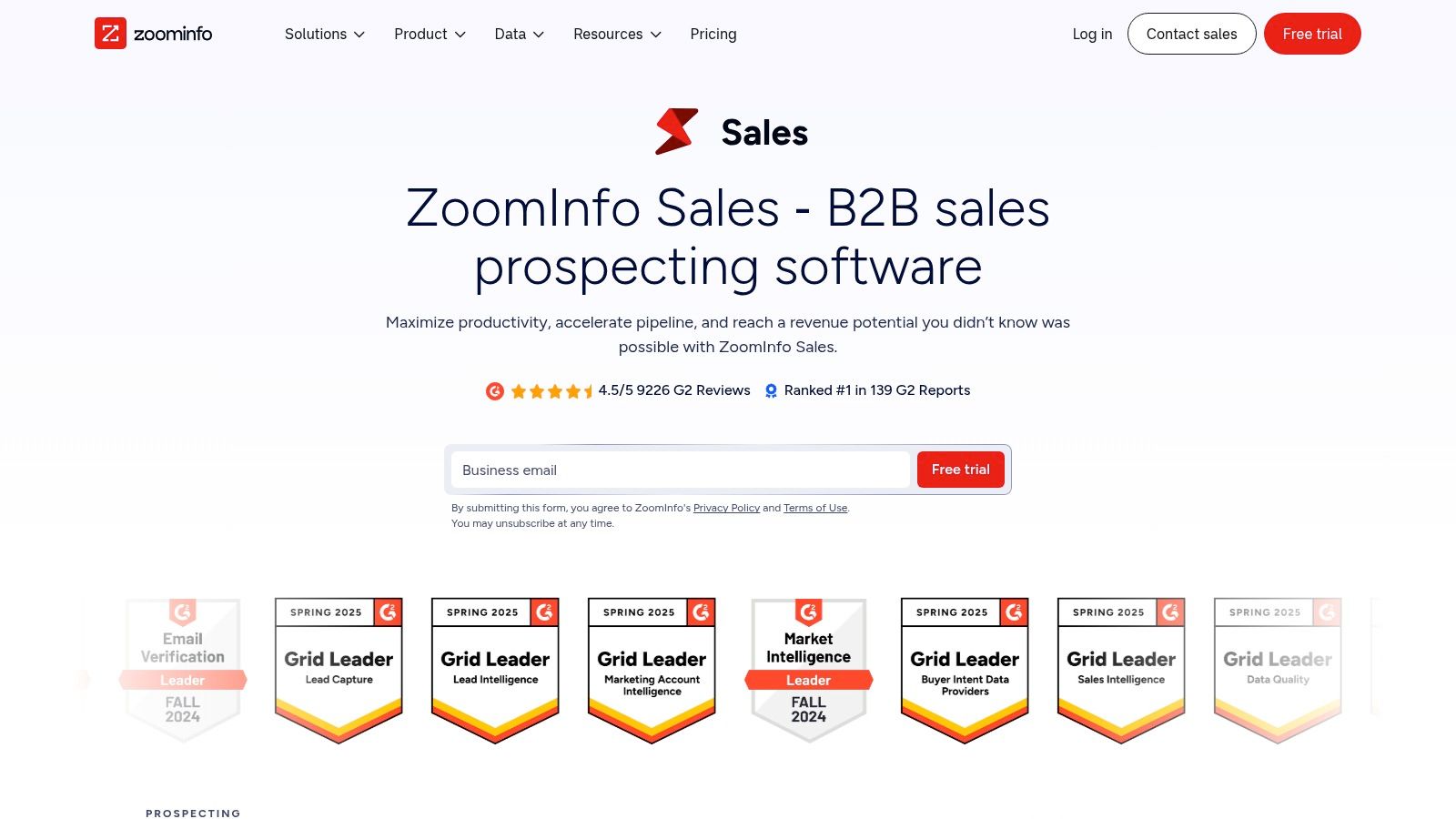
ZoomInfo Sales is the heavyweight option, built for organizations with real RevOps support. You get contact and company intelligence, org and firmographic detail, buying intent and other account signals, plus enrichment and integrations across sales and marketing systems. For a team working thousands of accounts in coordinated plays, that breadth is the point.
For a five person team, it's usually more contract than capability. Pricing is quote based, so budget for a sales conversation and a negotiation, not a checkout page. Test coverage against your own target list before signing anything, because a giant database that misses your niche is just an expensive phone book. Teams that do bring ZoomInfo data in from elsewhere sometimes look at ZoomInfo extraction with WebscrapingHQ to move records into their own workflows, and whatever the source, run exports through a lead list cleaner before a single send.
The Honest Limitation
Intent signals prioritize accounts, they don't close the gap to a named, reachable decision maker. You'll still map buying groups by hand on your best accounts. Best fit verdict: larger sales orgs prospecting broad markets, with ops staff to govern data quality and a budget that survives procurement.
5. Cognism
Cognism earns its place when your pipeline crosses borders. It's a sales intelligence platform with firmographic, technographic, and signal based search, AI assisted account research, list enrichment, and export into your CRM. The company puts compliance at the center of its data offering, which matters more than most roundups admit, especially for EMEA focused teams.
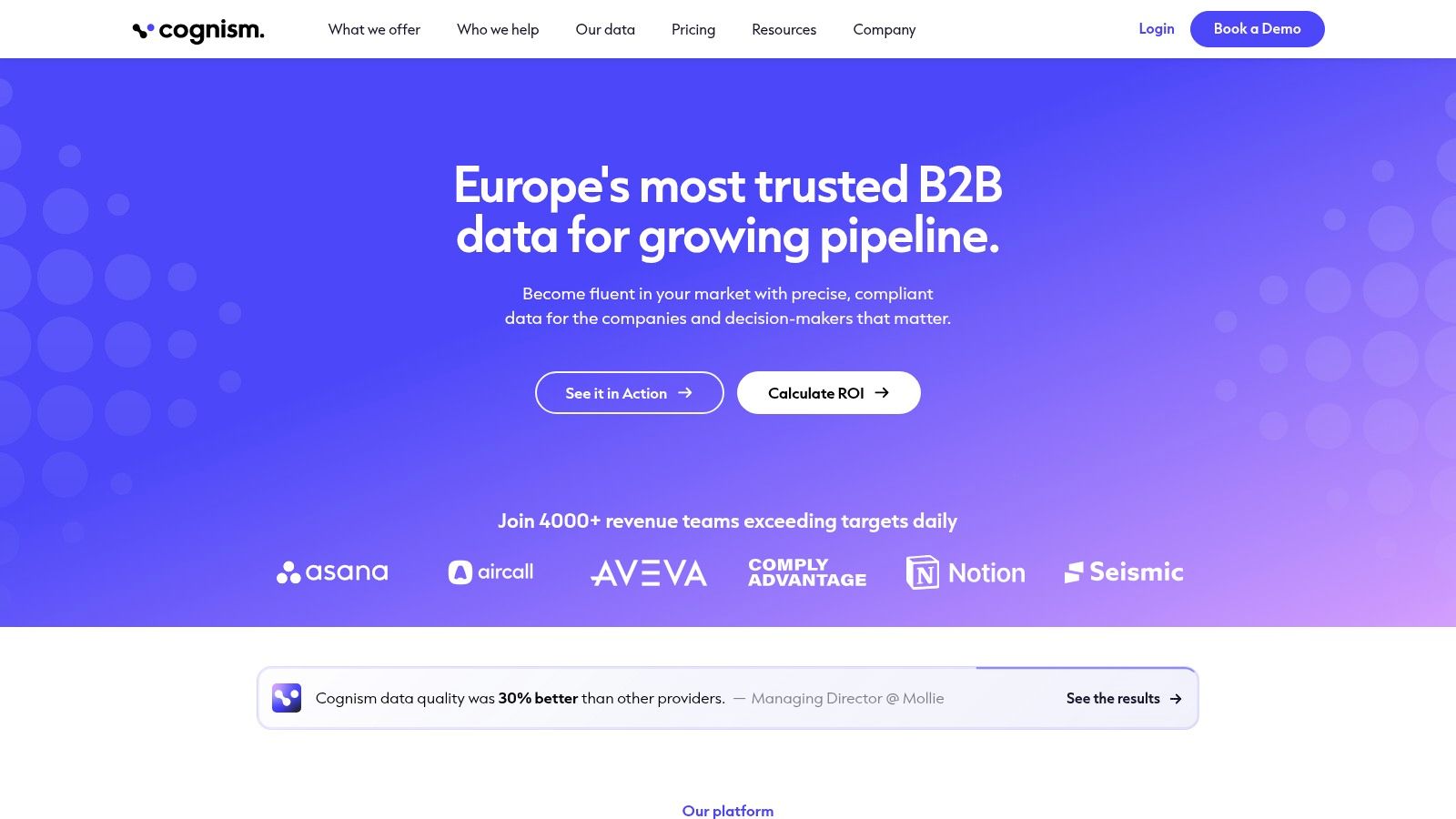
Compliance deserves real weight in your evaluation. Practical guidance for B2B campaigns recommends campaign specific Legitimate Interest Assessments, written data processing instructions, security controls, and clear privacy policy links, according to Data Innovation's privacy audit guide for B2B email campaigns. A technically brilliant workflow that can't document lawful basis, suppression handling, and vendor accountability is a liability with good reply rates. Ask every vendor on this list those questions, then compare the answers side by side instead of accepting a security page as proof.
The trade offs are commercial rather than functional. Pricing is quote based, and seat limits and package contents vary by plan, so a small team can end up paying for chairs nobody sits in. Confirm two things at the quote stage: how many users the plan includes, and which countries your reps will prospect. Then test coverage for those countries and personas during the trial, not after the signature. I'd treat Cognism as an EMEA layer stacked on top of a cheaper volume tool rather than a straight replacement for one, since paying enterprise rates to source US contacts you could get elsewhere is a poor trade.
Best fit verdict: international teams, particularly EMEA focused ones, that need compliant data and account research in the same workflow.
6. Lusha
Lusha is the quick draw option. The browser extension pulls business emails and phone numbers while you're looking at a LinkedIn profile or company site, which suits reps who prospect account by account instead of building giant lists on Fridays. Paid plans add company and contact search with advanced filters, bulk enrichment, CRM exports, API access, and signals.
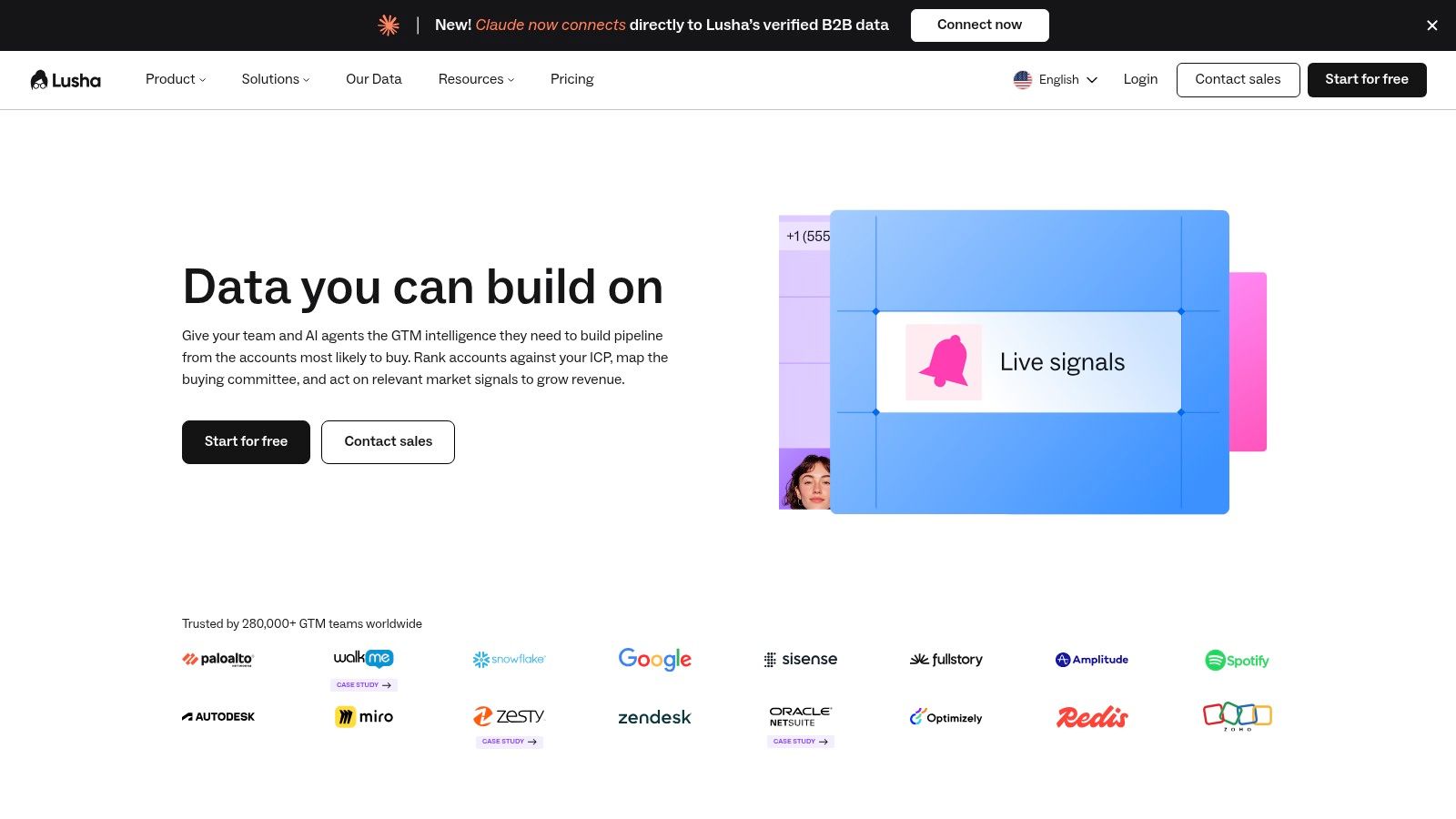
Everything runs on credits, and that's both the clarity and the constraint. You can see exactly what a reveal costs, but phone numbers consume more credits than emails, so call heavy teams burn through plans faster than the pricing page suggests. The free tier is useful for testing match rates on your own accounts before you commit. Advanced team and compliance features sit on higher or custom plans, so confirm what your tier includes.
- Buy it for: Fast, in the flow contact reveals and tidy CRM exports.
- Skip it if: You need deep account intelligence or high volume phone data on a fixed budget.
- Test first: Run your hardest segment, the small companies and odd titles, not the easy enterprise names.
Best fit verdict: individual reps and small teams who live in the browser and want contact data without a platform migration.
7. UpLead
UpLead puts pricing on the page, which is not the norm among quote-based databases. Public plans, a credit model, and a seven-day trial with five credits let you estimate list-building costs before finance gets involved. Search by company and prospect filters, then pull verified emails and mobile direct dials. Technographic filters and enrichment sit on higher tiers.
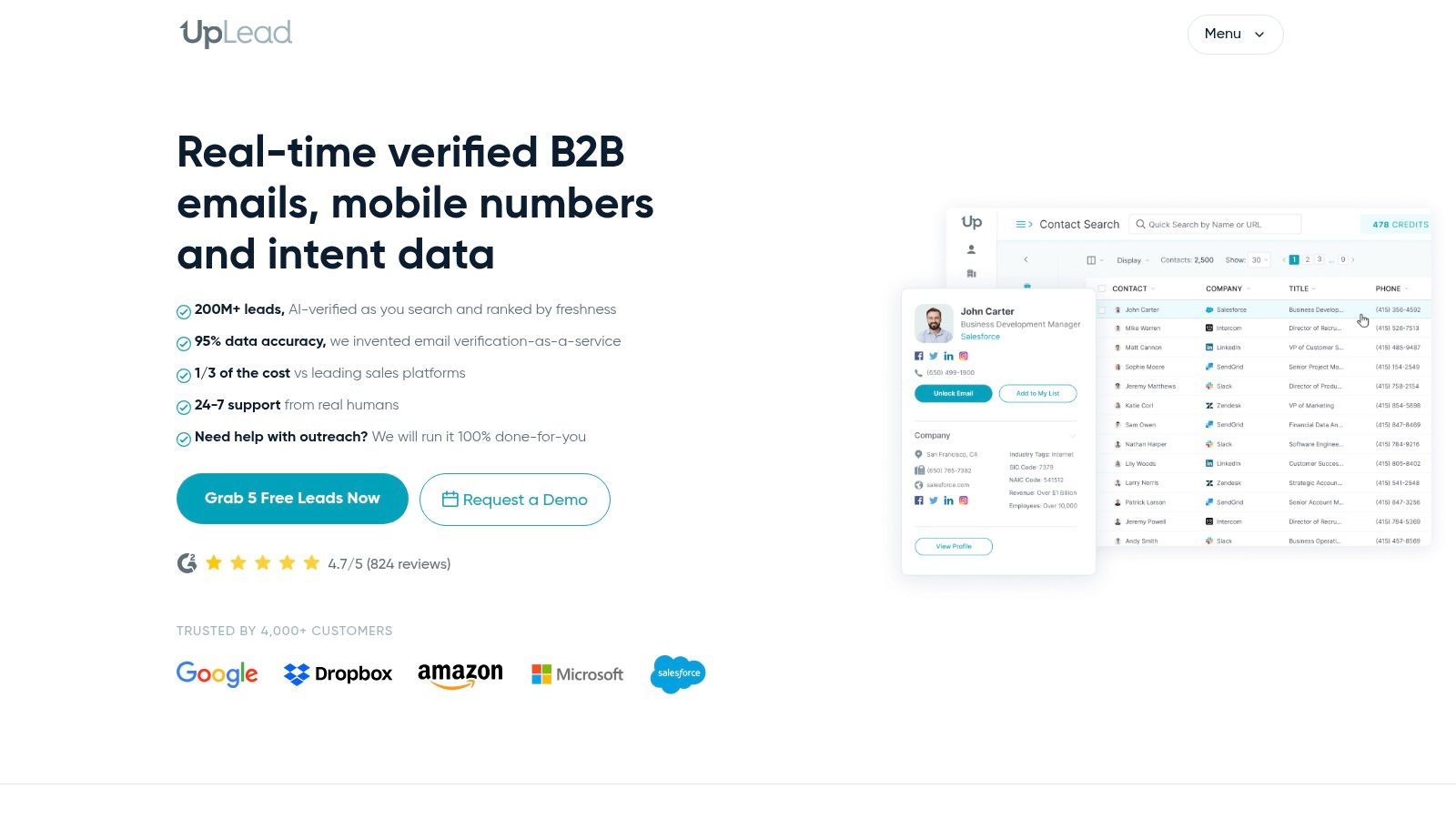
Suppression list uploads are the feature I would check first. They stop you paying to retrieve contacts already in your CRM or bought last quarter. A lot of prospecting budget goes to buying the same person from several vendors, each with a slightly different spelling. UpLead also connects to common CRMs and engagement tools and offers a Chrome extension for in-the-moment lookups.
Practical rule: Upload your suppression list before your first export, not after your first duplicate argument with RevOps.
The limits are real. Lower-priced plans are single-user, monthly credits cap how many contacts you can reveal, and team features plus buyer intent data sit in the custom-priced organization plan. That makes UpLead a poor fit for a team that wants five reps pulling lists from one shared seat. It works better as a deliberate export layer: one researcher or founder builds a tight list, cleans it against your CRM, and hands sales a small set of verified contacts.
Best fit verdict: cost-conscious teams that export in small batches and want verified contacts with pricing they can read. If your bottleneck is reply rates or booked calls rather than list coverage, another database just adds a bill. Fix the offer and the follow-up before you add UpLead to the stack.
8. Clay
Clay isn't really a database. It's a workbench for building your own prospecting machine, chaining multiple data providers into waterfall enrichment, running AI assisted web research through Claygent, and pushing results into your CRM. If your ICP has weird, specific criteria that no single database captures, Clay is where you encode them.
That flexibility explains its timing. In 2025, 18% of sales professionals used generative AI for content creation and 16% for prospect outreach, per Cirrus Insight's sales automation statistics. Clay serves the operators building those workflows themselves rather than waiting for a vendor's roadmap. Plans offer unlimited seats with costs tied to usage, plus a free plan and 14 day trial, and higher tiers add CRM syncing, APIs, and webhooks.
The bill and the build are the rub. Usage credits and actions make total costs harder to forecast, and somebody on your team has to design, debug, and maintain every workflow when a provider changes something. Two Clay accounts can produce wildly different results on the same list. Our comparison of building in Clay versus handing outbound over entirely is worth reading before you fall in love with the canvas.
Best fit verdict: RevOps minded teams with a technical owner who enjoys configuration and wants custom enrichment logic, not a shrink wrapped database.
9. Hunter
Hunter does a narrow job well. It finds professional email addresses by person, company, or domain, verifies them in bulk, and can send automated sequences from connected accounts. If your motion is email only and your budget is small, that focus is a feature. The free plan has no time limit, and credits aren't charged when Hunter can't find an address, which is how credit pricing should work everywhere.
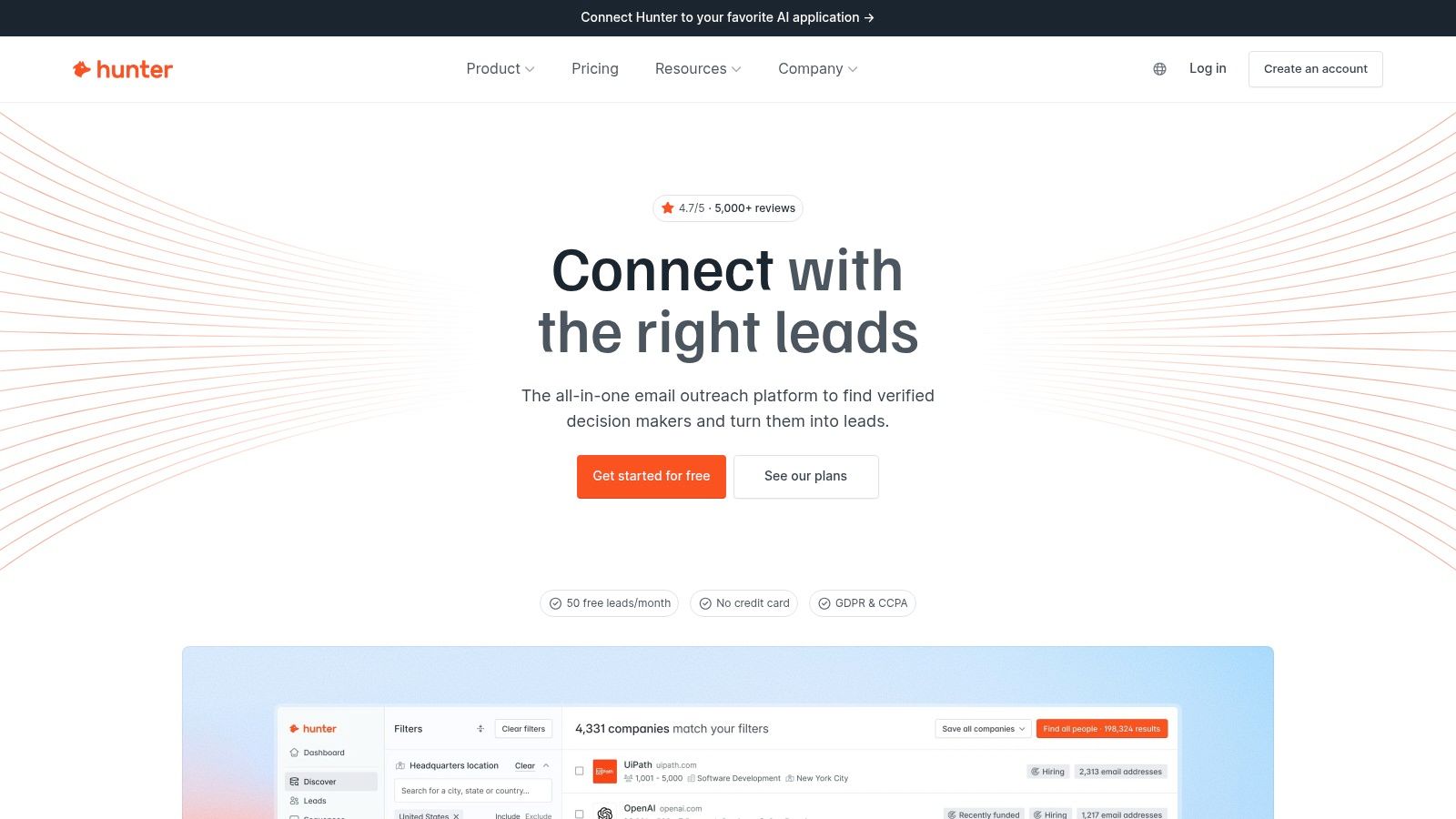
Don't confuse a verified address with permission to blast. Since February 2024, Gmail requires senders to authenticate domains with SPF or DKIM and keep reported spam rates below 0.3%, with Google recommending you stay below 0.1%, according to Google's email sender guidelines. Hunter gets you the address, your sending discipline decides whether you land in the inbox or the void. Check your setup with an email deliverability checker before scaling volume.
Credits are shared across features and reset with your billing period, so heavy verification months eat into finding. There's no meaningful phone data or account intelligence here, and that's fine if you don't need it.
Best fit verdict: lean, email first teams that want finding, verification, and light sequencing without buying a sales intelligence suite.
10. LeadIQ
LeadIQ exists to kill copy and paste. Its Chrome extension captures prospect data while you browse and pushes work emails, mobile numbers, and account context straight into your CRM and sales workflows. Add job change and other sales signals, CRM enrichment, and AI assisted outbound message generation, and it's built for reps who prospect inside LinkedIn all day.
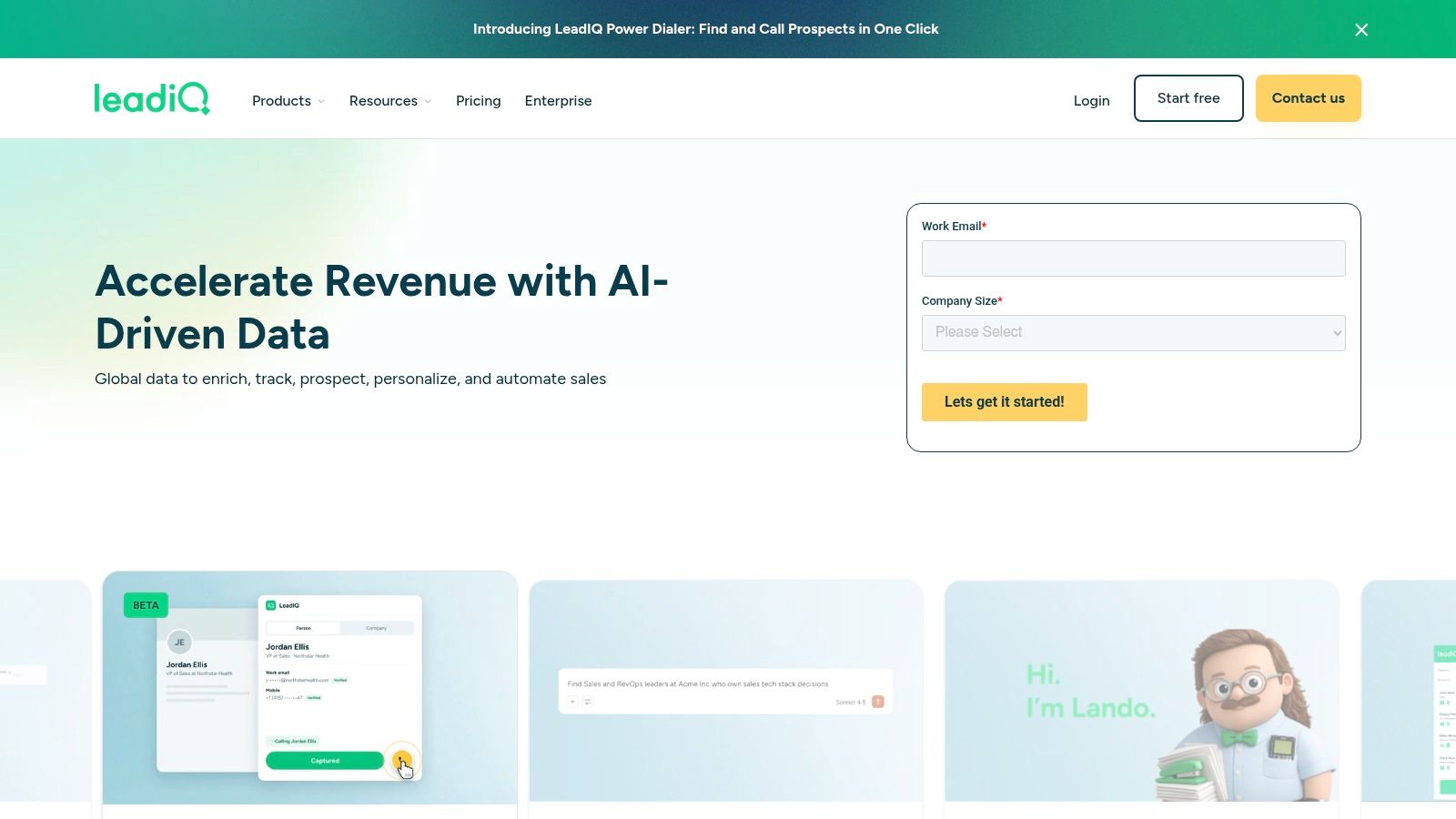
The AI writing piece is now table stakes rather than a differentiator. In 2024, 47% of sales professionals used generative AI tools to write sales content or prospect outreach messages, according to HubSpot's State of AI in Sales. So judge LeadIQ on capture speed and data accuracy, not on whether it can draft a first line. Every vendor can draft a first line now, and most of them read like it.
Cost structure needs attention. Published credit rules price phone numbers far above emails, the listed Pro plan can sting for a solo user, and some team controls require an enterprise plan. The free plan lets you test capture quality on real accounts first.
Best fit verdict: LinkedIn centric reps and teams who want one click capture into the CRM and will pay a premium per phone number for that convenience.
Sales Prospecting Tools at a Glance
This table is a fit chart, not a ranking. A database built for a 40-rep team with named territories wastes money at a three-person agency, and the reverse holds too.
| Best For | Free Plan / Trial | Pricing Model | Data Type | Standout Strength |
|---|---|---|---|---|
| Ever Outbound Inc., businesses that want managed B2B client acquisition | No free plan or trial | Plans from $97/month plus 5% commission on closed deals; first 2 closes commission-free | Managed prospecting, outreach, and booked meetings | Human-led campaigns with AI appointment setting and white-label fulfillment |
| Apollo.io, small and midsize teams combining prospecting and outreach | Free plan available | Free and paid tiers | B2B contact and company data | Prospecting, enrichment, and email sequences in one platform |
| LinkedIn Sales Navigator, finding and researching decision-makers | No free plan or trial | Per-license pricing; team and CRM features vary by plan | Professional profiles, account information, and activity signals | First-party profile and relationship context |
| ZoomInfo Sales, larger sales teams with structured prospecting workflows | No free plan or trial | Generally quote-based | Contact, company, firmographic, and intent data | Broad intelligence and workflow coverage |
| Cognism, international teams, especially those focused on EMEA | No free plan or trial | Quote-based | B2B contact and company data | International prospecting with a focus on compliant data |
| Lusha, individuals and teams needing contact data and enrichment | Free tier available | Credit-based plans | Business emails, phone numbers, and company data | Contact data, enrichment, and integrations in one place |
| UpLead, teams building prospect lists with verified contact details | Seven-day trial with five credits | Credit-based plans; organization pricing is custom | Verified emails, mobile numbers, and company data | Public pricing and suppression-list support |
| Clay, teams building customized enrichment and research workflows | Free plan and 14-day trial available | Usage-based credits; unlimited seats | Multi-source prospect data, enrichment, and research | Flexible, customizable data workflows |
| Hunter, email-focused prospecting and verification | Free plan available without a time limit | Credit-based plans | Professional email addresses and company domains | Email discovery, verification, and basic outreach |
| LeadIQ, sales teams capturing prospects into CRM workflows | Free plan available | Credit-based plans; enterprise options available | Work emails, mobile numbers, and sales signals | Prospect capture and CRM-oriented workflows |
Every row solves the same half of the problem: finding a name, a working email, and a reason to reach out. None of them write the offer, run the follow-up, or take the call. Ever Outbound's client acquisition service bundles cold traffic offer creation, master copywriting, surgical prospecting, and AI appointment setting, with plans from $97/month plus 5% commission on closed deals and the first two closes commission-free.
Build Your Stack, or Skip the Stack Entirely
If you're building, keep it boring. One data source plus one engagement layer covers most needs, with a verifier in between if your source is credit cheap and accuracy light. A typical sane pairing looks like Sales Navigator for targeting, Apollo or UpLead for contact data, and your existing sequencer to send. Clay earns a seat only when a named person owns the workflows. ZoomInfo and Cognism earn theirs when territory size or international compliance demands it, not because a competitor's logo wall looked impressive.
Validate Before You Commit
Never judge a database on its own demo accounts. Bring a sample of your real market, the awkward mid sized companies and nonstandard titles, and measure verified email rate, phone hit rate, and duplicates against your CRM. Then send a small, properly warmed campaign and watch what happens. Follow up structure matters as much as list quality, and sequences need to stop the moment someone replies, opts out, or gets disqualified. That last point isn't etiquette, it's law. The CAN-SPAM Act requires a clear opt out mechanism and says senders must honor an opt out request within 10 business days, per the FTC's CAN-SPAM compliance guide. Whichever tools you pick, your suppression list has to be sacred across all of them.
Track the work where your team will really look. Plenty of lean teams manage pipeline hygiene and follow up ownership through lead tracking workflows in monday.com rather than forcing every rep into a heavyweight CRM view on day one. The system matters less than the habit. Every prospect needs an owner, a next step, and a reason they're in the list at all.
The test that counts: qualified conversations per verified account, not contacts exported per rep.
DIY stops being worth it at a predictable point. When you're paying for three subscriptions, spending Fridays cleaning lists, and still writing follow ups at midnight, the stack owns you. That's the moment to price the alternative. With Ever Outbound Inc., we're pay-per-close, so our team runs research, copy, infrastructure, follow up, and booking for you, you pay 5% commission only when you close, and your first 2 closes are commission free.
Run this checklist this week. First, name your single biggest gap, data, sending, or hours. Second, trial one tool against your hardest segment and record verified coverage. Third, confirm opt out and suppression handling across every system. Fourth, add up subscriptions plus the labor to run them. Fifth, compare that total with paying only on closed deals. Pick the option that wins on your numbers, not on a feature grid.
If you'd rather spend your week on sales calls than on list cleaning, domain warmup, and sequence plumbing, Ever Outbound Inc. will run the whole outbound engine for you on a pay-per-close basis, with human researchers, writers, and setters booking qualified meetings straight onto your calendar. You only pay 5% when a deal closes, your first 2 closes are commission free, and you can watch every campaign, reply, and booking live in your dashboard. Book a call, see exactly how we'd build your campaign, and decide with real numbers in front of you.