November 28, 2026
What Does an Appointment Setter Do? the Real Job
An appointment setter finds potential buyers, starts the conversation, checks whether they fit, and books a meeting for a closer. The job isn't about negotiating contracts or packing someone's schedule with random names; it's about making sure every booked slot puts a real buyer with a real problem in front of your sales team.
Most popular advice treats appointment setting like a volume game. Fill the calendar, chase big booking numbers, and let the account executives sort out the mess later. Say a closer opens their Thursday schedule to five shiny new calls. The first is an office manager who thought she signed up for a free webinar. The second has zero budget until next year. The third and fourth never show up, and the fifth forgot why they accepted the invite in the first place. That calendar looks busy on a dashboard, yet it produced zero pipeline and burned half a workday.
If you've ever wondered what does an appointment setter do when the role drives revenue, the answer sits in two words: qualification and handoff. A strong setter doesn't measure success by raw calendar invites sent. They measure it by qualified meetings held and real opportunities created downstream.
Table of Contents
- What an Appointment Setter Does Day to Day
- The Workflow From Prospect List to Booked Call
- Email Rules That Keep Setters Out of Spam
- Skills That Make a Setter Effective
- Qualifying Prospects Before Anyone Gets Booked
- Why Booked Meetings Still Fail to Show
- Hiring a Setter In-House or Outsourcing
What an Appointment Setter Does Day to Day
An appointment setter finds potential buyers, starts the conversation, checks whether they fit, and books a meeting with the closer. Think of the role like a good matchmaker: the setter arranges the first date, and the closer handles the proposal. Because this is a front-end sales position, the setter rarely negotiates pricing or pushes for a signature. Their real objective is turning targeted accounts into legitimate sales conversations.
As Salesforce's 2026 State of Sales report notes alongside related U.S. Bureau of Labor Statistics job descriptions, front-end sales work blends prospect communication and outreach with operational coordination like reporting, CRM updates, and calendar scheduling. A booked calendar means very little if the person on the invite lacks authority, has no urgent business problem, or has no realistic reason to evaluate a solution.
Here is how those daily moving parts connect from initial targeting to the closer's handoff.

Every daily habit a setter performs either builds trust for the closer or creates cleanup work later. The table below breaks down the core responsibilities and shows what lands on the closer's desk when each one is done right.
| Responsibility | What it looks like in practice | What the closer receives |
|---|---|---|
| Prospect research | Finding accounts and decision-makers that match the target market | A named list of accounts with roles and context |
| First-contact outreach | Sending personalized emails, LinkedIn messages or calls | A prospect who has replied and shown interest |
| Qualification | Asking about need, authority, timing and fit | A conversation summary with a verified problem |
| Follow-up | Sending reminders and added context after silence | A reopened conversation instead of a dead lead |
| Calendar coordination | Matching time zones and confirming attendees | A confirmed meeting on the closer's calendar |
| CRM and records | Logging outcomes, notes and reschedules | A pipeline the closer can trust |
Say a setter working for a cybersecurity firm spots a short reply from a hospital CIO asking how their audit prep works. Instead of firing back a generic calendar link, the setter asks two quick questions, confirms the hospital is heading into an active compliance review this quarter, and locks in a 30-minute slot with the account executive's prep notes attached. The closer walks onto that call knowing the exact audit deadline and who else sits on the security committee.
Practical test: If a task produces a confirmed meeting with clear context attached, it belongs to the setter. If it produces a signed contract, it belongs to the closer.
That boundary applies whether you hire internally or use a managed outbound partner. At Ever Outbound, where we operate on a pay-per-close basis, the function spans list research, personalized outreach, contextual follow-up, qualification, and calendar booking rather than blasting out generic invitations and hoping for the best.
The Workflow From Prospect List to Booked Call
Appointment setters exist because closers lose staggering amounts of selling time to top-of-funnel prep. According to the Salesforce 2025 State of Sales report, sales representatives spent only 30% of an average workweek selling and 70% on non-selling work, including prospect research, lead prioritization, preparation, and data entry. Handing that repetitive front-end workload to a dedicated setter frees account executives to spend their week on discovery, solution design, and closing.
Before diving into the granular mechanics, the graphic below shows the five core stages that carry a cold account onto a closer's calendar.
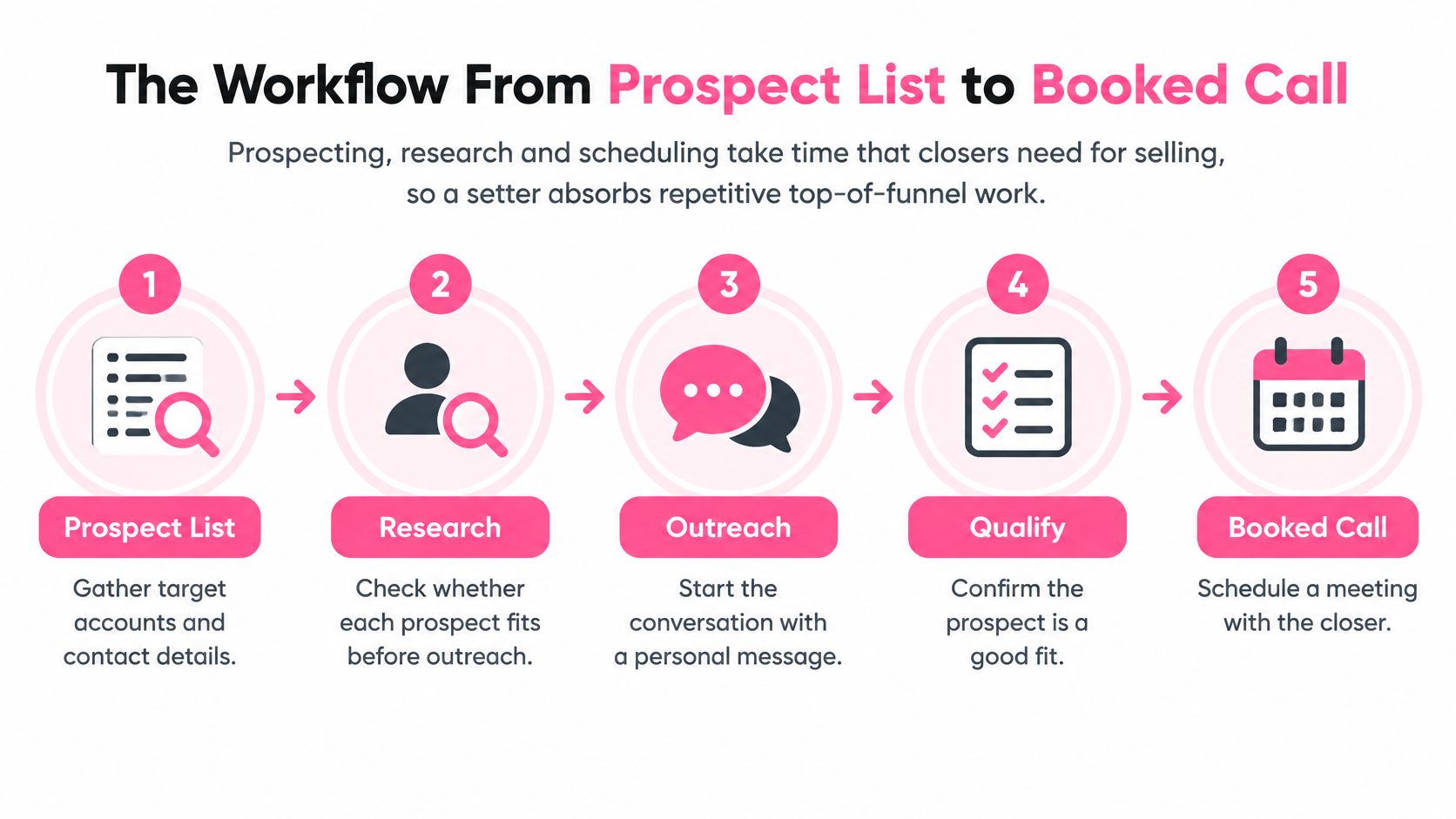
Seven Steps From Cold List to Closer Handoff
In day-to-day operations, those five stages unfold across seven deliberate actions. Skip a single step and the cracks show up immediately in bounce rates or awkward discovery calls.
- Build the target list by firmographics and role. Filter accounts by industry, revenue band, headcount, and buying title before writing a single word of copy. Why it matters: Tight targeting stops setters from burning hours chasing companies that could never afford the offer. Common slip: Downloading a massive scraped CSV from Apollo or ZoomInfo and mailing every job title in the directory.
- Verify each decision-maker before sending. Confirm the contact still works at the company and owns the relevant budget or workflow, using an email verification tool to strip dead addresses. Why it matters: Verified contacts protect domain health and keep outreach in front of actual buyers. Common slip: Skipping verification, which sends messages to departed employees or general info inboxes.
- Send short, specific first-touch messages. Name one recognizable operational problem and point to a concrete result achieved for a similar client. Why it matters: Busy executives delete walls of text within three seconds, whereas a sharp four-line note earns a real look. Common slip: Writing a five-paragraph company biography that never mentions the buyer's problem.
- Answer every reply the same working day. When a prospect asks a question or shows mild curiosity, respond while the original message is still fresh in their mind. Why it matters: Interest cools fast once a buyer moves on to afternoon meetings. Common slip: Letting positive replies sit unread in a shared inbox until Friday afternoon.
- Qualify interest with three or four focused questions. Check need, decision authority, realistic timing, and company fit before proposing a slot. Why it matters: A two-minute qualification exchange prevents wasted 30-minute demos. Common slip: Treating "sure, send times" as proof that the contact has a problem to solve.
- Book the meeting with a clear agenda and send a brief. Drop the invite onto the closer's calendar with all attendees listed, a plain-English agenda, and a short internal summary. Why it matters: Both sides enter the room aligned on what the call will cover. Common slip: Sending a blank calendar invite titled "Intro Call" with no notes in HubSpot or Salesforce.
- Run controlled follow-ups and suppress opt-outs immediately. Follow up on silence with fresh context rather than "just bumping this," and remove anyone who asks off the list right away. Why it matters: Most B2B replies arrive after the first touch, while ignored opt-outs wreck sender reputation. Common slip: Leaving an unsubscribed contact inside an automated cadence because nobody updated the suppression list.
Teams that rely heavily on phone outreach also layer scheduling tools into steps four and six. If you run voice-heavy campaigns, it helps to see how voice agents handle booking calls from Dograh, since phone-based scheduling follows the exact same speed-to-lead and confirmation rules as email. You can also see how our outbound workflow handles list building through booking when the full chain runs under one roof.
For a closer look at how daily setter habits translate into real calendar activity, watch the walkthrough below.
A healthy handoff at the end of this workflow looks boringly predictable: a booked slot on the closer's calendar, a confirmed buyer who knows why they're showing up, and a three-line note the closer can reference in the first 60 seconds of the call.
Email Rules That Keep Setters Out of Spam
One missed authentication rule or sloppy follow-up habit can send an entire outbound campaign straight to the spam folder, no matter how sharp the copy reads. Deliverability isn't solely an IT chore anymore. Mailbox providers throttle, reject, or junk-file messages automatically when senders miss baseline technical and behavioral standards, which makes inbox health part of the setter's operational job.
Under Google's Gmail sender guidelines, effective February 1, 2024, every sender emailing Gmail personal accounts must authenticate their domain with SPF or DKIM, keep valid forward and reverse DNS records, and transmit mail over TLS. Once volume climbs to roughly 5,000 messages per day to a provider, the Twilio email deliverability guide outlines the stricter bulk-sender framework used by Gmail and Yahoo: both SPF and DKIM authentication, domain alignment, a published DMARC policy set to at least p=none, one-click unsubscribe support, and a spam-complaint rate kept below 0.3% (with Google recommending below 0.1% wherever possible).
| Requirement | Threshold | Setter's responsibility |
|---|---|---|
| SPF or DKIM authentication | Required for all senders to Gmail personal accounts | Confirm every sending domain is authenticated |
| Forward and reverse DNS records | Required for all senders | Check sending infrastructure before campaigns launch |
| TLS transmission | Required for all senders | Use encrypted sending only |
| Bulk sender status | About 5,000 messages per day to a provider | Plan volume and spread it across properly configured domains |
| DMARC record | At least p=none for bulk senders | Confirm the policy is published on the sending domain |
| Spam-complaint rate | Below 0.3%, ideally below 0.1% | Monitor complaints daily and pause sending if they rise |
| One-click unsubscribe | Required for bulk senders | Remove unsubscribed contacts from every sequence at once |
What Setters Actually Control Each Week
You don't need to be a network engineer to keep your outreach landing in the primary inbox. As EmailLabs's 2024 sender requirements timeline emphasizes, Google and Yahoo enforce clear sender identity, non-misleading headers, and prompt opt-out handling right alongside technical authentication. Before launching a fresh sequence, running your setup through an email deliverability checker catches domain gaps before prospects ever see your name.
- Verify domain authentication before launch: Confirm the domain behind your visible From address passes authentication checks rather than assuming someone else handled it last quarter.
- Suppress opt-outs immediately: When someone replies "remove me" or clicks unsubscribe, strip them from every active sequence across all mailboxes the same day.
- Control follow-up frequency: Space out touchpoints sensibly and stop emailing unresponsive contacts before irritation turns into spam clicks.
- Watch for reputation spikes: Check daily bounce and complaint reports, and pause any campaign or inbox showing sudden drops in reply rates.
Treat these thresholds as a starting baseline rather than a permanent ceiling. Mailbox providers tighten enforcement periodically, so check current provider documentation before scaling daily sending targets.
Skills That Make a Setter Effective
Put two setters on the exact same prospect list with the exact same CRM, and one will double the other's held-meeting rate within a month. The difference rarely comes down to a louder voice or a cleverer pitch. It comes down to listening.
Say a VP of Operations replies, "Not a priority right now, send over some info." An untrained setter fires off a 12-page deck, marks the lead "warm," and never hears back. A skilled setter hears the hesitation underneath and asks what's taking priority this quarter, because that single question reveals whether the problem is real or nonexistent.
Concise writing sits right next to listening. Busy buyers skim outreach on a phone between meetings, so a four-sentence email anchored on one concrete operational headache beats a polished essay every time. When pushback arrives, strong setters stay curious rather than defensive. Consider how a seasoned setter handles the most common brush-off in agency outreach:
Prospect: "We already have an agency handling this for us." Setter: "Makes sense. If you could change just one result they're delivering over the next quarter, what would it be?"
Notice what didn't happen. The setter didn't trash the competitor, pitch a discount, or beg for 15 minutes. They opened a calm diagnostic question that invites the buyer to name an actual gap.
Daily Habits and Red Lines
Behind those conversations sits a quieter set of operational muscles. Strong setters keep spotless CRM hygiene in tools like HubSpot or Pipedrive so no follow-up disappears into a sticky note. They maintain emotional steadiness when most daily replies are polite rejections, triple-check time zones before sending invites across coasts or continents, and know when a polite silence means it's time to close the file and move on.
Just as telling is what experienced setters refuse to do:
- Promising outcomes they can't control: Never guarantee specific ROI numbers, delivery timelines, or custom pricing terms just to coax someone onto a call.
- Pressuring reluctant prospects onto the calendar: Talking someone into a meeting they don't want almost always ends in a ghosted Zoom room or a hostile closer call.
- Booking without confirming attendees: Sending an invite without verifying who's joining leaves the closer pitching a junior coordinator while the actual decision-maker stays absent.
You can spot the gap between an average setter and a great one in the final two minutes of a thread. The average setter hears a lukewarm "maybe" and scrambles to drop a booking link. The great setter pauses to ask the one clarifying question that proves the meeting is worth the closer's hour.
Qualifying Prospects Before Anyone Gets Booked
A booked meeting isn't a win by default. Filling a closer's week with unqualified calls inflates front-end activity dashboards while gutting sales productivity, because every hour spent explaining basic fit to the wrong person is an hour stolen from active deals. As Telemarketing.com's qualification criteria guide points out, verifying decision role, budget authority, stated need, and timeframe separates real opportunities from unverified contacts, and published benchmarks show no-show rates swinging anywhere from 6.5% to 28%, a spread that often hides weak targeting and sloppy expectation-setting.
Before a setter ever sends a calendar invite, the prospect should clear five acceptance checks:
- Company fit with your target market: The account matches your ideal industry, size, and operational profile rather than sitting on the fringes.
- Authority or real buying influence: The contact either signs the check or directly shapes the shortlist for the executive who does.
- A recognized problem in their own words: The buyer can articulate a current bottleneck or goal without the setter putting words in their mouth.
- A realistic evaluation timeframe: There's an active window to solve the problem, not a vague "maybe check back in two years."
- Explicit agreement to attend: The prospect clearly confirms the day, time, and purpose of the conversation.
If any check fails, the setter doesn't force the booking. They tag the account for future nurturing and keep the closer's calendar clean. For teams building structured intake filters, reviewing a dedicated cold qualification playbook helps standardize where that line sits before campaigns scale.
How Qualification Changes Across Verticals
Those five checks stay constant, yet the exact evidence shifts by industry. Say a setter works for a technical recruiting firm; they're checking quarterly hiring volume and stubbornly open engineering roles before booking. At a B2B management consultancy, the setter looks for a named strategic initiative already funded by leadership. For an IT managed service provider (MSP), qualification centers on upcoming support-contract renewals or recent security and uptime incidents.
Once the prospect clears the bar, the setter passes a tight handoff brief straight into the CRM and calendar notes:
- Stated problem: The specific pain point the prospect named in their own language.
- Current approach: The vendor, internal process, or workaround they're relying on today.
- Urgency and timing: Any deadline, renewal date, or growth trigger pushing the decision forward.
- Stakeholders involved: Who's attending the call and who else weighs in before a contract gets signed.
- Agreed agenda: The exact topics the prospect expects the closer to cover in the first 15 minutes.
Fewer, thoroughly qualified meetings routinely outperform a packed calendar of weak bookings. Ten well-briefed buyers with active problems create far more closed revenue than thirty half-interested contacts wondering why they're on the line.
Why Booked Meetings Still Fail to Show
Most sales playbooks treat the moment a calendar invite lands as the finish line. Then Tuesday rolls around, the closer sits alone on Google Meet for ten awkward minutes, and everyone shrugs it off as bad luck. In reality, a setter directly influences whether a meeting happens, and scheduling latency is one of the biggest silent killers in outbound sales.
Published figures highlighted in Callbox's B2B no-show analysis reveal how sharply attendance drops as the gap between booking and meeting stretches out.
| Scheduling lead time | No-show rate | Setter action |
|---|---|---|
| Same day | 6.9% | Offer near-term slots first |
| Next day | 9.6% | Confirm the reason to attend the day before |
| Eight or more days ahead | 23.0% | Book closer to the date or add a reminder sequence |
Look at that jump. A meeting scheduled eight or more days out fails to show more than three times as often as a same-day conversation. The fix starts while the prospect is still engaged: offer two near-term slots first instead of handing over an open two-week Calendly grid. For next-day calls, send a crisp confirmation message the afternoon before restating the agenda and who's joining. When a longer lead time is unavoidable because of executive travel, schedule a brief reminder sequence two days out and again the morning of the call.
Who Owns a No-Show and How to Measure It
When a prospect ghosts, teams love playing the blame game. Usually, ownership is shared across specific cracks in the setter's process: weak qualification produces thin commitment, vague outreach copy creates expectation gaps, long calendar gaps let urgency evaporate, and missing reminders allow busy buyers to forget. The setter also owns the recovery loop, following up politely within ten minutes of a missed start to offer two fresh near-term times without sounding annoyed.
If you only grade setters on raw bookings, you'll get a calendar full of polite maybe-laters. Grade them on qualified meetings held, and every habit upstream sharpens overnight.
Clean measurement requires breaking your funnel into five distinct stages instead of lumping everything under "leads": appointments set, appointments held, qualified meetings held, opportunities created, and closed revenue. Your show rate is held appointments divided by appointments set, and your no-show rate is its inverse. Tracking that full chain, the same discipline behind generating meeting-ready leads, tells you immediately whether you have a targeting issue, a calendar-timing issue, or a closer-conversion issue.
Hiring a Setter In-House or Outsourcing
Before posting a job ad or signing with an agency, run your business through a quick three-question test:
- How many target accounts do you need to reach each month? High-volume outreach across multiple segments demands serious daily list building and mailbox management.
- How fast do prospect replies need a human response? If your buyers expect answers within hours or the same working day, someone has to watch the inbox continuously.
- Does anyone on your team have bandwidth to manage research, copywriting, deliverability, and calendar coordination without dropping balls?
If your answers to the first two questions are high and the third is a hard no, an outsourced managed setter usually delivers faster traction. If your target universe is tiny and an existing salesperson already runs steady outreach without slipping on demos, an in-house hire can require less external coordination.
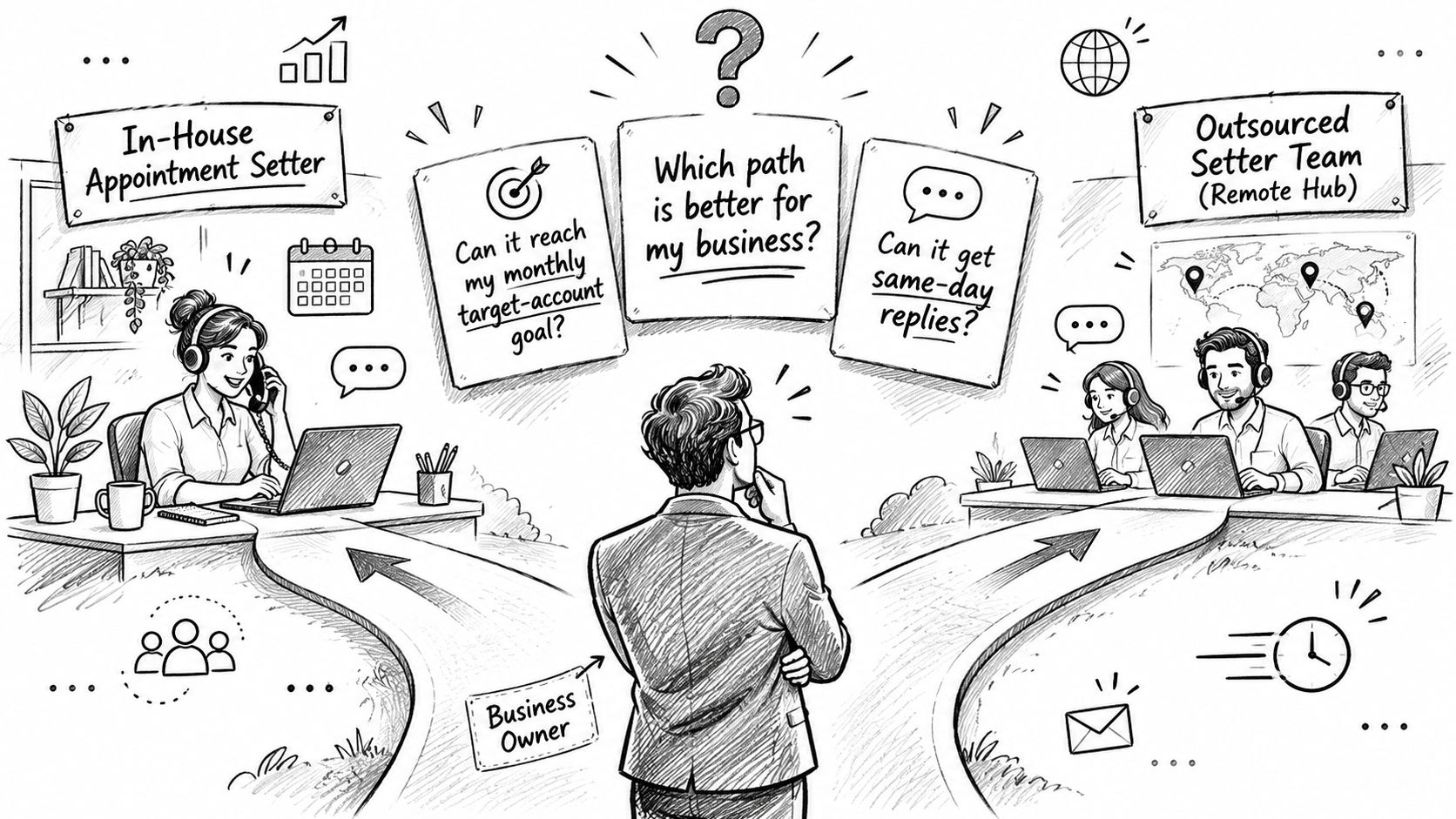
Comparing Control, Speed, and Operational Trade-Offs
Both paths come with honest trade-offs. An in-house setter gives you tight control over brand voice, instant hallway collaboration with account executives, and deep product immersion over time, though you absorb recruiting delays, tech-stack setup, and daily management overhead. If you're mapping out internal job descriptions, it helps to compare SDR and BDR responsibilities from GENTY recruitment so you hire for the exact outbound or inbound mix you need, and you can weigh the full operational math of outsourcing versus hiring an in-house SDR before committing headcount.
An outsourced partner brings warmed infrastructure, researched lists, copywriting, and booking workflows immediately, which typically improves speed of reply handling and lowers fixed overhead compared with building an internal desk from scratch. Even with a managed setup, you still define the qualification bar and own your live calendar etiquette. With our pay-per-close model at Ever Outbound, we offer DFY (Done-For-You) Appointment Setting that handles list building, copywriting, sending, and booking end to end, yet we never move or cancel a booked meeting on your behalf, so your team reaches out to the prospect directly if a reschedule comes up.
One more candid note on automation: while software speeds up routing, AI appointment setters operate without continuous human oversight and can produce errors or unintended outputs, which means clear guardrails and human judgment still matter whenever a prospect throws an unexpected question into the thread.
Take one concrete step today before you interview a single candidate or book a free discovery call with any vendor. Open a blank document and write down your exact five qualification criteria covering company fit, authority, recognized problem, timeframe, and agreement to attend. Once that standard lives on paper, you'll know immediately who can fill your pipeline.
At Ever Outbound Inc., our pay-per-close team builds verified prospect lists, runs warmed outbound campaigns, qualifies replies, and books ready-to-talk buyers straight onto your calendar so you only focus on closing deals. Because we earn a commission only when you close, our incentives stay tied to qualified meetings held and real revenue rather than empty calendar volume. Visit our site to book a free discovery call and see how a managed outbound engine can fit your sales process.