October 16, 2026
What Is an AI SDR and How It Books Meetings
An AI SDR is software that researches accounts, personalizes outreach, qualifies replies, and books meetings for closers. It's the digital version of the front-end sales grind, except it doesn't need coffee.
You're probably reading this while your inbox is already doing that annoying thing where promising leads sit beside “just following up” emails, and your closers are waiting on meetings that haven't been booked yet. If you want a clean mental model, the fastest way to think about sales enablement with AI is as a helper that takes the repetitive first half of outbound off your plate without pretending it can replace judgment.
Table of Contents
- Your Pipeline on Autopilot Morning
- Understanding AI SDRs Without the Buzzwords
- Inside the Machine: How AI SDRs Work
- Three Flavors of AI SDR From Helper to Autopilot
- Humans Plus AI The Dream Team Playbook
- Perks Pitfalls and Inbox Reality Checks
- Should You Hire an AI SDR Next
Your Pipeline on Autopilot Morning
The morning starts like a cluttered desk before a big pitch. An inbox is packed with half-finished follow-ups, one rep is rewriting the same opening line for the fourth time, and your closer is staring at a calendar that still has too much white space.
That gap is where an AI SDR fits. It handles the repetitive prospecting work, then passes along only the conversations that look worth a human's time.
The simplest way to see it is as a junior teammate with a very tidy desk. It can research accounts, draft outreach, send reminders, and keep threads moving. Humans still shape the offer, read the room, and decide what counts as a real opportunity. A useful companion piece on the human side is covered in the next section, where we break down the SDR role itself.
Practical rule: if a tool only sends more messages, it is not fixing the pipeline problem. It is just making the inbox louder.
That is why AI SDRs get so much attention. Teams want more qualified conversations without turning prospecting into a headcount problem, and they want the speed of automation without losing the human judgment that gets replies. A good way to frame sales enablement with AI is as control over how much of the workflow runs on its own, how much gets checked by a person, and how well deliverability and qualification stay in balance.
The question is not whether the software can send. It is how much autonomy you give it, where human review stays in place, and whether the pipeline gets cleaner instead of noisier.
Understanding AI SDRs Without the Buzzwords
A good AI SDR starts with a simple question, who should get human attention first? The answer used to live inside a rep's notebook and inbox. Now software can help sort the pile.
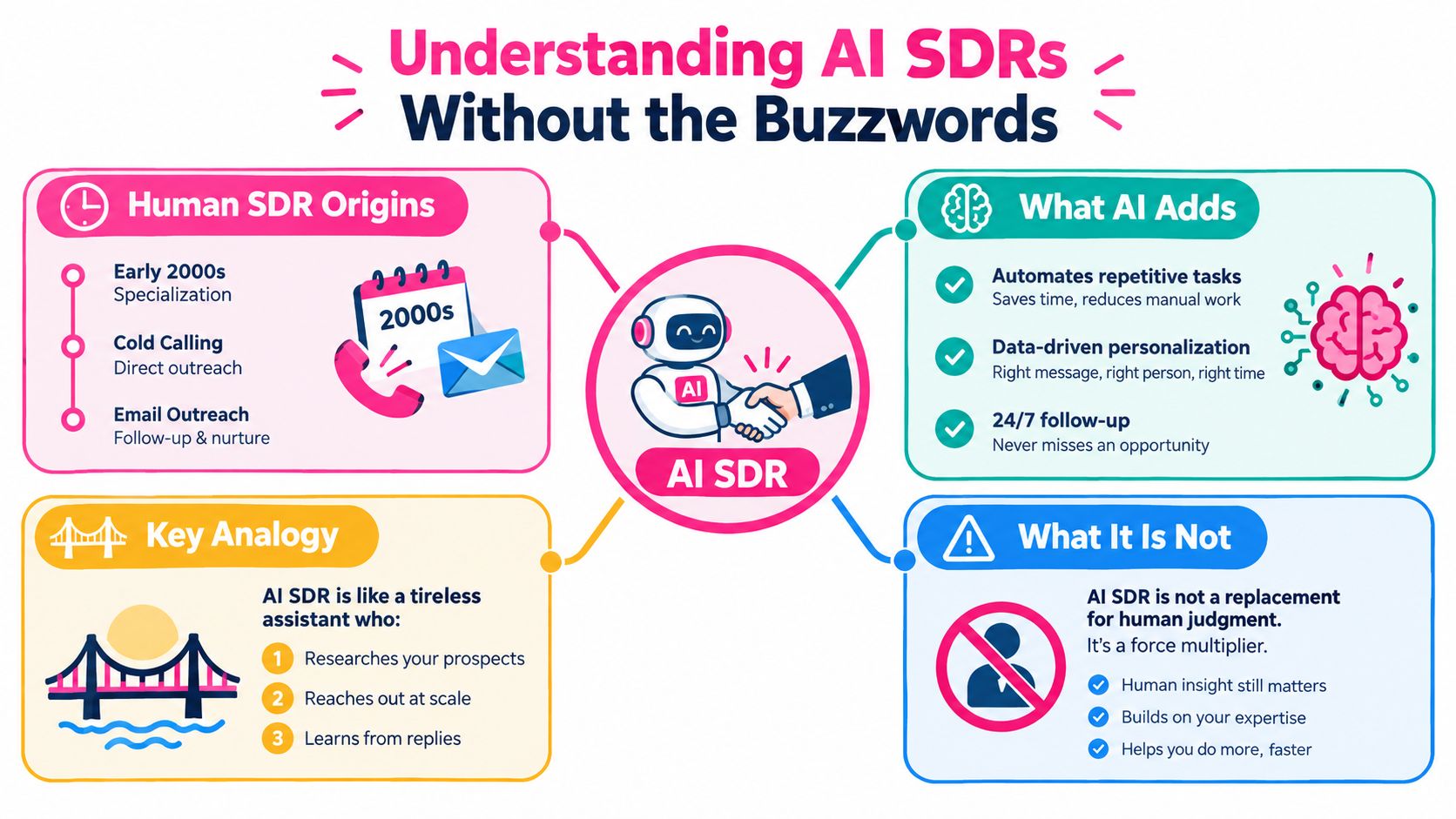
An AI SDR is best understood as a pipeline-development layer. It is neither a chatbot nor a closer. Its job is to help create sales opportunities before an account executive steps in, by researching target accounts, finding relevant contacts, personalizing outreach, starting conversations, qualifying interest, and booking meetings for the human team.
The label gets used in a few different ways. Some teams mean a workflow assistant that researches and drafts. Others mean a more autonomous sender that also runs follow-up. Some mean a human SDR team using AI tools to move faster. The tradeoff between automation and staffing is easier to see in whether to hire a person or use an AI setter, because the right setup depends on which parts of the workflow you want software to handle.
The mental picture is a front desk in a busy building. The AI SDR greets, routes, and filters. The human team handles the awkward, sensitive, or high-value conversations that need context and judgment.
An AI SDR is only useful when it produces qualified opportunities, not just activity.
That is why it should be judged differently from an automated email sender. A sender blasts messages. An AI SDR researches, adapts, replies, qualifies, and books with a purpose.
For a practical resource on qualification logic, the handoff rules in the workflow section below cover the same ground. Used well, that keeps the team focused on fit, not just volume.
Inside the Machine: How AI SDRs Work
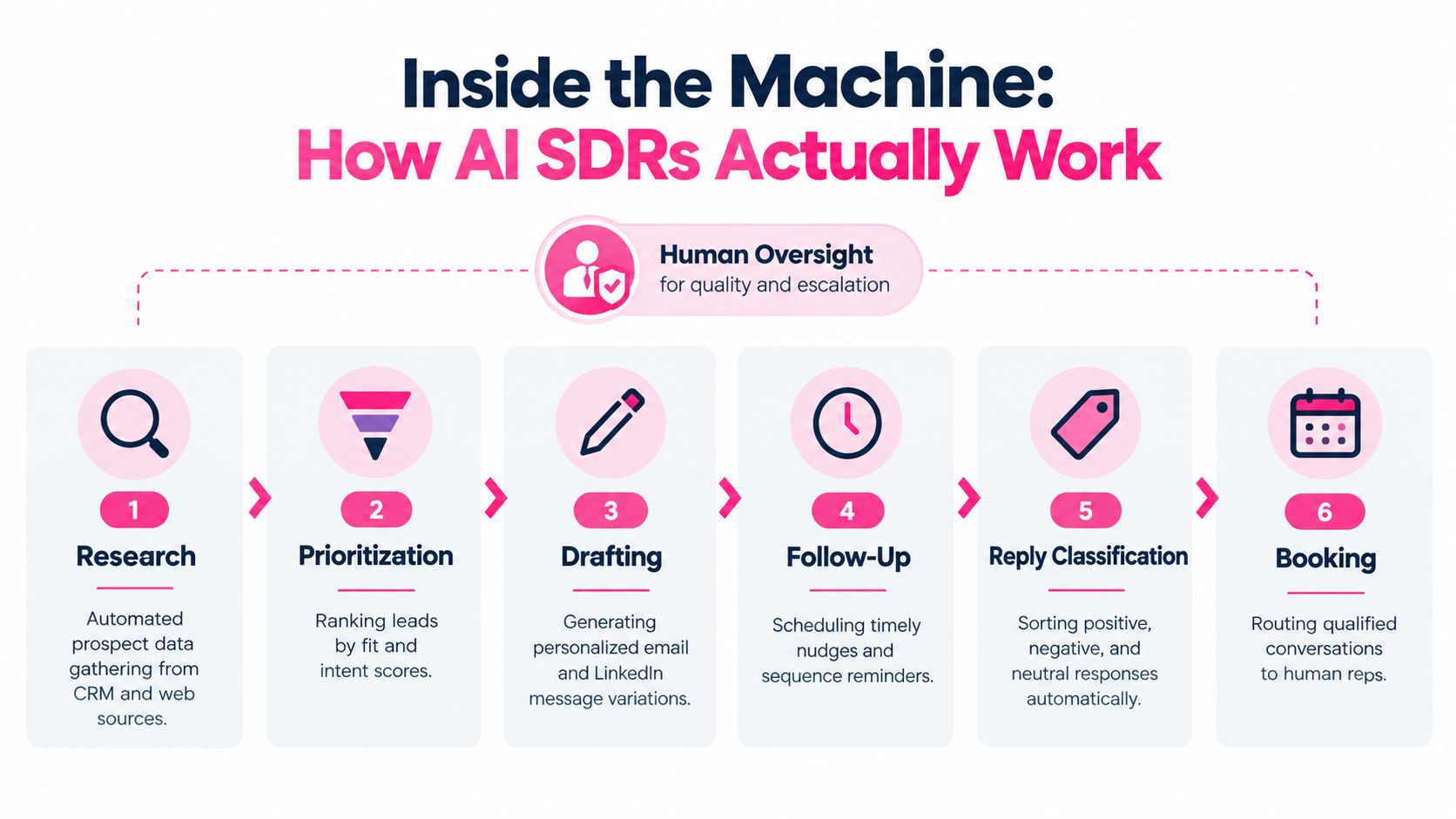
An AI SDR runs like a relay team, not a lone robot. One part gathers clues, another ranks the best prospects, another writes the message, and another decides what deserves a human handoff.
The six moving parts
Research starts the chain. The system pulls account and contact details, then looks for signals that make outreach feel relevant, such as role changes, recent activity, or fit against the target profile.
Prioritization comes next. The AI sorts who should get attention first, which means weak targeting can still sink a campaign even if the copy sounds polished.
Drafting turns the research into outreach. The machine produces variants, but the goal is not more words, it is a note that sounds tied to a real buyer context.
Follow-up matters because timing matters. A slow reply gives buyers time to drift toward another vendor.
Reply classification keeps the conversation sorted. Positive, negative, and neutral responses should not all go through the same path.
Booking is the handoff. Once a reply crosses the qualification bar, the system routes the meeting to a human calendar instead of pretending it can close the deal itself.
One documented production deployment processed nearly 2 million leads and sent close to 3 million messages, generating approximately 21,000 replies, about a 2% reply rate (ZenML deployment case). That scale shows what these systems are built for, but it also shows why controls matter. More throughput does not fix bad filters.
The quality question comes down to handoff rules, which the qualification criteria in the next section address directly. The test is simple: can the system raise activity without flooding your team with poor-fit meetings? SupportGPT's AI lead qualification insights frame that issue well, because qualification and routing matter as much as automation.
For a practical view of the operating model, how Ever Outbound works shows what a managed workflow looks like when humans still guard the quality line.
Build quality matters more than buzz. If firmographic filters, buying-signal rules, negative criteria, and escalation paths are not encoded, the AI can still produce the wrong kind of busy.
Three Flavors of AI SDR From Helper to Autopilot
Not every AI SDR means the same thing, and that's where buyers get burned. The category is fuzzy enough that one vendor may sell a drafting assistant while another sells an autonomous sender, then both call it an AI SDR.
Compare the autonomy levels
| Model | What AI Does | What Humans Own |
|---|---|---|
| Workflow assistant | Researches, drafts, summarizes, logs activity | Sending, targeting decisions, sequencing, replies |
| Autonomous sender | Runs outreach, follow-up, and basic reply handling | Offer, escalation, qualification rules, review |
| Human team using AI tools | Supports research and copy inside a mostly manual process | Nearly everything else |
The strongest recent independent benchmark cited in the available evidence, the Bridge Group's 2025 study of 351 B2B companies, found that only 1% classified an AI SDR as a distinct SDR model (Bridge Group benchmark summary). That doesn't mean AI isn't being used. It means many people are using the label to describe very different levels of autonomy.
This is the question buyers should ask: what exactly is automated, and who owns the mistake when targeting or follow-up goes wrong?
An internal comparison that helps with that decision is Ever Outbound's AI setter, because the issue isn't whether AI is present, it's how much decision-making it owns.
Buyer test: if the vendor can't explain the handoff between AI and human ownership, you're buying a black box with a nicer homepage.
That's the practical difference between helper, autopilot, and human-led process. The first saves time. The second saves labor. The third mostly speeds up work you were already doing.
Humans Plus AI The Dream Team Playbook
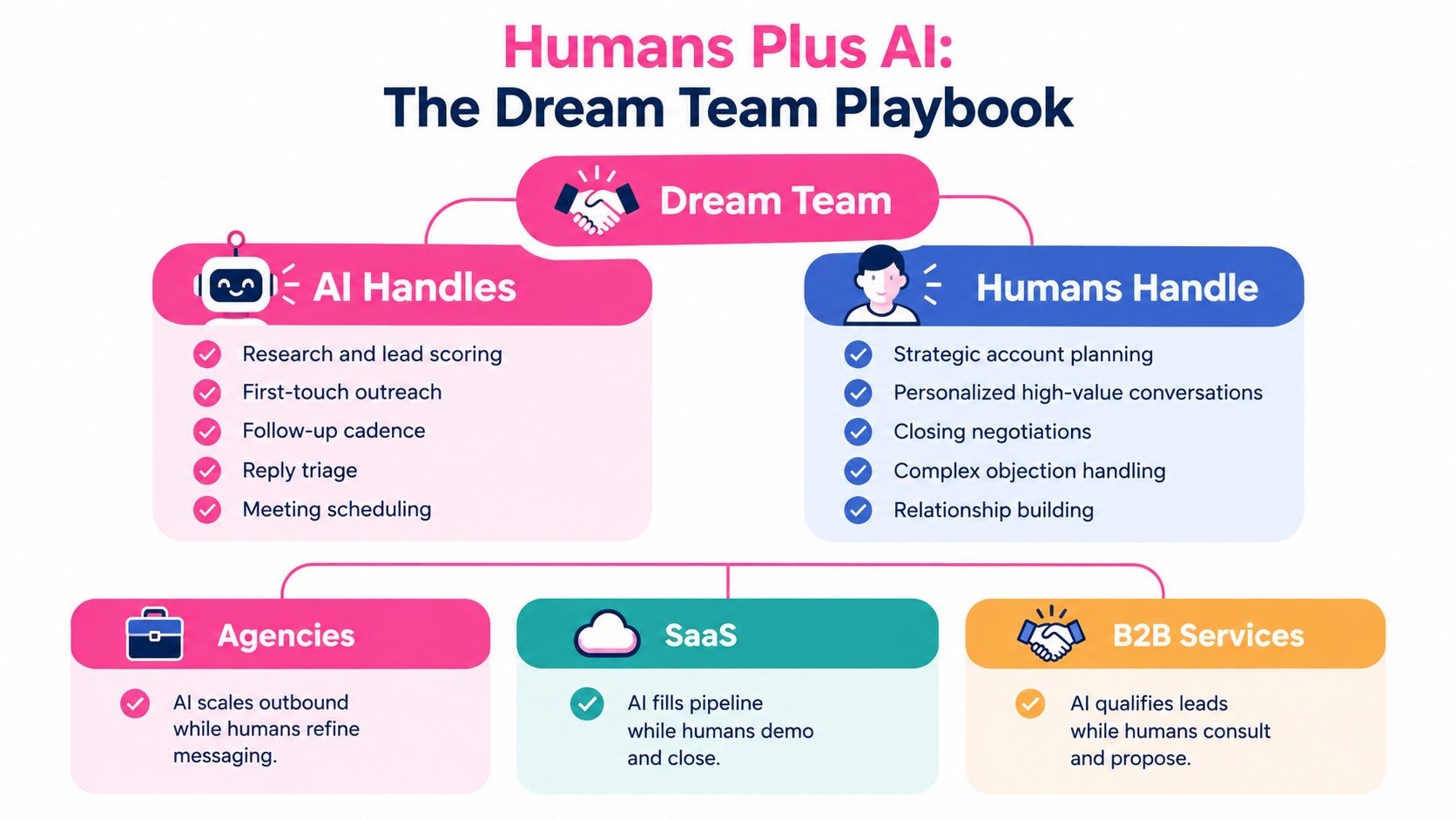
The cleanest operating model pairs AI on the repetitive parts with human control over taste, judgment, and trust.
Where each side shines
AI is strongest at research, lead scoring, first-touch outreach, follow-up cadence, reply triage, and meeting scheduling. Humans handle strategic account planning, personalized high-value conversations, closing negotiations, complex objection handling, and relationship building.
That split works especially well for agencies, SaaS teams, and B2B service businesses. AI keeps the pipeline moving while people stay focused on the conversations that shape revenue.
Industry summaries citing Salesforce report that 81% of sales professionals used AI tools at least occasionally in 2025, compared with 54% in 2024, but only 37% reportedly used AI as a core daily workflow (adoption summary). That gap says a lot. Many teams dabble. Fewer have a dependable operating rhythm.
For teams exploring a managed version of that split, Ever Outbound Inc. runs a pay-per-close model where a human research, copywriting, and appointment-setting team uses AI and managed sending infrastructure to book qualified sales calls. The structure matters because the incentives stay tied to closed deals, not just activity.
How the division of labor usually looks
- AI handles the repetitive lift: research, list building, timed follow-ups, and logging.
- Humans handle the judgment calls: offer positioning, ambiguous replies, and quality control. For the qualification criteria that define that handoff, see our guide to qualifying outbound replies.
- Both share the outcome: qualified conversations, not just booked calendar slots.
The result is calmer operations. Salespeople spend less time babysitting sequences, and better-fit prospects reach a human faster.
A practical rule for teams is simple. If a reply is vague, high-value, or sensitive, a person should own it. If the task is repetitive and rules-based, AI should probably do it first.
Perks Pitfalls and Inbox Reality Checks
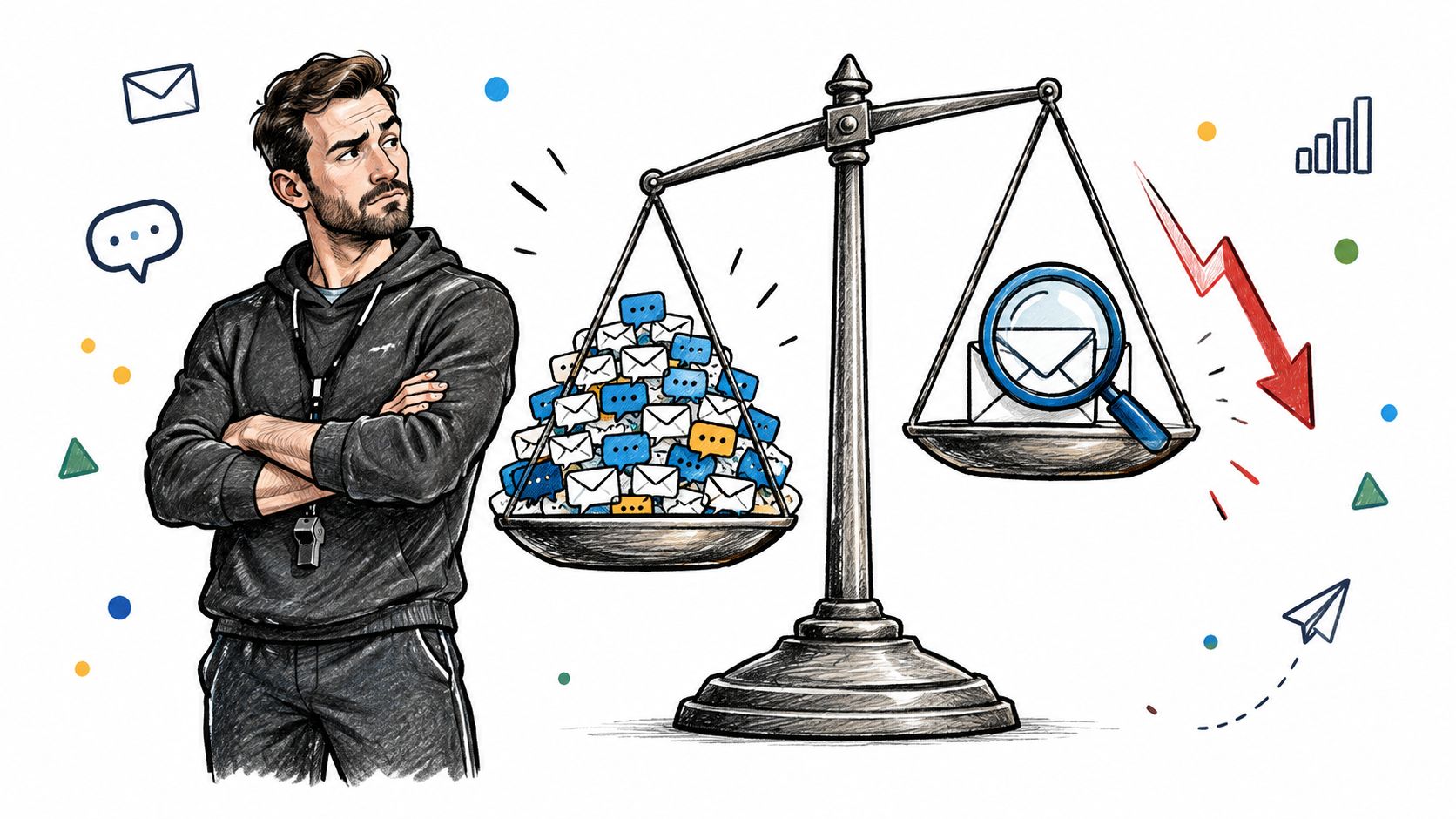
More outbound doesn't automatically mean better outbound. In fact, the wrong kind of scale can wreck relevance, and relevance is what gets a reply in the first place.
Volume is not the same as pipeline
Available recent commentary reports that AI-augmented outbound can increase activity substantially, but it also cites a fall in raw reply rates from 4.7% to 2.9% as monthly outbound volume rose from roughly 1,150 to 7,400 messages per representative (volume and reply-rate commentary). Even with cautious interpretation, the pattern is obvious. More sending can dilute relevance.
That's why deliverability controls matter. Gmail requires senders to use SPF or DKIM, and bulk senders must use SPF, DKIM, and DMARC. Google also warns that activity from other senders on a shared IP can affect reputation and reduce delivery performance (Google Mail sender guidance). If the messages don't land, the AI's writing quality barely matters.
Gmail's bulk sender rules add another layer. Since February 2024, senders sending 5,000 or more messages in a 24-hour period to personal Gmail accounts are treated as bulk senders, and Google recommends keeping the user-reported spam rate below 0.1% and avoiding 0.3% or higher (Gmail bulk sender requirements). That's a strong hint that blast tactics are fragile.
Inbox rule: a delivered message is not the same thing as an inboxed message, and an inboxed message is not the same thing as a qualified opportunity.
A useful operational check is this email deliverability checker, because sender reputation, suppression, and volume discipline matter before the AI ever gets to do its job.
The right scorecard is not message count. It's qualified meetings, sender reputation, and closed revenue. Everything else is just motion.
Should You Hire an AI SDR Next
If your team already has a real offer, a clear target market, and a clean handoff process, an AI SDR can be a smart layer on top of the work you're already doing. If your ICP is fuzzy or nobody owns replies, it'll just automate confusion.
The best use case is a hybrid one. Let AI do the research, routing, and follow-up speed, then let people handle the conversations that shape trust and buying intent.
A simple decision rule works well here. Choose AI SDR automation when the work is repetitive, rule-based, and high volume. Stick with human-led outbound when the account list is small, the sales motion is highly personalized, or every conversation needs deep context.
Ever Outbound Inc. fits that hybrid approach by combining AI-assisted outbound with human research, copy, deliverability management, and appointment setting on a pay-per-close basis, so you only pay when deals close. If you want to see how that model looks in practice, visit Ever Outbound Inc. and compare it against the way your team books meetings today.