October 30, 2026
What Is Intent Data and How to Use It
Intent data is behavioral evidence that a person or account is researching a topic, product, competitor, or category, not a demographic profile and not a guarantee they'll buy. A Gartner-based report says B2B buying groups spend 27% of their time on independent online research through third-party websites, often before a vendor knows who they are, according to TechTarget's summary of the research.
You may be looking at a familiar sales-floor mismatch: a rep works through a broad list of agencies that fit the company profile, while several promising accounts research pricing and compare competitors without ever getting a call. The list tells the rep who those companies are. Intent signals can offer a clue about what they're investigating now. The job is to read that clue without mistaking activity for a purchase decision.
Table of Contents
- What Intent Data Actually Means
- Where Intent Signals Come From
- How Account Scores Get Built
- When a Surge Is Not a Buyer
- Putting Intent Data to Work in Outbound and Demand Gen
- Choose In-House Scoring or Pay-Per-Close Outreach
What Intent Data Actually Means
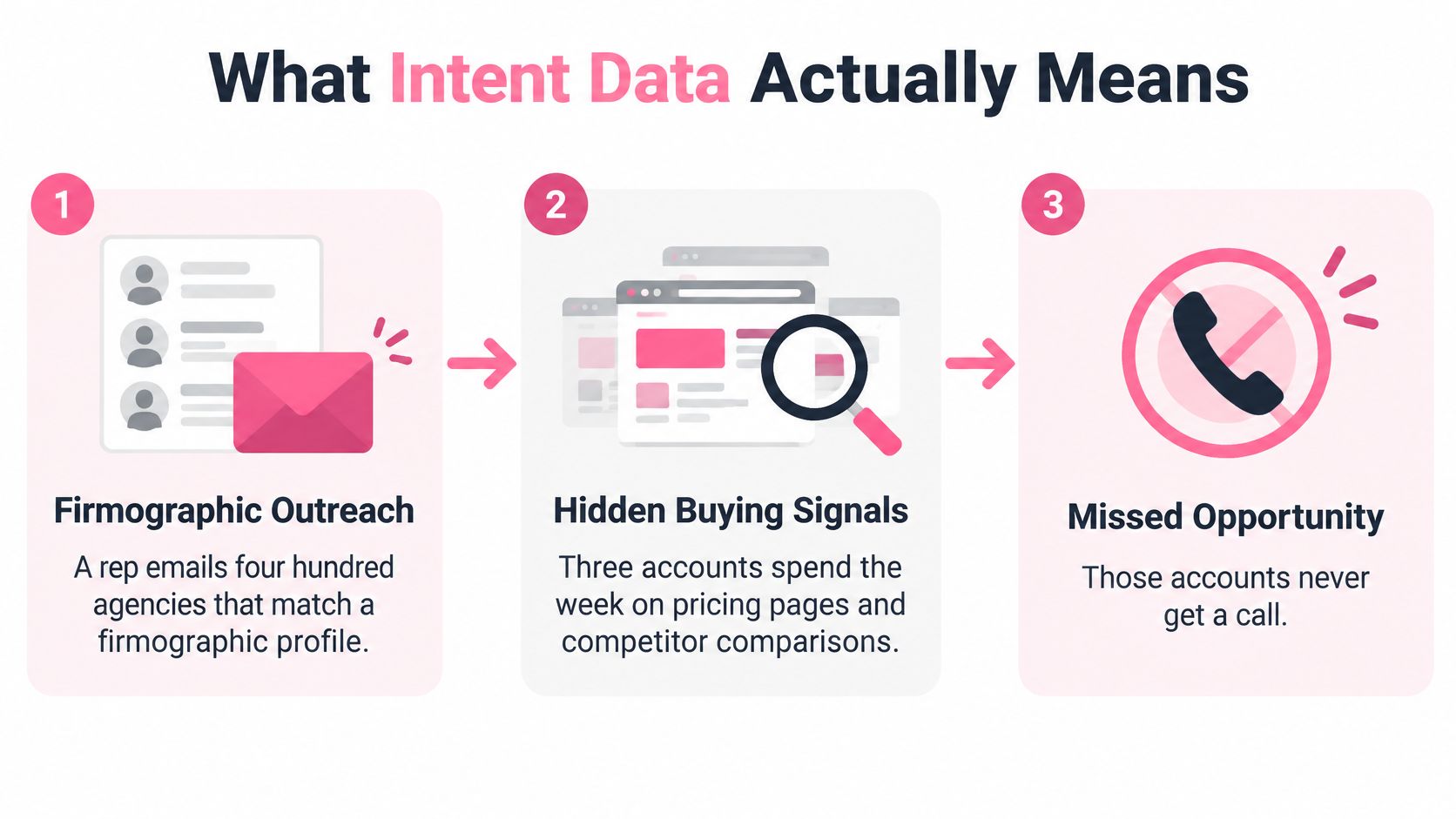
A rep sends outreach to four hundred agencies because they match the ideal customer profile. Meanwhile, three accounts spend the week viewing pricing pages and comparing competitors. No one contacts them. The first list describes companies that could be a fit; the quiet accounts may be showing a reason to pay attention now.
That difference is the simplest way to understand what intent data is. Firmographic data describes a company through attributes such as industry, size, or location. Intent data is behavioral evidence that a prospective buyer or account is actively researching a business topic, product, solution, competitor, or category online. It interprets research behavior rather than just adding a newer phone number to a contact record. Bombora's overview of intent data describes the distinction between first-party activity on a company's own digital properties and third-party research collected across external websites and then licensed or integrated for business use.
A visitor might read articles, download white papers, or compare solutions. First-party signals can show that someone reached your own site or product; third-party signals can indicate that a company is researching elsewhere, before it identifies itself through a form, a reply, or a sales conversation. Those external signals can be useful precisely because they may surface research that your team wouldn't see in its own analytics.
Unusual or relevant research means messaging, timing, and qualification deserve more attention. It doesn't mean the account will buy.
A 2022 Demand Gen Report survey cited by TechTarget found that 47% of marketers were using intent data to identify prospects actively researching a purchase. That describes marketers' use of the data, not a guarantee that an account flagged by a platform is ready to buy. The practical value is more modest and more useful: decide which accounts deserve research, which problem might matter to them, and whether a timely, qualified conversation makes sense.
The useful question isn't, “Did a dashboard show a spike?” It's, “What happened, how recently, and what other evidence makes this account worth contacting?” Answering it means identifying where signals come from, how a score is assembled, and which false alarms should stay out of your sequence.
Where Intent Signals Come From
Start with the source, then ask what that source can identify. The same apparent interest can mean very different things depending on whether it came from your pricing page, an anonymous publisher visit, or a customer's product activity. The table makes those differences visible.
| Source | Typical signals | Identity level | Strongest use | Main limit |
|---|---|---|---|---|
| First-party web | Pricing visits, repeat sessions, downloads, form abandonment, demo requests | Visitor or known account | Sales follow-up | Only people who already reached you |
| Product usage | In-app behavior from existing users | Known customer | Expansion or risk | Misses net-new buyers |
| Third-party content | Articles, white papers, publisher topics | Usually company or domain | Early topic timing | Often no named researcher |
| Reviews and comparisons | Software reviews and competitor pages | Account | Later-stage message | A preference may already be set |
| Search and topic surge | Category consumption above the account baseline | Account | Choose a research window | Jobs, students, or competitors can surge |
| Offline and relationship | Events, calls, direct mail, trade shows, chat, social | Person or account | Relationship timing | Slow and incomplete |
CDP.com's explanation of intent-data pipelines describes first-party events such as pricing-page visits, repeat sessions, downloads, and demo requests, alongside third-party searches, publisher content, software reviews, and competitor comparisons. A system can normalize and deduplicate events, associate anonymous activity with an organization where possible, weight recency and frequency, and turn the result into an account score or engagement tier. That score is a summary of signals, not a name tag for the person who generated them.
This identity gap matters. Third-party activity is often grouped at the domain or account level, so you might learn that a company is researching appointment setting without knowing whether the researcher is a decision-maker, a new employee learning the market, or someone gathering background. Product usage is different: it tells you about people already using your product and can help with expansion or account-risk conversations, but it won't reveal a net-new prospect who hasn't found you.
The most useful unit isn't one page view. It's a time-bounded pattern, joined to fit: repeated research on appointment setting alongside recent hiring or expansion, for example. A single visit to a comparison page can be a crumb. Several related signals within a recent window give a rep a better reason to investigate, though they still don't identify a buyer by themselves.
For a broader view of how prospects move from awareness to evaluation, this B2B customer journey guide can help you map research behavior to the decisions your team wants to support. If your workflow uses social activity as another clue, make sure you're clear about the role it plays; our LinkedIn outreach system is one way to connect targeted outreach with a defined prospecting process.
Before trusting any feed, be able to name its source, identity level, and blind spot. If a vendor can show a topic surge but not tell you whether the signal identifies a person or only an account, treat it as a research prompt rather than a contact instruction.
How Account Scores Get Built
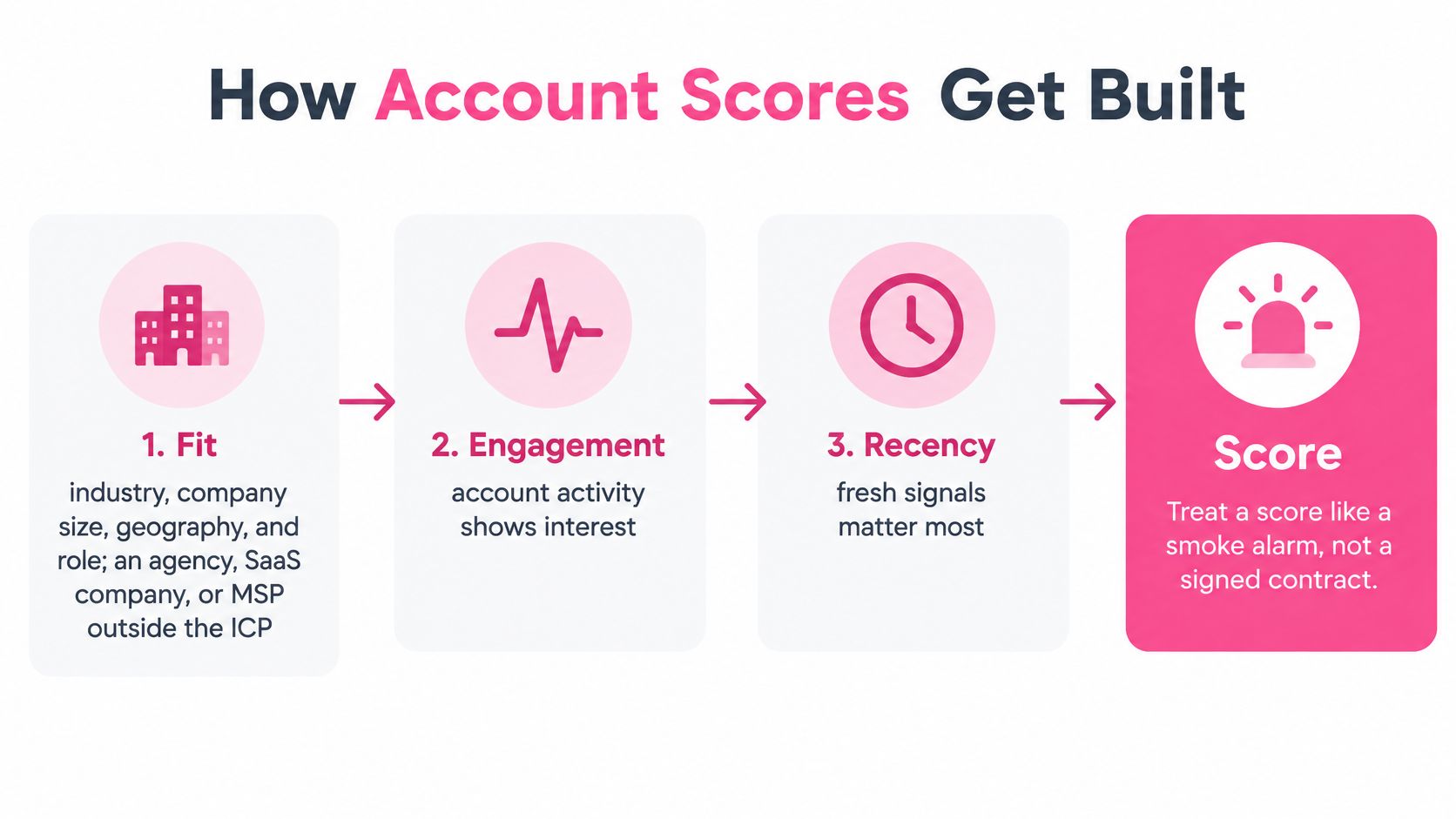
Treat an account score like a smoke alarm, not a signed contract. A smoke alarm tells you to check for trouble; it doesn't tell you what caused the smoke. Likewise, an intent score can flag an account for attention without confirming that anyone has approved a purchase.
HG Insights' account-scoring discussion emphasizes that the value of intent depends on signal quality, aggregation, and activation. A practical score combines three ingredients, and each one has a distinct job.
Start with fit
A company that's outside your ideal customer profile shouldn't rise to the top just because it researched a relevant topic. Apply a fit gate using industry, company size, geography, and role. An agency, SaaS company, or MSP outside your ICP doesn't become a good target just because a browser signal flashes.
Add behavior
Look for a topic surge compared with the account's own historical baseline, high-value page visits, review activity, and repeat engagement. Each signal should earn weight according to its relevance to your offer. A pricing-page visit is more directly connected to evaluating your solution than a general article read, but even the stronger signal needs context.
A surge could come from someone learning about a new subject, meeting a job requirement, researching as an existing customer, or evaluating you as a competitor. That's why an account score should help a rep ask a sharper question, not make the decision on the rep's behalf.
Let activity decay
Recent activity should carry more weight than old activity. Last quarter's white-paper download shouldn't count as strongly as this week's repeat visits to comparison pages. Without decay, an account can look urgent long after the original research has gone cold.
A reported 2026 meta-analysis summarized by HG Insights found that AI-scored, multi-signal account lists converted to pipeline at 2.4 times the rate of manually curated lists; the same discussion reports that 24% of B2B teams described intent-data ROI as exceptional despite 91% adoption. Those provider and market analyses are directional, not universal results from one controlled experiment. They're a reminder to test your own scoring and activation process, not a promise that adding a score will produce the same lift.
A simple score sketch keeps the logic auditable:
- Fit gate: Confirm that the company and relevant role match your ICP.
- Behavior: Add weight for multiple relevant signals, not one weak event.
- Recency cutoff: Reduce or suppress stale activity.
- Contact rule: Don't trigger outreach from a single weak signal.
Use the score to decide where to research and what hypothesis to test. For a practical definition of what makes a prospect ready for a sales conversation, see our meeting-ready leads criteria. The human still needs to validate the situation before treating a flagged account as an opportunity.
When a Surge Is Not a Buyer
A topic surge might come from a student writing a paper, a competitor investigating the market, an analyst comparing categories, a job candidate preparing for an interview, or someone gathering background. The chart can be accurate about activity and still be wrong about why it happened.
Available coverage from The Growth Syndicate on B2B intent data reports company-level match rates of roughly 30%–65% for stronger third-party providers and 10%–25% for weaker sources. In limited testing, about one in five correctly matched third-party surges showed no purchase interest. Those ranges don't guarantee that a particular provider will perform the same way for your market; they show why a company match isn't the same thing as a buyer match.
Using a surge alone to launch high-volume prospecting can waste seller time, create false positives, and damage deliverability. First-party activity is usually more actionable because it shows engagement with you: product usage, identified site behavior, a pricing-page visit, or a demo request. It still needs human interpretation, but it is a more direct clue about your own relationship with the account than a general category signal.
Set a contact bar
Before a third-party surge turns into outreach, require ICP fit, a relevant role, a reachable buying committee, a fresh research window, and at least one corroborating signal. That evidence might be a relevant first-party action or a separate business trigger that makes the account's interest more plausible. If those pieces aren't present, keep researching or wait for better evidence. Don't solve uncertainty by sending more emails.
The same restraint applies to identifiable profiles. Under the GDPR, processing intent data needs a documented lawful basis. The European Data Protection Board's guidance on lawful processing lists possible bases, including consent and legitimate interests; where an organization relies on legitimate interests, it must consider whether the purpose is lawful and real, whether the processing is necessary, and how the person's rights and freedoms weigh against the organization's interest. A commercial objective alone doesn't settle that assessment.
Consent must be specific and informed. The European Commission's information for individuals about data protection says consent information should identify the organization, explain the purpose and data involved, and describe how consent can be withdrawn. A vague notice about marketing may not clearly cover account scoring or behavioral profiling. For legitimate-interest assessments in the UK, the Information Commissioner's Office explains the purpose, necessity, and balancing tests.
Cookies, tracking pixels, fingerprinting, and similar technologies also need careful treatment. The ICO's guidance on profiling tools and lawful use says consent is generally required for these technologies when they aren't strictly necessary; when they collect personal information, that consent will generally also be the lawful basis for later processing. Aggregated, non-personal trends present a different risk from identifiable profiles built from trackable user activity.
For another way to think about matching messages to the buyer's stage, Excellorix's full-funnel strategy for ecommerce brands offers a useful contrast between educating earlier audiences and pursuing people closer to action. For outbound qualification, our cold qualification process gives the team a way to check whether interest is backed by a real business need.
Putting Intent Data to Work in Outbound and Demand Gen
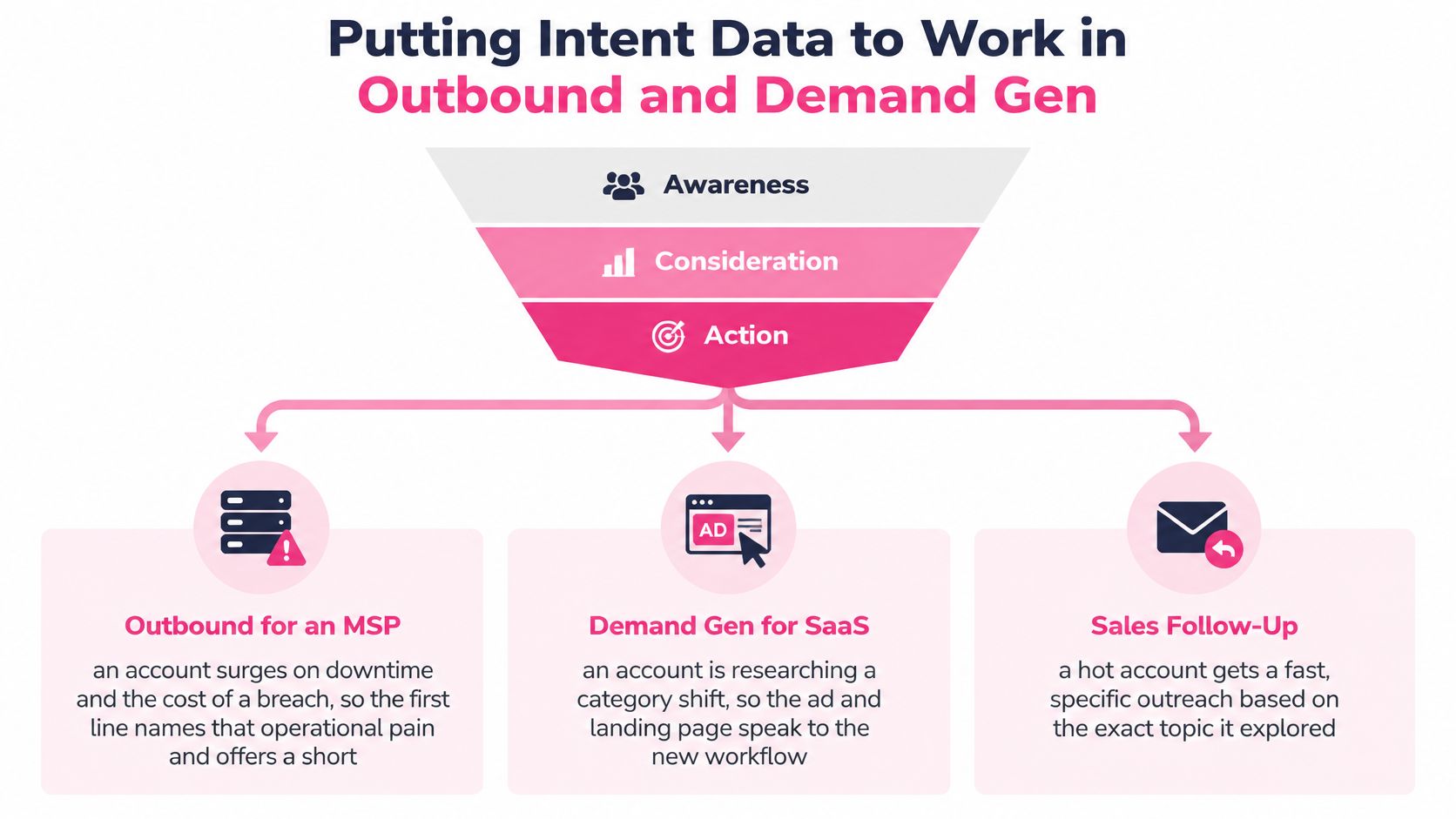
The same signal shouldn't trigger the same message every time. Early research calls for useful education; comparison behavior can justify a direct conversation; repeat first-party engagement may warrant a person-to-person follow-up. The point is to respond to the clue, not announce that you've been watching it.
An MSP might see an account researching downtime and the cost of a breach. If the company fits by size and location, the first message can name the operational pain and offer a short diagnostic, rather than unload a list of technical capabilities. The signal shapes the opening line; it doesn't replace checking whether the business is one the MSP can serve.
For demand generation, a SaaS company researching a broad category may be better served by an educational asset than a meeting request. If its activity shifts to competitor comparisons or pricing, a direct conversation with a clear point of view may fit. Repeated visits to your own product pages or a demo request are stronger reasons for a human follow-up, but the rep still needs to qualify the need and timing.
That caution matters because interest doesn't erase vendor preference. Forrester reports that 68% of buyers begin a purchase process with a preferred vendor already in mind, and that this preferred vendor wins 55% of the time. A generic “we saw you're researching X” message can arrive after a shortlist has formed and reinforce the incumbent's advantage. Use the signal to choose a relevant problem, then give the reader a reason to consider your approach.
Build the operating sequence
- Set the ICP gates first. Define industry, size, geography, and relevant roles before opening a surge list. This prevents a relevant topic from making a poor-fit account look attractive.
- Choose topics tied to your offer. Track the problems your team can solve, not every subject people discuss online.
- Require fit, activity, and recency. A surge without fit or fresh supporting behavior remains in research. Apply decay to older signals.
- Match the message to the stage. Early topic research calls for education; comparison or pricing behavior can justify a direct conversation; repeated first-party engagement can prompt human follow-up.
- Write a problem hypothesis. Don't make “we saw you researching this” the whole pitch. Explain the likely business problem and offer a useful next step.
- Measure sales outcomes. Judge the program by replies, qualification, and booked meetings, not by how many surging domains entered a sequence.
- Record provenance and lawful basis. Before building identifiable profiles, document where the signals came from and the basis for processing them.
Exporting every surging domain into a high-volume sequence burns deliverability and teaches the market nothing. A human needs to check fit, authority, need, and timing before a meeting counts as qualified. For a broader perspective on using automation to tailor revenue work, this resource on AI agents for revenue growth can help frame where machine-assisted personalization fits and where human judgment still matters. If you want to see how we organize prospecting and follow-up as a managed workflow, read how Ever Outbound works.
| Pattern | Extra evidence | Message | Do not |
|---|---|---|---|
| Topic surge only | ICP fit, reachable role, recent window | Useful education | Send a high-volume generic blast |
| Comparison or pricing research | Fit plus a buying-group contact | Direct conversation with a point of view | Make “we saw you researching this” the whole pitch |
| Repeat first-party engagement | Role, need, and timing check | Human follow-up toward a meeting | Treat one page view as a deal |
| Old or single weak signal | Apply decay; usually suppress | None until new activity | Give last quarter's download equal weight |
| No ICP fit | No extra evidence needed | Do not contact | Spend deliverability on a surge |
Choose In-House Scoring or Pay-Per-Close Outreach
Keep intent scoring in-house if you already have a clean first-party trail, someone who can maintain fit gates and decay rules, and writers who can turn research into a specific message hypothesis. You can then own the definitions, inspect the evidence, and adjust the contact threshold when the team learns which signals lead to qualified conversations.
Bring in an outreach partner when the bottleneck isn't deciding what a signal means, but doing the work that follows: researching accounts, writing the copy, managing sending, and getting a qualified person onto the calendar. We verify decision-makers before sending, write short, specific copy on warmed domains, and book interested prospects directly onto the client's calendar. When a prospect replies with interest, our team follows up and books qualified calls.
At Ever Outbound, we're pay-per-close. We earn when a deal closes from our work, so the model focuses on qualified conversations and completed sales rather than treating a surge as a result. It doesn't make every signal a deal, or remove the need to qualify the prospect.
The decision is straightforward: if the gap is your contact rule, enforce it internally first; if the gap is execution, buy execution. Learn more about our pay-per-close outreach model.
Ever Outbound Inc. provides done-for-you B2B client acquisition on a pay-per-close basis, combining prospect research, personalized outreach, and appointment setting to help qualified prospects reach your calendar. If intent signals are useful but your team needs help turning them into thoughtful outbound, visit Ever Outbound Inc. to see how the service works.