November 22, 2026
What Is Prospect Research? How B2B Teams Find Buyers
Prospect research is the process of identifying, investigating and ranking the people or companies worth contacting before any outreach begins, and it exists because informed contact beats volume every time. In 2025, 88% of B2B buyers said they wanted to hear from vendors while researching and evaluating options, so the audience is receptive, but only to people who arrive with something useful.
Say your team loads 4,000 purchased contacts into a sequencer on a Monday. By Thursday two people have replied and one of them is an out-of-office. The following week a single rep spends twenty minutes on one company, notices a second office opening and a freshly hired revenue leader, writes four sentences, and books a meeting. Same software, same week, opposite results, and the difference isn't charm.
Many groups don't lack data. They lack a threshold for deciding when the data is good enough to act on. That's the harder skill, and it's the one this whole discipline is built around.
Table of Contents
- What Prospect Research Means for B2B Sales
- The Five Data Layers Every Prospect Profile Needs
- Evidence That Holds Up and Where to Find It
- Running the Research Workflow Step by Step
- Ranking Prospects and Knowing When to Wait
- Compliance Rules, AI Guardrails and the Pre-Contact Gate
What Prospect Research Means for B2B Sales
Prospect research is the sorting decision behind every first email that lands well: who deserves contact, and why now. It's the work that happens before a message exists, and it's where outbound either earns a reply or slowly erodes the reputation of a sending domain.
Three jobs get mistaken for each other, and the confusion costs real money.
- Data enrichment fills gaps in a record you already have, such as a missing job title, a company domain, or a business email that still works.
- Prospect prioritization puts existing records in order so the best ones get attention first.
- Prospect research asks what should be understood before anybody makes contact: what the company is doing, what the person is responsible for, and what changed recently.
The dinner-party test makes it concrete. Two guests arrive at the same table. One has a firm handshake and a hope that small talk will carry the evening. The other read the host's note saying the person on their left just moved cities for a job in water treatment, so they ask about the move. Only one of those conversations goes anywhere. Research is reading the host's note.

A purchased contact list is a different product entirely. It tells you who exists. Research tells you who matters, why now, and what to say first. That distinction shows up in the numbers. In 2025, 88% of B2B buyers said they wanted to hear from vendors while researching and evaluating options, according to Sopro's State of Prospecting 2025 report, and a 2025 Gartner survey of 632 B2B buyers found 61% preferred an overall buying experience without a sales representative. Receptive and guarded at the same time. The only way through that gap is to arrive with something the buyer would otherwise have had to dig up alone, which is why open source competitor monitoring tactics from Digital Footprint Check belong in a researcher's toolkit: they turn public signals into context a buyer hasn't assembled yet.
The readiness test is unforgiving. A prospect is ready for outreach when the record explains why the account fits, names the right person, identifies a live problem and shows dated evidence for why now. Anything short of that is a name, not a meeting ready lead.
The Five Data Layers Every Prospect Profile Needs
A prospect profile is a stack. Researchers who skip a layer usually find out in the reply thread, or worse, in the silence where a reply thread should have been.
Walk it from the bottom. First, does the account fit at all on industry, headcount, revenue and region? Second, which tools and systems does it run? Third, can you reach a verified person in a real role? Fourth, has something happened recently that hints at timing? Fifth and last, what does your own CRM remember about previous wins, losses and churn with this account?
A single example shows how the layers talk to each other. Take a 120-person software firm on a common cloud platform. Fit is obvious from sector, size and region. Technographics show it already runs the platform your product integrates with, so the message can be about fitting into what they have rather than replacing it. Contactability means a named head of revenue with a work email you validated this month. The trigger is the job post for that role that went up six weeks ago, which usually means a new leader walking into a reporting mess. CRM history says you lost a deal there two years ago on price, so you route around the old champion and lead with time to value.
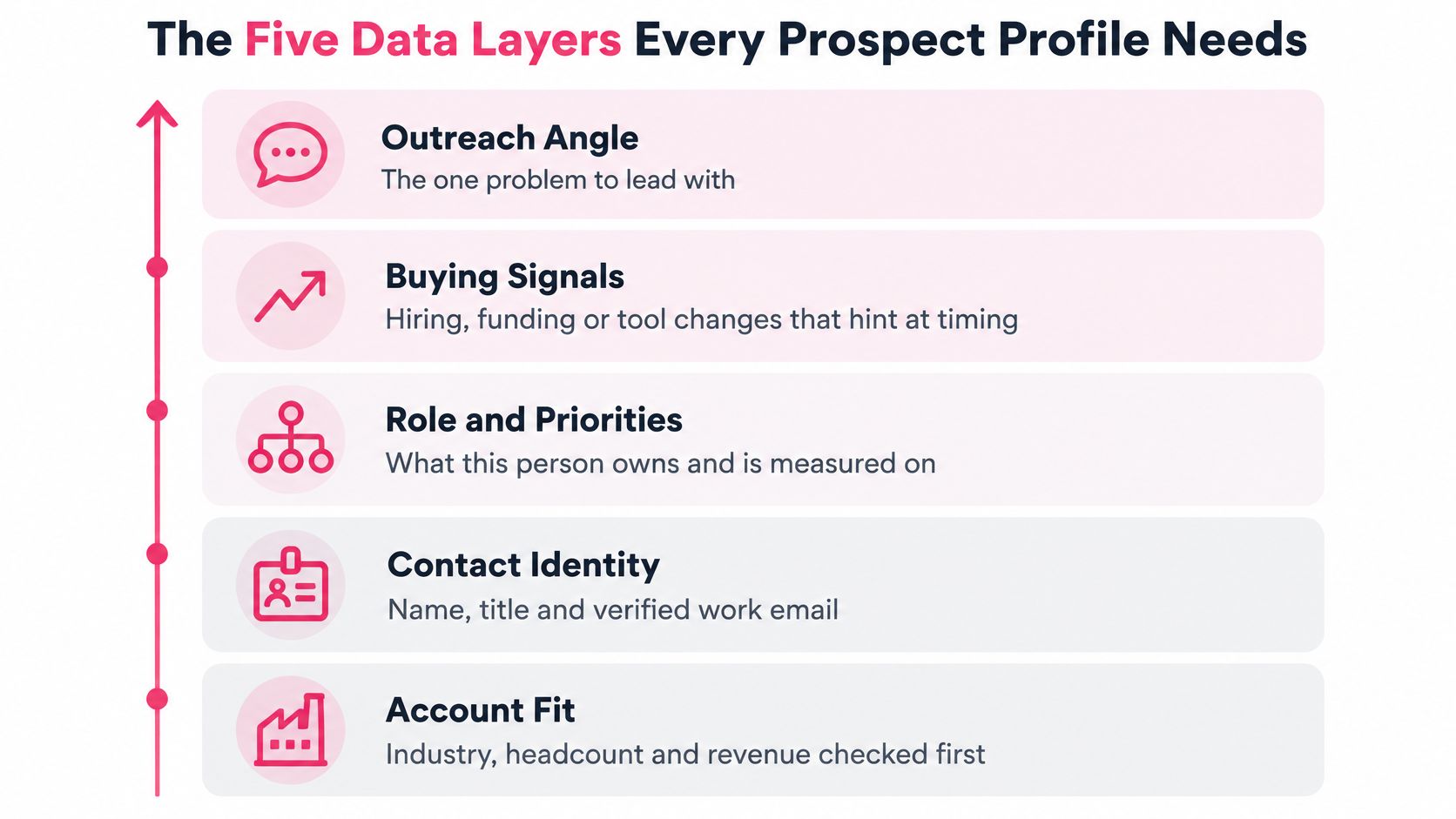
Fit without timing produces a broad list ranked on hope. Timing without fit produces false positives: a company that just raised a round and is hiring hard, in a sector you can't serve. The layers only pay off as a set.
| Layer | Question It Answers | Example Signal |
|---|---|---|
| Firmographics | Does the account fit our target market? | Industry, headcount, revenue, region |
| Technographics | Which tools and systems does it run? | Software stack or cloud platform in use |
| Contactability | Can we reach the right person? | Verified name, current role, valid channel |
| Intent signals | Is the timing right? | New hire, funding round, new market entry |
| CRM history | Have we worked with this account before? | Past wins, losses and churn reasons |
A record missing a layer isn't finished. It's a hypothesis wearing a job title. That's why refreshing CRM data from Prometheus Agency is worth the effort before you build a message on top of it, and why a quick pass through a lead list cleaner catches the duplicates that make two records look like two opportunities.
Evidence That Holds Up and Where to Find It
One record is a rumour. Two agreeing records are evidence. Three, and you can plan a campaign around them. Triangulation is the whole method: no single scraped field gets trusted until a second source confirms identity, role, organisation and interest.
The source categories haven't changed much in decades, and every one of them has a failure mode.
| Source | What It Reveals | Watch-Out |
|---|---|---|
| Own CRM or database | Past history with the account | Records may be outdated or duplicated |
| News coverage | Launches, funding and leadership moves | One story can be a one-off event |
| Referrals from partners or board members | Warm context and introductions | Hard to verify without a second source |
| Business directories | Company size, location and sector | Self-reported figures can be stale |
| Corporate and regulatory filings | Ownership, leadership and disclosures | Only covers organisations that file publicly |
| Professional profiles | Role, tenure and career path | Titles and tenure can be out of date |
| Event attendee lists | Shared interests and topics | Attendance signals interest, not buying intent |
The discipline lives in the labelling. A claim counts as observed only when a dated source supports it. "They're probably expanding into Germany" is an inference, and it should be written as one, with the evidence that prompted it sitting beside it. A colleague reading the record next quarter needs to know which half was fact.
When plenty of documentation hides a weak prospect
Companies with detailed websites, frequent announcements and a talkative leadership team are easier to research. They are not better prospects. Documentation quality and buying relevance are unrelated variables, and conflating them is how teams end up with pristine profiles of accounts that were never going to buy.
Practical rule: if you can't date a claim, you can't build a message on it. Undated evidence is a story someone told you.
That matters most for teams working across countries and industries, where title conventions and self-reported headcount vary wildly. If professional profiles are your primary source, run the check inside a proper LinkedIn research workflow so tenures get re-verified on a schedule instead of being trusted forever.
Running the Research Workflow Step by Step
Eventually the stack and the sources have to become a routine. Without one, every researcher invents private shortcuts, and nobody can audit the list when a campaign underperforms.
Here's the order that holds up, with the mistake teams make at each stage.
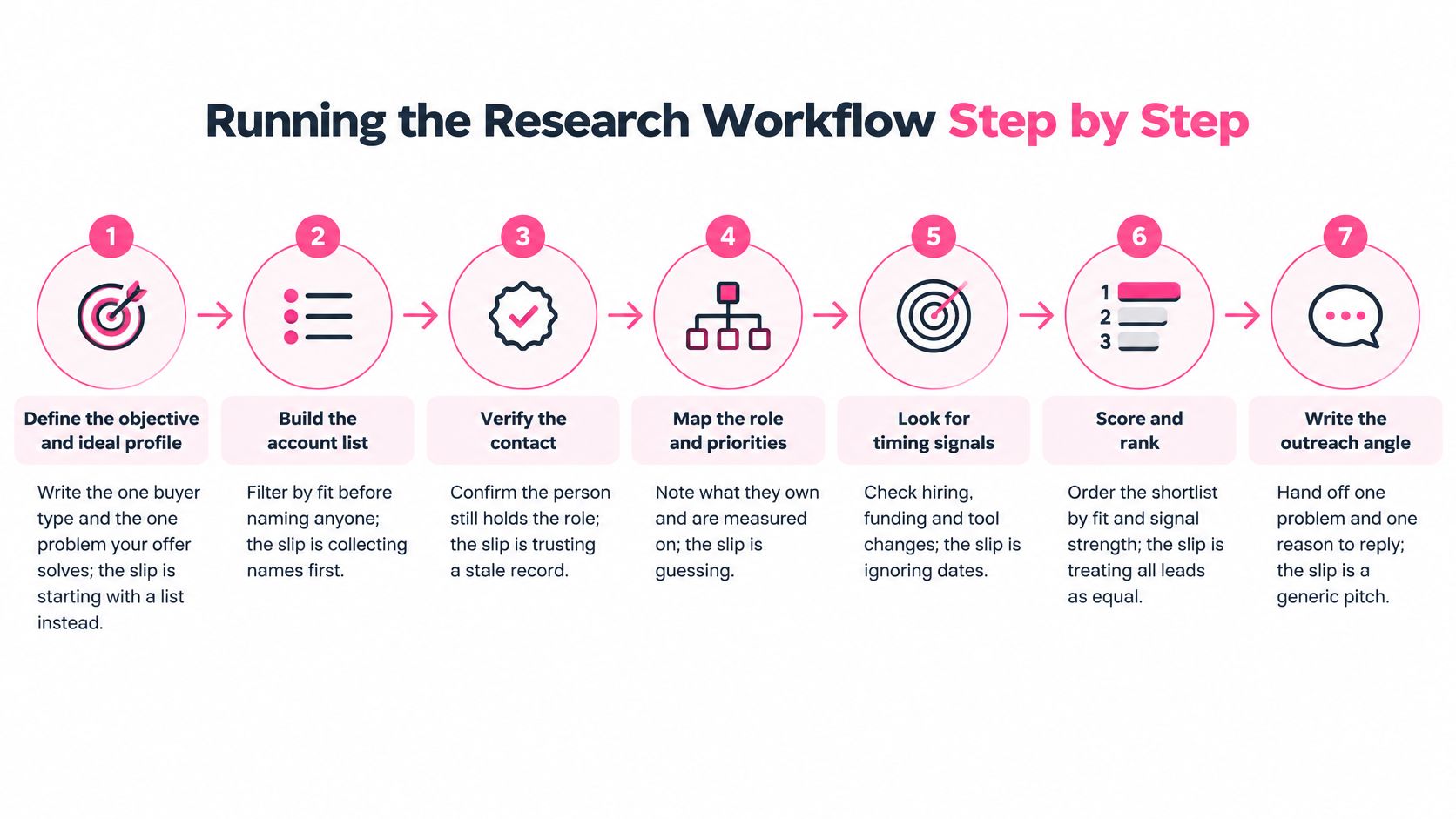
- Define the objective and the ideal profile. Write the one buyer type and the one problem your offer solves before anyone opens a database. A vague target produces a vague list, and vague lists are the reason "we tried outbound and it didn't work" exists as a sentence.
- Run automated screening. Use databases and third-party data to filter by fit. A screen produces raw indicators and nothing more. The usual slip is treating a screen result as a finding.
- Verify manually. Check each indicator against a second source. If a screener claims a company has 400 employees, confirm it against a filing or a recent release before you write a line about scale.
- Verify the contact. Confirm the name, the current role and a channel that works this quarter. Contact details go stale, and a wrong title in the first sentence is the fastest way to lose a reader.
- Build the context. Find the trigger, what the decision-maker owns, and the problem your offer speaks to. Skip it and your personalised email cites a funding round from 2023.
- Score the account. Rank against fit, authority, relevance, recency and evidence confidence rather than gut feel.
- Record the evidence, then decide. Sources and dates go into the record, and the account gets one label: contact, nurture or hold. Undated records can't be audited, defended, or improved.
That last step is where the routine earns its keep, because it turns a hunch into a pre-qualified account that another person could pick up and act on.
If you'd rather watch a research pass than read one, this walkthrough follows the same rhythm of screening, verifying and choosing an angle.
The audit question is simple: could a colleague explain why this prospect is on the list using only the record? If they'd need to ask you, the research isn't finished.
Ranking Prospects and Knowing When to Wait
Scoring fails when it collapses five separate judgements into one number nobody can argue with. Keep the dimensions apart: account fit, contact authority, problem relevance, signal recency and evidence confidence. A blended score of 82 tells you nothing about which dimension is weak, and the weak dimension is the one that decides whether the email is worth sending.
| Dimension | Strong Signal | Weak Signal |
|---|---|---|
| Account fit | Matches the target profile on size, sector and region | Large or famous but outside the target market |
| Contact authority | Current decision-maker with a verified role | Title unconfirmed or role has changed |
| Problem relevance | Tech stack or pain point matches the offer | Generic industry match with no specific need |
| Signal recency | Trigger within the last few months | Old announcement or stale hiring post |
| Evidence confidence | Two independent sources agree | One third-party surge or unsourced claim |
Run a comparison and the value of separation shows immediately. A recently appointed buyer, at an account that already runs your integration, with a publicly documented initiative announced last month, should outrank an equally suitable account with no current trigger. Under a single opaque score, those two accounts can land within a point of each other, and the sales rep gets no warning about which one is warm.
Freshness is a cost centre, not a footnote. An industry model puts contact-data decay at approximately 2.1% per month, according to Martal's analysis of B2B lead quality, which means a static database drifts into inaccuracy whether or not anyone touches it. Verification, role validation and refresh timestamps become operating requirements rather than spring cleaning.
A single third-party topic surge is a rumour with a dashboard. A recent signal corroborated by a second source, or by your own first-party behaviour, is something you can build a week around.
Then there's the bucket nobody builds: do not contact yet. It holds well-documented accounts with no confirmed decision-maker, no specific need and no plausible decision window. Not bad prospects, just early ones, and contacting them now spends the one first impression you get.
More data makes prioritization worse when it adds unverified signals, because it manufactures confidence. We build lists the same way we advise you to: Corne Advisory, a consulting and executive board placement firm, was connected with 505 ready-to-buy prospects, and that number only means something because of the ranking sitting behind it. The skill isn't collecting fields. It's knowing when to stop and wait.
Compliance Rules, AI Guardrails and the Pre-Contact Gate
The most expensive sentence in outbound is "it's public, so it's fair game." Public availability doesn't reset the rules, it just changes where the record came from. A record that names a person, a role and a work email is personal data in most jurisdictions, and the moment it enters a campaign it starts collecting obligations.
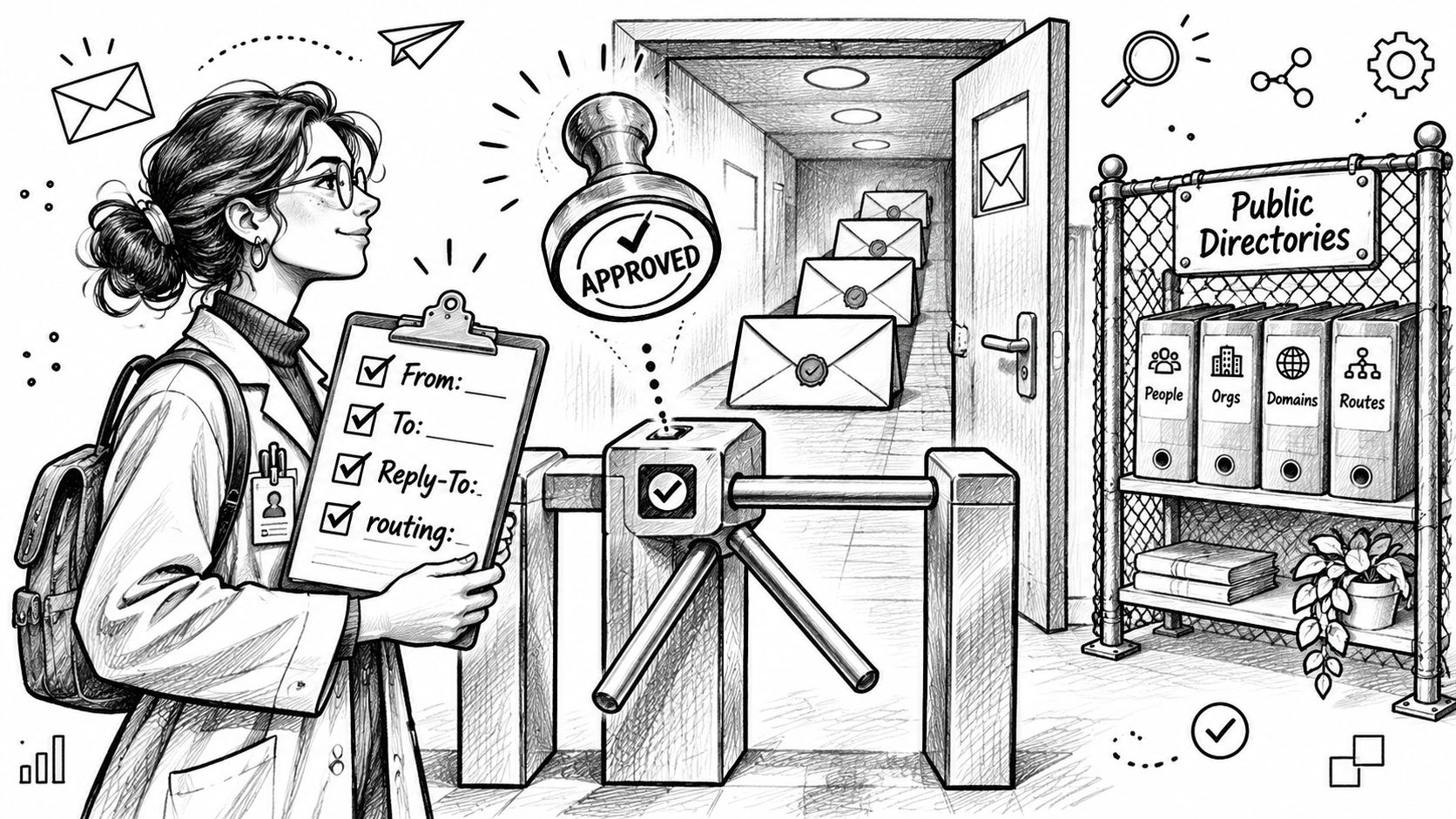
Start with the United States, because the requirements there are unusually concrete. The FTC's CAN-SPAM compliance guide says commercial messages must use accurate From, To, Reply-To and routing information, must avoid deceptive subject lines, and must give recipients a clear, conspicuous way to opt out. That mechanism has to remain able to process requests for at least 30 days after a message is sent, and every request must be honoured within 10 business days. Each separate violating email can carry a civil penalty of up to $53,088, which is a strange amount to lose over a subject line.
Europe treats it as a processing question rather than a formatting one. The UK Information Commissioner's Office says organisations using personal data for direct marketing should identify a legitimate interest, show that the processing is necessary, and balance that interest against the person's rights and freedoms. Publicly available contact details don't automatically remove electronic-marketing obligations, and buying or selling a business-contact list still requires UK GDPR compliance. The European Commission's guidance on legal grounds for processing data adds that direct-marketing lists must be kept up to date and that anyone who has objected must not be advertised to.
Four fields to complete before anyone hits send
- Source. Where the record came from, with the date it was captured.
- Lawful basis. The legitimate interest you're relying on and why processing is necessary for it.
- Relevance reason. Why this specific person, in this specific role, would recognise the problem you're describing.
- Opt-out status. Whether they've objected, and whether that objection is synchronised across every future send.
Fix those four and the rest of the research becomes usable. Skip them and you've built a liability with good formatting.
Where AI helps and where it quietly hurts
Automation looks like a shortcut until it inherits your mess. The Walton Family Foundation guide to AI use in fundraising warns that AI can amplify duplicate, incomplete or inconsistent CRM records, which means data-quality problems get resolved before automation starts, not after. AI output can also lean on inaccessible, outdated or contradictory sources, and a citation may support only part of a generated claim.
The workflow that survives scrutiny is boring. Use AI to discover and summarise. Require source-level verification for every personalised claim. Minimise sensitive data, preserve timestamps, and send ambiguous or high-risk records to a human reviewer for approval. AI doesn't remove the labour of research. It moves that labour toward validation, governance and judgement.
The gate has three exits: contact now, nurture later, do not contact yet. A record only passes through the first one when its compliance fields are complete and its evidence is dated.
Some teams would rather hand the whole gate to someone else. We're pay-per-close at Ever Outbound: we build your list of verified decision makers, write and send short copy on warmed domains, book interested prospects straight onto your calendar, and you show up to close the deals. The data handling rules behind that work are set out in how we treat prospect data.
If your pipeline depends on lists you can defend line by line, Ever Outbound Inc. runs the whole sequence for you, from verified decision-maker research to booking interested prospects directly onto your calendar. We work pay-per-close, so you only pay a 5% commission when a deal closes from our efforts, and your first two closes are commission-free. Visit Ever Outbound Inc. to see how the campaigns are built before you book a call.